
I cut the charging amps down to 10 on the big UPS. All is calm and peaceful. Quiet, even. It has all night to recharge. No need to rush things.
#diy_electronics

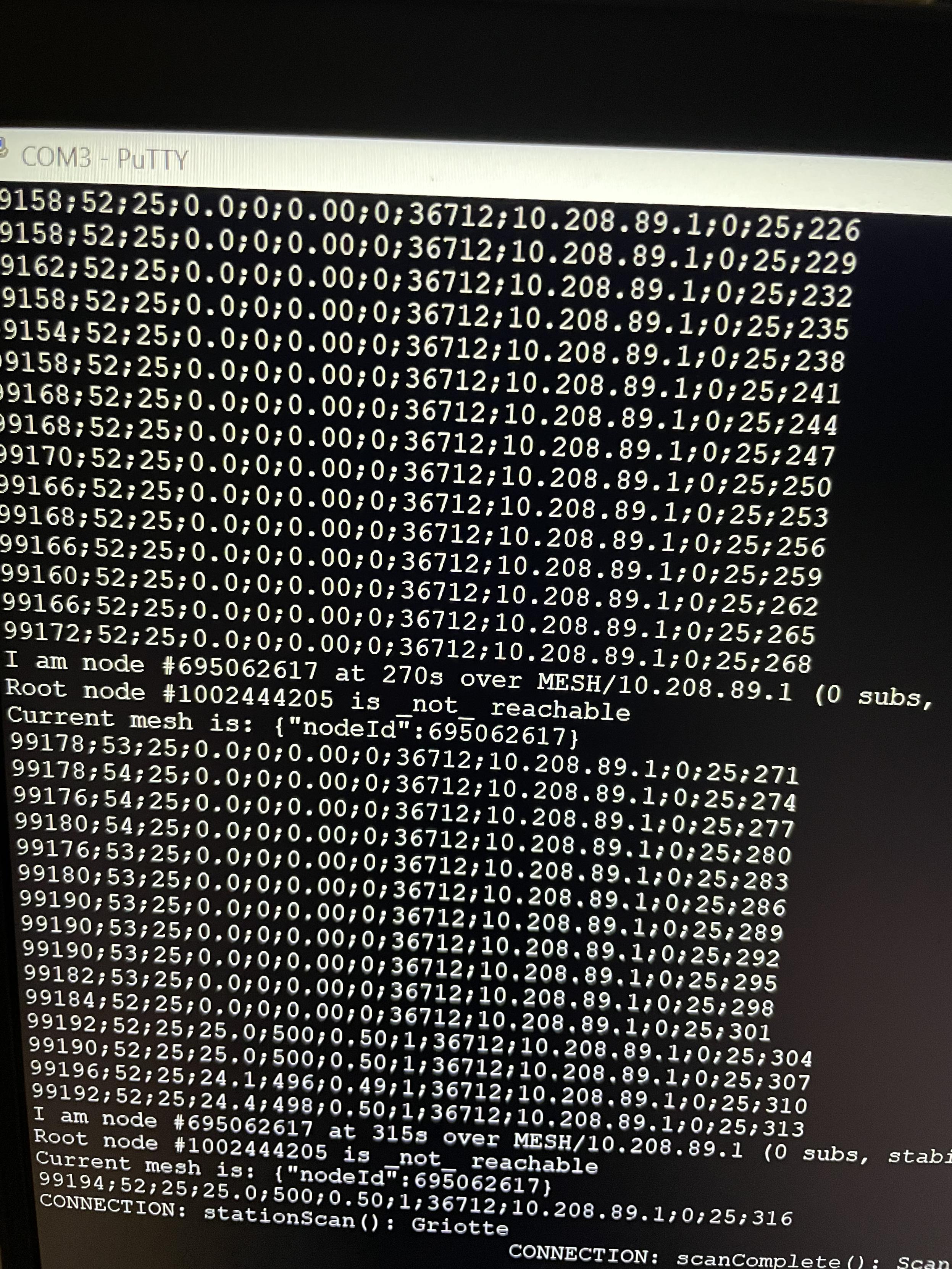
Today I used my custom IoT build to scan the air quality at the office and on the commute back
Turns out both locations seem to have better ventilation and air filtering than I would have thought, but I’d need to scan for longer periods of time to be sure
The train did have a buildup up until we started moving, which makes sense given what I know of their systems being mostly useless until the train leaves the station
I’ll probably need to think of a battery and data storage system to simplify scanning on the go like this, but I’m already satisfied that my little thing could be used so easily in this way
I just booted up a random laptop, plugged the USB and ran a serial console client (in this case PuTTY); no code changes at all, the same code and config that I use at home in a mesh
I wondered if I was overdoing it with the hours I'm using the big DIY UPS battery pack, so I went to solar sites to see what they think best practices are for LiFePo4 batteries.
According to everything I read, these are designed for 7500 cycles, but those cycles are deep cycles. I'm only using 20%-25% daily, before recharging. Taking into account holidays and weekends, when I won't be using it, the pack should be good for roughly 60 years. My heirs can enjoy some savings, lol.
If we ever get off-grid solar approved so I can hang panels on my deck, woo-hoo! In the meantime, I'm saving a bit during PGE's daytime and expensive early-evening rates on their TOD plan.

I built a thing fedi people 🤗🎉
#Electricians please look away, no wiring crimes habe been comitted here.


It looks like he has done all of the work. He needs someone to etch, and I assume stuff, some boards. I don't have access to the equipment. If you do, here's a worthwhile project! Teachers, here is a ready-made etching project for your students to work on (with potential revisions)!
„Microwave Oven Failure: Spontaneously turned on… by its LED display“
https://blog.stuffedcow.net/2024/06/microwave-failure-spontaneously-turns-on/
„Due to aging of the display’s LEDs, there is enough reverse-biased leakage through the LEDs to cause the door switch to be incorrectly sensed as open, causing the microcontroller to incorrectly think the door was open.“ #righttorepair #diy_electronics
I plugged 3 PCs, a laptop, a stereo, a preamp, and 2 monitors into the backup battery system. I set the inverter, which is in UPS mode, to switch to battery power at 7 am. It just switched to use line current at 10 pm. During those 15 hours, with the Mastodon/Peer Tube/Faircamp server doing its thing, and me in the Unreal Engine editor (until I crashed it), in Logic Pro doing the usual, using my browser, and eventually running a Steam turn-based game, I used 25% of the pack's capacity.
Based on last night's test, I think it will take 3 hours to recharge the pack.
If the server is down during a power failure, either I am the cause of the power failure, and am smoldering, or it is because Ziply is reliant on the grid, and isn't delivering backup power to its remote switches (though it is likely their data center(s) has/have backup power and remain(s) up). Isn't English great?
3 PCs ran off batteries for 5 hours. One was running the Unreal Engine editor, where I built texture streaming and ran the game. One is the server. One is idling. They used 8% of the battery pack.
It would appear that I could run all 3 on batteries from 7 am until 9 pm and use under 24%.
If I swapped the laptop for the idling PC, it probably would be 24% from Logic Pro. I may do this. It's well under 50% usage. This will allow almost all of the PC power to be consumed during the least expensive hours, when the batteries recharge. Heck, I might get away with leaving the idling PC on. It is supposed to be NAS, if I ever get my act together.
While loading the game, it dropped to a little over 4A. Once it got running, it's using 6.5-7.5A.
Today is a test of 3 PCs running for 4 hours solely off of batteries, to see how much it drains the battery pack. I'm hopeful that I can start it at 7 am, finish at 5 [Edit: Oops 9] pm, then charge overnight. Yesterday's test suggests it will work, but I used a much lighter load for part of it.
I should bring up the Unreal Engine editor. That will be a decent load, lol.
I'm not sure why it triggered 20 minutes late, but the inverter switched to battery power. The PC and light on that circuit had no glitch.
Woo, and may I say, hoo!
I'll want to understand why it did that, but it switched. (I heard it click - that must be a solenoid. No, I haven't taken the inverter apart.)
Progress!!
This should give me a baseline for how much the batteries drain with modest loads. I have had the PC running htop.
Okay. If I set everything correctly (ha!), in a half hour the inverter should swap sources from line to battery. That's a timer setting, as is the charge time setting.
Fingers proverbially crossed, I await the first attempt to do what I want this thing to do.
Assuming I haven't screwed something up, I set the inverter to run off of the battery pack from 5 pm to 9 pm, and to begin charging immediately after that, to continue until 7 am. We'll see what it actually does.
Dare I connect the server up before testing this? Oh, heck no. I'll test with an old PC and a floor lamp.

I really don't post my projects here enough. Here's some #electronics!
Number 1 and 2: A DC Distribution unit to power all my network equipment. Very dumb circuit: each output channel has an PPTC resettable fuse, a status LED, and a little capacitance for channel isolation, just in case.
Number 3: First revision of a phantom powered dynamic/ribbon mix pre-preamp. 25dB fixed gain, using a TI OPA1602 low-noise/low-distortion opamp.


In the process of stripping wires, a wire stripper I have used for 3 decades bit the dust. The grabber piece broke. Cheap, and fairly durable, considering.
I resorted to the old-fashioned method. A cutter on needle-nose pliers.
I'm at the point where I have to configure the inverter. Everyone is powered up. No smoke. No flames. No unusual messages.
The comms part is confusing because I have 2 Asian translations competing to make sense, and there are several protocols I could use. I hope to get the box recharging tonight.
It's like having a rack from the ISS in my place, but we're good.
I'm almost done setting up the DIY battery & inverter, or to put it another way, my overly-big UPS.
After reassembling the battery pack & verifying it worked, I've connected it to the inverter via battery cables, plus a repurposed indoor/outdoor plug cable to get power to the inverter from a wall plug, and a repurposed 6-outlet surge protector for the output. That part I may wind up rewiring for a longer cable, but it should do for what I mostly need it for.
I have to change some settings on the battery's BMS, then connect the two up. Hopefully, everyone communicates and voila.
It will have to cycle a few times for the batteries to balance.
I'm taking a break.
A manufacturer handily made a ring, attached in 4 spots, inside of another ring. This was so that they could use the same run of sheet metal for both sizes of cable that the device is made for. Naturally, ha ha, I needed the inner ring removed.
In sheet metal. Without enough space to fit decent cutters.
The last time I tried this with small cutters, the sheet metal had its way with the small cutters, and ruined them, but stayed put.
I had to use a custom hacksaw (the blade sticks out a couple of inches) and needle nose pliers to get it off. It? There were 2 of them.
It provided me with 2 keen new labels for my guitar cases, though.
"REMOVE THIS LABEL
BEFORE INSTALLING CABLE GLAND"

Idea: use 6 GPS modules in parallel to get a more precise (averaged) position.
#GNSS #GPS #electronics #electronicsDesign #diy_electronics #physicistJoke


Version 2 of the #eurorack overdrive module:
- Placed filtering caps closer to op amp.
- Schottkey diodes to protect against reverse polarity.
- Tip normal of input jack connected to ground to avoid noise/hum/interference when nothing is plugged in.
- Unity gain for unused op amp.
- More compact design.
I'm running out of ideas for what to improve. The next version will have drive, tone, and volume controls. #synthdiy #diy_electronics #electronicsDIY

Everything is upstairs. Yay!
I carried more than 235 pounds of stuff uphill 7 feet. My legs want to know why I even attempted to carry a linebacker.
Today was tear-down and get it upstairs day. Tomorrow is reassembly and find out if I broke the electronics day. Whee.
Client Info
Server: https://mastodon.social
Version: 2025.07
Repository: https://github.com/cyevgeniy/lmst