#ModernIonicCapital sketch
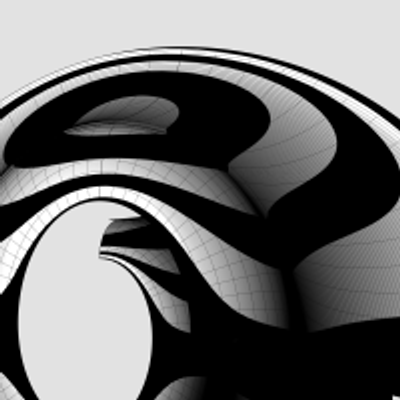
The modern #IonicCapital with curved faces and radial symmetry is a drop-in replacement for the classic Ionic capital with flat faces.
Unlike the classic variant, which has a rectangular footprint, the modern variant has a footprint that fits in a square. In the classic variant, the volutes and scrolls project out so that they are visible from the top. In the modern variant, there are no scrolls, the volutes have a curved face, and they are completely nestled under the top.
The sketch omits the #fillet at the bottom because we added that to the column #shaft in https://pixelfed.social/p/Splines/791794072490907090.
So, we start at the bottom with an #astragal which is exactly the same size as in the classic variant.
Next up from the bottom is the #ovolo which is shorter than in the classic variant. It still has a #tectonicSurface on which #decorativeElements rest, and a #virtualSurface that envelops the decorative elements. In this case, I chose a minimalist design with no #eggsAndDarts. Instead, I use another plain ovolo as a substitute that is offset from the tectonic surface by 1 part (or 8 units, when µ = 144).
Above the ovolo is the #channel, which in this case is a round slab whose surface matches the neck of the column with a radius equal to 5/6 of µ (120 units).
Above the channel is the #abacus which has a curved face that is repeated on all four sides. There is an abacus with flat sides in the classic variant as well, but it is not visible from the front because it is hidden behind the #volute slab. In fact, the vertical #braidsAssembly in the classic variant is attached to the abacus.
Above the abacus is a #reed, and above that, another small Ovolo that tops the modern capital.
The curved volutes follow the blue circular arcs at the bottom of the sketch. The volutes are shaped like a wedge, as can be seen more clearly in the corner facing the front. The portion of the wedge between the outer rims has a concave surface.
#virtualSurface

#3DPrinting
Early #3DPrinted prototype of #Classic #IonicCapital from a few years back using a #Prusa #MK4S #3DPrinter.
The length of the #volute from end-to-end is more than 10". I rotated the #voluteSlab 45° on the printer bed, and by the grace of #Pythagoras, I was able to print it inside the 8" build envelope of the MK4S.
This prototype has many imperfections, and some elements are just plain "wrong" -- like the curved inside of the volute channel (instead of flat).
The #ovolo is lacking #eggsAndDarts because I had not yet made the distinction between a #tectonicSurface on which the #decorativeElements rest, and a #virtualSurface that encloses the decorative elements. My calculations at the time always seemed to differ from those in #Scarlata's book. But as the physical #3DPrint shows, it is perfectly OK to go for a minimalistic look — even if it means a ribbon shorn of #braids. It's the distinctive design of the core tectonic elements that has the greatest impact.
I used brown silk filament for the braids, because, why not? For this prototype, I printed them separately and glued them to the #scroll.
Also, the scrolls are misshapen because I had not yet figured out the correct geometry. It would be another 4 years of tinkering with my #CAD design to finally get my #Eureka moment — and that's when I decided to start this series.
Early #3DPrinted prototype of #Classic #IonicCapital from a few years back using a #Prusa #MK4S #3DPrinter.
The length of the #volute from end-to-end is more than 10". I rotated the #voluteSlab 45° on the printer bed, and by the grace of #Pythagoras, I was able to print it inside the 8" build envelope of the MK4S.
This prototype has many imperfections, and some elements are just plain "wrong" -- like the curved inside of the volute channel (instead of flat).
The #ovolo is lacking #eggsAndDarts because I had not yet made the distinction between a #tectonicSurface on which the #decorativeElements rest, and a #virtualSurface that encloses the decorative elements. My calculations at the time always seemed to differ from those in #Scarlata's book. But as the physical #3DPrint shows, it is perfectly OK to go for a minimalistic look — even if it means a ribbon shorn of #braids. It's the distinctive design of the core tectonic elements that has the greatest impact.
I used brown silk filament for the braids, because, why not? For this prototype, I printed them separately and glued them to the #scroll.
Also, the scrolls are misshapen because I had not yet figured out the correct geometry. It would be another 4 years of tinkering with my #CAD design to finally get my #Eureka moment — and that's when I decided to start this series.

Classic #IonicCapital #Tectonic Surfaces Plan
We already made the 8 unit tall #fillet at the bottom of the #capital a part of the #shaft in https://pixelfed.social/p/Splines/791794072490907090. So, excluding that, the remainder of the capital is 14 parts or 112 units tall, for the bottom half of which we use the #revolve operation (like the #columnBase and #columnShaft), and for the top half we use the #extrude operation (like the #pedestal, #entablature, and #plinth).
Starting at the bottom, we have an #astragal that is 2 parts or 16 units tall and has the same profile as a #reed and #torus, falling in between the two in terms of size. The arc AD is shown in gray because it is an invisible #virtualSurface that envelops the decorations like #eggsAndDarts on the #ovolo. This is the measurement that is given in #Scarlata's #PracticalArchitecture, but it makes no mention of the #decorative and #tectonic surfaces. Arc BC with a radius of 4 parts or 32 units is the tectonic surface on which the Ovolo decorations rest. Such decorations have a variable or uneven surface which may not exceed 1 part or 8 units.
Points E and F mark the horizontal tangent or maxima of the second spiral and the first (outermost) spiral, respectively. The gap between them is exactly 4 parts or 32 units. GH is the profile for the vertical side surface on which part of the #ribbon and #braid lie flat, protruding exactly 6 units to coincide with the invisible virtual flat surface through EF.
The #cymaReversa is 2 parts or 16 units tall and 1.5 parts or 12 units wide. It starts 4 units to the right of F and stops 4 units short of the top fillet, which is one part or 8 units tall and 20 parts or 160 units from the #columnAxis.
Of the 4 parts or 32 units between G and H, the lower 3 parts or 24 units are part of the #voluteChannel groove and the top 1 part or 8 units is a fillet that follows the curve of the #volute and progressively gets narrower until it converges with the #eye of the volute.
We already made the 8 unit tall #fillet at the bottom of the #capital a part of the #shaft in https://pixelfed.social/p/Splines/791794072490907090. So, excluding that, the remainder of the capital is 14 parts or 112 units tall, for the bottom half of which we use the #revolve operation (like the #columnBase and #columnShaft), and for the top half we use the #extrude operation (like the #pedestal, #entablature, and #plinth).
Starting at the bottom, we have an #astragal that is 2 parts or 16 units tall and has the same profile as a #reed and #torus, falling in between the two in terms of size. The arc AD is shown in gray because it is an invisible #virtualSurface that envelops the decorations like #eggsAndDarts on the #ovolo. This is the measurement that is given in #Scarlata's #PracticalArchitecture, but it makes no mention of the #decorative and #tectonic surfaces. Arc BC with a radius of 4 parts or 32 units is the tectonic surface on which the Ovolo decorations rest. Such decorations have a variable or uneven surface which may not exceed 1 part or 8 units.
Points E and F mark the horizontal tangent or maxima of the second spiral and the first (outermost) spiral, respectively. The gap between them is exactly 4 parts or 32 units. GH is the profile for the vertical side surface on which part of the #ribbon and #braid lie flat, protruding exactly 6 units to coincide with the invisible virtual flat surface through EF.
The #cymaReversa is 2 parts or 16 units tall and 1.5 parts or 12 units wide. It starts 4 units to the right of F and stops 4 units short of the top fillet, which is one part or 8 units tall and 20 parts or 160 units from the #columnAxis.
Of the 4 parts or 32 units between G and H, the lower 3 parts or 24 units are part of the #voluteChannel groove and the top 1 part or 8 units is a fillet that follows the curve of the #volute and progressively gets narrower until it converges with the #eye of the volute.

Client Info
Server: https://mastodon.social
Version: 2025.07
Repository: https://github.com/cyevgeniy/lmst