
Drööhn des Tages
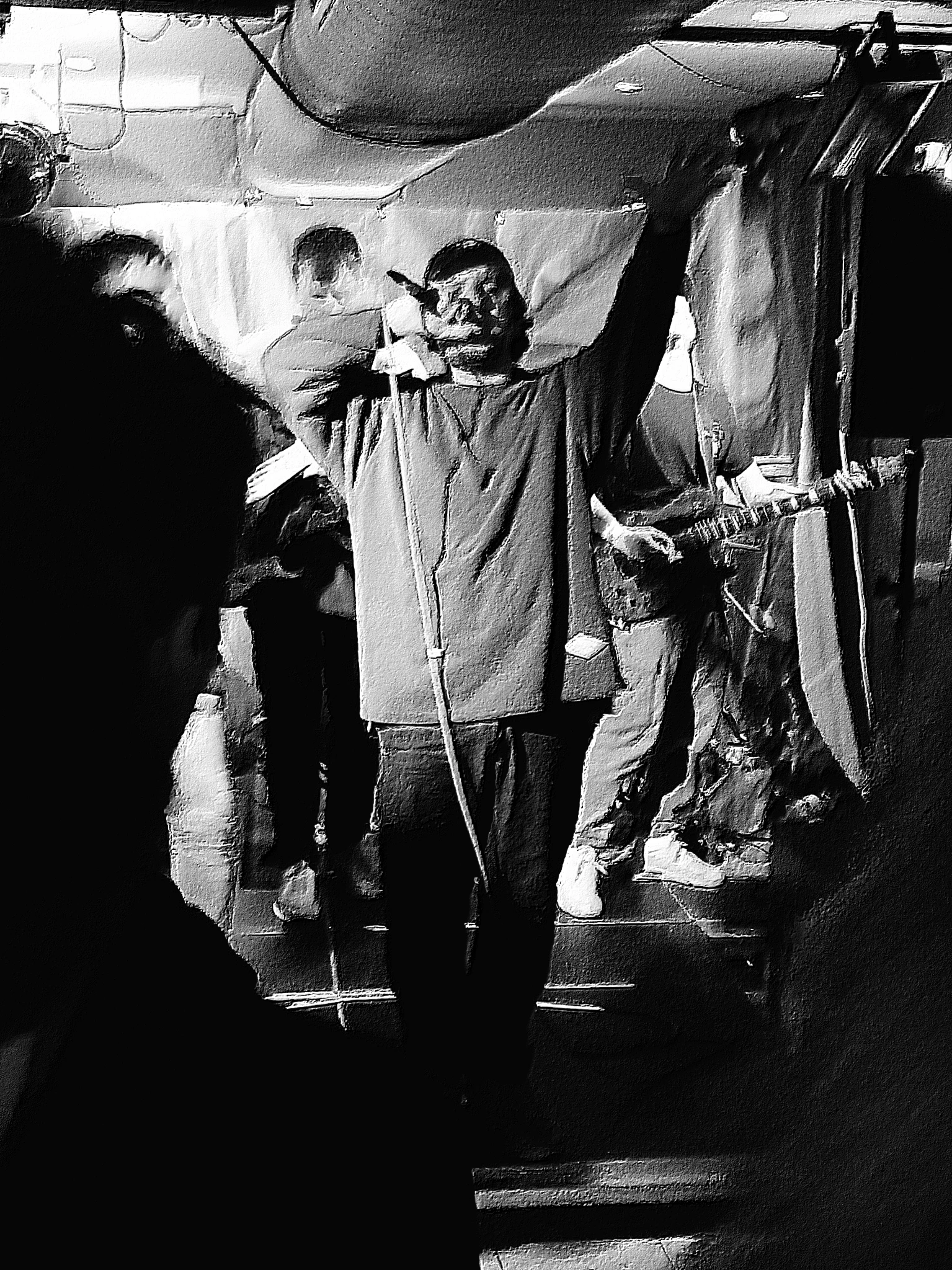
FULL[FORCE]FORWARD
Wie Kerosin den Jet antreibt,
So ist der Sound in unseren Ohren,
Mitgerissen von der Energie
Wie emporgehoben von der puren Massivität
KEEP ON ROCKIN
Klänge unsere Seelen gleich
#drööhndestages #poetry #lyrik #rocker #fastforward #fullforce #sound #rock #metalhead #metal
#sound



🎹🛠️ From a table that "sings" with compressed air to a device that plays #music through your jawbones, the Guthman Musical Instrument Competition winners are pushing the limits of #sound.
These inventors are combining #3D printing, #robotics, and #physics to create #instruments that look and sound unlike anything you’ve seen before.
#innovation #engineering #stem #art #science #georgiatech #design
We make poetry out of a mouthful of air
In his wonderful How To Read a Poem and Fall in Love With Poetry, Edward Hirsch reflects on the orality which marks the poetic form. For most of history it was been an oral art and it retains that orality even now. Inspired by the boast of W.B. Yeats that “I made it out of a mouthful of air” Hirsch reflects that:
As every poet does. So, too, does the reader make, or remake, the poem out of a mouthful of air, out of breath. When I recite a poem I inhabit it, I bring the words off the page into my own mouth, my own body. I become its speaker and lt its verbal music move through me as if the poem is a score and I am its instrumentalist, its performer. I let its heartbeat pulse through me as embodied experience, as experience embedded in the sensuality of sounds.
At the weekend I found myself thinking about the word ‘phoneme’ and its parallel to tokens upon which large language models rely. We too compose meaningful units out of components so atomic that their constituent character falls beneath the surface of our awareness. I was making the point to a friend using the word ‘phoneme’ and was suddenly struck that ‘phoneme’ itself is composed of phonemes: pho-ne-meme. It was startling to experience the concept itself involuntarily decomposed into atomic units.
Except these aren’t phonemes. These are syllables. Phonemes are even more basic units of sound out of which syllables are composed. The fact what presented itself to me as the most basic unit was not, when I thought about it, actually the most basic unit was itself striking. This led me to discover the International Phonetic Alphabet in which phonemes can be rendered using the phonemic alphabet. In which case ‘phoneme’ is composed as /f əʊ n iː m/. This is how GPT 5.2 breaks that down phonetically:
f as in fan
əʊ the diphthong like the vowel in go
n as in no
iː the long vowel like in see
m as in man
It’s a struggle to remain at this atomic level. It’s too basic and too strange. Though it does suddenly make me regret not doing the linguistics degree I fleetingly considered as a teenager. You can stay at this level but it takes a bit of training to do it. The syllabic register is more accessible but even then it takes work. You have to manually decompose as an analytical exercise rather than seeing or feeling the composition. This highlights to me how we’re embedded in the semantic register such that we have to abstract from what words convey in order to analyse them as sign systems.
There are mysteries in the phonetic register. This exercise is akin to repeating a word until the meaning is lost. It just becomes a sound. Then a series of sounds. Until its unsettling to realise that only a minute ago, before you repeated the word fifty times, it conveyed a meaning with an immediacy which now feels inaccessible. There are mysteries in the semantic register as well though. If we instrumentalise our use of words, or rush through speaking and writing, we lose the experience of the force which animates them. There are words which energise us and words which drain us. Words which move us and which leave us cold. There’s a meeting in our experience of words between something deeply human and something…. Other.
Poetry I think is the purest form of connection to that mystery. If we rush through reading a poem it remains flat and inert. The meaning only emerges through us if we take the time to linger with what we are reading. There’s an obvious role of the unconscious here, at least in my experience of as someone who gets gripped by certain lines which I then find myself circling round and preoccupied by. Why am I gripped by these lines? What is it they are evoking in me? Why are they evoking this? I find it hard to appreciate a poem as a whole because I need that foothold to gradually learn to inhabit the poem or rather to find a way to let it inhabit me. The analytical register is too ready-to-hand for me, a tool that presents itself when I have a question but if I do that with a poem (at least too soon) the fragile life of what I’m ready withers and dies in front of me.
There’s something there which we’re encountering with poetry. How it feels and looks changes as we change. But it is in a real sense, I increasingly think, an encounter:
And the ragged rock in the restless waters,
Waves wash over it, fogs conceal it;
On a halcyon day it is merely a monument,
In navigable weather it is always a seamark
To lay a course by: but in the sombre season
Or the sudden fury, is what it always was.T.S. Eliot, The Dry Salvages
As Yeats put it we make poems out of mouthfuls of air. What I’m circling round is I think how mysterious and remarkable this is. How we have the capacity not just to produce meaningful sounds with motor movements of our mouth, tongue and throat that coordinate human action but that carry transformative meaning that transcends the very system of signs we have constructed. That reaches beyond and past it. The theme of the Other I’m just as much circling round relates to what is beyond. What is that deeper reality beyond the sign system. This makes me think that I’m unsatisfied with the obvious Lacanian reading that I’m talking about the machinic quality of the linguistic system. The alien mechanisms through which it churns away in a quasi-autonomous way. I’m talking about what’s in us that exists beyond that system yet remains utterly dependent on it for intersubjective expression.
Perhaps this is just the unconscious: the mycelium which chains together more sensory intensities then we could possibly process and out of which a mushroom of conscious meaning occasionally pops up. I don’t know, I’ve confused myself and I’m going to stop rambling now. But this feels like fertile terrain.
(I’ve also got a book to finish imminently and I’m struck that this sudden mystical fixation on inarticulacy could be the world’s most abstract procrastination exercise 🤔)
#EdwardHirsch #eliot #inarticulacy #language #linguistics #poetry #sound #Yeats

Guida DIY amplificatore
Riceviamo e pubblichiamo questo prezioso contenuto, scaricabile. "L'idea dietro la sua realizzazione è quella di rendere disponibile e "open source" la documentazione per realizzare un amplificatore che abbia un costo irrisorio, tendenzialmente una buona resa sonora e sia alimentabile a batteria, per poter essere usato in scenari di manifestazioni/presidi o altri contesti che richiedano soluzioni un pò alternative." <https://smashrepression.noblogs.org/guida-diy-amplificatore/

Help editing /usr/share/pulseaudio/alsa-mixer/paths/analog-output-speaker.conf #sound #pulseaudio #2404 #alsa #interface

Die Unterdrückung regierungskritischer Medien und das harte Vorgehen gegen Journalist:innen in Georgien war heute Thema bei Journal-Panorama.
https://sound.orf.at/radio/oe1/sendung/233840/journal-panorama
#Radio #Audio #Sound #Medien #JournalPanorama #oe1 #ORF #Pressefreiheit #Österreich #Georgien #Journalismus #Gewalt #Widerstand #Podcast #Kaukasus #Reportage

La definición más PETE DE TODA LA HISTORIA DE LA ACÚSTICA, según Gustavo Basso. Te quiero mucho señor Basso.
(Percepción Auditiva, 2006, G. Basso).
#acoustic #sound #engineering #science

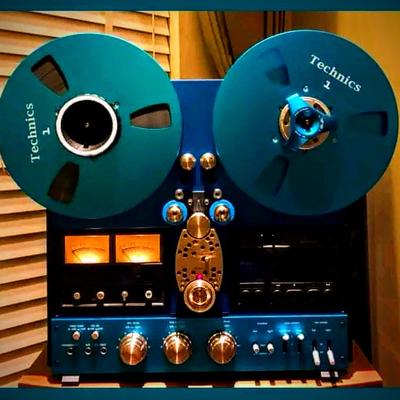
Digital audio myth debunked here with evidence in physics mathematics and chemistry. The chemical makeup of the vinyl record has influence on the physics and the mathematics of what your stylus and cardridge (moving magnet / moving coil) will pickup.
Be amazed at the fact that the signal remains smooth when going through AD DA conversion all the way up to the Nyquist frequency
Watch, listen and learn
https://www.youtube.com/watch?v=cD7YFUYLpDc
#Digital #physics #mathematics #Lineair #Algebra #chemistry #Analog #Signal #Audio #Vinyl #PA #Studio #Sound #Noise #Ratio #effects #faders #Yamaha #Behringer #Mackie #Focusrite #Nyquist



Analog and digital have gotten married since the 1980's when we analyze the Vinyl Signal path.
My current signal path
* Vinyl Direct Drive Turntable to mix.
* Audio Interface3 to mix.
* Always on HW Music player to mix.
* Instrument Mixer
* Yamaha Mixing Console
* AUX0 send FX Rack
* AUX1 send FX Rack
* AUX0 Return Master Bus
* AUX1 Return Master Bus
* Mixing Console to Headphone AMP0
* Mixing Console to Headphone AMP1
* Mixing Console to Digitizer send
* DAW receive
You can clearly see a mix of digital and analog equipment in my Studio hardware setup, which IS mostly analog on purpose
Vinyl has crucial digital equipment in its signal path of production. Without it your records would sound terrible. SO get over it, you need digital even as an Analog purist
#Audio #Vinyl #PA #Studio #Sound #Digital #Analog #Signal #Noise #Ratio #effects #faders #Yamaha #Behringer #Mackie #Focusrite






Effort Sounds (Male) - NPC/Player Audio Pack #Grunt #Sound #Punch #Soundeffects #Voice #Effortsounds #Jump #Npc #Player #Kick #Jumping #Male #Vocalizations #Blocks #Effort #AssetStore
https://u3dn.com/packages/effort-sounds-male-npc-player-audio-pack-285382

If you turn the volume up can hear a #dingo howling up the valley #australian #wildlife #sound #nightlife #night

Added some small animations and sound effects to the UI Sound effects are from @kenney.nl@bsky.brid.gy's interface sounds pack (kenney.nl/assets/inter...) #GodotEngine #GameDev #Sound #UI

frontside 50-50
that sound ist so great #skateboarding #skateboard #sound
The Young Gods, Appear/Disappear. (Ein "ah de gibt's ah no"-Moment.) #sound

Client Info
Server: https://mastodon.social
Version: 2025.07
Repository: https://github.com/cyevgeniy/lmst