Lines That Slip
Same basic formula as my former piece Spiral Reactor 2091. Mandala theta julia.
#popart #UltraFractal #FractalArt #GraphicDesign #RetroFuturism #GeometricAbstraction #DigitalArt #ArtProcess #NoAI #MathArt #Perspective #mastoArt
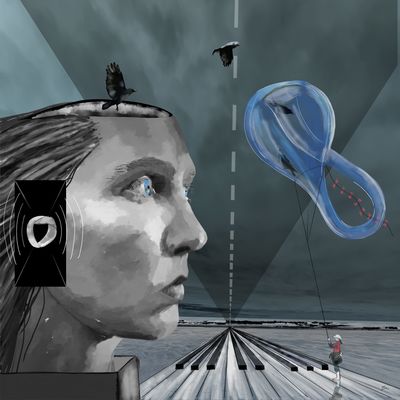
Lines That Slip
Same basic formula as my former piece Spiral Reactor 2091. Mandala theta julia.
#popart #UltraFractal #FractalArt #GraphicDesign #RetroFuturism #GeometricAbstraction #DigitalArt #ArtProcess #NoAI #MathArt #Perspective #mastoArt

Lilypads
Jeremy Fisher would like this one 🐸
Wallpaper Group: 3*3

Python Draws Cycloid Curve
Two waves merge into one stunning pattern mathematical waves combine to form hypnotic interference patterns that flow Experiment with it
#python #pythontricks #codingtips #programmingtutorial #cycloid #parametriccurves #mathart #pythonmath #viralpython #pythonshorts #curveart
One or two days ago I saw in Mastodon a program similar to this, written in #p5js . I wanted to reply to that post but I can't find it.
In any case, here a similar (but interactive) design written in #Kotlin with #OPENRNDR
See how to produce screenshots is just one line of code, and the `contentScale` argument results in 3x resolution, so the window is 800x800 pixels and the screenshot is 2400x2400 pixels).


Bobbly sputniks
Reminds me of cartoon spaceships
Wallpaper Group: 333

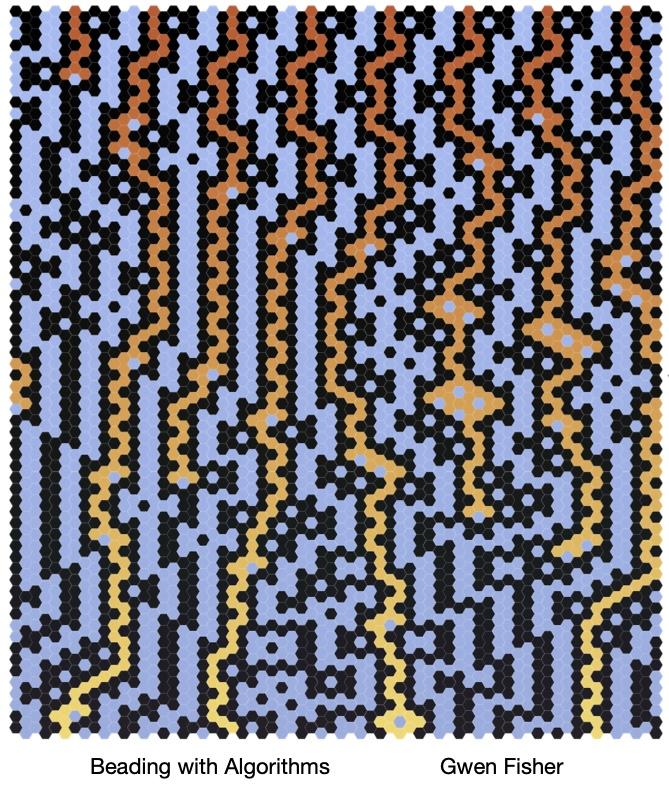
This is cellular automata applied to a staggered grid, like we use in beaded peyote stitch. All of these images were created with the same algorithm, what I call “Vines on a Fence.” The only difference among them is how I started each patch. I give the recipe for Vines on a Fence on page 105 of my new book, Beading with Algorithms #mathart #cellularautomata #algorithms



Glitterball unfurled
I need to get out my dancing shoes 🤣
Wallpaper Group: 442

@gwenbeads I feel it is a must-read for me even if I do not do any beading...
But it also reminds me of a vaguely similar project of German artist Tim Otto Roth, named “Mathematical Socialism” (https://www.maso.gallery/index.php), in which he uses cellular automata rules to weave carpets.
#CellularAutomata #MathArt #TextileArt #Weaving #TimOttoRoth
Ninja Meditation
The blue shapes remind me of Ninjas
Wallpaper Group: 333

Wish you a peaceful #KaleidoSaturday wherever you are!
#Art #GenerativeArt #kaleidoscope #mandala #MastoArt #MathArt #MathsArt #PsychedelicArt #visuals
A little cellular automata to color your day #mathart #generativeart

Oxalis cluster
I love Oxalis - every day it opens to the light and then closes in the evening. Magical every time.
Wallpaper Group: 3*3

English flowers
Reminds me of patterns on stoneware
Wallpaper Group: 4s2

Fire in the grid
I love the dynamic vibrancy of this.
Wallpaper Group: 442

‘Form & Number: A History of Mathematical Beauty’ has been updated: https://archive.org/details/cain_formandnumber_ebook_large
Quite a few typos have been fixed, and there are *many* small but important typographical improvements, mostly to kerning and spacing.
Karl Berry, the treasurer of the TeX Users Group and one of the editors of its journal ‘TUGboat’, has been doing a frankly heroic job of proof-reading the book with a typographer's eye — thank you Karl!
(The new PDF is available for download immediately; archive.org will re-generate images for the in-browser reader during the next few hours.)
Attached is a preview of a two-page spread from the print variant of ‘Form & Number’, showing the start of a section on the Ikhwān al-Ṣafāʾ and a diagram of the numerical structure of their cosmology.
#MathematicalBeauty #HistMath #MathArt #aesthetics #InternetArchive


New post on Fractal Kitty:
https://www.fractalkitty.com/filtering-snowflakes/
#mathart #pascalsTriangle #binomialExpansion #mtbos #snowflakes #iteachmath
Ziggy Windmills
Perhaps the windmills are blowing seeds?
Wallpaper Group: 632

Glowing Limes
Radiating through green corridors
Wallpaper Group: *333

Star rings
Just 5 colours but to me gives the feeling of more.
Wallpaper Group: 3*3

A pair of these colorful earrings would make a fine budget-conscious Valentine's Day treat for a math-loving person in your life. Each is a projection to real 3-space of the image of the complex unit disk under the mapping
\[
t \mapsto (t^{2}, t^{3}, t^{5}).
\]
Shipping within the contiguous US normally takes no more than 5 business days. Through February 14, use the code Math26 at checkout for 15% off all my nylon earring designs.
https://www.diffgeom.com/product/volante-rainbow/
https://www.diffgeom.com/product-category/nylon-wearables/
I also have specially-priced delicate versions---loosely, the image of the unit circle under the same mapping---in natural and polished bronze, and one pair in rhodium-plated brass.