#interdependence

The Lifeboat Academylifeboatacademy
2026-02-10

This moment can’t be understood in isolation.

Prosperity can hide deep forgetting. Seen over time, the unraveling we’re living looks less like random failure and more like a long-delayed correction — ecological, moral, and relational.

The question isn’t whether rebalancing will occur, but whether we participate in the learning or resist it until the cost grows.

Full reflection:
emotusoperandi.medium.com/bles

Picture of Neville Chamberlain at a press conference with the title of the Lifeboat Academy's weekly anchor article across the top: Blessing or Curse? (The end is nigh, but that's not a bad thing)
2026-01-27

Jesus: “Be you #compassionate as your Creator in heaven is compassionate.” Science is rediscovering mystics' wisdom on the priority of #compassion & #interdependence. Hildegard: “Everything in the heavens, on the earth, & under the earth is penetrated w/connectedness (&) relatedness.” bit.ly/4agB15U
Painting by Terrance Osborne, Wikimedia Commons.

The Lifeboat Academylifeboatacademy
2026-01-10

Modern life often trains us into a posture of solitary strain — as if everything depends on our effort alone.

Unlearning begins when we release the reflex to bear the world solo and remember ourselves as part of a living system.

A social post from @lifeboatacademy which says: “You are not Atlas carrying the world on your shoulder. It is good to remember that the planet is carrying you.” — Vandana Shiva
2026-01-06

#ThomasMerton: "The whole idea of #compassion is based on a keen awareness of the #interdependence of all these living things...all part of one another & all involved in one another. " Compassion is the #MoralLaw of interconnectivity w/ others' pain & matthewfox.org/books/a-way-to-

Buddhistdoor Global (BDG)buddhistdoor
2025-12-30

BDG feature: From Ignorance to Insight: The 12 Links of Business Decline and Rebirth

🔗 Read more: tinyurl.com/yrzajk5z

2023-11-01

Care is not charity or kindness. Care is the deeply fraught, complex, abolitionist, political work of protecting one another and the planet.

We updated our care vocabulary page with selections from “Are We Teaching Care or Control?

Care is not charity or kindness. Care is the deeply fraught, complex, abolitionist, political work of protecting one another and the planet, meeting everyone’s needs in balance with the collective good, and keeping our communities safe without the use of policing.

Freedom requires care because freedom is not just a right—it is also a responsibility. Freedom means getting to be our whole selves, in community with other whole selves, without any threat to or assault on our well-being. Freedom means an experience of daily life in which each of us is fully seen and affirmed, treated with unconditional dignity and care, and embraced as an invaluable person of immeasurable worth. Freedom, then, sets an incredibly high standard for community life. It requires that every member of the collective work toward the goals of protection, safety, and unconditional care for all people and for the natural world.

Are We Teaching Care or Control?

Educators must understand challenging behavior as a “collective public health reality.”

Are We Teaching Care or Control?

Related reading from our community,

https://stimpunks.org/glossary/care/

https://stimpunks.org/glossary/interdependence/

https://stimpunks.org/access/healthcare/

https://stimpunks.org/2021/12/11/autism-in-care-settings-managing-sensory-load/

https://stimpunks.org/glossary/community/

https://stimpunks.org/philosophy/care-work-makes-all-other-work-possible/

https://stimpunks.org/2023/04/01/a-credo-for-support-respecting-autonomy-in-a-society-of-interdependence-and-care/

https://stimpunks.org/glossary/rest/

https://stimpunks.org/aid/community-care/

https://stimpunks.org/2022/12/11/none-of-us-ashes-all-of-us-flames-lets-organize-our-lives-around-love-and-care/

#behavior #care #education #interdependence
Weekend Storiesweekendstories
2025-12-19

's frames care as imperative rather than mere conservation. Through (), non-harming (), and the ideal, it extends to all sentient beings affected by . () invites engagement, not passivity, distinguishing natural cycles from destruction.

🌍 fabriziomusacchio.com/weekend_

The last batch of sawnwood from the peat forest in Indragiri Hulu, Riau Province, Indonesia. Deforestation for oil palm plantation. Source: Wikimedia Commonsꜛ (license: CC BY-SA 2.0)
2025-12-16

#MurrayStein: “Jung needed to have experience. What is your experience of God? This was Jung’s approach to religion.” I share similar questions: How do we experience the divine? How do those of other cultures and religions do the same? #Interdependence is key to the future. bit.ly/4q4QJWI

Stan Stewart (muz4now)muz4now.com@bsky.brid.gy
2025-12-15
Lawrence Nault- Stone & SignalMountainHermit
2025-12-04

"The forest has no concept of ownership. Only interdependence. That is its secret strength." L. Nault

Follow the words that move you. Read my books.

A dark blue background with large, light blue quote marks at the top, and in white, the quote "The forest has no concept of ownership. Only interdependence. That is its secret strength." attributed to Lawrence Nault
2025-12-02

En su mensaje “Consejo Para Los Jóvenes de Este Nuevo Milenio”, el Maestro Alfredo Sfeir-Younis, en línea con su visión sobre la consciencia y los derechos humanos, propone que el aprendizaje es fundamentalmente un proceso de transformación interior y autodescubrimiento. Urge a los jóvenes a rechazar los errores del pasado y a construir una civilización ecológica como único camino hacia un futuro compartido. Sfeir-Younis les pide ser embajadores de paz y activistas inteligentes y conscientes, adoptando valores colectivos que maximicen la interdependencia con todos los seres sintientes y la naturaleza. Enfatiza la necesidad de unirse a los protectores de la sabiduría y de desarrollar un camino espiritual propio para navegar la complejidad de la vida.

🔗 youtu.be/QnHs9XATZds

#EcologicalCivilization #ConsciousActivism #AmbassadorsofPeace #Interdependence #SpiritualPath #YouthForChange

2025-11-27

Out now: #HSR 50.4 - Varieties of #Refiguration I
On Multiple #Spatialities, Spatial Arrangements, and the #Economy. (Nina Baur, Elettra Griesi, Lara Espeter, Florence Eyok, Elmar Kulke & Lynn Sibert)

The contributions in this HSR Special Issue analyze multiple spatialities in three key areas: the refiguration of economic regions, the refiguration of #spaces and #infrastructures, and the refiguration of translocal chains of #interdependence.

gesis.org/en/hsr/current-issues

2025-11-24

“No man is an island, / Entire of itself; / Every man is a piece of the continent, / A part of the main.”*…

Individualism has been been a growing force in cultures around the world since the Enlightenment; it picked up momentum in the 20th century (c.f., e.g., Adam Curtis’ masterful Century of Self [and here]); and has become a– if not the— foundational concept in liberalism. But, Nils Gilman argues, the biological discovery of the holobiont gives the lie to “the autonomous individual” in a way that has massive implications not only for how we think about, but also how we govern ourselves…

We like to believe we end at our skin. This is the primary hallucination of modern political philosophy in the West, the foundational axiom upon which we have erected our laws, our economics, and our sense of self-worth. Philosophical liberalism imagines human individuals as discrete, bounded entities — monads moving through space, contained entirely within a fleshy envelope that separates “self” from “other.” This architectural model of the human being underpins the political concept of the autonomous liberal subject, just as it grounds the social scientific commitment to methodological individualism. It asserts that the basic unit of human reality is the singular actor, the “I” that thinks, chooses, and owns.

However, this model is a biological fiction. It is a map that corresponds to no territory found in nature. Over the last three decades the life sciences have undergone a quiet revolution that renders the classical liberal view of the subject not merely philosophical debatable, yet factually incorrect. The concept of the holobiont, coined by Adolf Meyer-Abich in 1943 but popularized in the anglophone world by Lynn Margulis in the 1990s, has shattered the idea of the unitary organism. We now know that every macro-organism is actually a dynamic ecosystem, a chimera composed of a host and billions of symbiotic microbes that function as a distinct, integrated biological unit. You are not a single entity. You are a walking coral reef, a plural assemblage of human and non-human cells negotiating a fragile, continuous existence. Roughly half the cells in your body are not human; they are bacterial, fungal, and viral. They do not merely hitch a ride. They digest your food, regulate your immune system, modulate your mood, and structure the development of your brain.

The implications of this biological reality for political theory are cataclysmic. The entire edifice of Liberalism, from Hobbes and Locke to modern libertarianism, rests on the assumption of the “atomic individual” — a sovereign state of one. This core concept of liberal political theory posits a world of separate, self-governing agents who enter into contracts and demand rights to protect their private sphere from intrusion. The liberal subject claims (and demands) to be walled off, protected, and kept clean of the influence of others.

Biology exposes this desire for total autonomy as not just false, but a death wish. In the logic of the holobiont, absolute immunity is not health; it is starvation. A body hermetically sealed against the “other” dies. Our physical existence requires constant contamination and collaboration with foreign agents. We cannot be “self-made” because we are constitutively “made-with.” Donna Haraway describes this shift as moving from autopoiesis (self-making) to sympoiesis (making-with). We do not precede our relationships; our relationships constitute us. If the political subject is physically constituted by “others,” the concept of self-sovereignty collapses. One cannot be the sole monarch of a kingdom occupied by foreign powers that provide the essential infrastructure for the kingdom’s survival…

[Gilman elaborates on the implications both for our political and management systems and for the social sciences that study them. And he explores why this new perspective is hard to internalize and embrace…]

The resistance to this holobiontic perspective is fierce because it is terrifying. As Rudyard Kipling observed (in a quote often misattributed to Nietzsche), “The individual has always had to struggle to keep from being overwhelmed by the tribe. If you try it, you will be lonely often, and sometimes frightened. But no price is too high to pay for the privilege of owning yourself.” The autonomous liberal subject offers psychological safety. It promises control. It tells us that we are captains of our souls. Embracing the holobiont requires admitting that we are porous, vulnerable, and inextricably entangled with things we cannot control. It demands that we surrender the fantasy of the impermeable border. The skin is not a wall; it is a heavily trafficked interface. The state is not a fortress; it is a metabolic node in a planetary flow.

We are living through the friction between our laws and our biology. We legislate for individuals, yet we live as assemblages. We worship independence while our bodies are grounded in interdependence. The future of political theory cannot simply be an adjustment of liberal categories. It requires a fundamental ontological revision that starts with relation rather than separation. We must stop trying to protect the self from the world and begin understanding the self as a spatially intensified instantiation of the world.

Clinging to the myth of the autonomous subject is a massive act of collective denial. It represents a refusal to look at the microscope and see the legions teeming inside us. We construct our societies around a myth of being that does not correspond to biogeochemical reality. The cost of this error is everywhere apparent — in the degradation of our ecology, the polarization of our politics, and the isolation of our private lives. We try to seal ourselves off, creating sterile environments that make us sick, physically and politically. The holobiont offers a different path, one that acknowledges that to be one is always to be many. We are not solitary thinkers looking out at nature. We are nature looking at itself, through a lens made of billions of other lives. The sovereign is dead. Long live the swarm…

The Sovereign Individual Does Not Exist,” from @nilsgilman.bsky.social.

Further complicating the issue: “Externalities, Rights, and the Problem of Knowledge,” from Cyril Hédoin

Very short summary: This essay explains how the knowledge problem [the challenge of a central authority having the information needed to make rational decisions for a complex system like a society] applies to the definition of jurisdictional rights. Jurisdictional rights define spheres of individual sovereignty. Rights are appropriately defined if they internalize all potential externalities. However, individuals may disagree about what counts as an externality. This disagreement stems from individuals’ preferences, which are typically dispersed and local. I discuss various solutions to this problem, including the use of polycentricity...

[Image above: source]

* John Donne

###

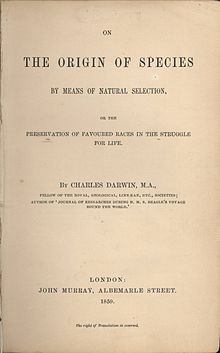
As we incorporate the interconnected, we might recall that it was on this date in 1859 that our perspective was shifted in a different kind of way: Charles Darwin published The Origin of the Species.  Actually, on that day he published On the Origin of Species by Means of Natural Selection, or the Preservation of Favoured Races in the Struggle for Life; the title was shortened to the one we know with the sixth edition in 1872.

Title page of the 1859 edition

source

#charlesDarwin #culture #darwin #externalities #history #holobiont #individualism #individuality #interconnection #interdependence #philosophy #politics #reason #rights #society #theOriginOfTheSpecies
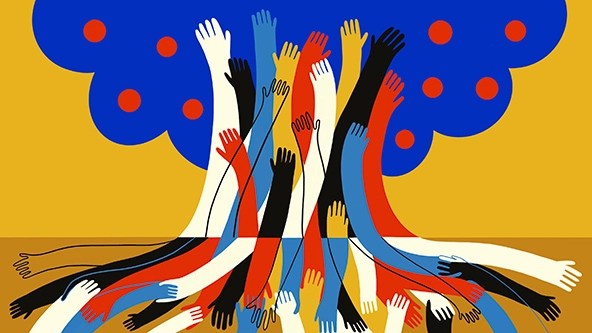
An abstract illustration featuring multicolored arms reaching upward from a layered base, with a vibrant blue cloud and red circles above, symbolizing unity and collective strength.Title page of Charles Darwin's book 'On the Origin of Species', published in 1859, detailing natural selection and the preservation of favored races in the struggle for life.
Buddhistdoor Global (BDG)buddhistdoor
2025-11-21
Learn with Leshleycitify@mastodon.online
2025-11-21

“‘No man is an island.’ – Donne. Yet modern hyper‑connectivity can feel isolating. Interdependence versus individuality remains a timeless tension.” #Interdependence #Individuality #Donne #SocialPhilosophy #DeepThoughts

Buddhistdoor Global (BDG)buddhistdoor
2025-11-20

BDG feature: Thích Nhất Hạnh’s Engaged Buddhism After Wartime Vietnam, Part 2

🔗 Read more: tinyurl.com/2ja2wabr

2025-11-18

The work of Alfredo Sfeir-Younis, Freedom From Fear and the United Nations, posits that liberation from fear necessitates a deep engagement with the very origins of suffering. He argues that fear is rooted in the anticipation of suffering, which itself arises from factors such as ignorance, diminished personal and collective power, and the breakdown of interdependence. Sfeir-Younis critiques contemporary economic and social systems for often perpetuating fear to achieve material gains, emphasizing that true freedom requires a fundamental transformation across multiple societal levels, advocating for a crucial shift from competition to cooperation, from material accumulation to spiritual growth, and from individualistic pursuits to a shared vision of collective well-being, positioning the United Nations as a key actor in facilitating these profound global transformations.

🔗 neljorsa.com/freedom-from-fear

#SpiritualGrowth #FreedomFromFear #CollectiveWellbeing #GlobalTransformation #Interdependence #CompetitionToCooperation

Client Info

Server: https://mastodon.social
Version: 2025.07
Repository: https://github.com/cyevgeniy/lmst