
The Epstein-Number:
You have Epstein-Number 0 if you are Jeffrey Epstein.
You have Epstein-Number n+1 if n is the lowest Epstein-Number of someone you had correspondence with.
The lower your Epstein-Number, the more guilty you are.
#Graphtheory
#graphtheory

The Graph Theory of Circuit Sculptures https://hackaday.com/2026/02/03/the-graph-theory-of-circuit-sculptures/
#Art #LEDHacks #CircuitSculpture #Graphtheory #LEDfilament

Astroturfing Is Pretty Pointless When Social Subgraphs Are Fragmented (e.g., the Fediverse)
I am seeing astroturfing in the fediverse again, by AT Protocol developers implicitly trying to shill their products. I think it is stochastic behavior by developers with too much time on their hands. Honestly, I do not care. I like the people on ActivityPub more, but I like the AT Protocol better, and I have developed for both. Astroturfing on ActivityPub networks is fascinating to me because it is so pointless.
I am actually a Computational Biologist and Computer Scientist whose specialty is combinatorics, social graphs, graph theory, etc. Specifically, I use this to create epidemiological models for the memetic layer of human behaviors that act as vectors for diseases, using the SIRS model. I do not just study germs; I study human behaviors.
The models I construct extend into a “memetic layer,” in which beliefs, norms, and behaviors (such as risk-taking, compliance with public health measures, or susceptibility to misinformation) spread contagiously through social networks. These behaviors function as vectors that modulate biological transmission rates. As a result, the spread of ideas can accelerate, dampen, or reshape the spread of disease. By running computational simulations and agent-based models on these graphs, I study how network structure, influential nodes, clustering, and platform-specific dynamics affect behavioral contagion. I also examine how these factors influence epidemiological outcomes.
To say it very concisely, I study how the spread of bat-shit insane beliefs, shit posts, and memes influences whether or not there is a measles outbreak in Texas. Ironically, this is an evolution of my studying semiotics, memetics, and chaos magick in high school. I got a job where I can use occult, anarchist techniques professionally.
I think a large reason why I do not care about astroturfing in the fediverse is that it’s so pointless, lol. Astroturfing to manipulate the narrative would actually work better on Bluesky to keep people there than trying to recruit from the fediverse. Furthermore, big instances are relatively small. Some people on Bluesky have follower lists larger than an entire large instance in the fediverse.
Within ActivityPub networks, astroturfing rarely propagates far, because whether information spreads depends on properties of the social graph itself. Dense connectivity, short paths between communities, and a sufficient number of cross-cutting ties support diffusion. ActivityPub’s architecture tends to produce graphs that are fragmented and highly modular. This limits the reach of coordinated activity.
ActivityPub is a system where each instance maintains its own local user graph and exchanges activities through inboxes and outboxes. This makes it autonomous and decentralized. The network consists of loosely connected subgraphs. Cross-instance edges appear only through explicit follow relationships. The ActivityPub protocol does not provide a shared or complete view of the network. Measurements of the fediverse consistently show uneven connectivity between instances, clustering at the instance level, and relatively long effective path lengths across the network. Under these conditions, large cascades are uncommon.
Instance-level clustering means that in ActivityPub networks, users interact much more with others on the same server than with users on different servers. Because each instance has its own local timeline, culture, and moderation, connections form densely within instances and only sparsely across them through explicit follow relationships. This creates a network made up of tightly connected local communities linked by relatively few cross-instance ties, which slows the spread of information beyond its point of origin.
However, with the AT Protocol, global indexing and aggregation are explicitly supported. Relays and indexers can assemble near-complete views of the social graph. Applications built on top of this infrastructure operate over a graph that is denser and easier to traverse. There are fewer structural barriers between communities. The diffusion dynamics change substantially when content can move across the graph without relying on narrow federated paths.
Astroturfing depends on coordinated amplification, typically through tightly synchronized clusters of accounts intended to manufacture visibility. Work on coordinated inauthentic behavior shows that these tactics gain traction when they intersect highly connected regions of the graph or bridge otherwise separate communities. In networks with strong modularity, coordination remains local. ActivityPub’s federation model produces this kind of modularity by default. Coordinated clusters stand out clearly within instances. Their effects remain confined to those local neighborhoods.
Astroturfing on ActivityPub therefore tends to stall on its own because of the underlying graph topology. Without dense inter-instance connectivity or any form of global indexing, coordinated campaigns have a hard time moving beyond the immediate regions where they originate. Systems built on globally indexable social graphs, including those enabled by the AT Protocol, expose a much larger surface for viral spread. Network structure and connectivity account for the divergence where that is independent of moderation, cultural norms, ideology, or intent.
It’s just really funny to me how these stochastic techbro groups waste so many resources. I personally don’t want to go viral, which is why I avoid platforms where I can. The fact that it’s harder to achieve high virality on ActivityPub is exactly why I prefer the fediverse over the Atmosphere. One way to think about it is that you can change the ‘genetics’ of a system with a retrovirus, where memetic entities act as cultural retroviruses to reprogram the cultural loci of a space. That is their end goal. They are trying to hijack cultures memetically. You see this a lot with culture jamming.
Basically, the astroturfing on ActivityPub networks is designed to jam and subvert the culture. But, as I have already said, the topological structure makes memetic virality stall. They cannot achieve that kind of viral spread in the fediverse, which is why I cannot understand why they do this every year.

The article reports a study using graph theory and resting-state fMRI to examine how acute alcohol intake reshapes brain networks in healthy social drinkers. Findings show a shift from a globally integrated network to a more fragmented, locally clustered topology, with reduced global efficiency and increased local efficiency and clustering, especially in occipital regions.
This work is of interest to psychology because it links subjective intoxication to objective network changes, illustrating how alcohol can alter information processing and perception. It also helps explain individual differences in responses to alcohol, a key area in understanding human behavior and cognition.
Article Title: Alcohol shifts the brain into a fragmented and local state
Link to PsyPost Article: ift dot tt/w2AiokP
Copy and paste broken link above into your browser and replace "dot" with "." for link to work. We have to do it this way to avoid displaying copyrighted images.
#AlcoholEffects
#BrainConnectivity
#GraphTheory
#RestingState
#Neuroscience

Propositions As Types Analogy • 1
• https://inquiryintoinquiry.com/2013/01/29/propositions-as-types-analogy-1/
One of my favorite mathematical tricks — it almost seems too tricky to be true — is the Propositions As Types Analogy. And I see hints the 2‑part analogy can be extended to a 3‑part analogy, as follows.
Proof Hint ∶ Proof ∶ Proposition
∷
Untyped Term ∶ Typed Term ∶ Type
or
Proof Hint ∶ Untyped Term
∷
Proof ∶ Typed Term
∷
Proposition ∶ Type
See my working notes on the Propositions As Types Analogy —
• https://oeis.org/wiki/Propositions_As_Types_Analogy
#Mathematics #CategoryTheory #ProofTheory #TypeTheory
#Logic #Analogy #Isomorphism #PropositionalCalculus
#CombinatorCalculus #CombinatoryLogic #LambdaCalculus
#Peirce #LogicalGraphs #GraphTheory #RelationTheory
RE: https://mastoxiv.page/@arXiv_mathCO_bot/115904052353835071
Here is the second manuscript coming out of the "Topics in Ramsey theory" online-only problem-solving session (https://sparse-graphs.mimuw.edu.pl/doku.php?id=sessions:2025sessions:2025session1) of the Sparse (Graphs) Coalition, which took place less than a year ago.
The first manuscript already came out a couple months earlier (https://arxiv.org/abs/2510.17981).
Both have made serious progress in serious Erdős problems.
#combinatorics #remoteconferences #graphtheory #extremalcombinatorics #erdős


Recent research challenges the idea that general intelligence relies on global brain efficiency or small-world architecture. A large-scale analysis shows that whole-brain measures do not predict cognitive ability, while node-level patterns—especially within-module degree in specific regions like the temporal poles and cerebellum—are linked to intelligence.
This article is of interest to psychology because it clarifies how cognitive abilities relate to brain structure, highlighting the importance of local connectivity over global network properties. It underscores the value of large, diverse datasets in testing theories of intelligence and the specificity of neural mechanisms.
Article Title: Global brain efficiency fails to predict general intelligence in large study
Link to PsyPost Article: ift dot tt/ZqvWjkC
Copy and paste broken link above into your browser and replace "dot" with "." for link to work. We have to do it this way to avoid displaying copyrighted images.
#neuroscience #intelligence #brainconnectivity #graphtheory #restingstatefMRI
Advances in #Klotski technology. Extremely well-produced video on state space and graph theory.

Perceiving relationships gives glue people the edge
Seeing what’s in between as well as what is — in information architecture and in the way organisations work.https://duncanstephen.net/perceiving-relationships-gives-glue-people-the-edge/


This is an extremely rewarding video, and as Prof. Knuth explains at the start, chosen to be accessible to an undergrad audience.
It's a tiny illustration Knuth's astonishingly thorough, penetrating yet playful career in #math and #computerscience
SPEND THE HOUR:
youtu.be/VW3vgJYYIok #graphtheory
youtu.be/VW3vgJYYIok

My first under 10x10cm #MechanicalKeyboard PCBs arrived from JLCPLC - and they’re so tiny! Smol keyboard time - 15 or 16 keys on each half, and a 5-way navigation button, but no diodes using #GraphTheory http://astrobeano.blogspot.com/2025/12/5-way-switch-in-diode-free-graph-theory.html - and in further boundary pushing it should take a pair of #RaspberryPi RP2040-Zero or RP2350-Zero in TRRS wired mode, or the NRF52840 “Zero” controllers for Bluetooth (using opposite sides of the PCB rather than jumpers as they have almost equivalent footprints): https://codeberg.org/peterjc/pico-keyboards/src/branch/main/bivvy16d

#GOFAI code is actually fun. It is a rewarding mental workout, not a mental atrophy.
#computerscience #graphtheory
RE: https://bsky.app/profile/did:plc:osg2vzhifd2tjfsvfwua7scy/post/3mc265o2euc2r
This thing all things devours:
Birds, beasts, trees, flowers;
Gnaws iron, bites steel;
Grinds hard stones to meal;
Slays king, ruins town,
And beats high mountain down.
— Tolkien • The Hobbit
Talking about time is a waste of time. Time is merely an abstraction from process and what is needed are better languages and better pictures for describing process in all its variety. In the sciences the big breakthrough in describing process came with the differential and integral calculus, that made it possible to shuttle between quantitative measures of state and quantitative measures of change. But every inquiry into a new phenomenon begins with the slimmest grasp of its qualitative features and labors long and hard to reach as far as a tentative logical description. What can avail us in the mean time, still tuning up before the first measure, to reason about change in qualitative terms?
Et sic deinceps … (So it begins …)
#Animata, #CSPeirce, #Change, #Cybernetics, #DifferentialLogic, #GraphTheory, #LawsOfForm, #Logic, #LogicalGraphs, #Mathematics, #Paradox, #Peirce, #Process, #ProcessThinking, #SpencerBrown, #SystemsTheory, #Time, #Tolkien
This is magnificent.
#math #graphtheory #illustration
RE: https://bsky.app/profile/did:plc:beqpqpce3wnzazg5vc3mezhr/post/3lvedbp2plk25
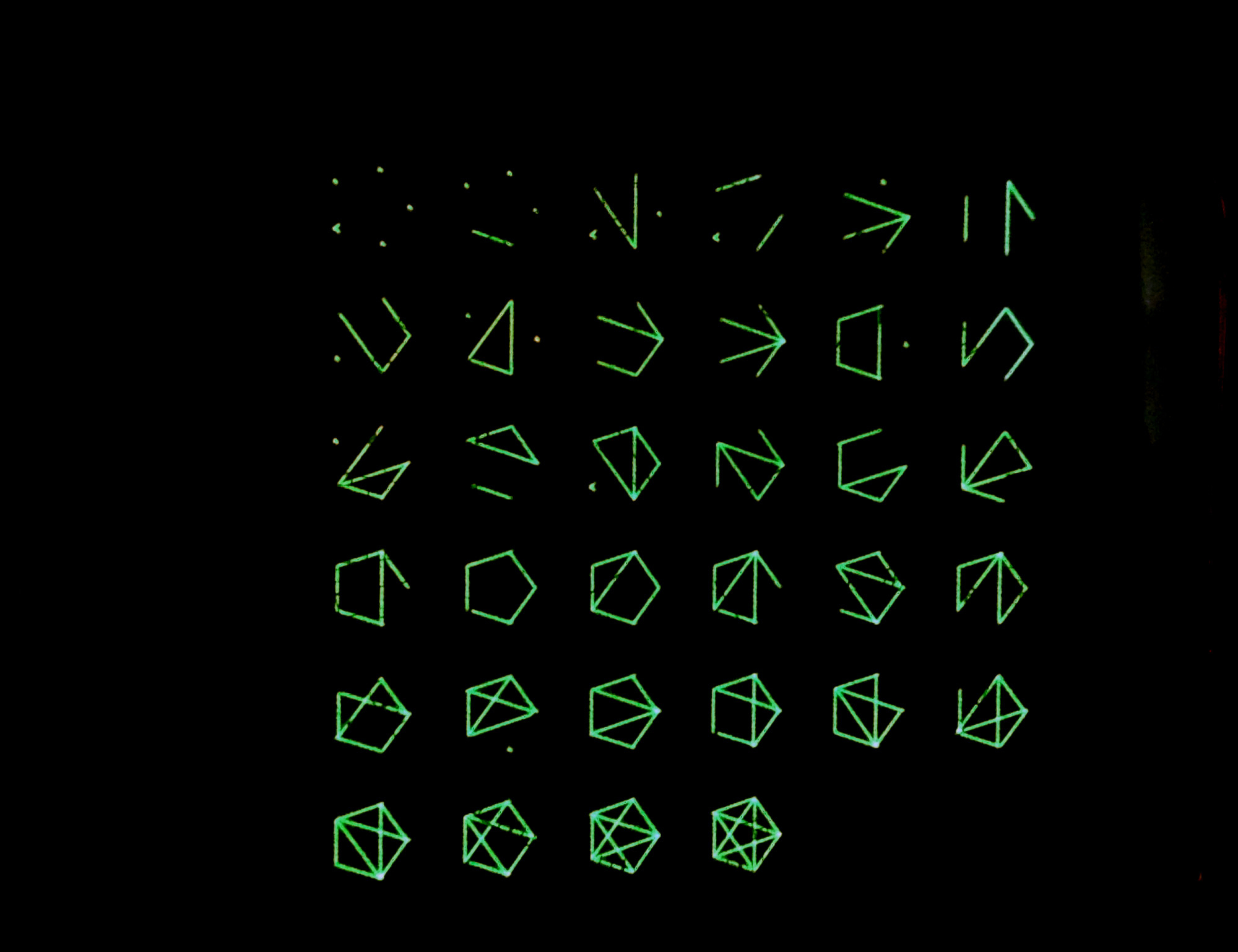
Enumerating graphs is fun. This code is meant to enumerate graphs up to isomorphism for each number of edges, in order 5. The population increases dramatically by order! There's an international contest too #math #computerscience #graphtheory math.stackexchange.com/a/1484987 oeis.org/A000088
Good things have been done. You can download previously paywalled ACM articles. #computerscience #graphtheory

Riffs and Rotes • Happy New Year 2026
• https://inquiryintoinquiry.com/2026/01/01/riffs-and-rotes-happy-new-year-2026/
There's a deep mathematical significance I see in the following structures, and I'm hoping one day to find a way to explain all the things I see there. Meanwhile, you may take them as an amusing diversion in recreational maths.
\( \text{Let} ~ p_n = \text{the} ~ n^\text{th} ~ \text{prime}. \)
\( \begin{array}{llcl}
\text{Then} & 2026 & = & 2 \cdot 1013
\\
&& = & p_1 p_{170}
\\
&& = & p_1 p_{2 \cdot 5 \cdot 17}
\\
&& = & p_1 p_{p_1 p_3 p_7}
\\
&& = & p_1 p_{p_1 p_{p_2} p_{p_4}}
\\
&& = & p_1 p_{p_1 p_{p_{p_1}} p_{p_{{p_1}^{p_1}}}}
\end{array} \)
No information is lost by dropping the terminal 1s. Thus we may write the following form.
\[ 2026 = p p_{p p_{p_p} p_{p_{p^p}}} \]
The article linked below tells how forms of that order correspond to a family of digraphs called “riffs” and a family of graphs called “rotes”.
The riff and rote for 2026 are shown in the next two Figures.
Riff 2026
• https://inquiryintoinquiry.com/wp-content/uploads/2026/01/riff-2026-card.png
Rote 2026
• https://inquiryintoinquiry.com/wp-content/uploads/2026/01/rote-2026-card.png
Reference —
Riffs and Rotes
• https://oeis.org/wiki/Riffs_and_Rotes
cc: https://www.academia.edu/community/VBA6Qz
cc: https://www.researchgate.net/post/Riffs_and_Rotes_Happy_New_Year_2026
#Arithmetic #Combinatorics #Computation #Factorization #GraphTheory #GroupTheory
#Logic #Mathematics #NumberTheory #Primes #Recursion #Representation #RiffsAndRotes



In the thrilling new world of #Lean4, we've finally proven bounds for the Randomized MaxCut #Approximation algorithm that nobody asked for. 📈🔍 Now you can confidently cut those graphs like a pro while impressing... well, nobody. Because who doesn't love an NP-Complete problem just chilling with some approximation algorithms? 🙄🎉
https://abhamra.com/blog/randomized-maxcut/ #RandomizedMaxCut #NPComplete #Algorithms #GraphTheory #HackerNews #ngated
My second #ErgoMechKeyboard was also featured on this Keyboard news blog https://kbd.news/Gamma-Omega-Hesse-2762.html - as was my first https://kbd.news/Gamma-Omega-TC36k-2690.html and the prior #GraphTheory diode-less #MechanicalKeyboard designs like https://kbd.news/JESK56-2322.html and https://kbd.news/reJESK-2485.html
Client Info
Server: https://mastodon.social
Version: 2025.07
Repository: https://github.com/cyevgeniy/lmst