#gettingthingsdone

2026-02-01

Still haven't found a simple, sustainable way to handle your weekly to-dos? Look no further.
Try @kepano's minimalist genius system, explained in full here: stephango.com/todos

Kepano's to-do system is elegantly simple: Start each week with a fresh note, jotting down only the tasks you remember from memory. Add new ones as they arise during the week. Come week's end, carry forward unfinished items that still matter—or let them fade away. If a task slips your mind when rebuilding the list, it likely wasn't crucial. That's it.

It translates beautifully to paper with this clean, undated ISO 8601 weekly planner notebook (perfect 2-page spreads for the weekly reset): a.co/d/dOvLqgg

#Productivity #TodoSystem #Minimalism #Obsidian #WeeklyPlanning #GettingThingsDone

DoSchuDoSchu
2026-01-27

Du haderst mit deiner Tagesplanung?
Hm, hast du schon 'Interstitial Journaling' probiert: Lern es kennen in meinem Blog und Mini-eBook (kostenfrei) - damit erkennst du 'schwarze Löcher' im Tag und kannst sie eingrenzen doschu.com/2026/01/interstitia
Du brauchst nur Stift und Tageskalender oder Notizheft 🫶

Vorschau Mini-eBook Interstitial Journaling
Ankur Sinha "FranciscoD"sanjay_ankur@fosstodon.org
2026-01-20

How do you manage your task list? If you're not happy with your current setup, give #Taskwarrior a try---it's a really lean, simple yet powerful and extensible tool for managing tasks. It also includes in-built syncing features so that you can use across multiple devices.

taskwarrior.org

Recently, I needed to split tasks into smaller tasks. I came up with a quick script:

ankursinha.in/2025/07/05/split

#Productivity #TaskTracking #GettingThingsDone

Pluralistic: Daily links from Cory Doctorow – No trackers, no ads. Black type, white background. Privacy policy: we don't collect or retain any data at all ever period.pluralistic.net@web.brid.gy
2026-01-16
2026-01-15

gibt es Empfehlungen für eine #todo-liste (zB nach #gettingthingsdone) in Open Source, gerne CLI mit strukturierten Exporten oder so? Microsoft Todo mag zwar gut sein, ich würde das aber gerne sinnvoll machen ;)

Adrian SegarASegar
2026-01-07

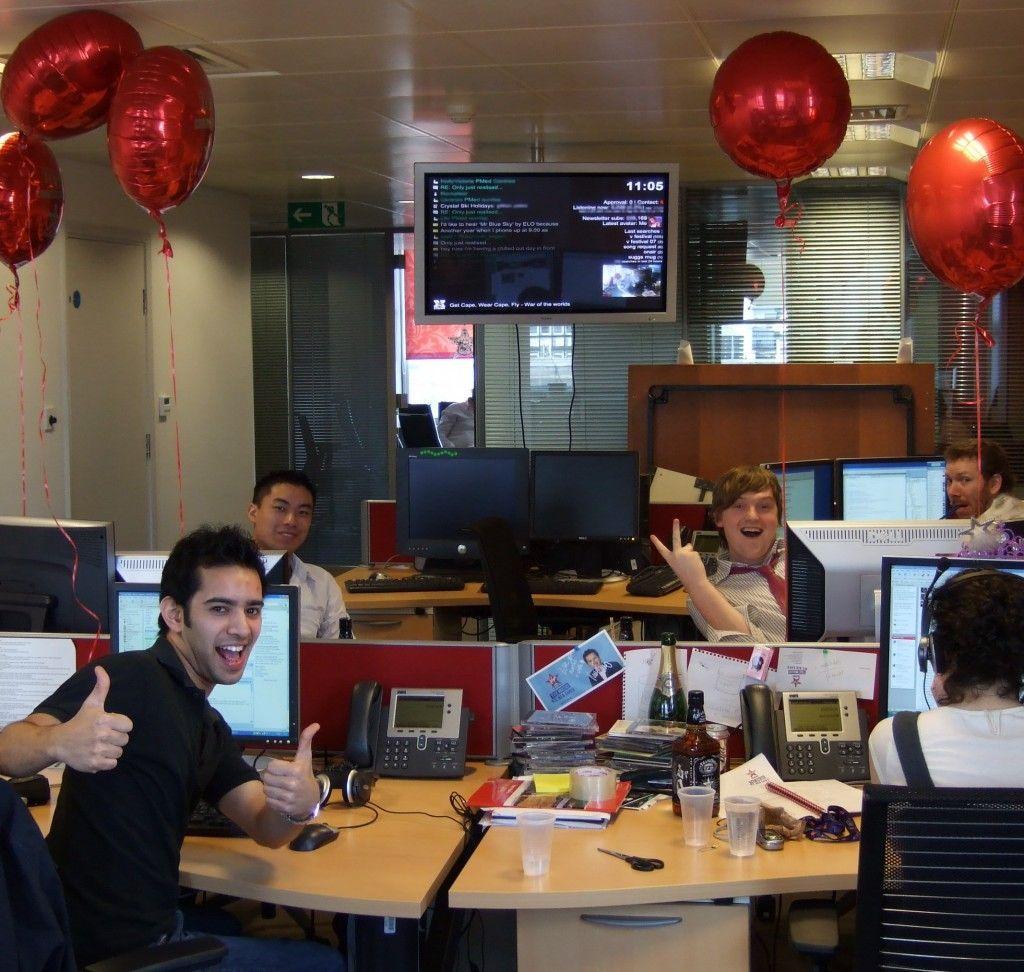
How can you continuously improve your work life? Designing and conducting a regular work life review can work wonders.

conferencesthatwork.com/index.

continuously improve work life: photograph of happy workers in an office. Photo attribution: Flickr user jamescridland
Jason Nassijnassi
2025-12-27

I'm getting a jump start on 2026 by setting up my planner for the year. Until 2025, I'd always been frustrated with my planning system fizzling out for the year as quickly as you stop going to the gym 😉

Then this past year, I figured out my own personal planner system that WORKED for me, and now I'm sharing how I set up my 2026 planner.

youtu.be/q0Y78ayuYME

#2026

Adrian SegarASegar
2025-12-19
working productively: a photograph of the view out of my office window in early winter
Adrian SegarASegar
2025-12-16

Why I've found David Allen's "Getting Things Done" to be the most powerful tool for improving your personal work environment

conferencesthatwork.com/index.

improving your personal work environment: a photograph of an incredibly messy desk. Image attribution: Flickr user harryharris
diesUndDasMitTassen 🇺🇦Andreas_Sturm
2025-11-22

@FreitagsFrage Zum Sortieren nutze ich Ansätze aus , also kategorisieren und in einem priorisieren. Ich habe eine 1/3/5 Regel: Arbeiten kann ich nur an einer Aufgabe, Dringend sind maximal 3, Wichtig maximal 5. Um das zu erreichen priorisiere ich zyklisch neu. Das nutze ich privat und im Job und wende es auf Mailclients / Posteingang genauso an, wie auf Projektmanagementwerkzeug und Todoliste.

@Minjyla

2025-11-18
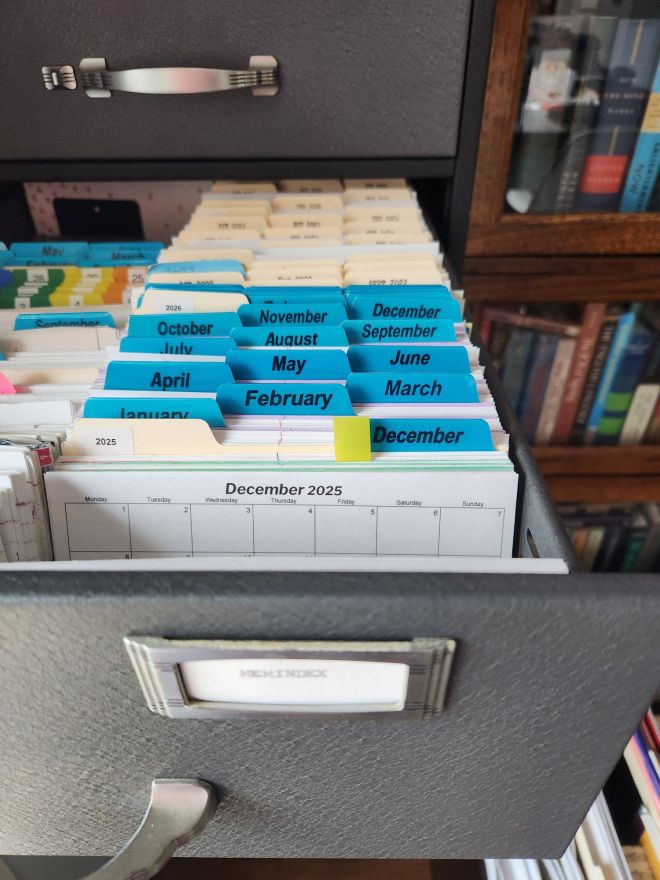
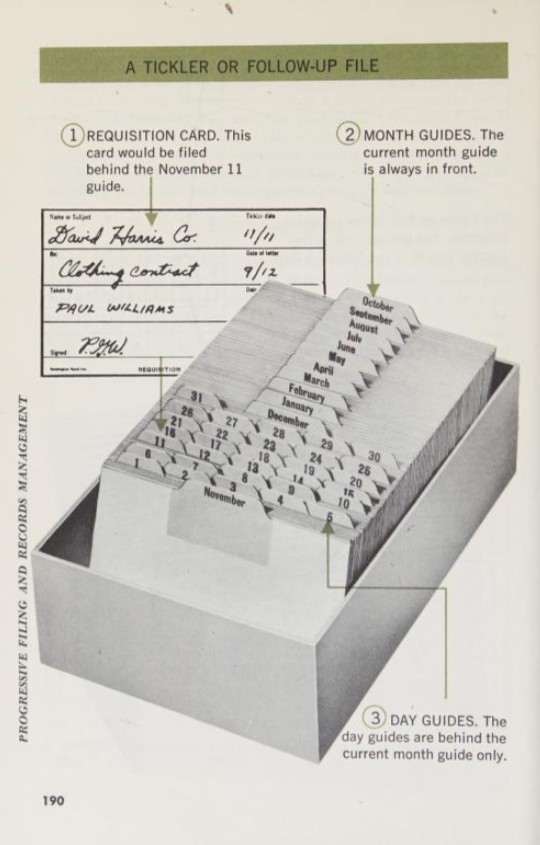
Watching people online chat, ask questions, and generally get excited about their planners for 2026, I thought I would spend a few minutes to set up my Memindex-inspired planner version using 4 x 6″ index cards and tabbed dividers. It’s amazing how useful a $2.50 block of 500 index cards can be for planning out your coming year.

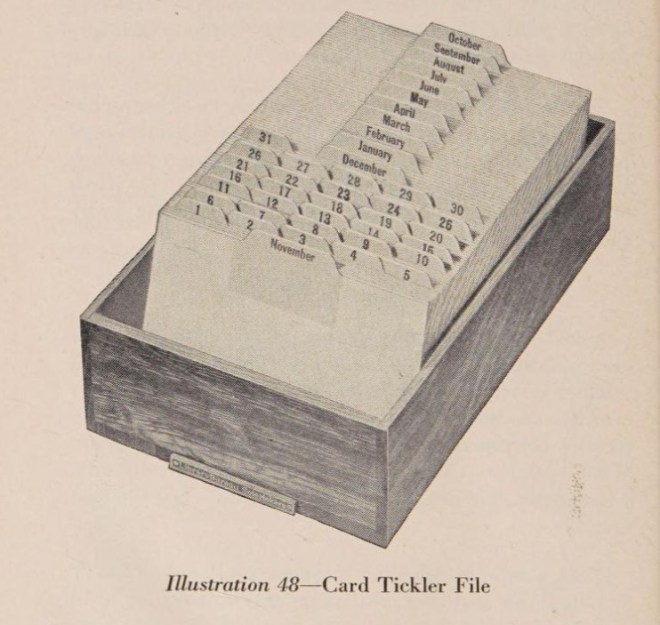
Interestingly, I’ve recently come across versions of this same sort of tickler file recommended in mid-20th century textbooks for filing and indexing in business contexts:

Cadwallader, Laura Hanes, and Sarah Ada Rice. 1932. Principles of Indexing and Filing. Baltimore; Chicago: H.M. Rowe Company. page 134: https://archive.org/details/principlesofinde0000laur/page/134/mode/2up


Kahn, Gilbert, Theo Yerian, and Jeffrey R. Stewart, Jr. 1962. Progressive Filing and Records Management. 1st ed. New York: Gregg Publishing Division, McGraw-Hill Book Co., Inc. page 190: https://archive.org/details/progressivefilin0000gilb/page/190/mode/2up 

The careful observer will notice that both of the photos in texts by different authors nearly 30 years apart are the same! I would suspect that they’re from a manufacturer’s catalog (Remington Rand) earlier in the century. It’s even more interesting that one can still quickly create such a set up with commercially available analog office supplies now.

A Steelcase file index drawer open showing a four inch chunk of cards separated by tabbed cards featuring the names of the 12 months of the year and one divider in the back labeled 2026. On the front card is a calendar for the month of December 2025. In the blurry foreground is a label for the drawer of cards that reads "Memindex".Portion of a book page featuring an image of a card catalog tray full of index cards. In the front is a tab for November followed by 1/5 cut tabs numbered 1-31 followed by tabs for the months December - October.Portion of a book page featuring an image of a card catalog tray full of index cards. In the front is a tab for November followed by 1/5 cut tabs numbered 1-31 followed by tabs for the months December - October. At the top is the heading "A Tickler for Follow-up File" with numbered details pointing at portions of the card index.
2025-11-06

I quite like Oliver Burkeman’s “3-3-3 method” - for planning your day, you can realistically only do three hours of focussed work before you’re worn out, then choose three maintenance tasks to keep things ticking along, and three todo items so the wheels don’t fall off the bus.

Except that on days like this, it may turn out to be “2.5-1-can-I-go-back-to-bed-please?”

#productivity #GettingThingsDone

Adrian SegarASegar
2025-10-31

How can you continuously improve your work life? Designing and conducting a regular work life review can work wonders.

conferencesthatwork.com/index.

continuously improve work life: photograph of happy workers in an office. Photo attribution: Flickr user jamescridland
2025-10-28

Again, I’m having a strong feeling of “How on earth is it possible to do all the things that need doing, in each day?!”

Why do I never seem to make progress*; why does The Immense List Of Things never seem to go down?

Is “Getting Things Done” only a tantalising dream?

* I do, yesterday I finished a small part of the Link code on my Transputer emulator, and continued sorting out my new laptop, so “never” is a bit of all-or-nothing thinking.

#Productivity #GettingThingsDone #CBT

Jan David :ferris:jdno@hachyderm.io
2025-10-26

Has anyone here good resources to dive deeper into #GettingThingsDone and #OmniFocus? I want to revamp my task management and feel like my current implementation can be improved A LOT...

Adrian SegarASegar
2025-10-23
working productively: a photograph of the view out of my office window in early winter
2025-09-18

My "daily GTD review" didn't hold up quite as well as I expected. There were a few problems with it:

  1. "must dos" were useful as often as they weren't. I ended up moving the truly mandatory stuff to the calendar instead, and when I need to concentrate on a handful of projects or actions I just create a new project and put everything there

  2. the more projects I had, the longer the daily review took me while providing less value. I find that if I have many projects, it's a bit less important to have each one in tip-top shape all the time. Nowadays I just do a weekly review and then chug along, feeling assured that I have enough tasks to last me a week

  3. such a detailed daily review made it easier to skip weekly reviews, since the lower horizons were taken care of and I didn't feel all that stressed about them. This kept me from working on higher horizons, impacting my overall happiness and motivation

I think daily reviews served their purpose as a crisis management tool, but I should have reduced them as early as possible.

Today, my daily review consists of processing the few choice inboxes and glancing through the calendar, waiting-for, and projects list. All the other stuff moved back to the weekly review, which expanded to also include periodic work on higher horizons.

We'll see what I think of this in one more year :)

#GettingThingsDone #GTD

Adrian SegarASegar
2025-09-14

How can you continuously improve your work life? Designing and conducting a regular work life review can work wonders.

conferencesthatwork.com/index.

continuously improve work life: photograph of happy workers in an office. Photo attribution: Flickr user jamescridland
Adrian SegarASegar
2025-09-10

Why I've found David Allen's "Getting Things Done" to be the most powerful tool for improving your personal work environment

conferencesthatwork.com/index.

improving your personal work environment: a photograph of an incredibly messy desk. Image attribution: Flickr user harryharris

Client Info

Server: https://mastodon.social
Version: 2025.07
Repository: https://github.com/cyevgeniy/lmst