#Universals

John Wycliffe

His last name is also spelled: Wyclif, Wickliffe, & Wicklyf.

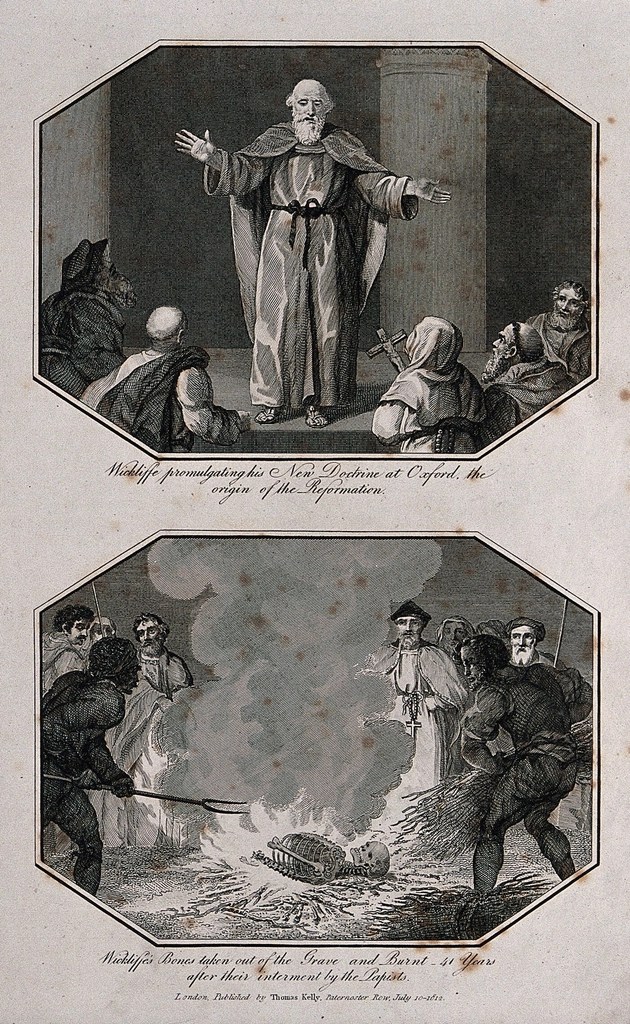
He’s an English scholastic philosopher, Christian reformer, Catholic priest, & a theology professor at the University of Oxford. He’s often called the “Morning Star of the Reformation.”

He made radical challenges to the Roman Catholic Church like advocating for or made a vernacular translation of the Vulgate Bible into Middle English. He paved the way for the Protestant Reformation nearly 200 years before Martin Luther.

Before he was a reformer, Wycliffe was a titan of Scholasticism at Oxford. At the time, the intellectual world was divided between Realist & Norminalists. The Norminalists, like William of Ockham, argued that “universals” (like the concept of “justice” or “humanity”) were just names (nomina) we give to groups of individual things.

John was a fierce Realist. He believed that universals were real entities that existed in the mind of God. For Wycliffe, everything in the physical world was a direct reflection of a divine archetype.

Wycliffe’s most radical political theory was the Dominion of Grace. He argued that all authority (dominium) is a gift from God. Which meant that the church wasn’t allowed to own property or have ecclesiastic courts, & men in mortal sin weren’t entitled to exercise authority in the church or state, nor to own property. He added a dangerous caveat: only those in a state of grace have a right to exercise authority.

Wycliffe’s later followers (derogatorily called Lollards by their orthodox contemporaries in the 15th & 16th centuries. Lollards meaning “mumblers” or “idlers.”) adopted a number of the beliefs attributed to Wycliff such as theological virtues, predestination, iconoclasm, & the notion of caesaropapism, with some questioning the veneration of saints, the sacraments, requiem masses, transubstantiation, monasticism, & the legitimacy/role of the Papacy.

Wycliffe was born in the village of Hipswell, near Richmond in the North Riding of Yorkshire, England. In 1356, Wycliffe completed his bachelor of arts degree at Merton College as a junior fellow. That same year, he produced a small treatise, The Last Age of the Church.

In 1361, he was Master of Balliol College in Oxford. That year, he was presented by the college to the parish of Fillingham in Lincolnshire. For this, he had to give up the headship of Balliol College, though he could continue to live at Oxford.

Wycliffe’s greatest legacy is his role in the 1st complete translation of the Bible into Middle English (circa 1382). At the time, the Bible was only available in the Latin Vulgate. This was accessible solely to the educated clergy.

Wycliffe believed that the Bible was the ultimate authority. Then every person (from the King to the “plowman”), needed to be able to read it.

Wycliffe didn’t just translate words. He helped create the English language. He’s credited with introducing, or popularizing, over 1,000 words into English, including: female, justice, communication, treasure, & glory.

His “potent” ideas were blamed for the Peasants’ Revolt of 1381. Wycliffe didn’t endorse the violence, however the rebels used his discourse of “equality before God” & Wycliffe’s critiques of Church wealth to justify their demands.

In the U.S. culture, Wycliffe’s legacy is preserved in 2 distinct ways:

  • The Democratic Spirit of the Bible: The American religious tradition of individual Bible interpretation & the rejection of centralized ecclesiastical authority can be traced directly back to Wycliffe’s “priesthood of all believers.”
  • Wycliffe Bible Translators: Founded in 1942 in California by William Cameron Townsend. This organization (now 1 of the largest of its kind in the world) was named in honor of John Wycliffe. It carries on his mission by translating the Bible into thousands of indigenous languages worldwide.

Wycliffe passed away from a stroke, during a Mass, in 1834. In 1415, the Council of Constance declared him a heretic. In 1428, by order of Pope Martin V, his remains were exhumed from his grave in Lutterworth, burned to ashes, & cast into the River Swift.

Make a one-time donation

Your contribution is appreciated.

Donate

Make a monthly donation

Your contribution is appreciated.

Donate monthly

Make a yearly donation

Your contribution is appreciated.

Donate yearly

#1356 #1361 #1382 #1415 #1428 #15thCentury #16thCentury #1834 #1842 #BalliolCollege #bible #Caesaropapism #California #Catholic #DominionOfGrace #Dominium #England #Fillingham #Hipswell #Iconoclasm #IndigenousLanguages #JohnWycliffe #LatinVulgate #Lincolnshire #Lollards #MartinLuther #Mass #MertonCollege #MiddleEnglish #Monasticism #MorningStarOfTheReformation #Nomina #Norminalists #NorthRiding #Oxford #Papacy #PeasantsRevoltOf1381 #Pope #PopeMartinV #Predestination #ProtestantReformation #Realists #RequiemMasses #Richmond #RiverSwift #RomanCatholicChurch #Sacraments #Scholasticism #TheLastAgeOfTheChurch #Translate #Transubstantiation #Universals #UniversityOfOxford #VulgateBible #WilliamCameronTownsend #WilliamOfOckham #WycliffeBibleTranslators #WycliffeSBible #Yorkshire

2024-05-27

Precursors Of Category Theory • 3
inquiryintoinquiry.com/2024/05

❝Act only according to that maxim by which you can at the same time will that it should become a universal law.❞

— Immanuel Kant (1785)

C.S. Peirce • “On a New List of Categories” (1867)

❝§1. This paper is based upon the theory already established, that the function of conceptions is to reduce the manifold of sensuous impressions to unity, and that the validity of a conception consists in the impossibility of reducing the content of consciousness to unity without the introduction of it.❞ (CP 1.545).

❝§2. This theory gives rise to a conception of gradation among those conceptions which are universal. For one such conception may unite the manifold of sense and yet another may be required to unite the conception and the manifold to which it is applied; and so on.❞ (CP 1.546).

Cued by Kant's idea regarding the function of concepts in general, Peirce locates his categories on the highest levels of abstraction able to provide a meaningful measure of traction in practice. Whether successive grades of conceptions converge to an absolute unity or not is a question to be pursued as inquiry progresses and need not be answered in order to begin.

Resources —

Precursors Of Category Theory
oeis.org/wiki/Precursors_Of_Ca

Propositions As Types Analogy
oeis.org/wiki/Propositions_As_

Survey of Precursors Of Category Theory
inquiryintoinquiry.com/2024/05

#Aristotle #Peirce #Kant #Carnap #Hilbert #Ackermann #SaundersMacLane
#Abstraction #Analogy #CategoryTheory #Diagrams #FoundationsOfMathematics
#FunctionalLogic #RelationTheory #ContinuousPredicate #HypostaticAbstraction
#CategoryTheory #PeircesCategories #PropositionsAsTypes #TypeTheory #Universals

2024-05-26

Precursors Of Category Theory • 2.3
inquiryintoinquiry.com/2024/05

In the logic of Aristotle categories are adjuncts to reasoning whose function is to resolve ambiguities and thus to prepare equivocal signs, otherwise recalcitrant to being ruled by logic, for the application of logical laws. The example of ζωον illustrates the fact that we don't need categories to “make” generalizations so much as to “control” generalizations, to reign in abstractions and analogies which have been stretched too far.

References —

• Aristotle, “The Categories”, Harold P. Cooke (trans.), pp. 1–109 in Aristotle, Volume 1, Loeb Classical Library, William Heinemann, London, UK, 1938.

• Karpeles, Eric (2008), Paintings in Proust, Thames and Hudson, London, UK.

Resources —

Precursors Of Category Theory
oeis.org/wiki/Precursors_Of_Ca

Propositions As Types Analogy
oeis.org/wiki/Propositions_As_

Survey of Precursors Of Category Theory
inquiryintoinquiry.com/2024/05

#Aristotle #Peirce #Kant #Carnap #Hilbert #Ackermann #SaundersMacLane
#Abstraction #Analogy #CategoryTheory #Diagrams #FoundationsOfMathematics
#FunctionalLogic #RelationTheory #ContinuousPredicate #HypostaticAbstraction
#CategoryTheory #PeircesCategories #PropositionsAsTypes #TypeTheory #Universals

2024-05-26

Precursors Of Category Theory • 2.2
inquiryintoinquiry.com/2024/05

Aristotle —

❝Things are equivocally named, when they have the name only in common, the definition (or statement of essence) corresponding with the name being different. For instance, while a man and a portrait can properly both be called animals (ζωον), these are equivocally named. For they have the name only in common, the definitions (or statements of essence) corresponding with the name being different. For if you are asked to define what the being an animal means in the case of the man and the portrait, you give in either case a definition appropriate to that case alone.

❝Things are univocally named, when not only they bear the same name but the name means the same in each case — has the same definition corresponding. Thus a man and an ox are called animals. The name is the same in both cases; so also the statement of essence. For if you are asked what is meant by their both of them being called animals, you give that particular name in both cases the same definition.❞ (Aristotle, Categories, 1.1a1–12).

Translator's Note. ❝Ζωον in Greek had two meanings, that is to say, living creature, and, secondly, a figure or image in painting, embroidery, sculpture. We have no ambiguous noun. However, we use the word ‘living’ of portraits to mean ‘true to life’.❞

#Aristotle #Peirce #Kant #Carnap #Hilbert #Ackermann #SaundersMacLane
#Abstraction #Analogy #CategoryTheory #Diagrams #FoundationsOfMathematics
#FunctionalLogic #RelationTheory #ContinuousPredicate #HypostaticAbstraction
#CategoryTheory #PeircesCategories #PropositionsAsTypes #TypeTheory #Universals

2024-05-26

Precursors Of Category Theory • 2.1
inquiryintoinquiry.com/2024/05

❝Thanks to art, instead of seeing one world only, our own, we see that world multiply itself and we have at our disposal as many worlds as there are original artists …❞

— Marcel Proust

When it comes to looking for the continuities of the category concept across different systems and systematizers, we don't expect to find their kinship in the names or numbers of categories, since those are legion and their divisions deployed on widely different planes of abstraction, but in their common function.

#Aristotle #Peirce #Kant #Carnap #Hilbert #Ackermann #SaundersMacLane
#Abstraction #Analogy #CategoryTheory #Diagrams #FoundationsOfMathematics
#FunctionalLogic #RelationTheory #ContinuousPredicate #HypostaticAbstraction
#CategoryTheory #PeircesCategories #PropositionsAsTypes #TypeTheory #Universals

2024-05-25

Precursors Of Category Theory • 1
inquiryintoinquiry.com/2024/05

A few years ago I began a sketch on the “Precursors of Category Theory”, tracing the continuities of the category concept from Aristotle, to Kant and Peirce, through Hilbert and Ackermann, to contemporary mathematical practice. My notes on the project are still very rough and incomplete but I find myself returning to them from time to time.

Preamble —

❝Now the discovery of ideas as general as these is chiefly the willingness to make a brash or speculative abstraction, in this case supported by the pleasure of purloining words from the philosophers: “Category” from Aristotle and Kant, “Functor” from Carnap (“Logische Syntax der Sprache”), and “natural transformation” from then current informal parlance.❞

— Saunders Mac Lane • “Categories for the Working Mathematician”

Resources —

Precursors Of Category Theory
oeis.org/wiki/Precursors_Of_Ca

Propositions As Types Analogy
oeis.org/wiki/Propositions_As_

Survey of Precursors Of Category Theory
inquiryintoinquiry.com/2025/05

#Aristotle #Peirce #Kant #Carnap #Hilbert #Ackermann #SaundersMacLane
#Abstraction #Analogy #CategoryTheory #Diagrams #FoundationsOfMathematics
#FunctionalLogic #RelationTheory #ContinuousPredicate #HypostaticAbstraction
#CategoryTheory #PeircesCategories #PropositionsAsTypes #TypeTheory #Universals

2024-05-24

Survey of Precursors Of Category Theory • 5
inquiryintoinquiry.com/2024/05

A few years ago I began a sketch on the “Precursors of Category Theory”, tracing the continuities of the category concept from Aristotle, to Kant and Peirce, through Hilbert and Ackermann, to contemporary mathematical practice. A Survey of resources on the topic is given below, still very rough and incomplete, but perhaps a few will find it of use.

Background —

Precursors Of Category Theory
oeis.org/wiki/Precursors_Of_Ca

Propositions As Types Analogy
oeis.org/wiki/Propositions_As_

Blog Series —

Notes On Categories
inquiryintoinquiry.com/2013/02

Precursors Of Category Theory
1. inquiryintoinquiry.com/2013/12
2. inquiryintoinquiry.com/2013/12
3. inquiryintoinquiry.com/2014/01

Precursors Of Category Theory • Discussion
1. inquiryintoinquiry.com/2020/09
2. inquiryintoinquiry.com/2020/09
3. inquiryintoinquiry.com/2020/09

Categories à la Peirce —

C.S. Peirce • A Guess at the Riddle
inquiryintoinquiry.com/2012/03

Peirce's Categories
1. inquiryintoinquiry.com/2015/10
2. inquiryintoinquiry.com/2015/10
3. inquiryintoinquiry.com/2015/11
•••
19. inquiryintoinquiry.com/2020/05
20. inquiryintoinquiry.com/2020/05
21. inquiryintoinquiry.com/2020/06

C.S. Peirce and Category Theory
1. inquiryintoinquiry.com/2021/06
2. inquiryintoinquiry.com/2021/06
3. inquiryintoinquiry.com/2021/06
4. inquiryintoinquiry.com/2021/06
5. inquiryintoinquiry.com/2021/06
6. inquiryintoinquiry.com/2021/06
7. inquiryintoinquiry.com/2021/07
8. inquiryintoinquiry.com/2021/07

#Aristotle #Peirce #Kant #Carnap #Hilbert #Ackermann #SaundersMacLane
#Abstraction #Analogy #CategoryTheory #Diagrams #FoundationsOfMathematics
#FunctionalLogic #RelationTheory #ContinuousPredicate #HypostaticAbstraction
#CategoryTheory #PeircesCategories #PropositionsAsTypes #TypeTheory #Universals

2024-03-06

Usually ascribed to John Scotus Eriugena is the view that forms of species and genera exist in reality separately from particulars while each particular participates in that one and the same form... Read more at philosophy indefinitely...
#philosophy #universals #epistemology #historyofphilosophy #Boethius #particulars #conceptualism #platonism #theoryofforms #medievalphilosophy philosophyindefinitely.wordpre

2023-08-01

Survey of Precursors Of Category Theory • 4
inquiryintoinquiry.com/2023/08

A few years ago I began a sketch on the “Precursors of Category Theory”, tracing the continuities of the category concept from Aristotle, to Kant and Peirce, through Hilbert and Ackermann, to contemporary mathematical practice. A Survey of resources on the topic is given below, still very rough and incomplete, but perhaps a few will find it of use.

Background —

Precursors Of Category Theory
oeis.org/wiki/Precursors_Of_Ca

Propositions As Types Analogy
oeis.org/wiki/Propositions_As_

Blog Series —

Notes On Categories
inquiryintoinquiry.com/2013/02

Precursors Of Category Theory
1. inquiryintoinquiry.com/2013/12
2. inquiryintoinquiry.com/2013/12
3. inquiryintoinquiry.com/2014/01

Precursors Of Category Theory • Discussion
1. inquiryintoinquiry.com/2020/09
2. inquiryintoinquiry.com/2020/09
3. inquiryintoinquiry.com/2020/09

Categories à la Peirce —

C.S. Peirce • A Guess at the Riddle
inquiryintoinquiry.com/2012/03

Peirce's Categories
1. inquiryintoinquiry.com/2015/10
2. inquiryintoinquiry.com/2015/10
3. inquiryintoinquiry.com/2015/11
•••
19. inquiryintoinquiry.com/2020/05
20. inquiryintoinquiry.com/2020/05
21. inquiryintoinquiry.com/2020/06

#Aristotle #Peirce #Kant #Carnap #Hilbert #Ackermann #SaundersMacLane
#Abstraction #Analogy #CategoryTheory #Diagrams #FoundationsOfMathematics
#FunctionalLogic #RelationTheory #ContinuousPredicate #HypostaticAbstraction
#CategoryTheory #PeircesCategories #PropositionsAsTypes #TypeTheory #Universals

2023-07-07

The Medieval Problem of #Universals (Stanford Encyclopedia of #Philosophy)
> [all related to the] issue of how universal #cognition of singular things is possible.
plato.stanford.edu/entries/uni

Friedrich Wilhelm GrafeWilhelm_Grafe@fediphilosophy.org
2023-01-01

@philosophy
@philosophie

@bryankam

there's an important paper wrt #knowledge by #universals in #Spinoza by #YitzakMelamed (jhu)
"Spinoza’s Critique of Gersonides’ view on Divine Omniscience
(07.10.16)"
[ but unfortunately can't say whether and where published ]
where in "Part III: Spinoza Turns the Table" Melamed points to respective passages in "Cogitata Metaphysica", and in 'Short Treatise'

2019-10-19

Client Info

Server: https://mastodon.social
Version: 2025.07
Repository: https://github.com/cyevgeniy/lmst