#SBand

2025-10-17

I think that we've seen a good deal of news lately about satellite traffic and how there is a good deal of it that is unencrypted

pcmag.com/news/leak-from-the-s

And then there was news of Scott Tilley in British Columbia, Canada who discovered that there were some satellites in a classified network that were sending data in the wrong direction

npr.org/2025/10/17/nx-s1-55752

He has some incredible documentation on what he captured, and how he captured it using fairly common equipment that most geeky-type-folks would have lying around our labs.

zenodo.org/records/17373141

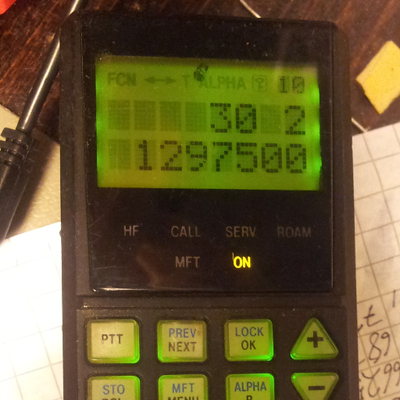
I was able to replicate his setup and started capturing data just to see what I could find. I have to say that I was taken aback from the sort of thing that I was able to grab - again - completely unencrypted.

#sattelites #DataEncryption #Signal #SBand #SBandEmissions #YouKnowTheRules
2024-11-03

Voyager 1 Fault forces Switch to S-Band.

Voyager 1 stopped communicating altogether, suggesting that further fault protection trips disabled the powerful X-band transmitter and switched to the lower-powered S-band downlink. The current problem began when controllers sent a command to turn on one of the spacecraft’s heaters.

blogs.nasa.gov/voyager/2024/10

#voyager1 #fault #sband #space #engineer #tech #media #science #news

This was potentially mission-ending; the S-band downlink had last been used in 1981 when the probe was still well within the confines of the solar system, and the fear was that the Deep Space Network would not be able to find the weak signal. But find it they did and on October 22 they sent a command to confirm S-band communications. At this point, controllers can still receive engineering data and command the craft, but it remains to be seen what can be done to restore full communications. They haven’t tried to turn the X-band transmitter back on yet, wisely preferring to further evaluate what caused the fault protection error that kicked this whole thing off before committing to a step like that.

<Following Voyager news these days feels a little morbid, like a death watch on an aging celebrity.>
2024-09-09

Stupidity inbound.
The sheer audacity of building and selling a radar based on a regenerative receiver-transmitter while also selling it as a 2.4GHz one while actually operating on 3GHz turned out to be irresistible in the long term.
So now there's ten of 'em.

#microwaves #RADAR #sband #regen #superregen

"Omnispace says .. seeing interference from direct-to-device payloads on recently launched .. Starlink satellites, offering an early test of new Federal Communications Commission regulations ..."

".. company now had “empirical evidence” of increased noise in S-band from Starlink .. that have payloads operating on similar frequencies."

spacenews.com/omnispace-report

17.5.2024

#FCC #Interferenzen #ITU #MSS #Omnispace #Raumfahrt #Satelliten #Sband #SCS #SpaceFlight #SpaceX #Starlink #TMobile

"
DeSK: Weltweit erste öffentliche Spektraldatenbank

Die SALSAT-Mission der TU Berlin bereits seit 3,5 Jahren in Betrieb. Eine Pressemitteilung des Deutschen Zentrums für Satelliten-Kommunikation e.V. (DeSK).
"
raumfahrer.net/desk-weltweit-e

21.4.2024

#DeSK #RACCOON #Raumfahrt #SBand #SALSA #SALSAT #Satelliten #Spektrumanalysator #TUBerlin #UHF #VHF

2022-01-21

Apollo Comms Flight Hardware Deep Dive

You no doubt recall the incredible Apollo Guidance Computer (AGC) reverse engineering and restoration project featured on the CuriousMarc YouTube channel a few years ago. Well, [Marc] and the team are at it again, this time restoring the Apollo Unified S-Band tracking and communication system flight hardware. As always, the project is well documented, carefully explained, full of problems, and is proceeding slowly despite the lack of documentation.

Like the guidance computer, the Unified S-Band system was pretty innovative for its day -- able to track, provide voice communications, receive television signals, and send commands to and monitor the health of the spacecraft via telemetry. The system operates on three frequencies, an uplink containing ranging code, voice and data. There are two downlinks, one providing ranging, voice, and telemetry, the other used for television and the playback of recorded data. All crammed into two hefty boxes totaling 29 kg.

So far, [Marc] has released part 9 of the series (for reference, the Apollo Guidance Computer took 27 parts plus 8 auxiliary videos). There seems to be even less documentation for this equipment than the AGC, although miraculously the guys keep uncovering more and more as things progress. Also random pieces of essential ground test hardware keep coming out of the woodwork. It's a fascinating dive into not only the system itself, but the design and construction techniques of the era. Be sure to check out the series (part 1 is below the break) and follow along as they bring this system back to life. [Marc] is posting various documents related to the project on his website. And if you missed the AGC project, here's the playlist of videos, and the team joined us for a Hackaday Chat back in 2020.

#radiohacks #space #apollo #apolloguidancecomputer #nasa #restoration #sband #spacecraft #telemetry

image

Client Info

Server: https://mastodon.social
Version: 2025.07
Repository: https://github.com/cyevgeniy/lmst