#Mites

neville parknev@flipping.rocks
2026-02-17

Still the depths of winter here. I have been having dreams about bugs. I recently had a dream about finding plump whirligig mites everywhere: some their usual orange-red, others greenish because they had just eaten something green…I miss the mites.

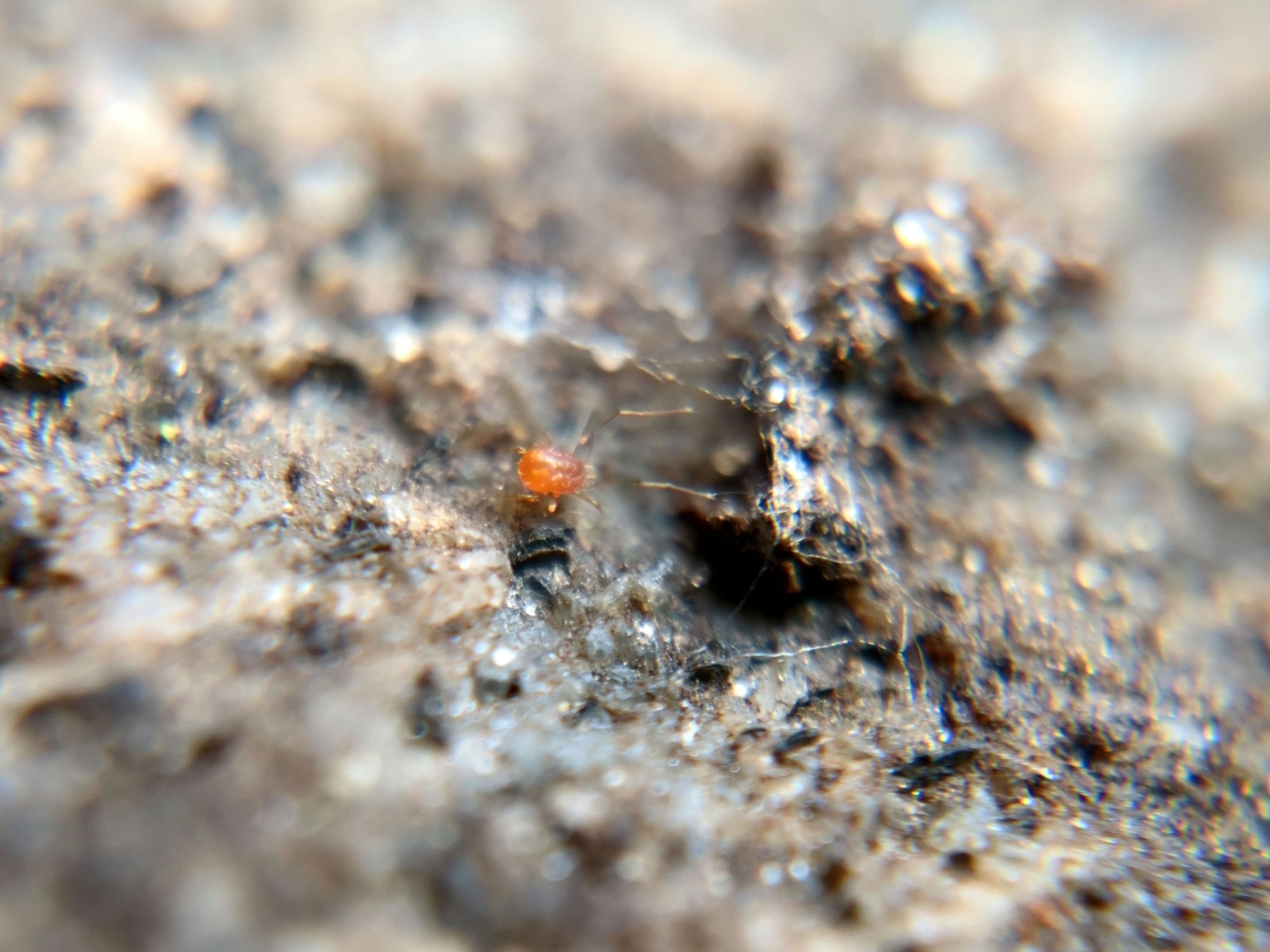
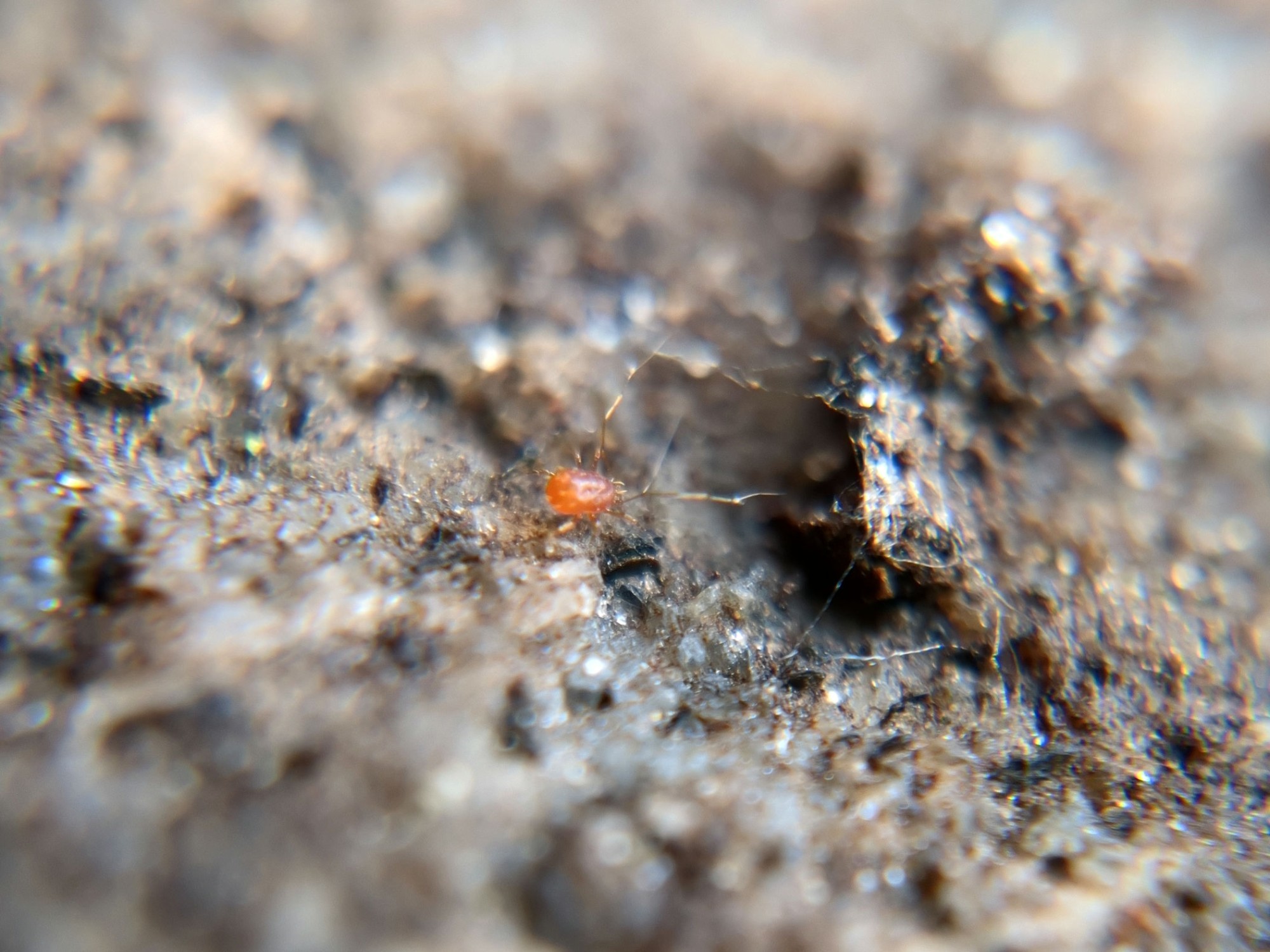
Here are some whirligig mites I found a couple of years ago on a rock down by the lake, fighting over a dead midge. #iNaturalist observation: inaturalist.org/observations/2 :inaturalist:

#MiteMonday #Mitestodon #arachnids #mites #Acariformes #Anystidae

Three whirligig mites, somewhat squarish mites with spiky legs and wide-set little eyes, around a dead midge. Each of them has seized a different part of the midge in their mouthparts: head, legs, thorax. One is yellow-orange, one is orange, and the third is orange-red.A sudden blur of motion as each one tries to chase the others off.The yellow-orange and orange mites are on either side of the midge's thorax, and the red-orange one has a leg.However, at the end the red-orange one has ended up with the mite and is feeding on the abdomen.
2026-02-04

A striking #character of adult #mites in #Histiostomatidae (#Astigmata) is a highly #sclerotized area on the upper surface of #proterosoma. Its #latticelike #structure forms a #taxonomically relevant #symmetrical #pattern of windows, for which I introduced a #nomenclature in my PhD thesis. This area is a site of #muscleorigins (see #SEM section through a bigger specimen of #Acaridae).
©#StefanFWirth 2026

Please support my work with a coffee
ko-fi.com/sfwirth

#pics
©S.F. Wirth edit 2026

1-3 SEM cross section through the proterosoma of a larger specimen of Acarus sp. (Acaridae, Astigmata) to show the pattern of muscles for the gnathosoma mobility, the mobility of mouthparts and of the first legs. Acaridae do not have the conspicuous windows-pattern-sclerite in this area, thus this is just a comparative visualisation. I interpret the dorsal sclerite with windows pattern as an evolutionary adaptation to the very small size of Histiostomatidae. 
4 section through Histiostoma sp. In the area of legs 1 to show the general relevance of dorso -ventro musculature. 
© Stefan F. Wirth, this edit 2026Scientific drawing of the proterosoma shield of Histiostoma palustre Wirth, 2003.
It is based on a SEM with top-down perspective to the shield, introducing a taxonomically useful nomenclature for the symmetrical pattern of "windows",
© Stefan F. Wirth, this edit 2026Adult female Mite Histiostoma sp. (Histiostoma feroniarum complex) from rotting lemons in Italy feeding on a mixture of dying fungus and bacteria, with its conspicuous proterosoma sclerite with lattice-like pattern of windows in side-view, © Stefan F. Wirth, 2006, thus edit 2026, Berlin
2026-01-30

@kim_harding #mites similar to scabies but not requiring intimate contact are a perennial problem here! As the article says, soap and water, forget them. Not human transmitted here - there aren't any! But wild animals, particularly wild pigs and badgers who used to have diggings in the area. Microscopic wind-blown eggs too.

Being allergic also sends early warnings.

Experimenting with using solid oxygen-based bleach in cool laundry now, as hot washes and chlorine-based bleach are so environmentally heavy.

Easily grown Pennyroyal tincture works but highly NOT recommended unless you know what you're doing - lethal by paralysis to humans too! 50% DEET is lethal to them as well as repellent. Veterinary and agricultural #Permethrin is very cheap and available in bulk BUT being very insoluable in water, the cheap sources I've found are dissolved in toxic organic solvents, often including toluene. The low-concentration human pharmaceutical ointments are the scarce rip-off.

2026-01-08

#Freelancers like me depend on support to survive and be productive, I much appreciate support for a coffee: ko-fi.com/sfwirth
I am performing #science, #sciencecommunication and #arts, often combining arts/science. My #topicrange is wide, it reaches from titan #isopods over the behaviors of the Mediterranean #Junebeetle and even over an #animated #video about the #Cambrianexplosion towards #phoretic #mites of the #Histiostomatidae. Here H. sp. from rotting #lemonfruits. Please support my work.

Frontal view to a titan isopode of my culture, © Stefan F. Wirth, December 2025Handstand acrobatics as part of a thanatosis behavior of the Mediterranean June beetle, now also part of the urban fauna in Berlin, © Stefan F. Wirth, Berlin 2025An artistic overview to indicate the complexity of evolutionary steps in the animal kingdom during the Cambrian Explosion from multicellular organisms over bilateral symmetry even to primeval protostomians and deuterostomians. We belong to the latter taxon. © Stefan F. Wirth, Berlin December 2025.About the feeding behavior and the complex filter feeding mouthparts of phoretic mites of the Histiostomatidae (Astigmata, Acariformes, Arachnida), here a SEM photo of a female mite Histiostoma sp. from rotting lemon fruits in Italy being fixed in feeding action. © Stefan F. Wirth, 2006/2026, Berlin.
2026-01-02

#Mouthparts in #mites of the #Acariformes are usually normal shaped as typical for #arachnids. The #chelicerae are the feeding organs consisting of digitus fixus and d. mobilis. #Pedipalps have sensing functions with different kinds of #sensoryorgans. In #Histiostomatidae (#Astigmata) the whole #gnathosoma is modified into a complex #filterfeeding organ that creates an #underpressure on #food surfaces.
© #StefanFWirth Berlin 2026

Reference
S. F. Wirth (2023)
fao.org/fileadmin/user_upload/

Female mite of Histiostoma sp. (H. feroniarum-complex) feeding on a food heap consisting of a mixture of fungus material and bacteria Membraneous components of the laterally bulged distal pedipalp articles get in contact with the food surface and there create an underpressure that facilitates the food intake (fungus, bacterial components). © Stefan F. Wirth 2006/2026, Berlin
2025-12-24

#Mites of the #Histiostomatidae live in #darkness in their #ephemeral #microhabitats. The distinctive deutonymphs are the #dispersal stage, being transported by insects. #Adults, however, live freely and #communicate via complex #olfactorysignals. An important #glandularcomplex is located on the dorsal body side. I participated in a study about the #geranial-rich glandular #secretions (2012).

© #StefanFWirth 24 Dec. 2025

Ref

doi.org/10.1080/01647954.2012.

#SEM #pics

©S.F. Wirth, Histiostoma sp.

Adults and free living juveniles of mite Histiostoma sp. (Histiostoma feroniarum-complex) reared in 2006 from rotting lemons-samples collected in Sorrento (Italy). These specimens of the SEM were fixed in their natural action in their original substrate. Smaller magnification, © Stefan F. Wirth, new edit 24 December 2025, BerlinDetail of adult female of mite Histiostoma sp. (Histiostoma feroniarum-complex) reared in 2006 from rotting lemons-samples collected in Sorrento (Italy): the excretion opening of the lateral oil glands is visible between two setae on the upper side of the hind body (hysterosoma). The specimen of the SEM was fixed in its natural action in its original substrate. Large magnification © Stefan F. Wirth, new edit 24 December 2025, Berlin
neville parknev@flipping.rocks
2025-12-23

Been a long time since I posted anything for #MiteMonday, but I was going through my camera and found this one I don't think I've shared before! Just a good old _Allothrombium_ red velvet mite.

#Mitestodon #arachnids #mites #Acari #Acariformes #Prostigmata #Trombidiidae

A soft, wrinkled bright red mite with a somewhat peanut-shaped body and robust legs, creeping down a shallow valley of lichen-spattered tree bark.
ghost with camera 👻📸nisemikol@vernissage.photos
2025-12-16
Green leaves with small, clustered pink growths on the surface, possibly galls, surrounded by blurred green foliage in the background.Green leaves with small pinkish-red growths resembling buds or galls scattered across the surface. Background consists of blurred foliage and branches, creating a lush, natural setting.Branch with green leaves displaying small, pinkish galls scattered along the surfaces. The background is a blurred mix of additional foliage and vibrant green tones, with hints of orange blossoms. The focus highlights the texture and natural formation of the galls on the leaves.A branch with glossy green leaves, each adorned with small, pinkish-red growths. The background is dense with leafy green foliage, suggesting a forest or woodland setting. The branch occupies a diagonal position from bottom left to top right, creating a contrast with the dark, blurred backdrop.
ghost with camera 👻📸nisemikol@vernissage.photos
2025-12-12

Gall Mite Set I

My research points me to the *Eriophyes* (w.wiki/GcAD) genus, but I don't have a good guess for the species 🤷‍♂️

#PNW #USA #WA #MasonCounty #ONF #Summer #Nature #Fauna #Animals #Mites #Galls #Plants #Parasites #Forest #Hiking #Outdoors #Photography #MobilePhotography #Wikipedia

Green leaves with clusters of small, pink, fuzzy galls growing on their surfaces, indicating a potential plant reaction to insects. The background is a blurred natural green, emphasizing the leaf and galls in the foreground.Close-up of green plant leaves with clusters of small pink bumps along the edge of a leaf, with a soft-focus leafy background.Close-up of a green leaf on a thin branch with multiple small pink, stalk-like growths on its surface, set against a blurred green forest background.Close-up of a leafy branch with a green leaf in sharp focus, covered in clusters of small pink bumps along the edge; blurred green foliage in the background.
2025-12-11

El pols radial NO representa una sistòlica d’almenys 80 mmHg

https://media.blubrry.com/empod_cat/op3.dev/e/audios.empod.cat/MeM_PolsRadialNo80.mp3

Podcast: Play in new window | Download

Els primers manuals del Suport Vital Avançat en Trauma (ATLS per les sigles en anglès) parlaven d’una relació entre la presència de pols palpable en determinades ubicacions amb uns valors de pressió arterial sistòlica.

LlocPressió Arterial Sistòlica Estimada (mmHg)Radial>80Femoral70-80Caròtide60-70

Doncs per aquest Menys és Més us diem que això és un mite. En el llibre Myths in emergency medicine ens diuen que aquesta correlació, d’origen incert, ha estat refutada en diverses ocasions. Ja en un article del 1988 de Poulton, en vint pacients traumàtics amb pressions arterials no invasives per sota de noranta, aquesta relació que suggeria l’ATLS només era acurada en un 25% dels casos, sobreestimant de forma habitual la pressió que realment tenien els pacients. Un altre estudi del 2000 de Deakin, aquest amb vint pacients en xoc hipovolèmic amb la pressió arterial mesurada de forma invasiva també observava aquesta sobreestimació, tot i que corroborava el fet que els polsos perifèrics es deixaven de palpar abans que els centrals.

Això no vol dir que la palpació dels polsos no sigui útil, sinó que no l’hem de correlacionar amb un valor específic de pressió, encara menys amb els que havia suggerit l’ATLS. Per tant, no hem de basar les nostres decisions en l’assumpció d’uns valors de pressió arterial que estimen segons la presència de pols palpable en diferents llocs.

Transcripció de l’àudio

#MenysÉsMés #Mites #Pols #PressióArterial
Avantbraç d'una persona blanca recolzat sobre una superfície. Una mà subjecta la mà d'aquest avantbraç mentre dos dits d'una altra mà li prenen el pols radial.Portada del llibre: "Myths in Emergency Medicine"
neville parknev@flipping.rocks
2025-11-30

NEW ZEFRANK about mites and spiders using static electricity! Also some other non-arachnid organisms I guess youtu.be/DxSrU-rqs7A

#bugstodon #arachnids #mites #spiders

neville parknev@flipping.rocks
2025-11-24

#MiteMonday: a tiny _Podocinum_ mite found under a rock. Its extremely thin elongated front legs have forked hairs at the end, and it seems to use these legs like antennae to navigate.

Much better pictures here: bugguide.net/node/view/514391

#Mitestodon #arachnids #mites #Acari #Parasitiformes #Mesostigmata #Podocinidae

A small relatively hairless reddish-brown mite reaching out with extremely long front legs, so thin they are almost invisible except where the light catches them, towards some random debris on the underside of a rock.In this photo you can see more of the bristles on its body and the forked hairs at the end of each front leg.The mite approaches and tentatively touches a white snail shell, which is several times its size but still extremely tiny.
2025-11-15

#Ascospores are the result of the sexual reproduction of #Ascomycota #fungi, being single celled or #septate. There are different ways of #dispersal. One option is obligatory or accidental transport via animals, such as #mites. The photos show mating mites of #Histiostoma sp. seemingly covered with 4 chambered ascospores. J. Karakehian et al. (2021) studied "Methods for observing, culturing, and studying living ascospores".

© #StefanFWirth 2025

Ref
doi.org/10.5943/ajom/4/2/1

#SEM
©S.F.Wirth

Side view, anterior (frontal) area: Mating mites of Histiostoma sp. (ex soil substrate from Amsterdam, collected and photographed years ago) with male on the top and female on the bottom, covered with 4 chambered septate spores, seemingly Ascospores. It is unknown, whether this fungus transport is obligatory (phoresy) or accidental. Adult mites of Histiostomatidae can disperse spores only within their ephemeral habitats. The mite's dispersal stage is the deutonymph. Deutonymphs of this species here are unknown. In case they would carry spores, it would be named hyperphoresy. © Stefan F. Wirth, photos edited 2025Spores between mite legs: Mating mites of Histiostoma sp. (ex soil substrate from Amsterdam, collected and photographed years ago) with male on the top and female on the bottom, covered with 4 chambered septate spores, seemingly Ascospores. It is unknown, whether this fungus transport is obligatory (phoresy) or accidental. Adult mites of Histiostomatidae can disperse spores only within their ephemeral habitats. The mite's dispersal stage is the deutonymph. Deutonymphs of this species here are unknown. In case they would carry spores, it would be named hyperphoresy. © Stefan F. Wirth, photos edited 2025Side view, two mites on top of each other: Mating mites of Histiostoma sp. (ex soil substrate from Amsterdam, collected and photographed years ago) with male on the top and female on the bottom, covered with 4 chambered septate spores, seemingly Ascospores. It is unknown, whether this fungus transport is obligatory (phoresy) or accidental. Adult mites of Histiostomatidae can disperse spores only within their ephemeral habitats. The mite's dispersal stage is the deutonymph. Deutonymphs of this species here are unknown. In case they would carry spores, it would be named hyperphoresy. © Stefan F. Wirth, photos edited 2025
2025-11-14

#safely eradicate #parasites via #gene-drive
#medical : lice, scabies : #gene_drive
#lice (body, pubic, head) & #mites (' #scabies ') and #bedbugs have no #natural_predators , it would be fantastically amazing to have a #genedrive to #eradicate the sometimes-lethal insects. Last year, it was widely reported, one on the east coast had died -- was literally eaten alive by a parasite colony in jail. No treatment had been granted, despite repeat complaints. More recently, prisoners in #ice jails, families & children in #Gaza , and held in #Israeli #prisons have reported being deliberately #infected with scabies and lice, suffering horribly. Also #RX #treatment_resistance - much like #antibiotic_resistance w #superbugs - to conventional RX (#antiparasitics ) has skyrocketed: in late 1990s, efficacy was ~97% in USA. But a decade ago by 2016, dropped to ~35%. Today, the identical treatment is prescribed as 30 years ago. Finally, said #drugs = #neurotoxin #nerve_damage . A #genedrive could fix all of that. What is it? A gene edit which makes 100% of all offspring male: no females = inability to #reproduce and it perpetuates every generation so an edited male reproduces w nonedited female and all eggs become male, also carrying the gene-edit.... And eventually the colony depopulates entirely. A very fast & effective cure ..... versus.... a months-long hopeless battle dousing one's body in vinegar, daily, plus numerous other toxins & nerve damage. #genomics #genetics

Charring Auhcharring58
2025-11-07

are small arachnids (eight-legged arthropods) of two large orders, the Acariformes and the Parasitiformes, which were historically grouped together in the subclass Acari. However

#Mites are small arachnids (eight-legged arthropods) of two large orders, the Acariformes and the Parasitiformes, which were historically grouped together in the subclass Acari. However
2025-11-03

#Mites of the #Histiostomatidae (#Astigmata) not only have highly #modified #mouthparts (see photo) that form a #filterfeeding organ, but their #copulatoryposition is also an #evolutionary #modification. Other Astigmata mate back-to-back, while Histiostomatidae have the male riding on top of the female, head over head. See here the dorsal #copulationopening of a #female of #Histiostoma sp..

©#StefanFWirth 2025

Further reading S.F. Wirth ( 2024)
fao.org/global-soil-partnershi

SEMphotos ©S.F. Wirth

Mouthparts of Histiostoma sp. (ex lemon fruits, Sorrento, Italy, see literature link) in dorsal view, SEM photograph, © Stefan F. WirthCopulation opening of Histiostoma sp. (ex lemon fruits, Sorrento, Italy, see literature link) in dorsal view, SEM photograph, © Stefan F. WirthFemale of Histiostoma sp. (ex lemon fruits, Sorrento, Italy, see literature link) in dorsal view with marker position of the copulation opening, SEM photograph, © Stefan F. Wirth
neville parknev@flipping.rocks
2025-10-29
neville parknev@flipping.rocks
2025-10-25
neville parknev@flipping.rocks
2025-10-24
neville parknev@flipping.rocks
2025-10-21

Client Info

Server: https://mastodon.social

Version: 2025.07
Repository: https://github.com/cyevgeniy/lmst