Millennials complain that their Boomer parents won't throw anything away. A psychologist explains why.
https://fed.brid.gy/r/https://www.upworthy.com/why-boomer-parents-wont-throw-things-away
Millennials complain that their Boomer parents won't throw anything away. A psychologist explains why.
https://fed.brid.gy/r/https://www.upworthy.com/why-boomer-parents-wont-throw-things-away

A falta de atenção dos millennials me deixa de cara. Não sei como esse pessoal consegue viver assim. Imagino quantas oportunidades eles perdem diariamente.
Só espero que a pessoa não esquente a cabeça com nada na vida, pois dessa forma será melhor para ela.

📰 Na 39-jarige millennial kiest Peru voor gepensioneerde rechter (83) als president
https://nieuwsjunkies.nl/artikel/1wPt
🕣 08:24 | NOS Nieuws
🔸 #Verkiezingen #Peru #Millennials #Rechter
'Adults' are honestly confused by these 15 strange things the younger generations do
https://fed.brid.gy/r/https://www.upworthy.com/older-generations-dont-understand-young-people-ex1

#MotionlessInWhite #LambOfGod #SummersLastStand #SummersLastStandTour #SummersLastStandTour2015 #Toronto #TorontoON #TorontoONCA #TorontoOntario #TorontoOntarioCanada #MolsonAmphitheatre #MolsonCanadianAmphitheatre #RBCAmphitheatre #August82015 #Aug82015 #Millennial #Millennials

📰 De nachtclub is op sterven na dood
https://nieuwsjunkies.nl/artikel/1wLh
🕒 15:00 | NPO Radio 1
🔸 #Nachtclub #Dood #Millennials #NL
Millennial mother updates tough-love Boomer parenting lines to make her daughter feel loved
https://fed.brid.gy/r/https://www.upworthy.com/mom-updates-boomer-tough-parenting-lines

La fatiga de la opinión: cuando todos hablan y nadie escucha
#aperturaintelectual #vmrfaintelectual
#PensamientoCrítico #GeneraciónZ #CulturaDigital #RedesSociales #Influencers #Educación #Debate #Sociedad #Análisis #ColumnasDeOpinión #ContenidoDeValor #CulturaDigital #Millennials #Educación #OpiniónPública #AnálisisSocial #Reflexión #DebateAbierto #SociedadActual #ContenidoConCausa #Criterio @victormanrf
@victor M. Reyes Ferriz
@vicmanrf
@victormrferriz
Víctor Manuel…
Users Are Too Dependent on Centralized Techno-Fascist Corporate Structure to Ever Leave Discord
I’m watching people scatter into countless real-time chat alternatives to Discord after Discord started pulling the age-verification and age-gating card.
It’s very frustrating because people are entirely missing the point of a community and how social networks work. Real-time platforms and social media networks only work well when a large number of people share the same space at the same time. If everyone creates separate servers or competing apps, the result is fragmentation that makes it unviable.
One reason why Bluesky became so successful is the invitation and starter-pack move. It essentially allowed people to move collectively as cliques. Bluesky used invitations and starter packs to move groups of friends together. This kept communities intact. Moving as cliques preserves network structure, whereas random scattering does not. People aren’t do not seem to intend to move as cliques or subgraphs of networks off of Discord. And the whole reason people were on Discord was to host their communities, so an alternative becomes pointless if your community doesn’t remain intact.
Instead of an active, strongly connected, possibly distributed network, you get dozens of small pockets. I am referring to a potential distributed network rather than a single centralized platform, because Matrix is an example of a decentralized chat protocol. Not all alternatives have to be centralized like Discord. Technically, many older chat protocols, such as XMPP and IRC, are examples of federated real-time synchronous messaging. They allowed communication between users on different, independently operated servers. Federation means that multiple servers can interconnect so that users from separate networks can exchange messages with one another seamlessly.
Decentralized alternatives would not be a problem if people moved to the same distributed network as cohesive groups. However, what I am seeing is that people move in disconnected and stochastic ways to entirely separate distributed networks, so communities are not kept intact. For example, when people move to XMPP servers or Matrix servers, it bifurcates and disconnects social networks. Notice I said XMPP or Matrix, which logically means people are on Matrix but not XMPP, or they are on XMPP but not Matrix. That implies a person would need to be on both Matrix and XMPP to speak to their original community from Discord if it split down the middle. To synchronize conversations in chats, there would need to be a bridge. It’s a pretty complicated solution.
The likely outcome is that people will remain on the dominant platform because of its scale and structure. The deeper irony is that while people may want independence from corporate platforms, they often struggle to organize effectively without the centralized structure those platforms provide. They’ve become so dependent on corporate structures to support their communities that they have no clue how to organize their own social networks in a sustainable way.
I’ve always been an internet nerd, but most of my social life has been offline. I view my interactions with the social app layer of the internet as a game, so losing that domain of the Internet is not devastating to me.
I’ll give you an example. This is a WordPress site. You hear this insincere nostalgia from Millennials and Gen X for a simulacrum that never was, especially concerning forums. Check this out: when you go into the plugin installation section of WordPress, this is on the second row you see:
That means any WordPress site has the capability to host a forum. They’re nostalgic for a setup where you can use a simple install script on any hosting service to install WordPress. After that, you can then just add a plugin to turn it into a forum. Hell, they can do this on WordPress.com if they don’t want to self-host.
You can make a forum, but no one will use it because they’d rather use a centralized platform like Reddit. Users have become so dependent on corporations to structure and organize communities that they can’t do it themselves. It’s sort of like the cognitive debt that accrues when people outsource their thinking to AI.
The issue is not that forums are hard to host or create; rather, the issue is that people have become so dependent on centralized corporate structures that they can’t maintain or organize their own communities, which is why everyone ends up on Reddit or Discord. A reason I keep hearing for why people don’t want to leave Discord is that it’s hard to recreate the community structure that Discord’s features provide. They claim that they want independence from corporate platforms, but rely on the centralized structure those platforms provide to function socially.
People say they want decentralized freedom, but in practice they depend on centralized platforms to maintain social cohesion. Stochastically scattering to the digital winds of the noosphere destroys the very communities they’re trying to preserve.
Millennials assemble! Topshop returns to 32 UK high street locations from today

Millennials are debunking Boomer claims that parenting was 'just easier' back then and they've brought the receipts

Boomers when you confront them with facts #boomer #housingmarket #costofliving #millennials #YouTube https://www.youtube.com/watch?v=S5y77Ebj5Ak
Gen Zer tries to dub Gen X 'the worst generation.' A Millennial hilariously shut them down.
https://fed.brid.gy/r/https://www.upworthy.com/gen-x-gen-z-ex1

A Thing I Miss About Old-School Forums Was It Was Harder to Bull Shit People
I don’t miss old-school forums. However, one of the very few norms I do miss about them is that you were required to support your argument with sources.
On present social media, sources don’t matter. Evidence doesn’t matter. It only matters if enough people with a large enough pool of influence say it so frequently that it becomes the norm and the consensus. It has become out of the norm for anyone to ask for sources. They see massive accounts with massive influence on a platform saying it in a trending section, their feeds, their For You pages, etc., and they adopt it. No questions asked. And if there is dissent, they are promptly beaten down, because the consensus is what these authority figures say without evidence. That was not the norm on bulletin board forums. Not at all.
It doesn’t matter if it is Reddit, Bluesky, or Mastodon—scrolling through the trending topics section prompted this—people will write out an opinion they know others will likely disagree with, prima facie, as if it is well supported. As in, it has zero evidence. Then people collectively affirm that unsupported argument until it becomes a consensus. Then, when it drums up engagement, they flesh out the argument as if it is well supported.
While you’re talking to real people on the fediverse and maybe Reddit (albeit it might be a real person who had an LLM draft a response), I know for a fact from software developers that AI agents simulating users on Bluesky are running around, and they are so convincing you cannot tell it is an AI agent. I brought up that point because old-school astroturfing would work by creating a call-and-response dynamic with a person planted in the audience to artificially create a dialogue where a narrative forms and spreads.
You see it all the time on TikTok, where a TikTok influencer responds to a random comment. Now that AI agents are reaching the point where their simulations of people are accurate predictions of people, they can fool human intuition. Hell, Bluesky has an entire section of their documentation dedicated to setting up bots.
https://docs.bsky.app/docs/starter-templates/bots
Here is the starter script to make bots on Bluesky:
This folder contains a starter template for creating a bot on Bluesky. In this example, the bot posts a smiley emoji on an automated schedule once every three hours.
https://github.com/bluesky-social/cookbook/tree/main/ts-bot
And, of course, you create the disease so you can sell the cure. And, of course, after flooding networks with bots, you have bot detectors
Bluesky Bot Detector
Check if an account is likely to be a bot. Our algorithm analyzes multiple factors including posting patterns, profile characteristics, and network behavior. It is still a beta, take the results with a grain of salt…
https://bskycheck.com/botcheck.php
Yeah, the fediverse has automated accounts, too. But they are not LLM agents. Examples of this on Bluesky are Letta AI Social Agent, Bluesky Automation Agent, Telegram to Bluesky Agent, and LLM Bot Framework. It absolutely blows my mind how much anti-AI discourse on Bluesky is actively spread by AI itself, where it collects data from how real people interact with it, spreads it, and internalizes narratives from it. There are two versions: good ones, and bad ones. The bad ones exist so that people make incorrect associations and underestimate their ability to tell what is and isn’t an agent. Since the fediverse and Bluesky are tightly correlated with the same memeplex, it spreads here memetically.
They create the impression of a consensus that is then adopted, such that it becomes the consensus. This would not have been very effective within the culture of old-school bulletin boards, because everyone’s default mode was skepticism—they would ask for corroborative sources, read the sources, and even explain to whoever posted them why it was a bad source.
What prompted this was an arbitrary heuristic about the number of people you should have within a collective, coalition, etc., with zero proof and zero evidence on Mastodon.
I’m not in high school anymore. I am not in college anymore. Because of things like this, I have contempt for your average Internet user and am not interested in creating or running communities, personally. You guys are insufferable as fellow users; I wouldn’t want to be in charge of managing your social interactions. I don’t want to admin an online community in any shape, way, or form—especially for free. I have a husband and a kid—although I don’t have custody of my son; that is a long story. So, no, I don’t miss forums, because as someone approaching 40 (I will be 38 this year), I am in a different space in life.
In case you’re wondering what the hell I am talking about, whenever I address misinformation outside of narrow contexts, I don’t explicitly mention it, because that actually creates a memetic payload. One of my biggest frustrations about people who argue online against misinformation is that they spread it. Think of it like this: when you requote something, quote it in the text, or share screenshots, your response is the wrapper, and we can view the misinformation as the payload. It is like hiding poison in food.
When you argue against misinformation and you don’t abstract it to quarantine the harmful memetic aspects, your rebuttal is a wrapper. A person who is susceptible to the memetic contagion will disregard your argument—the wrapper—and consume the misinformation.
I do not miss forums; however, I do miss cultural norms where people actually cared about facts. Influence is a form of power, and when you seek power where someone else loses, that is called domination. I miss when people cared about genuine collaboration instead of dominating and abusing each other.
I am keeping tabs on the tech discourse here concerning features people want. There’s an intersection and a convergence between Bluesky’s transparency report and what people are screaming about here: harassment. It is sort of like how people were giving Bluesky a hard time about user moderation tools being used to block Nazis instead of suspending them. The issue is that it was indicative of a culture tolerant of Nazis. The fact that the tools existed indicated the issue.
People want tools to handle harassment on the fediverse; however, that implies a hostile global forum culture. That’s the problem. The social layer of the Internet is connected to hostile, antisocial memeplexes.
That’s also a reason why I wouldn’t ever run a community now. Hostility is endemic to Internet cultures.
The major issue I have with how most content online is written, whether on blog posts or social media, is that it is written in a persuasive, not expository, rhetorical style. If your intention is to inform, you use exposition.
However, they’re not trying to inform you; rather, they are framing and presenting it in a way to influence you. Most content is not written in a way where you are presented with data that you interpret, evaluate, and use to come to your own conclusions; rather, it is presented and framed in a particular way they want you to interpret it.
If I feel pressure to go in one direction or the other, I will stop reading. They don’t understand that you can objectively describe knowledge without framing it normatively. It comes across as, “Don’t believe your lying eyes and don’t trust your own thoughts, experiences, values, beliefs, and reactions — trust us instead.” I added this section while literally trying to read a blog post about protocols linked from the fediverse. The entire thing was couched persuasively. It was not a technical description of evaluation; rather, it was a persuasive post implicitly filled with normative prescriptions.
I am Not Migrating Back To IRC
So, with this whole Discord surveillance age verification situation, I am seeing lots of talk on every social media platform, including Discord ironically, about moving back to IRC. I am not going back to IRC. Though, I do not really have a valid interest in it, because I use Discord just to monitor occult cults and extremist groups, lol. So, it is not like I would be really displaced, anyway. I would just need to figure out a new exploit or hack.
I’m a Computational Biologist, so I am half in Biology and half in software engineering. I tend to look at technology and evolution as analogous to one another. Software, dynamical systems, and evolution are analogous. Evolution functions like a survivorship process. Lineages that leave more descendants become more represented over time where drift, mutation, recombination, and migration all perturb the system. It’s a stochastic dynamical system.
Speciation is a change under isolation. Once gene flow is cut off, divergence accumulates. Eventually, compatibility breaks, creating a divergence. A fork. You can think of it in a version control system like this: you stop merging upstream commits. You accumulate independent changes, and at some point the codebases are no longer interchangeable.
With evolution, even when traits resemble ancestral forms, they arise through new mutations in the current system. It’s a forward, not backward, branch. So from an evolutionary and software engineering perspective, progress happens by forking and optimizing what exists. That means you will not get progress by trying to migrate everyone back to legacy infrastructure.
I’m not migrating to IRC because it is not progress or evolution. It is technologically regressive. Regressive attitudes are why we are essentially in a weird, industrial, cyberpunk version of the 1930s right now. Hoping old-school forums make a comeback and that everyone migrates back to IRC is a technological and societal regression. It’s the same nostalgia-driven impulse that MAGA rides on. It’s not evolutionary or progressive. It’s regressive and backward. So that triggers all the alarm bells in my head, because this is sort of how we got here. Donald Trump rode in on a regressive platform of nostalgia and populism. Roughly 10–12% of Bernie Sanders supporters in 2016 voted for Donald Trump under that wave.
Trump’s 2016 rise was driven significantly by populist themes such as critiques of establishment politics, nationalism, economic resentment, and appeals to voters dissatisfied with the status quo in both parties. Anyone paying attention in 2026 should see the cycle repeating itself. This weird form of technological regression is a techno-populist version of it. America never learns is lesson, does it?
Currently, I am on Matrix, albeit I use it more or less for bridge and puppeteer bot purposes. To me, it’s like going back to using muskets when everyone else is using AK-47s. The solution is not to make more regressive pieces of technology. They are least effective when you are essentially in a guerrilla, stochastic war with your own fascist government.
Boomer grandparents often forget what it's like having young kids. Millennials call it 'gramnesia.'
https://fed.brid.gy/r/https://www.upworthy.com/grandparenting-ex1

Young people share their petty 'boomer' complaints, proving old folks can be right
https://fed.brid.gy/r/https://www.upworthy.com/young-people-share-boomer-complaints-ex1

📰 Smithuijsen: millennials zijn verwend, maar ook ontevreden
https://nieuwsjunkies.nl/artikel/1w3a
🕟 16:24 | RTL Nieuws
🔸 #Boekenweek #Millennials #Journalist #Onderzoek #Schrijver
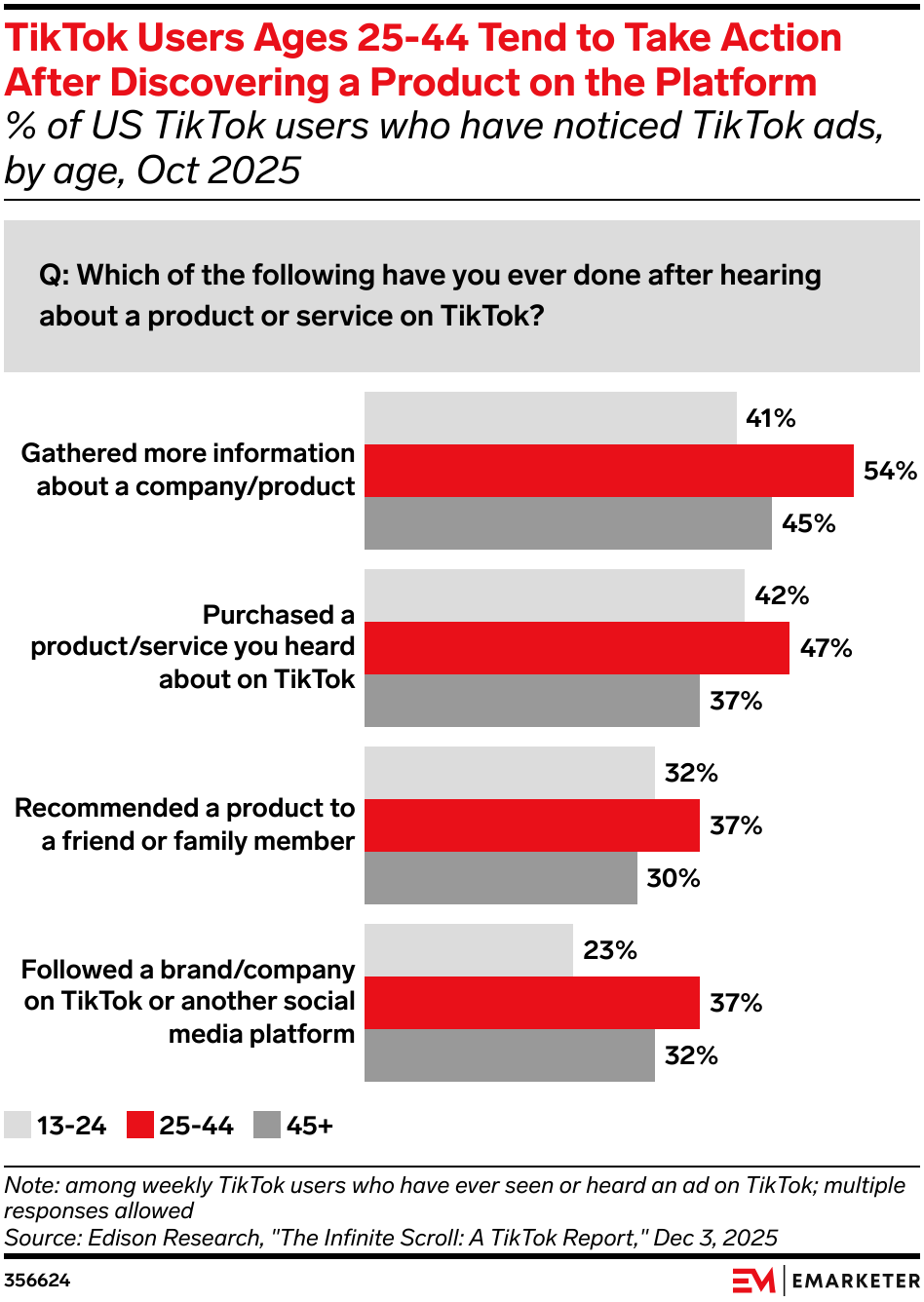
#Millennials are now matching #GenZ in #socialcommerce behavior: 43% bought via in-app social shops in the last 3 months.
Key insight: #TikTok wins discovery & research with 25–44s, but Instagram still closes the sale, leading final checkout
https://www.emarketer.com/content/tiktok-s-best-shoppers-millennials--not-gen-z