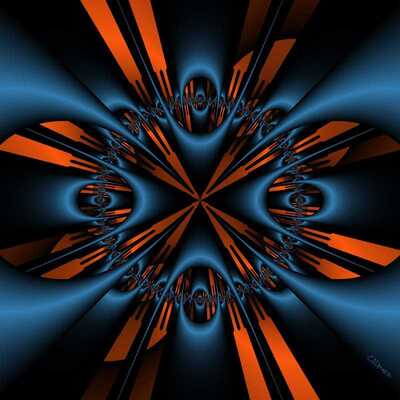
For Genuary 9, a crazy automaton, I'm combining a cellular automaton with the concept of "odious numbers" I learned about during #mathober. Each cell is assigned one of 4 states, and if sum of states of 8 surrounding cells is an odious number, increment the state. Otherwise go back to 0.
#Mathober
Mathober in this weeks CodePen Spark! It was a really fun month of math doodles.
#Mathober code is complete!
On codepen: https://codepen.io/collection/yyapOP
On OpenProcessing: https://openprocessing.org/curation/90042
Thank you Everyone that participated - It was so inspiring to see all of the are, posts, humor and creations.
It's Halloween! How could I resist a pumpkin for today's #inkyDays drawing?
And that's a wrap for this month of drawing, mostly from Math inspirations. All of this month's drawings and more are now posted for my supporters on Patreon and Ko-fi: https://www.patreon.com/posts/140222503
https://ko-fi.com/Post/InkyDays-October-2025-P5P01M567L
#ink #drawing #art #Mathtober #mathober #SciArt #MastoArt #GenerativeArt #ProceduralArt


31. Intermittently cruel, unfit for chapel, he has a tendency to be mean (7)
#Mathober2025 #Mathober #Mathtober #Day31
#CrypticClue #CrypticCrossword #Cryptic
Today's Mathtober prompt is "Minor". For this one, I went with the vernacular meaning, and added some baby penguins with a 'grown up' penguin for today's #inkyDays drawing.
https://www.patreon.com/posts/140222503
https://ko-fi.com/Post/InkyDays-October-2025-P5P01M567L
#Mathtober #mathober #ink #drawing #art #penguins #GenerativeArt #ProceduralArt #MastoArt #wip


October is almost over! For all us procrastinators, still time to write a post or two to participate in #October blogging challenges like:
#Blogtober
#IndieWebMovieClub on #Hackers
#Inktober
#Mathober
#WeirdWebOctober
+ coding challenges:
#Hacktoberfest — https://blog.holopin.io/posts/hacktoberfest-2025
Many more at:
* https://indieweb.org/October
* https://indieweb.org/blog_carnival
🎃 And tomorrow is #Halloween so consider a holiday theme for your site as well! See #IndieWeb examples for inspiration:
* https://indieweb.org/Halloween
Last but not least, perhaps we’ll see some of you at #IndieWebCamp Berlin this weekend!
* https://indieweb.org/2025/Berlin
This is post 13 of #100PostsOfIndieWeb. #100Posts
← https://tantek.com/2025/182/t1/movie-club-tomorrowland-submissions
→ 🔮
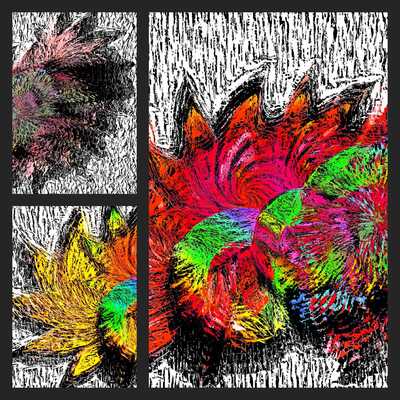
SenseFlow
Blog/Images/Code: https://blog.illestpreacha.com/mathober2025digraphsink2
#mathart #mathober #mathober2025 #mathober5 #graph #digraphsink
For my 31st sketch of Mathober2025 (curated by @fractalkitty) graphed in #MermaidJs, SenseFlow takes the prompt of Digraph Sink and uses the Senses as an example as such
#creativecoding #coding
#newmedia #scifi #animation
#math #graph #design #dataviz
#worldbuilding #illestpreacha
Found a bluesy geogebra jam on YouTube for the hexyl triangle today while thinking about #mathober
Poetic Carousel Again
#Mathober Curation by
@fractalkitty
Blog/ More Poems/Code https://blog.illestpreacha.com/mathober2025notation2
Poetic Notations made through Matrices
For My 29th Sketch of Mathober2025 using the 7th Prompt of “Notation” ,PoeticCarouselAgain is coded with Ruby & Python it remixes my Poetic Carousel Code (https://blog.illestpreacha.com/napowrimo24-poetic-matrices) code that uses 3 x 3 matrices to form a poetic notation to write the poems.
#Mathober2025 #Mathober7 #Notation #Python #Ruby
Poem 3
Poetic Stanza 1 :
[['d' 'p' 'v']
['s' 'e' 'i']
['u' 'h' 'c']]
Poetic Stanza 2:
[['d' 's' 'u']
['p' 'e' 'h']
['v' 'i' 'c']]
Deploying Powerful Visions
Synchronizing Every Imaginations
uniting Harmonious Content
Deploying Sparkling Unions
Proudly Echoing Honour
Viscously Intertwining Content
#creativecoding #poetry #poem #ciphers #transposition
#micropoem #illestpreacha #worldbuilding #ElectronicLit
DanglingSpheres
Video: https://youtu.be/Wo1D316Cs88
Blog: https://blog.illestpreacha.com/mathober2025amalgamation2
#mathart #mathober #mathober2025 #mathober26 #Spheres #Amalgamation #animation #livecoding
For My 29th Sketch of Mathober2025 (curated by @fractalkitty) , DanglingSpheres is coded with LiveCodeLab with the 26th Prompt of Amalgamation: A Bunch of Spheres dangling in mid-air.
A Spheres wishes
To be more than a 3D Circle
but wonders what are the hurdles
and how can it lead to switches?
#creativecoding #coding
#newmedia #scifi #animation
#math #geometricart #geometry
Today's Mathtober prompt is "Hexyl", and I found some pages on it over on Wolfram's math info site: https://mathworld.wolfram.com/HexylCircle.html
I decided to go with an abstraction and playing with a Chemistry inspired pattern.
Here's an in-progress shot.
https://www.patreon.com/posts/140222503
https://ko-fi.com/Post/InkyDays-October-2025-P5P01M567L
#Mathtober #mathober #SciArt #inkyDays #ink #drawing #art #GenerativeArt #ProceduralArt #wip #wipWednesday

30. If it’s first then one row and one column are removed before the eighteenth (5)
#Mathober2025 #Mathober #Mathtober #Day30
#CrypticClue #CrypticCrossword #Cryptic
ReyeMisConfiguration
Blog/Images/Code: https://blog.illestpreacha.com/mathober2025reyeconfiguration
#mathart #mathober #mathober2025 #mathober20 #ReyeConfiguration #animation #livecoding
For My 28th Sketch of Mathober2025 (curated by @fractalkitty ) ReyeMisConfiguration is coded with #LiveCodeLab with the 20th Prompt of Reye Configuration. It is a mis-configuration has it isn’t the proper usage of the 12 Points & 16 lines
12 Points
16 Lines
Assuming they been revise
What are the new joints?
That have intertwined?
#creativecoding #coding
#newmedia #scifi #animation
#math #geometricart #geometry
OverLaidShards
Video: https://youtu.be/TUDeQaGy7Wo
Blogpost: https://blog.illestpreacha.com/mathober2025monotonic2
#mathober #mathober12 #mathober2025 #Monotonic #creativecoding #coding #livecoding
For my 27th sketch of Mathober2025 (curated by @fractalkitty) coded in #HydraVideoSynth, OverLaidShards takes the 12th prompt of “Monotonic” and uses a monotonic relationship to write the code as the amount of characters used decreases till the end.
Overlaid Shards
Crossing boundaries & Yards
Floating & Loading
As the shards are encoding
#creativecoding #coding
#newmedia #scifi #animation
#math #geometricart #geometry #glitch
Today's Mathtober prompt is "Recursion". Right away, sorting trees came to mind, and I decided to go with roots instead of branches in terms of a tree.
Here's an in-progress shot. Yes, I filled in the 'tree' recursively while drawing it by hand. I paused while drawing, and took a few in-progress shots.
https://www.patreon.com/posts/140222503
https://ko-fi.com/Post/InkyDays-October-2025-P5P01M567L
#Mathtober #mathober #SciArt #MathArt #ink #drawing #art #wip #inkyDays

I've got one more #mathober post - today's prompt is "recursion", and this by-hand construction of the Spiral of Theodorus seems sort of recursive. Just keep adding triangles over and over. The length of the hypotenuses are the square roots of 2 through 17 times the edge length of the smallest triangle.

#mathober day 28: #recursion
"More Bubbles": https://openprocessing.org/sketch/2696244
Okay, to be honest, this is an older sketch and I forgot if there even is a recursion in the code and if no one looks into the code, no one will find out. Most likely there is not.
I'm actually afraid of using recursions since I feel unsure of properly managing the termination conditions – BUT every recursion can be replaced by a loop and this would be my first choice anyway.


As a several-days-late contribution for the #Mathober Day 25 prompt ‘Wedge’, I would like to point out a little historical curiosity involving ‘wedge’.
Attached is a detail from an Old Babylonian clay tablet of geometrical problems and a reconstruction of the diagram.
The cuneiform text reads: ‘The square-side is 1 cable. ⟨Inside it⟩ I drew 12 wedges and 4 squares. What are their areas?’ (trans. Robson, ‘Mesopotamian mathematics’, p.95)
The term ‘wedge’ translates the Akkadian ‘santakkum’, which names any figure with three (possibly non-straight) sides. (1 ‘cable’ = approximately 360 metres)
The exact symmetry of the configuration is vital to the problem. Without symmetry, which is suggested by the (necessarily approximate) diagram, but which is not made explicit in the question, the ‘wedges’ could be (e.g.) non-isosceles triangles of different sizes, and the problem would be insoluble.
The problems on the tablet [https://www.britishmuseum.org/collection/object/W_1905-0515-1] comprise various geometric configurations in which symmetry is implicitly required for the solution.
#HistMath #HistSci #geometry #symmetry #Mathober2025
1/2


Client Info
Server: https://mastodon.social
Version: 2025.07
Repository: https://github.com/cyevgeniy/lmst