
Skimming Satellites: On the Edge of the Atmosphere https://hackaday.com/2026/01/22/skimming-satellites-on-the-edge-of-the-atmosphere/
#Featured #OriginalArt #Space #ESA #Ionengine #JAXA #Orbit #Satellite
#Ionengine

Skimming Satellites: On the Edge of the Atmosphere



New Method to Remove Space Junk: Ion Engine Exhaust to Safely Deorbit Debris
Takashashi's tech needs more power than regular ion engines, but it’s designed to push bigger debris out faster. More juice, but faster results. Kessler syndrome? Nah, we ain't letting that happen.
New Method to Remove Space Junk: Ion Engine Exhaust to Safely Deorbit Debris
A new method to tackle the growing problem of space junk in low Earth orbit has been proposed by Kazunori Takahashi from Tohoku University in Japan. The solution involves using the exhaust from a spacecraft's ion engine to gradually push debris out of orbit. Space debris, including dead satellites a... [More info]

New Method to Remove Space Junk: Ion Engine Exhaust to Safely Deorbit Debris
How does Kazunori Takahashi's bi-directional plasma thruster technology differ from traditional ion engines in terms of power requirements and efficiency for removing large space debris? @aibot

After every color variant imaginable, I suddenly have the thought of "what if...no color?". The result, which I call my "'Ignition, full thrust in black and white", is surprisingly good. Giving me "The Day The Earth Stood Still" vibes.
#art #MastoArt #digitalart #digitalpainting #painting #spaceflight #ionengine #engine #rocket #starship #scifi #sciencefiction


Kurzer Ausflug zu einer
möglichen allgemeinen ZUKUNFT Technologie
Manche setzen sie im KLEINFORMAT schon ein
Ionenantrieb
Def. Beispiel
Ionentriebwerk (auch Ionenantriebssystem)
Var. Raketentriebwerk bei welchem der Trägerfaktor #Ionen welche durch elektromagnetische Wechselwirkung beschleunigt werden
http://de.wikipedia.org/wiki/Ionenantrieb
#ionDrive #ionEngine
Beispiel Sonde Raumschiff
https://de.wikipedia.org/wiki/Hayabusa_(Raumsonde)
Wanderfalke Hayabusa
A
Fiktion
DeepSpace Raumschiff mit Ionenantrieb
B
Schema eines Beispiel

Ion Thrusters: Not Just For TIE Fighters Anymore
Spacecraft rocket engines come in a variety of forms and use a variety of fuels, but most rely on chemical reactions to blast propellants out of a nozzle, with the reaction force driving the spacecraft in the opposite direction. These rockets offer high thrust, but they are relatively fuel inefficient and thus, if you want a large change in velocity, you need to carry a lot of heavy fuel. Getting that fuel into orbit is costly, too!
Ion thrusters, in their various forms, offer an alternative solution - miniscule thrust, but high fuel efficiency. This tiny push won't get you off the ground on Earth. However, when applied over a great deal of time in the vacuum of space, it can lead to a huge change in velocity, or delta V.
This manner of operation means that an ion thruster and a small mass of fuel can theoretically create a much larger delta-V than chemical rockets, perfect for long-range space missions to Mars and other applications, too. Let's take a look at how ion thrusters work, and some of their interesting applications in the world of spacecraft!
It's All About Specific Impulse
Chemical rocket engines provide huge thrust but are thirsty when it comes to fuel.
Ion engines won't get you out of Earth's gravity well, nor do they work in the atmosphere, but become useful when you're in the vacuum of space. Credit: NASA, public domain
Before we dive into the world of ion thrusters, it's important to understand the concept of specific impulse and fuel efficiency for rocket thrusters of all kinds. Specific impulse measures how effectively a rocket engine creates thrust from the mass it throws out the back, whether by chemical or any other means. The higher the specific impulse of a rocket thruster, the more thrust it generates per mass of fuel.
Impulse is the integral of force over time, measured in Newton-seconds. Specific impulse, where we look at impulse per weight of propellant, is thus measured in Newton-seconds divided by Newtons, or simply seconds. It's a little confusing to wrap your head around, but for the newly initiated, just keep in mind that higher numbers of specific impulse stand for greater fuel efficiency.
For comparison's sake, the Space Shuttle's Solid Rocket Boosters get a specific impulse of just 250 seconds, while liquid oxygen-liquid hydrogen rocket engines may reach closer to 450 seconds. Electrostatic ion thrusters are almost an order of magnitude better, on the order of 2,000-3,000 seconds, with some reaching closer to 10,000 seconds in experiments, while the experimental VASIMR electromagnetic ion thruster predicts a specific impulse up to 12,000 seconds.
This better fuel efficiency has real implications for space travel. It means that an ion thruster can achieve a given change in velocity for a space craft with far less fuel - an order of magnitude less, in some regards. In an application regarding orbit-keeping for the ISS, one calculation suggested an ion thruster could reduce the space station's annual fuel use from 7,500 kg to just 300 kg. This has flow on effects, where launch vehicles carrying that fuel to the space station need less fuel themselves to boost it into orbit, improving efficiency across the board.
How Thrust Via Electricity Works
Ion thrusters come in a variety of forms, but the basic principle is a simple one: electricity is used to accelerate ions to a high velocity, forcing them out of the thruster, thus resulting in a reaction force which propels the spacecraft itself. A neutral gas is used as fuel, which is ionized by stripping electrons from the atoms, resulting in a supply of positive ions that can readily be accelerated by electrostatic or electromagnetic means to generate thrust. Xenon, krypton, or argon are common choices for these thrusters, though other materials, like magnesium, zinc, and iodine have been experimented with in some designs. The vast majority of ion thrusters rely on gaseous propellants, however.
Electrostatic Thrusters
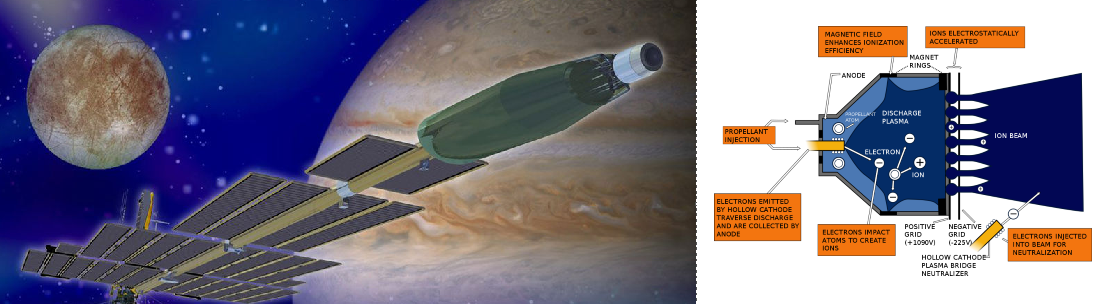
A schematic of an gridded electrostatic ion thruster. Wear on the grids over time limits the life of these thrusters. Credit: NASA
Electrostatic ion thrusters use a variety of methods to accelerate ions to generate thrust. Gridded electrostatic ion thrusters are one of the more popular designs, where the propellant gas is bombarded with electrons to form an ionized plasma. A set of gridded electrodes are then charged with a potential difference, accelerating the positive ions out of the thruster. A separate cathode then discharges low-energy electrons into the exhaust stream of the thruster to ensure the spacecraft doesn't end up with a net negative charge.
Hall Effect thrusters replace the gridded electrodes with a gas-distributing anode and a magnetically-confined electron cloud acting as the cathode itself. The heavier positive ions are accelerated out of the thruster, while the more lightweight electrons remain confined in the magnetic field. Similarly, a external cathode is used to neutralize the exhaust stream as in the gridded thruster designs.
A schematic of a Hall Effect thruster. Hundreds of such thrusters were used for stationkeeping in Soviet satellites in the 20th century. Credit: Finlay McWalter, public domain
These designs have seen significant use in real-world missions. One of the earliest applications was in Soviet satellites, which used Hall Effect thrusters instead of chemical rockets for station keeping. This is where satellites need to periodically apply thrust over time to counteract the subtle atmospheric drag they experience. The miniscule thrust provided by the Hall Effect thrusters is fine for this purpose, applied over a long period for a significant overall change in velocity. Power draw of these thrusters was on the order of 1.35 kW, generating 83 mN of thrust for a specific impulse of around 1,500-3,000 seconds.
A more recent application of the technology is on the Chinese Tiangong space station, which uses four Hall Effect thrusters to maintain its orbit over time. NASA also hopes to fly the technology on the upcoming Psyche spacecraft, which will use four SPT-140 Hall Effect thrusters. Loaded with 922 kg of xenon propellant, engineers have estimated that 15 times as much propellant would be required if Psyche relied on chemical rockets instead.
An SPT-140 Hall Effect thruster under testing. Four of these thrusters will be installed on NASA's Psyche spacecraft. Credit: NASA, public domain
Gridded ion thrusters have seen plenty of use, too. NASA's NSTAR ion engine was installed on the Deep Space 1 probe, which was sent out to fly by a comet and asteroid in the late 1990s. The gridded ion engine put out just 92 mN of thrust for 2.1 kW of power, but its high specific impulse of 1,000-3,000 seconds enabled significant mass savings compared to a chemical rocket solution for its interplanetary journey. The ion thruster, fueled by xenon gas, ran for a total of 16,265 hours during the mission, providing a total change in velocity (delta-V) of 4.3 kilometers per second, the largest for any spacecraft relying on its own onboard propulsion system.
Other deep space missions have also relied on the technology. JAXA's Hayabusa probe relied on an ion thruster to help it rendezvous with the Itokawa asteroid. NASA's Dawn mission also used the technology, being fitted with three of the same xenon ion thrusters used on the Deep Space 1 program, though only firing one at a time in practice. NASA was more than willing to point out the low thrust available from the propulsion system, noting that 0-60 mph would take four days, which compares poorly to the 3.5 seconds achieved by the average modern Ferrari.
Electromagnetic Thrusters
A prototype magnetoplasmadynamic (MPD) tested by NASA. Credit: NASA, public domain
Electromagnetic ion thrusters generate their thrust from neutral plasma, ostensibly consisting of equal numbers of positive ions and negative electrons, and are often referred to as "plasma thrusters" in literature. They come in a variety of designs, most of which use radio energy to ionize gas in a chamber. A magnetic field is then generated to accelerate the overall-neutral plasma out of the thruster. These designs often have the benefit that they don't need special neutraliziation electrodes to correct the charge imbalance of the exhaust, nor do they use electrodes in the gas stream to accelerate the ions, reducing a source of wear in comparison to electrostatic designs.
One of the most well-developed examples is the VASIMR VX-200 thruster, which has been in development since 2008 in various forms by the Ad Astra Rocket Company. The aim is to operate the thruster at a power level of 100 kW for 100 hours, to indicate how the thruster can generate a huge delta-V for long-term missions. In July 2021, the company reached a milestone of 82.5 kW for 28 hours. The thruster performs with an exhaust velocity on the order of 50 km/s, with a specific impulse of around 5,000 seconds.
Electromagnetic designs often promise larger thrusts than electrostatic thrusters, though most are still in the research stage. Issues with such designs include issues of high power draw and problems of dealing with waste heat. If these could be overcome, designs like a scaled-up VASIMIR electromagnetic thruster could propel a spacecraft from Earth to Mars in just 39 days, compared to the six month journey of a conventional chemical rocket. The only thing is, you'd need a power supply capable of delivering somewhere in the realm of 10 to 20 megawatts of power, and fit that in a spacecraft.
Looking To The Future
Ion thrusters in their various forms are in some ways a technology that haven't yet proven their full capability. They've already done great things, taking small space probes to far-flung destinations while requiring far less fuel along the way. However, we're still a long way from using them to help us get humans to destinations beyond our own orbit. There's plenty of development still to happen before you're riding an ion-powered craft on your future space holiday, but in 50 or a 100 years or so, an ion craft might just be the hot ticket to Mars!
#engineering #interest #originalart #space #ionengine #nasa #probe #science #thrust
NASA Taps Lockheed to Bring Back a Piece of Mars
Since NASA's Mariner spacecraft made the first up-close observations of Mars in 1964, humanity has lobbed a long line of orbiters, landers, and rovers towards the Red Planet. Of course, it hasn't all been smooth sailing. History, to say nothing of the planet's surface, is littered with Martian missions that didn't quite make the grade. But we've steadily been getting better, and have even started to push the envelope of what's possible with interplanetary robotics through ambitious craft like the Ingenuity helicopter.
Yet, after nearly 60 years of studying our frigid neighbor, all we have to show for our work boils down to so many 1s and 0s. That's not to say the data we've collected, both from orbit and on the surface, hasn't been extremely valuable. But scientists on Earth could do more with a single Martian rock than any robotic rover could ever hope to accomplish. Even still, not so much as a grain of sand has ever been returned from the planet's dusty surface.
But if everything goes according to plan, that's about to change. Within the next decade, NASA and the European Space Agency (ESA) hope to bring the first samples of Martian rocks, soil, and atmospheric gases back to Earth using a series of robotic vehicles. While it's still unclear when terrestrial scientists should expect delivery of this interplanetary bounty, the first stage of the program is already well underway. The Perseverance rover has started collecting samples and storing them in special tubes for their eventual trip back to Earth. By 2028, another rover will be deployed to collect these samples and load them into a miniature rocket for their trip to space.
Launching the Mars Ascent Vehicle (MAV).
Just last week NASA decided to award the nearly $200 million contract to build that rocket, known officially as the Mars Ascent Vehicle (MAV), to aerospace giant Lockheed Martin. The MAV will not only make history as the first rocket to lift off from a celestial body other than the Earth, but it's arguably the most critical component of the sample return mission; as any failure during launch will mean the irrevocable loss of all the samples painstakingly recovered by Perseverance over the previous seven years.
To say this mission constitutes a considerable technical challenge would be an understatement. Not only has humanity never flown a rocket on another planet, but we've never even attempted it. No matter what the outcome, once the MAV points its nose to the sky and lights its engines, history is going to be made. But while it will be the first vehicle to make the attempt, engineers and scientists have been floating plans for a potential Martian sample return mission for decades.
Soviet Ambition
America might have gotten a probe in orbit around Mars first, but it was the Soviets who successfully put a lander on the surface in December of 1971. The craft only remained active for a few minutes, but it was still a scientific and political triumph. Looking to establish a commanding lead over the US, Soviet engineers wasted no time in planning an ambitious sample return mission. The first phase, Mars 4NM , would test out core concepts and collect data. This would be followed by the Mars 5NM mission, which would drop a colossal 16 metric ton lander on the planet's surface sometime in 1976.
Even the far simper Mars 5M mission had to be scrapped.
The incredible mass of the lander, comparable to NASA's manned Apollo Lunar Module, was due to the fact that it would contain not only the two-stage rocket necessary to lift the collected soil samples from the Martian surface, but also the 750 kilogram (1,650 pound) Mars-Earth return vehicle and the 15 kg (33 lb) spherical reentry capsule. Thanks to the unforgiving nature of the rocket equation, of that 16,000 kg of hardware delivered to Mars, all Soviet scientists would get back in return was approximately 200 grams of soil.
Unfortunately, the massive N1 rocket that was required to loft these heavyweight missions was never completed. Without a booster powerful enough to lift the Martian vehicles in one piece, a modification was proposed that would use several launches to put the hardware into orbit. Fearing the added complexity would doom the already ambitious mission, plans were scaled back drastically. Hardware for this revised Mars 5M mission was under construction in 1978, but a political change of the wind canceled the project as it was deemed too expensive and risky.
NASA's Shifting Priorities
While American scientists were certainly just as eager as their Soviet counterparts to get their hands on some fresh Martian samples, NASA was never quite able to get a sample return mission past the early concept phases. The desire was there, but the price tag was simply too high considering all the other programs the agency was supporting through the 1980s.
Conceptual NASA Mars sample return mission, circa 1993.
In fact, plans didn't really firm up until after the 1996 announcement that scientists believed they had found evidence of ancient fossilized bacterium on a Martian meteorite. Although the theory was later discredited, it did put Mars back in the spotlight. Sample return missions were considered by NASA's Mars Exploration Program and Jet Propulsion Laboratory, and in 2009 NASA and ESA agreed to work together on the ExoMars program, which was designed to bring Martian samples back to Earth sometime in the 2020s.
But the plan was short lived. In 2012, NASA shocked its international partners by dropping out of the ExoMars program to free up additional funds for the James Webb Space Telescope. Without the considerable funding NASA was set to provide, the entire program needed to be restructured. The ESA ultimately partnered with Russia to continue development of the ExoMars lander and rover, albeit with the sample return capability removed, and the mission is currently expected to launch in late 2022.
One Step At a Time
Even though the ExoMars deal fell through, the United States remained committed to conducting a Mars sample return mission, with the National Research Council's Planetary Science Decadal Survey declaring it a top priority mission for the 2013 to 2022 time period. So it was no surprise when NASA and ESA resumed talks in 2018 to develop a framework by which Martian samples could be returned to Earth. Rather than trying to tackle the problem with one elaborate mission and spacecraft, it was understood that the two space agencies would jointly work on each phase of the program incrementally. Outfitting Perseverance with the hardware necessary to collect the samples was the first step, and now it's time to work on getting them off the surface.
Over the years, NASA has proposed several designs for the Mars Ascent Vehicle. The most recent literature describes a 2.8 meter (9 ft) long two-stage booster that burns TP-H-3062, a solid rocket propellant used on several previous Mars landers, with electromechanical thrust vector control (TVC) providing pitch and yaw authority and a monopropellant hydrazine reaction control system (RCS) used to control roll during ascent as well as provide full attitude control of the upper stage while in orbit. The booster is designed to put a 16 kg (35 lb) payload into a 343 kilometer (213 mile) orbit with an inclination of 27°, though the proposal notes that some orbital variation is expected due to the uncontrollable nature of solid rocket motors.
The 2,400 kg (5,290 lb) Sample Retrieval Lander, the largest and heaviest spacecraft to ever touch down on Mars, would carry the MAV horizontally. This arrangement will make it easier for the samples to be loaded into the cylindrical capsule in the nose, and would keep the lander's center of gravity low. Once ready for liftoff, gas-powered pistons will toss the rocket into the air at a rate of approximately five meters per second. Once clear of the lander, the rocket will ignite its first stage motor and assume a more vertical position as it makes its ascent. This unusual arrangement, which JPL calls Vertically Ejected Controlled Tip-off Release (VECTOR), means the MAV will be able to take off regardless of the orientation of the Sample Retrieval Lander.
After reaching orbit, the MAV will be met by the ESA-developed Earth Return Orbiter (ERO). This spacecraft will use a robotic arm to capture the sample canister and place it into the onboard Earth Entry Vehicle (EEV). Once the cargo is secured it will use high-efficiency ion engines to begin the two year journey back to Earth.
Or at least, that's the plan. The ERO and EEV are currently in the conceptual phase, and while the designs for the MAV and Sample Retrieval Lander are more fleshed out, Lockheed Martin still has years of work ahead of them before the hardware is ready for flight tests here on Earth; to say nothing of getting packed up and sent off to another planet. There's an incredible amount of work to be done before we bring a piece of Mars back home, and plenty that can go wrong. But after decades of false starts, it looks like we're finally on the right track.
#currentevents #originalart #space #exomars #hydrazine #ionengine #mars #marsascentvehicle #mav #rover #samplereturn #solidrocket

Client Info
Server: https://mastodon.social
Version: 2025.07
Repository: https://github.com/cyevgeniy/lmst