#workingpaper

Media of Cooperationmediaofcoop
2026-02-06

📄 New Working Paper veröffentlicht

🎤 Bina Elisabeth Mohn: "Prototyp 'Bundle Explorer: Berühren' Zur praxeologischen Konturierung semantischer Felder am Beispiel eines kamera-ethnographischen Forschungstools"
🔗 im Open Access: dspace.ub.uni-siegen.de/handle

,

Media of Cooperationmediaofcoop
2025-12-15

📄 New Working Paper published

🎤 Luciana Serrano: "Research with/in Communities Fissures and Practices for an Anthropology Otherwise“
🔗 dspace.ub.uni-siegen.de/handle

This paper pushes for a reframing of Anthropology as a collaborative and situated practice grounded in relationships rather than extraction.

2025-11-12

Kennt Ihr bereits die letzten beiden Veröffentlichungen unserer 4Memory Working Paper Serie?

Nr. 8: "Blue Paper: Technische Spezifikationen für den NFDI4Memory Data Space"
🌐 Zum Paper: zenodo.org/records/16614629

Nr. 9: "Nachnutzung von Forschungsdaten in Studium und Lehre: Sammlung von Lehrszenarien in der geschichtswissenschaftlichen Lehre"
🌐 zenodo.org/records/16812354

#NFDI4Memory #WorkingPaper #DigitalHistory #DataSpace #DataLiteracy #FDM

@esciences @fiz_karlsruhe & @LandesarchivBW

Rudolf Thomas INDERST (he|him)gamestudies.bsky.social@bsky.brid.gy
2025-09-25

Wir haben ein neues #WorkingPaper veröffentlicht: Inderst, Rudolf T. & Daniel Meis (2025) Schlachtfeld Berlin. Orte der deutschen Demokratiegeschichte im digitalen Spielraum : Über die Konzeption einer ludonarrativen und diskursanalytischen Monografie zu ausgewählten Shooter-Titeln. #Gamestudies

Schlachtfeld Berlin. Orte der...

2025-08-25

Dive deeper into this groundbreaking framework and rethink how religion speaks. Metaphor Papers article:
🔗 omp.ub.rub.de/index.php/metaph

3/3

#metaphorpapers #workingpaper

Media of Cooperationmediaofcoop
2025-07-04

🏠Wie verändern sich alltägliche Haushaltspraktiken durch intelligente, sensorbasierte Medientechnologien?

📄 Read our new Working Paper
🔗 dspace.ub.uni-siegen.de/entiti

Rudolf Thomas INDERST (he|him)gamestudies.bsky.social@bsky.brid.gy
2025-06-25

FRISCHER LESESTOFF! Mit meiner ehemaligen IU-Kollegin @nadinetrautzsch.bsky.social habe ich ein neues HNU Working Paper verfasst: "Spielräume des Wissens : Game Studies und Game Design zwischen Disziplin und Wissenschaft". publications.hnu.de/5436/ #gamestudies #gamedesign #workingpaper #hnu #iu

Spielräume des Wissens : Game...

AI數字分析領航者 :mastodon: AI底層數據建模aphoebusli
2024-10-28
2024-03-14

Juhu, die 2. Version unseres @DHTheorie Working Papers, Artikel #Annotation von @janhorstmann und mir bei der @ZfdG ist online :D
doi.org/10.17175/wp_2023_002_v
#workingpaper #dhd #dh #wisskomm

2024-03-01

Das #WorkingPaper: Diese wohl offenste Form unserer Publikationsformate nimmt innovative Fragestellungen oder Grundsatzthemen aus den DH in den Blick. Es kann z. B. Empfehlungscharakter haben oder bisher unbeackerte Grundlagendesiderate erstmalig in Angriff nehmen. Begutachtet wird es im öffentlichen Begutachtungsverfahren (Open Public Peer Review) - von der Community, für die Community! #DHd2024 #Publizieren

Das Cover des Working Papers 3 der ZfdG: Claudia Frick / Melanie Seltmann: Referenzrahmen für eigenstände digitale Wissenschaftskommunikation durch Forschende (= Working Papers der Zeitschrift für digitale Geisteswissenschaften, 3). 2023
Centre for Population ChangeCPCpopulation@sciences.social
2023-09-29

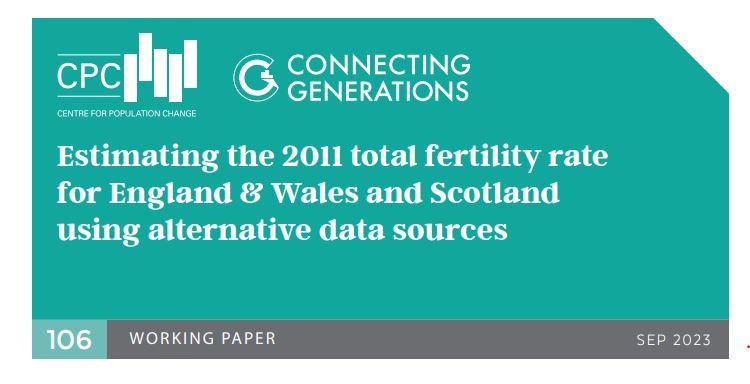
📘NEW CPC-CG #WorkingPaper⤵️

📈Estimates the 2011 total #fertility rate (#TFR) using the #ONS Longitudinal Study, Scottish #Longitudinal Study, and the 2011 #Census Secure #Household #Microdata samples, compared to estimates from vital registration.

By Joanne Ellison, Bernice Kuang, Sarah Christison, Ann Berrington and Hill Kulu

▶️ cpc.ac.uk/docs/WP_106_Estimati

ESRC Centre for Population Change and Connecting Generations | Working Paper 106 | Sept 2023 | Estimating the 2011 total fertility rate for England & Wales and Scotland using alternative data sources
2023-08-12

"New study shows 18% productivity decline by those working from home"

Color me skeptical. My reasons:

1. This "study" is a "working paper" and not peer-reviewed.

2. They claim to have accounted for accuracy in the paper, but doing this is notoriously hard. They could easily have made mistakes when they looked at accuracy.

(By "accuracy" I mean the accuracy of the data entry. You've gained nothing if you're going faster in the office, but also make more mistakes.)

3. Correlation is not causation.

4. Correlation is not causation.

5. Correlation is not causation.

If I had a dime for every crackpot who confuses correlation and causation, I'd be a rich man.

Illustration: some study shows that there is a correlation between taking a 30-minute walk per day, and better health. Someone latches onto this and says that everyone should walk 30 minutes per day to improve their health. They did not account for the fact that people who are healthy in the first place are those capable to take a walk every day. Nor do they account for the fact that those people who can afford the walk probably have money. When you have to work two jobs, the walk goes out the window. So it is not the daily walks that make people healthy, it is being healthy and having money that makes people able to take the walks.

I'm not at all convinced that there NOT is something else at play in this "study" and that correlation and causation have been confused.

I don't have proof of this, only an inkling. I've gone very quickly over the study.

#WorkFromHome #CorrelationIsNotCausation #WorkingPaper #PeerReview #NBER

techspot.com/news/99738-new-st

nber.org/system/files/working_

2023-08-01

Der Ausschnitt aus dem Beitrag zu Wissenswertem im @WisskommPortal sagt es schon: Kommentiert gerne noch unser Working Paper aka. den angesprochenen Referenzrahmen. Noch etwas über 2 Wochen ist dafür Zeit.
Zum Referenzrahmen geht es hier lang:
doi.org/10.17175/wp_2023b

Den Gastbeitrag gibt es hier:
wissenschaftskommunikation.de/

#WissKomm #SciComm #DH #Forschung #WorkingPaper #Referenzrahmen

Feedback erwünscht

Welche Kompetenzen braucht es für gute Wissenschaftskommunikation? Und wie können sich Kommunikator:innen selbst in diesen Kompetenzen einschätzen? Als Antwort auf diese Fragen haben Melanie Seltmann von der TU Darmstadt und Claudia Frick von der TH Köln einen Referenzrahmen für Wissenschaftskommunikation entwickelt. Im Gastbeitrag sprechen sie über den Inhalt und ihre Entscheidung, den Text öffentlich zur Diskussion zu stellen.
2023-08-01

fedihum.org/@DHTheorie/1107862

Ab heute hat die Community noch einen Monat Zeit, um das #Glossar zu kommentieren, das die @DHTheorie AG des @DHd in der @ZfdG als #WorkingPaper veröffentlicht hat.

2023-06-15

📢 New #Research Summary: "Education for All?
A Nationwide Audit Study of School Choice" by @PeterBergman & Isaac McFarlin Jr.

Key Finding
#Schools subject to choice –both charter & traditional public schools– are less likely to respond to application inquiries from parents signaling their student has a behavior problem, requires intensive special education services, or has a record of poor academic performance.

#Insights from a 50-page NBER #WorkingPaper in 1000 words
learningcollider.org/research-

2023-05-16

📣 #News #Research #WorkingPaper

What happens when researchers around the world collaborate with and engage local educators, NGOs, governments, and families?

➡ One of the largest, most robust studies of mobile phone-based, #remoteeducation
➡ Finding that when 1:1 tutoring phone calls are paired with text messages
#Learning is boosted by an incredible 0.33 standard deviations on average - more effective (and more cost-effective) than most interventions.

#Education
nber.org/papers/w31208

2023-04-04

📢New Working Paper out!
#sfb1265 PI Angela Million, Xiaoxue Gao & Rui Wang analyse the production and refiguration of "gating spaces" and the meaning of #gatedness in a Chinese enclosed residential compound.
#gatedcommunity #urbanplanning #spatialmethods #workingpaper #spatialresearch #UrbanChina
Read it here:
sfb1265.de/en/publications/pub

2023-04-03

New #Census #WorkingPaper in @nberpubs "Where Have All the "Creative Talents" Gone? Employment Dynamics of US Inventors" by Ufuk Akcigit & Nathan Goldschlag nber.org/papers/w31085

ABSTRACT

How are inventors allocated in the US economy and does that allocation affect innovative capacity? To answer these questions, we first build a model of creative destruction where an inventor with a new idea has the possibility to work for an entrant or incumbent firm. If the inventor works for the entrant the innovation is implemented and the entrant displaces the incumbent firm. Strategic considerations encourage the incumbent to hire the inventor, offering higher wages, and then not implement the inventor's idea. To test this prediction, we combine data on the employment history of over 760 thousand U.S. mventors with information on jobs from the Longitudinal Employer-Household Dynamics (LEHD) Program at the U.S. Census Bureau. Our results show that (1) inventors are increasingly concentrated in large incumbents, less likely to work for young firms. and less likely to become entrepreneurs, and (i1) when an inventor is hired by an incumbent, compared to a young firm. their earnings increases by 12.6 percent and their innovative output declines by 6 to 11 percent. We also show that these patterns are robust and not driven by life cycle effects or occupational composition effects.
2023-04-03

New #Census #WorkingPaper in @nberpubs "Measuring the Characteristics and Employment Dynamics of U.S. Inventors" by Ufuk Akcigit and Nathan Goldschlag nber.org/papers/w31086

ABSTRACT

Innovation is a key driver of long run economic growth. Studying innovation requires a clear view of the characteristics and behavior of the individuals that create new ideas. A general lack of rich, large-scale data has constrained such analyses. We address this by introducing a new dataset linking patent inventors to survey, census, and administrative microdata at the U.S. Census Bureau. We use this data to provide a first look at the demographic characteristics, employer characteristics, earnings. and employment dynamics of inventors. These linkages, which will be available to researchers with approved access, dramatically increases the scope of what can be learned about inventors and innovative activity.
2023-03-31

New #Census #WorkingPaper "On The Role of Trademarks: From Micro Evidence to Macro Outcomes" by Emin Dinlersoz, Nathan Goldschlag, Mehmet Yorukoglu, and Nikolas Zolas census.gov/library/working-pap

Abstract

What are the effects of trademarks on the U.S. economy? Evidence from comprehensive firm- level data on trademark registrations and outcomes suggests that trademarks protect firm value and are associated with higher firm growth and marketing activity. Motivated by this evidence, trademarks are introduced in a general equilibrium framework to quantify their aggregate effects. In the model, firms invest in product quality and marketing to build a customer base subject to depreciation. Firms can register trademarks to protect their customer base and reduce the cost of informing consumers. The model’s predictions on the incidence and timing of trademark registrations, as well as firm growth and advertising expenditures, are consistent with the empirical evidence. Analysis of the calibrated model indicates that the U.S. economy with trademarks generates higher product variety, quality, and welfare, along with higher concentration, compared to the counterfactual economy with no trademarks.

Client Info

Server: https://mastodon.social
Version: 2025.07
Repository: https://github.com/cyevgeniy/lmst