#deepsky

Thomas HanrathastrocampEU
2026-02-05

LBN 728 - another very faint nebula in Ursa Major.

I collected these photons in January 2025 at Observatory Hoher List with my mobile Apo setup.

▼ Baader Apo 95 CaF₂ | SkyEye62AM

astrocamp.eu/en/lbn-728/

LBN 728
Westport ObservatoryWestportObservatory@vmst.io
2026-02-04

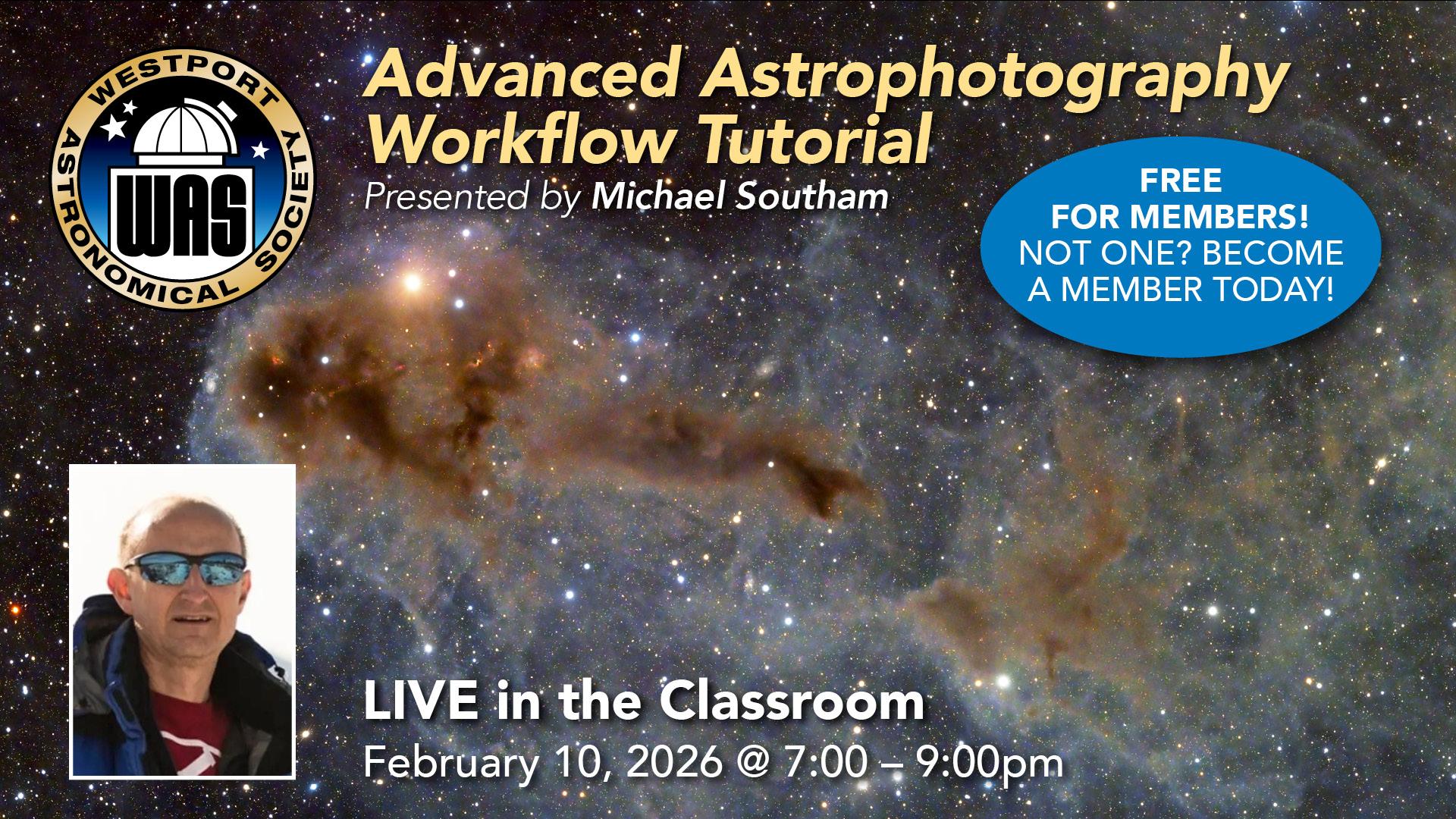
📸✨ One week from tonight!
Ready to level up your astro game? Join us for an Advanced Astrophotography Tutorial at the Westport Observatory. We’re diving deep—gear, capture, processing, and the tricks that turn “nice” into wow. If you already shoot the sky and want better results, this is for you.

👉 Details & registration: was-ct.org/events/advanced-ast

#Astrophotography #AdvancedAstro #NightSky #DeepSky #PlanetaryImaging #WestportObservatory #WAS #LearnAstro #SpaceNerds

Promotional banner for an advanced astrophotography workflow tutorial by Michael Southam, hosted by Westport Astronomical Society.
JD Gadina 🦄macmade
2026-02-02
The size of the Andromeda Galaxy in the night sky, compared to the Moon.
Thomas HanrathastrocampEU
2026-01-29

LBN 729 is a beautiful but very faint nebula.
January and February are nice months to photograph this object in Ursa Major.

This picture is a mono, starless version of the data i collected one year ago in 2025.

▼ Baader Apo 95 CaF₂

astrocamp.eu/lbn-729-2/

LBN 729
Thomas HanrathastrocampEU
2026-01-28

3 years ago, in January 2023, I captured this beauty, the comet C/2022 E3.

C/2022 E3 (ZTF) follows a highly elliptical orbit with a period of approximately 50,000 years. It reached its perihelion on January 12, 2023, at a distance of 1.1 astronomical units (AU) from the Sun.

▼ Vixen VC200L

astrocamp.eu/en/c-2022-e3-ztf/

C/2022 C3
Frank Adleradfr
2026-01-26

Introducing my little side-project:

Astro Planner is a web-based astrophotography planning tool that ranks deep-sky targets for tonight based on your location, gear, horizon, moon + light pollution - so you spend less time in Stellarium and more time imaging.

Try it: adfr.io/thoughts/20260126_intr

Thomas HanrathastrocampEU
2026-01-23

A single mono and starless snippet of my latest photon-collection-session this week.
A part of the Rosette Nebula, Sharpless 175.

▼ Baader Apo 95 CaF₂ | SkyEye62AM

Sh2-175
Frank Adleradfr
2026-01-23

LDN 1235 (the Shark Nebula) in Cepheus, ~650 ly away. A dark dust cloud revealed by the Milky Way star field it extinguishes, with faint blue reflection near the head (vdB 149/150).

Full image: adfr.io/astro/20260120_ldn1235

2026-01-23
The Shark Nebula
=============

LDN 1235 — the Shark Nebula — lurks in Cepheus about 650 light-years away. It isn’t a bright, glowing nebula; it’s a dense cloud of interstellar dust that shows up by blocking the star field behind it, carving out the shark’s dark “nose” and body across the Milky Way backdrop.

Near the head you can spot faint blue reflection nebulosity (vdB 149/150), where nearby hot stars scatter light off the dust. Spanning roughly 15 light-years from head to tail, this is just a small slice of a much larger dusty complex—and a reminder that some of the most dramatic deep-sky targets are defined by the subtlest contrast.

Scope: Askar 103APO
Lens: Askar 0.6x Reducer
Camera: ZWO ASI 294MC Pro
Filter: Svbony UV/IR-Cut
Mount: SkyWatcher AZ-EQ5-GT
Guiding: SkyWatcher Evoguide 50ED with ZWO ASI 224MC
Controller: ZWO ASIAir Pro
Focusser: ZWO EAF

Integration time: 18hrs 55min

Full version and print available at:
https://adfr.io/astro/20260120_ldn1235

#astrophotography #deepsky #nebula #sharknebula #darkshark #ldn1235 #space #cosmos #universe #stars #nightphotography
#longexposure #spacephotography #astronomy #astrophoto #stargazing #science #nightsky #celestial #dust
Bubulcus & Bolotasbbcamping@pixelfed.social
2026-01-23
Look up to the sky...

The Whirlpool Galaxy, aka M51, was the first galaxy classified as a spiral. It lies 23 million light-years away in Canes Venatici constellation, next to the tail of the Big Dipper (Ursa Major). Paired with NGC 5195, it's one of the most famous interacting systems, visible with binoculars under dark skies.

#Seestar #Astrophotography #DeepSky #DarkSky #Galaxy #UnderTheStars #Camping #CampingInPortugal #Évora #Alentejo
Deep-space photo of the Whirlpool Galaxy (M51) and its companion NGC 5195, showing M51’s bright spiral arms and glowing core against a dark, star-filled sky. Captured at Bubulcus & Bolotas Camping using a Seestar telescope.
Saschasn0opy
2026-01-22

My next project I'd consider to be finished for now: M42, also known as the Orion Nebula. 24 hours of total exposure time between November and January.

Shot on my Askar FRA400 + ZWO ASI2600MC

Full resolution + details on my Astrobin profile: app.astrobin.com/i/7e57h4

Picture of Messier 42 also known as the Orion Nebula
2026-01-22
IC-434 🌌
1,500 light-years

IC 434 – Horsehead region 🌌
After a long break, it felt good to be back under the stars.
Not perfect, but meaningful.
Light traveling for thousands of years, finally reaching my sensor.
Sometimes that’s enough.
#astrophotography #deepsky #ic434 #horseheadnebula
#nebula #nightphotography #space #cosmos
#stargazing #backunderthestars
#astronomy #nightscape #universe
Saschasn0opy
2026-01-19

Northern lights were photo-bombing my telescope's view of M 42 today

The Orion Nebula with a red-green gradient caused by Northern Lights.

Client Info

Server: https://mastodon.social
Version: 2025.07
Repository: https://github.com/cyevgeniy/lmst