
Tiesitkö, että Valentinus on myös epilepsian ja mehiläishoitajien suojeluspyhimys?
#Valentinus

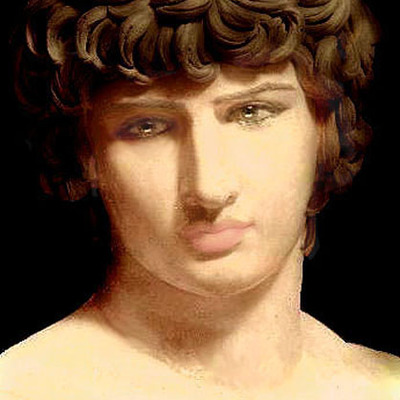
🪷 February 14th: Happy #ValentinesDay 💝💖💌💞💕 In #Alexandria in 130 AD #Antinous possibly met Gnostic mystic #Valentinus. If you wear a flower on St Valentine's Day in honor of #Antinoos / Valentinus, you will meet (or hear of) a new love by day's end. https://antinousstars.blogspot.com/2026/02/did-antinous-meet-st-valentine-both-in.html 💘💕💞 🪷

Spirituality & Religious Studiesspiritualityreligiousstudies.wordpress.com@spiritualityreligiousstudies.wordpress.com
2026-02-05Irenaeus
Irenaeus of Lyons (circa 130-202 AD) is 1 of the most important theologians of the 2nd century. He’s often called the “Father of Catholic Theology.” He served as a crucial bridge between the era of the Apostles & the developed institutional Church of the later Roman Empire.
He was born in Smyrna (modern-day Turkey). He was a student of Polycarp, who was himself a disciple of John the Apostle. This connection to an actual eyewitness of Jesus gave Irenaeus a unique statue. In an era where secret teachings were being whispered in various sects, Irenaeus could claim a direct, public, & verifiable line of “transmission” back to the source.
Around 177 AD, he traveled to Lugdunum (Lyons, in modern-day France) to serve as a priest. Eventually, he became the bishop after his predecessor, Pothinus, was martyred.
Irenaeus’ legacy is defined by his battle against Gnosticism. Gnosticism is a diverse movement that threatened to dismantle early Christianity. Generally, Gnostics believed:
- The material world was evil, created by a lesser, bumbling deity (Demiurge).
- Salvation came through secret, esoteric knowledge (gnosis).
- Jesus didn’t have a physical body (Docetism), as matter was inherently corrupt.
Irenaeus saw this as a total rejection of the Hebrew scriptures & the reality of the Incarnation. To counter this, he wrote his 5-volume masterpiece, “Against Heresies” (Adversus Haereses). Irenaeus’ theology’s centerpiece is the concept of Recapitulation. He argued that Jesus “summed up” all of humanity in Himself.
Just as the 1st Adam failed at the Tree of Knowledge, Jesus (the “new Adam”) succeeded on the tree of the Cross. Irenaeus taught that Jesus went through every stage of mortal human life (infancy, youth, & adulthood) to “sanctify” & “undo” the corruption introduced at each stage of the Fall.
Before Irenaeus’ time, there wasn’t the New Testament as we know it today. Different groups/sects used different, & various, gospels. This is where we get the infamous banned books of the Bible. Irenaeus was the 1st major figure to argue for the Four-Fold Gospel.
He insisted that there could be no more, & no fewer, than 4 Gospels (Matthew, Mark, Luke, & John), using a poetic justification: just as there are 4 zones of the world (or 4 corners) & 4 principal winds, the Church had to have 4 “pillars” of the Gospel. By doing this, he helped stabilize the core of the Christian Bible.
To fight the Gnostic claim of secret traditions, Irenaeus proposed 2 tests of “Truth”:
- The Rule of Faith:
- A summary of essential beliefs (a forerunner of the Apostles’ Creed) that all true churches held in common.
- Apostolic Succession:
- Irenaeus argued that if Jesus had secret knowledge, he would’ve given it to the bishops he appointed.
Irenaeus’ most profound contribution to theology is the concept of Recapitulation (anakephalaiosis). Using the math of his day, he sought to “sum up” the entire human experience through Christ.
To counter his Gnostic opponents, Irenaeus significantly develops Paul’s presentation of Christ as the Last Adam. Irenaeus’ presentation of Christ as the New Adam is based on Paul’s Christ-Adam parallel in Romans 5:12-21.
But also dervies significantly from the Johannine presentation of Adam-Christ typology. Irenaeus uses this parallel to demonstrate that Christ truly took human flesh. Irenaeus considered it important to emphasize this point because he understands the failure to recognize Christ’s full humanity links the various strains of Gnosticism together, as seen in his statement that “according to the opinion of no one of the heretics was the Word of God made flesh.”
Irenaeus believes that unless the Word became flesh, humans weren’t fully redeemed. He explains that by becoming man, Christ restored humanity to bring in the image & likeness of God, which they’d lost in the Fall of Man.
Just as Adam was the original head of humanity through whom all sinned, Christ is the new head of humanity who fulfills Adam’s role in the Economy of Salvation. The Economy of Salvation (a.k.a. Divine Economy) is that part of divine revelation in the Roman Catholic tradition that deals with God’s creation & management of the world, particularly his plan of salvation accomplished through the Church. Irenaeus calls this process of restoring humanity: Recapitulation.
Irenaeus emphasizes the importance of Christ’s reversal of Adam’s actions. Through His obedience, Christ undoes Adam’s disobedience. Irenaeus presents the Passion as the climax of Christ’s obedience, emphasizing how this obedience on the tree of the Cross undoes the disobedience that occurred through a tree.
Irenaeus’ interpretation of Paul’s discussion of Christ as the New Adam is significant because it helped develop the recapitulation theory of atonement.
Irenaeus took part in the Quartodeciman Controversy. When Victor I of Rome tried to force a universal practice of fasting until Easter to supersede the Jewish practice & prevent Christians from partaking of the Passover, Polycrates who led the Churches of Anatolia continued to hold old traditions of the paschal feast. For this reason Victor I wanted to excommunicate Polycrates & his supporters. But this was a step too far for Irenaeus & other bishops.
Tradition holds that he was martyred around 202 AD during the persecution of Emperor Septimius Severus. Thought historical records of his death are sparse compared to his writings.
In 2022, Pope Francis officially declared him a “Doctor of Unity” (Doctor Unitatis), acknowledging his role in bridging the Eastern & Western theological traditions.
One-Time Monthly YearlyMake a one-time donation
Make a monthly donation
Make a yearly donation
Choose an amount
$1.00 $5.00 $10.00 $1.00 $5.00 $10.00 $5.00 $10.00 $15.00Or enter a custom amount
$Your contribution is appreciated.
Your contribution is appreciated.
Your contribution is appreciated.
DonateDonate monthlyDonate yearly #130AD #177AD #202AD #2022 #2ndCentury #Adam #AdversusHaereses #AgainstHeresies #Anatolia #Apostles #ApostlesCreed #ApostolicSuccession #BannedFromTheBible #ChristianBible #Christianity #Christians #Demiurge #DivineEconomy #Docetism #DoctorOfUnity #Easter #EconomyOfSalvation #EmperorSeptimiusSeverus #Excommunication #FallOfMan #FourFoldGospel #France #Gnosis #Gnosticism #Gnostics #Gospel #IrenaeusOfLyons #Jesus #Johannine #John #JohnTheApostle #LastAdam #Lugdunum #Luke #Lyons #Mark #Matthew #PaschalFeast #Passover #PaulTheApostle #Polycrates #PopeFrancis #Pothinus #QuartodecimansControversy #Recapitulation #RomanCatholicism #RomanEmpire #Romans51221 #Smyrna #TheCross #TheFall #ThePassion #TreeOfKnowledge #Turkey #Valentinus #VictorIOfRome
Spirituality & Religious Studiesspiritualityreligiousstudies.wordpress.com@spiritualityreligiousstudies.wordpress.com
2025-09-01Predestination
Predestination is the doctrine that all events have been willed by God. This usually references to the eventual fate of an individual soul.
Predestination often seeks to address the contradiction of free will. God’s omniscience seems to conflict with human free will.
In this way, predestination can be regarded as a form of religious determinism/predeterminism. Also known as theological determinism. Determinism is a metaphysical view that all events within the universe can occur in only 1 possible way.
Josephus wrote, during the 1st century, that there were 3 main Jewish sects. They differed on this subject. Josephus argued that the Essenes & Pharisees thought that God’s Providence orders all human events. The Pharisees still maintained that people were able to choose between right & wrong. Josephus wrote that the Sadducees didn’t have a doctrine of Providence.
In the New Testament, Romans 8-11 speaks on a statement of predestination, in Romans 8:28-30. People have interpreted this passage in some different ways. Some say this only has to do with service & not about salvation.
Others say that this passage should be interpreted to the Christian community as a group rather than individuals. While some Catholics believe that this passage teaches that God has predestined the salvation of all humanity.
Some Protestants believe that this passage is teaching that God has predestined a certain set of people to salvation, & the remainder of humanity is predestined to reprobation. Reprobation is a doctrine that teaches that a person can reject the Gospel to a point where God can, in turn, reject them & curses their conscience.
Origen when writing in the 3rd century taught that God’s Providence extends to every single person. He believed God’s predestination is based on God’s foreknowledge of every human being’s merits, whether in their current life, or a previous one.
Valentinus believed in a form of predestination. In his opinion, people are born into 1 of 3 natures. This depended on which elements prevailed in a person. In Valentinus’ view, a person born with a bad nature can NEVER be saved because they’re too inclined to evil.
Some people have a nature that’s a combo of good & evil. They can choose salvation. The 3rd type of person has a good nature & will be saved because they’re inclined to be good.
Irenaeus attacked predestination that Valentinus set out. Irenaeus argued that it was unfair. For Irenaeus, people were free to choose salvation or not.
In the 4th & 5th century, Augustine of Hippo also taught that God orders all things whilst preserving human freedom. Prior to 396, Augustine believed that predestination was based on God’s foreknowledge of whether people would believe, that God’s grace was “a reward for human assent.”
In response to Pelagius, Augustine said the sin of pride consists in assuming that “we are the ones who choose God or that God chooses us (in His foreknowledge) because of something worthy in us.” Augustine argued that it’s God’s grace that causes the individual act of faith.
Scholars are divided over whether Augustine’s teaching implies double predestination, or the belief that God chooses some people for damnation, as well as some for salvation.
Catholic scholars tend to deny that Augustine held this view. Some Protestants & secular scholars believe that Augustine did indeed believe in double predestination.
Augustine’s view raised some objection. Julian of Eclanum said that Augustine was bringing Manichean ideals into the Church. Tensions became obvious, eventually, with the confrontation between Augustine & Pelagius culminating in the condemnation of Pelagianism. As interpreted by Augustine, at the Council of Ephesus in 431. Pelagius denied Augustine’s view of predestination in order to affirm that salvation is achieved by an act of free will.
The Council of Arles, in the late 5th century, condemned the position “that some have been condemned to death, others have been predestined to life.” This seems to follow Augustine’s teaching.
The Second Council of Orange in 529 also condemned the position that “some have been truly predestined to evil by divine power.”
In the 8th century, John of Damascus emphasized the freedom of the human will in his doctrine of predestination. He argued that acts arising from peoples’ wills aren’t part of God’s Providence at all. Damascene teaches that people’s good actions are done in cooperation with God, but aren’t caused by Him.
Cassian believed that despite predestination being a work that God does, God only decides to predestinate based on how people will respond.
In the 13th century, Thomas Aquinas taught that God predestines certain people to the beatific vision based solely on his own goodness rather than that of creatures. Aquinas also thought that people are free in their choices, fully cause their own sin, & are solely responsible for it. According to Aquinas, there are a few ways in which God wills actions.
Again in the 13th century, William of Ockham (Of Occam’s Razor fame.) taught that God doesn’t cause human choices & associated predestination with divine foreknowledge. Ockham/Occam taught that God predestines based on people’s foreseen works, he sustained that God’s will wasn’t constrained to do this.
John Calvin repudiated the idea that God allows rather than actively decrees the damnation of sinners, as well as other evil. Calvin didn’t believe God to be guilty of sin. But rather he considered God imposing sin on His creation to be an enigmatic mystery.
Though he maintained God’s predestination applies to damnation is caused by their sin. but that the salvation of the saved is solely caused by God.
In Roman Catholicism, free will isn’t denied. Predestination plays a very small role in Roman Catholicism. The “heretical” 17th & 18th century sect within Roman Catholicism known as Jansenism preached the doctrine of double predestination.
Although Jansenism claimed that even members of the saved elect could lose their salvation by doing sinful, un-repented deeds, implied in Ezekiel 18:21-28. According to the Roman Catholic Church, God doesn’t will anyone to mortally sin & so to deserve punishment in Hell.
The Mormons (LDS church) rejects predestination. But they believe in foreordination. Foreordination teaches that during the pre-mortal existence, God selected (foreordained) particular people to fulfill certain missions (“callings”) during their mortal lives.
For example, prophets were foreordained to be God’s/the Lord’s servants (Jeremiah 1:5), all who receive the priesthood were foreordained to that calling & Jesus was foreordained to enact the atonement.
However, all such people foreordained to retain their agency in mortality to fulfill that foreordination or not. The Mormon church (LDS church) teaches the doctrine of mortal agency, the ability to choose & act for oneself, & decide whether to accept Christ’s atonement.
One-Time Monthly YearlyMake a one-time donation
Make a monthly donation
Make a yearly donation
Choose an amount
$5.00 $10.00 $15.00 $5.00 $10.00 $15.00 $5.00 $15.00 $20.00Or enter a custom amount
$Your contribution is appreciated.
Your contribution is appreciated.
Your contribution is appreciated.
DonateDonate monthlyDonate yearly
#13thCentury #17thCentury #18thCentury #396 #3rdCentury #431 #4thCentury #529 #5thCentury #Cassian #ChurchOfLatterDaySaints #CouncilOfArles #CouncilOfEphesus #CouncilOfOrange #Damascene #Determinism #Essenes #Ezekiel182128 #Foreordained #IrenaeusOfLyons #Jansenism #Jeremiah15 #Jewish #JohnCalvin #JohnOfDamascus #Josephus #JulianOfEclanum #Late8thCentury #Manichean #Mormons #NewTestament #OccamSRazor #Origen #Pelagius #Pharisees #Predestination #Predeterminism #Protestants #Reprobation #RomanCatholicChurch #RomanCatholicism #Romans811 #Romans82830 #Sadducees #SecondCouncilOfOrange #StAugustineOfHippo #TheologicalDeterminism #ThomasAquinas #Valentinus #WilliamOfOckham

🪷 February 14th: Happy #ValentinesDay 💝💖💌💞💕 In #Alexandria in 130 AD #Antinous possibly met Gnostic mystic #Valentinus. If you wear a flower on St Valentine's Day in honor of #Antinoos / Valentinus, you will meet (or hear of) a new love by day's end. https://antinousstars.blogspot.com/2025/02/astro-forecast-february-13th-2025.html #Valentine 🪷

Huomenna on ystävänpäivä. Kaupallista hapatusta voisi toki sanoa, mutta silti haluaisin a) romanttista huomiota Pyhän Valentinuksen hengessä (hän oli myös ruton pyhimys??!?) ja b) juhlia hyvää ystävätilannettani.
Olen oppinut vasta aikuisena olemaan ystävä, ja minulla on nykyään monta hyvää ystävää. Heistä useampi on vain jotenkin päättänyt, että tosta Satusta pitää pitää, vaikkei se oikein osaa tai tajua ystävähommia. Ja sitten olen vähitellen oivaltanut, miten olla ystävä. Tykkään muuten Saijonmaan Ystävän laulusta, vaikka melodramaattisuus naurattaa.
🪷 Happy #ValentinesDay 💝💖💌💞💕 In #Alexandria in 130 AD #Antinous possibly met Gnostic mystic #Valentinus. If you wear a flower on St #Valentine's Day in honor of #Antinoos/Valentinus, you will meet (or hear of) a new love by day's end. https://antinousstars.blogspot.com/2024/02/did-antinous-meet-st-valentine-both-in.html 🪷

Happy Valentine’s Day and Happy Valentinus Day! Spiritual Awakening Radio Podcast @ YouTube: https://youtu.be/YDRMNcaufkw
Spiritual Awakening Radio Podcast @ Apple Podcasts:
https://podcasts.apple.com/us/podcast/happy-valentines-day-and-happy-valentinus-day-the/id1477577384?i=1000599501344
Spiritual Awakening Radio Podcast @ Spotify:
https://open.spotify.com/show/5kqOaSDrj630h5ou65JSjE
ABOUT: https://santmatradhasoami.blogspot.com/2023/02/happy-valentines-day-and-happy.html
#HappyValentinesDay #Valentines #Valentinus #ValeninesDay #SpiritualAwakeningRadio #Podcasts #Spiritual #Spirituality #Gnosticism #Mysticism #NagHammadiLibrary #GnosticGospels #Poetry #ApplePodcasts

🪷 14 Feb Happy #ValentinesDay 💝💖💌💞💕 In #Alexandria in 130 AD #Antinous possibly met Gnostic mystic #Valentinus. If you wear a flower on St #Valentine's Day in honor of #Antinoos/Valentinus, you will meet (or hear of) a new love by day's end. https://antinousstars.blogspot.com/2023/02/did-antinous-meet-st-valentine-both-in.html 🪷
🪷 14 Feb Happy #ValentinesDay 💝💖💌💞💕 In #Alexandria in 130 AD #Antinous possibly met Gnostic mystic #Valentinus. If you wear a flower on St #Valentine's Day in honor of #Antinoos/Valentinus, you will meet (or hear of) a new love by day's end. https://antinousstars.blogspot.com/2023/02/did-antinous-meet-st-valentine-both-in.html 🪷
One of the most mystical lectures from the point of view of Alexandrian Valentinian Christianity: a contemplative text known as The Treatise on Resurrection (Nag Hammadi Codices Book One, 4). It pertains to self or soul realization, divinization. https://youtu.be/tmQQt640xmI
#divinization #theosis #gnosis #valentinus #naghammadilibrary #treatise onresurrection #gnostic #christianity #christianmystics #christianmysticism #secondcenturyad #Youtube
Have You Heard the Universe Inside?
"It is thus that each one has acted, as if asleep, during the time of ignorance, and thus a person comes to understand, as if awakening. And happy is the one who comes to himself and awakens." -- Valentinus of Alexandria
Have You Heard the Universe Inside?
"The Regulator" by Dream Syndicate
Video: https://youtu.be/k4rALGC0_P0
Have You Heard the Universe Inside?
#TheRegulator #DreamSyndicate
#Dreams #Illusion #GospelOfTruth #Valentinus #NagHammadiLibrary

Podcast: Spiritual Satsang Discourses by Sant Ravidas, Huzur Baba Sawan Singh, Baba Somanath, Sant Kirpal Singh, and Baba Ram Singh Ji
Podcast @ Youtube: https://youtu.be/BPuVKRli8HE
@ All the Podcast Sites/APPS:
https://linktr.ee/SpiritualAwakeningRadio
@ my Podcast Website:
https://SpiritualAwakeningRadio.libsyn.com/website
#spiritualawakeningradio #santmatsatsangpodcast #spiritualawakening #santmat #Gnostic #Gnosticism #GnosticGospels #SoundCurrent #Meditation #Spirituality #Satsang #GospelOfTruth #Valentinus #NagHammadiLibrary

The #Gnostic Gospel of Truth by #Valentinus PODCAST: https://www.youtube.com/watch?v=bKzfhCwbfew&t=5s
"May the Grace beyond time and space that was before the beginnings of the Universe fill our inner being and increase within us the semblance of itself as the grain of mustard seed." — Valentinus

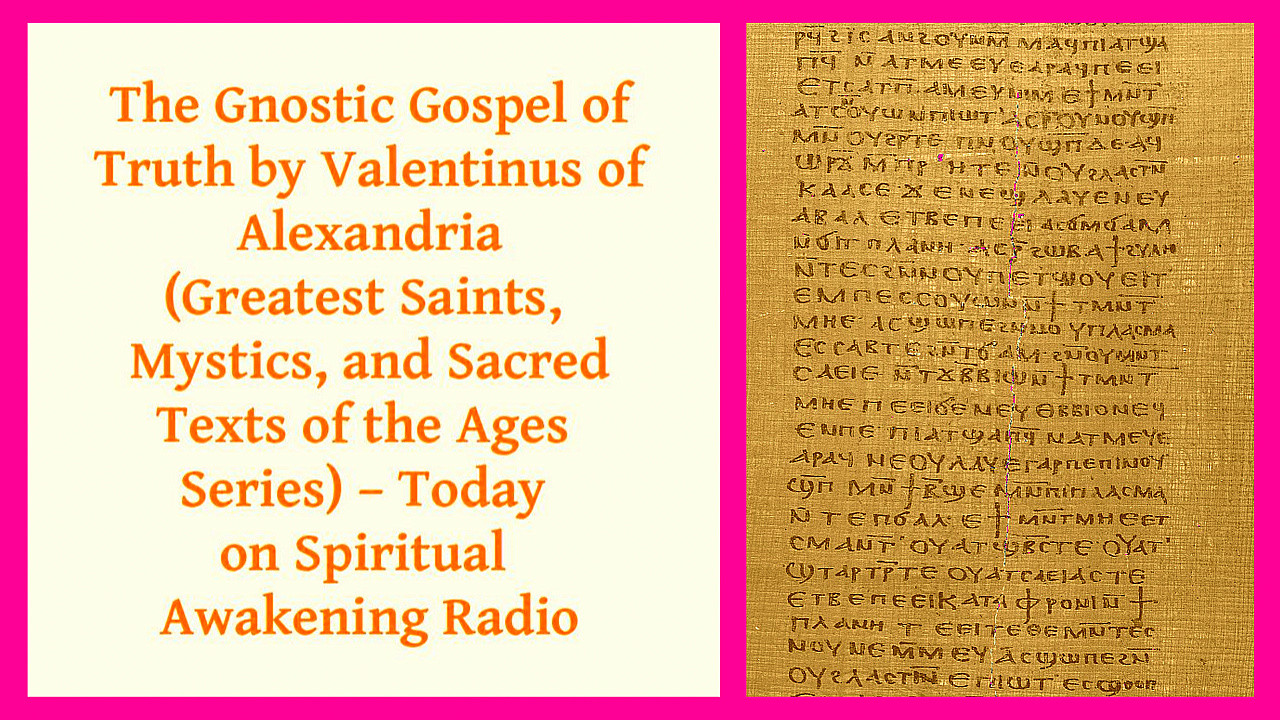
PODCAST: The Gnostic Gospel of Truth by Valentinus (Greatest Saints and Mystics of the Ages Series) -- Today on Spiritual Awakening Radio With James Bean: https://youtu.be/bKzfhCwbfew
#GospelOfTruth #Valentinus #GnosticGospels #Gnostic #Gnosis #Valentinians #TheNagHammadiLibrary #NagHammadiLibrary #JungCodex #GospelOfThomas #MaharshiMehi #SantMat #Sant_Mat #Radhasoami #PathOfTheMasters #SpiritualAwakeningRadio #Podcasts #Spirituality #SpiritualTalks #SpiritualPodcasts #SpiritualRadio
Client Info
Server: https://mastodon.social
Version: 2025.07
Repository: https://github.com/cyevgeniy/lmst