#TopSpeed

Arnd Layeriamlayer8
2026-01-11

I’ve just been thinking about this:

I have no idea how performant my car is because I’m practically only accelerating using . I also never switch out of .

and have ceased being the least buying factor.

2026-01-06

the most innovative is probably the naming ID.EVERY1 (haha get it? everyONE) well... can it fly? no
youtu.be/my3kVExPfg8 #omg #germany #vw the most boring possible #presentation of a new #car #ev possible

#NetRange 250km (155 miles)
#ReleaseDate 2027
#MotorPower 70 kW (95 PS / 94 HP)
#TopSpeed 130 km/h (81 mph)
Price ~ 20000 bucks

visionbitesvisionbites
2026-01-05

🎉Website-Relaunch für Elterntalk NRW 🔄💻

Dank der Migration von WordPress zu besticht das System jetzt mit maximaler , Nutzererfahrung und .

⏩ Mehr über den Web-Relaunch: visionbites.de/blog/website-re

The Last Psion | Alexthelastpsion@oldbytes.space
2025-12-21

For the first time in ages, I've had a good afternoon writing code!

I've been working on #ecobj. I can now analyse six OMF record types (well, five and a bit) using some rough-and-ready Pascal. And I've started to get a picture of how the original ECOBJ.EXE moves the records around.

As far as I know, there are 10 record types that ECOBJ.EXE handles. So I'm over halfway there. Sort of.

Using the #TopSpeed Object Disassembler (TSDA) has really helped to make sure I'm heading in the right direction. #DOSBox makes this easy by letting me send the output from TSDA.EXE to a file, so I can view it on Linux.

Two panes in tmux, both displaying text files using bat. On the left is output from TSDA, on the right is the output from the new ECOBJ. There is a list of extrn statements on the left that correspond with EXTDEF OMF records on the right.
The Last Psion | Alexthelastpsion@oldbytes.space
2024-12-27

Someone asked me some questions on the #Psion Series 3, so I thought I'd post my response here in case anyone else is interested. #LongRead

Emulator

You've got two options. The first is the original "emulators" written by Psion, S3AEMUL.EXE and S3CEMUL.EXE. They both run in DOS and emulate the 3a and 3c. But they're less of an emulator than a runtime environment for #EPOC16 (the OS). There's good and bad to this. You can run S3AEMUL and S3CEMUL straight in #DOSBox and it will talk to your host OS's filesystem (Windows, Linux, macOS, whatever). You need to map an M: drive in DOSBox for the internal storage, but once that's done you can copy files straight into that folder on your host OS and run them in the emulators. The downside is that it's not true hardware emulation. You won't get a good judge of the speed of a real device, and some syscalls aren't implemented so will fail or crash the #emulator. They're bundled with the SDK (see below).

The alternative is #MAME. This is the closest to proper hardware emulation you're going to find. You can either dump your own ROMs using a tool called #EDisAsm, or you can find them in the usual MAME ROM repos. The one thing that is notably missing is RS232 emulation from the later models, because we haven't been able to find any documentation on the silicon, but it's working fine with the 3a.

Toolchain

At the moment you have only one option - the Psion SIBO C SDK with the #TopSpeed C Compiler. You're going to need DOSBox (I personally prefer DOSBox Staging). It's all available on the Internet Archive in one easy download, including all the documentation you will need.

archive.org/details/psion-sibo

From there, you have a few libraries you can use. There CLIB, which is a pure ANSI C implementation, designed to easily port apps - don't use it, it's slow and you'll be missing a lot of features. Then there's PLIB, which is Psion's C dialect - very nice to use, and you can put together a C app pretty quickly. Finally, there's OLIB, which is Psion's proprietary OO C - it feels very clunky, but once you get over that it can be very powerful.

EPOC16 apps are restricted to a very pure version of the small memory model, but you can split code up into libraries known as DYLs.

In the past I've written code using VS Code, which can be made to play nicely with the SDK's header files. I've not got it working with NeoVim and clangd yet, but it should be possible with cmake.

The SDK comes with a debugger (SDBG.EXE), a DOS GUI app. If you run SDBG.EXE in DOSBox Staging, run the Psion3a MAME emulation, and enable RS232 over TCP on both, you can use SDBG to send apps to MAME. If you enable symbols, you can step through the code. It's rudimentary by modern standards, but it works pretty well.

I say "at the moment" because I'm slowly rewriting the tools in the SDK. I already have a new working version of #CTRAN, the preprocessor for Psion OO C, but I'm a long way from a compiler. There have been efforts to coax gcc into compiling for SIBO/EPOC16, but I think they have stalled for now.

If you want some examples of EPOC16 C and OO C code, take a look at these:
github.com/thelastpsion/edisas
github.com/thelastpsion/pyrami
github.com/thelastpsion/nfsc
github.com/nickmat/Psion3-Wari
github.com/nickmat/Psion3-Vect

Device

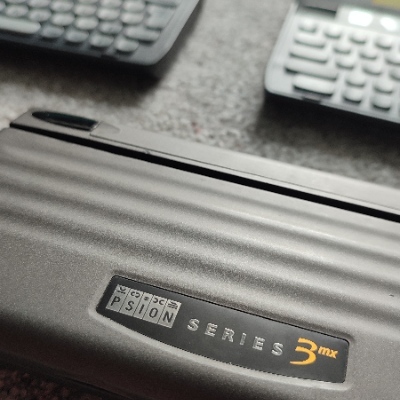
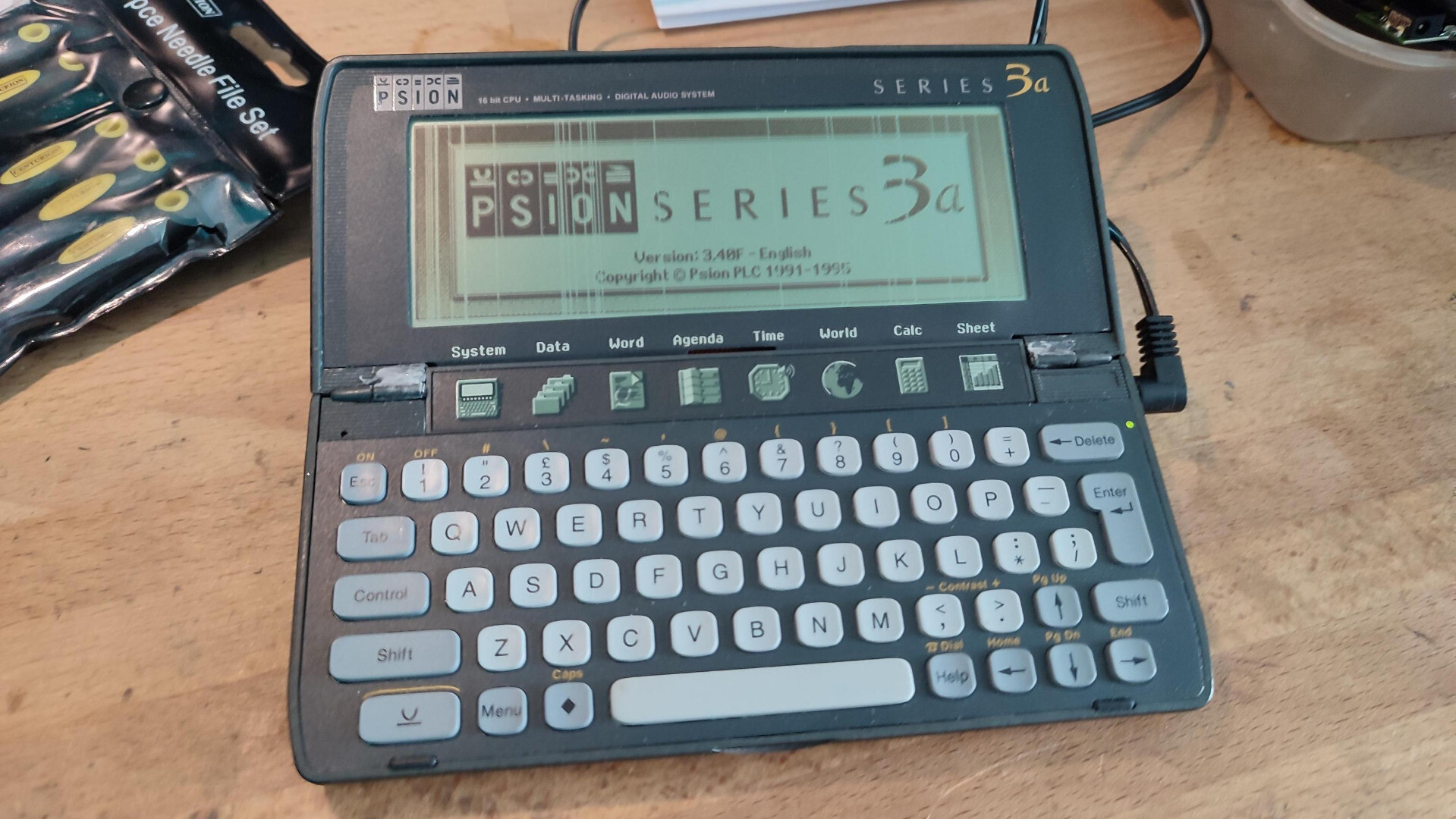
The 3mx is the best choice. It's significantly faster than the earlier models (27.6 MHz vs 7.6 MHz), has a switchable backlight, the fastest RS232 and the best version of EPOC16. I "daily drive" one for journalling, adventure games, and a few other small tasks. After that I'd say the 3c (beware - they were covered in soft-touch rubber, so will need cleaning) and the 2MB 3a. The latter is the most common. Most 3c units came with a backlight, except for the early UK ones. The 3a doesn't. Arguably the non-backlit screens have better contrast so you don't need the backlight so much in lower light, but the backlight has obvious benefits.

#RetroComputing #RetroDev #16bit

EV FutureEVfuture
2024-11-12

BYD’s YangWang U9 hits an impressive 243 mph, setting new standards in electric supercar performance. Speed, power, and innovation combined. ⚡️🏎️

evfuture.io/from-192-mph-to-24

The Last Psion | Alexthelastpsion@oldbytes.space
2024-10-28

REPOST (JAN 2024): My first thoughts on #Psion's dialect of Object Oriented C for the Series 3 and related portable computers.

Includes the JPI/Clarion #TopSpeed #compiler, a proprietary preprocessor, the Eiffel programming language, and a handful of calling conventions.

Also, did somebody say Objective-C?

This is an old blog post from the beginning of the year. If you've been following my journey in recreating #CTRAN, this was written a week before I decided to take the plunge.

hackaday.io/project/161291-the

(Yes, I did say in the article that I definitely wouldn't be writing a compiler. I did say that.)

#RetroComputing #EPOC16 #CDECL #Clarion #TopSpeed #TopSpeedC #RetroProgramming #RetroDev #Smalltalk #ObjectPascal #preprocessor #Eiffel #OOP #ObjectiveC #compilers #ObjectOriented

The Last Psion | Alexthelastpsion@oldbytes.space
2024-10-28

Here's something I wish would be open sourced.

The #TopSpeed C #compiler is an integral part of the #Psion SIBO C SDK.

Old timers might remember JPI as a group of developers who left #Borland in 1987, after Borland decided not to use the team's new compiler technology. They took their code with them, and it became the TopSpeed compiler.

From what I gather, the TopSpeed compiler IP is now owned by #SoftVelocity, the company who now also owns Clarion. I emailed them about 6 years ago, asking them if they would consider open sourcing the compiler code. I got no response, which I guess is to be expected.

I even found someone who had a copy of the source code (written in Modula-2), but they understandably wouldn't give it to me without the IP owner's approval.

This is the situation with so many bits of software (including the SIBO C SDK tools) from this time. We are lucky that copies of the applications still exist, otherwise the job of building C software for #EPOC16 would be significantly more difficult. But it is likely that the original source code, along with many other codebases, will disappear thanks to copyright laws that don't support digital preservation.

#retrocomputing #vintagecomputing #digipres

Screenshot of the TopSpeed Multi-Language Programming Environment for DOS, by JPI/Clarion/TopSpeed Corporation.
2024-06-20

The Aspark Owl SP600 just made history! Unofficially becoming the world's fastest EV, it hit a top speed of 272.6 mph (438.73 km/h) on a long road in Germany. With a 64kWh battery, 2,012bhp, and 1,475 lb-ft of torque, this Japanese electric supercar is a force to be reckoned with. Developed by Manifattura Automobili Torino, the Owl SP600 has undergone rigorous testing to achieve this milestone.

#AsparkOwl #ElectricVehicle #FastestEV #Supercar #SpeedRecord #AutomotiveNews #EVRevolution #Aspark #TopSpeed #ElectricSupercar

The Last Psion | Alexthelastpsion@bitbang.social
2024-05-03

Thinking again about contacting companies regarding access to legacy code/docs.

- SoftVelocity (#TopSpeed compiler)
- Zebra (#Psion SIBO/EPOC16)

Ideally, it would be released under a FOSS or CC license, but I know there could be legal hurdles preventing this. e.g.: if licensed code was included, it's never going to happen.

It would at least be good to be allowed to see code for educational use or derivative works.

I've tried in the past but not got far. Maybe I need to push more?

SpazioGames.itspaziogames
2024-04-11

🚀 "Aprile 2024: Scegli la Micro SD perfetta per il tuo ASUS ROG Ally! "

🔗 spaziogames.it/articoli/miglio

The Last Psion | Alexthelastpsion@bitbang.social
2024-03-18

Just tried compiling Wari, a game written in #Psion OO C. The project uses #Borland Make 3.6.

Got it to compile first time with my SIBO SDK setup - all good!

However... Borland Make uses 16-bit DPMI, and its extender won't load 32-bit DPMI binaries. If I pre-load the 32-bit extender, it won't load 16-bit DPMI binaries, so Make won't run!

TL;DR: I can't use the new #ctran with Borland Make 3.6.

Looks like I'll be converting that Makefile to GNU Make or a #TopSpeed project.

#dos #dosbox

The Last Psion | Alexthelastpsion@bitbang.social
2024-01-05

ICYMI: My first thoughts on #Psion's dialect of Object Oriented C for the Series 3 and related portable computers.

Includes the JPI/Clarion TopSpeed compiler, a proprietary preprocessor, the Eiffel programming language, and a handful of calling conventions.

Also, did somebody say Objective-C?

hackaday.io/project/161291-the

#RetroComputing #EPOC16 #CDECL #Clarion #TopSpeed #TopSpeedC #RetroProgramming #RetroDev #Smalltalk #ObjectPascal #preprocessor #Eiffel #OOP #ObjectiveC

The Last Psion | Alexthelastpsion@bitbang.social
2023-12-24

Thought I'd have a quick look at converting the #TASM code in #EDisAsm to #TopSpeed #assembler. It would get rid of a dependency, which can't be a bad thing. And it can't be that hard, right?

Nope! Much harder than I thought! 😂

Here's a link to an excerpt from the TopSpeed Advanced Programmer's Guide (I can't find the whole thing). It has thoroughly confused me and made me realise I should just go back to my main quest.

clarionhub.com/t/unfinished-te

#assembly #x86 #psion #RetroComputing #RetroDev

Client Info

Server: https://mastodon.social
Version: 2025.07
Repository: https://github.com/cyevgeniy/lmst