#Resume

Winter Reruns: “If an Agency Sends You a Role You Aren’t Interested in It is Better to Reply and Explain the Reasons Why Not, So the Agency Can Get a Closer Match Next Time”

I’m taking time off! I’ll be back with new content in late February. Take this survey to share your opinions about what would be most helpful/interesting. While I’m out, I’m running a selection of Hiring Librarians’ greatest hits and most reviled posts.

This is another high-viewed post, which first ran on June 25, 2012. It is from a series of posts I called Recruiter Spotlight, which, as the name may tell you, were interviews with people who worked as recruiters in the LIS field (I’d be happy to restart this, so if you’re a recruiter and you want to be interviewed, shoot me an email at hiringlibrarians at gmail and I’ll respond just as soon as I get back).

Nicola also answered many questions for Further Questions. She has since shifted industries and is no longer recruiting for LIS; her update is included in the post Job Hunter’s Web Guide: Sites of Yore.

This interview is with independent recruiter Nicola Franklin. Her firm, The Library Career Centre, provides recruitment services for employers as well as for-pay candidate services such as CV / resume writing and interview coaching. Ms. Franklin has been in the library recruitment field for 20 years.  Prior to striking out on her own, she worked with Manpower pls, Sue Hill Recruitment, and then the international firm, Fabric.  She is a fellow of the Recruitment & Employment Confederation and member of the Special Libraries Association.

Questions about Recruitment:

Can you give us a brief run-down of how a recruitment firm works? 

When you send your CV or resume to register with a recruitment firm, they will generally invite you for an interview (phone/skype or in person depending on distance, etc) and your CV/resume will be added to a database.  Your file on the database will usually also have notes of your interview and some codes or classification tags added, covering basic categories such as locations, salary bands, qualifications, industry sectors and skills.

When a recruiter gets a new vacancy from a client, they will use the codes to search the database, to gather a ‘long list’ of potential candidates.  In most library firms, the consultant will then look through the resumes and interview notes for each of those candidates, matching more closely between the job requirements and each candidate’s’ skills and requirements.

This weeding process will create a slightly shorter long-list, and it is those people who will be contacted  (either by a mail-merge email or on the phone, depending on how many potentially suitable people make the list).  Some of those contacted will either not reply at all, or will decline to apply for the role, leaving a short-list.  It is important for candidates to realise that their response (or non response) will be recorded; if an agency sends you a role you aren’t interested in it is better to reply and explain the reasons why not, so the agency can get a closer match next time, rather than to ignore it.  On the one hand, the agency will be no wiser as to what would interest you, and on the other (after several tries at contacting you) the agency may assume you’re no longer looking and archive your file.

In some cases all of those on the short-list will be submitted to the client, in other cases the consultant will sift the list further to reduce the numbers – a consultant would generally want to send between 3 and 10 resumes to their client, depending on what’s been agreed.  In most cases, the consultant will either also submit a report on each candidate, explaining why they’re a good fit for the role, or call or visit the client to present each candidate verbally.  This is really where the value of having a recruiter work for you shows through, as you have someone rooting for you and trying to persuade the hirer to interview you!

What types of vacancies are you most frequently placing candidates in?  In what types of organizations?

I cover all part of the wider information industry, including traditional library roles in public or academic settings, information or knowledge management in government and the private sector, and records management across  all kinds of organisations.

Increasingly there has been a merger of these different disciplines, especially at more senior levels.  In the UK there has been a marked decrease in roles in the public sector over the past two or three years, while the private sector declined earlier than that and has since been recovering (albeit slowly).

The main problem caused by the recession has been a dearth of mid-level roles. There have been some entry-level roles still being recruited, and organisations have generally replaced senior or very specialist  roles, but they often seem to feel they can ‘make do’ with fewer Assistant Librarians or Information Officers.  This has made career development very difficult for many people, especially as this situation has persisted since 2008.

What should candidates do differently when applying to a recruitment firm?  Is there anything they should be sure to include with you that they wouldn’t tell a direct-hire job, etc.?

A resume or CV for a recruitment firm should be slightly longer and more detailed than when sending it direct to a hirer.  In the latter case you are tailoring it specifically for that role, while for an agency there may be several types of role you’d like to be considered for and so your resume needs to reflect a broader range of your skills and experiences.  Also remember that some agency databases can search CVs for keywords, so make sure the ‘jargon’ keywords or acronyms are included (something I’d be advising against for a CV to be sent directly to a hirer).

At the interview stage with an agency, be sure to tell your recruiter honestly about any gaps or any issues you have had (eg a personality clash with a colleague or manager).  They will be able to advise you on how to best present things at an employer interview.

Are there particular qualities or experiences that will give a candidate an edge in being considered for positions you are trying to fill?

The main quality to display is enthusiasm.  Librarianship isn’t a role most people get into for the monetary rewards, and hirers expect candidates to be passionate about what they’re doing.  Coming across as fed up, bored or even worse hostile, is a sure way to make a consultant think twice when deciding whether to put you forward to their client.  You need to make sure they will feel confident representing you.

Secondly, candidates who have a realistic appreciation of their skills and aptitudes, and clear career goals, are easier for both recruiters and hirers to assess and fit into their open vacancies.  Spending time doing an audit of your skills and reflecting on what you have to offer, and also where you want your career to go, will pay off dividends later.

Once an initial placement has been made, what should a candidate do to keep on good terms with your agency (in order to ensure future placements)?

It’s good to keep in touch with your recruitment agency, from an initial call or email to let them know how you’re settling into your new role to an update later on.  You never know when you might need their services again!  I attend many library and information sector specialist group’s networking events and seminars, and it’s always nice when candidates come up and say hi.  Recruiters are used to being discrete, so don’t be afraid one will say ‘are you looking again’ or anything embarrassing while your boss is nearby!

Is there anything else you’d like my readers to know about recruitment agencies or the Library Career Centre?

I set up The Library Career Centre so that I could offer services over and above the standard recruitment process described above.  During my 20 years in the library recruitment sector, I had noticed that candidates often needed guidance on improving their resume, or their interview technique could do with some tweaking, or they simply had difficulty articulating what skills they had to offer or what their career goals were.

During a recruitment agency registration interview there is only about half an hour to gather all the information the consultant needs on career history and future goals – which doesn’t leave much time to give advice.  The Library Career Centre therefore offers support and advice directly to candidates on all these areas, in a more relaxed atmosphere where we can take time to explore issues more carefully.  This support is offered via 1-1 coaching as well as workshops and seminars.   The 1-1 services are designed on a modular basis, so a job seeker can pick and chose to get help on just those areas they are struggling with, or can put together a programme of support to suit their own needs.

I also use social media a great deal to keep up to date with issues and in touch with people – @NicolaFranklin on Twitter or http://uk.linkedin.com/in/nicolafranklin on LinkedIn, and I make regular posts on my blog.

Questions from the survey:

What are the top three things you look for in a candidate?

Relevant experience and skills for the role in question

Open minded and keen to continue learning

Enthusiasm and energy

Do you have any instant deal breakers, either in the application packet or the interview process?

Body language or answers which contradict claims made on the resume/application form, eg; ‘great interpersonal sills’ on the resume coupled with awkward/introverted body language, or ‘excellent ICT skills’ on the resume coupled with obvious inability to use tabs or other formatting tools in Word.  Quite apart from the skills that were claimed which may be lacking, the mere fact of making exaggerated or untrue claims show either (at best) poor self awareness or (at worst) dishonesty.

What are you tired of seeing on resumes/in cover letters?

Profile statements which are clearly regurgitated cliches, and don’t show any correlation between the applicants touted attributes and those required for the job.

Is there anything that people don’t put on their resumes that you wish they did?

Achievements – most resumes recount experiences or duties, some add in skills or attributes, very few include achievements (ie, how did the organisation benefit from having hired the applicant).

How many pages should a cover letter be?

√ Only one!

How many pages should a resume/CV be?

√ Two is ok, but no more

Do you have a preferred format for application documents?

√ No preference, as long as I can open it

Should a resume/CV have an Objective statement?

√ Yes

If applications are emailed, how should the cover letter be submitted?

√ I don’t care

What’s the best way to win you over in an interview?

Be engaged with the role and organisation; demonstrate that you’ve done (good quality) research about the organisation, understand the role requirements and have put some thought into how your skills match up to the tasks in the job.

What are some of the most common mistakes people make in an interview?

Not having done enough preparation, even for obvious questions like ‘why would you be good for this role’ or ‘where do you want your career to be in 5 years’.

How has hiring changed at your organization since you’ve been in on the process?

Over the past 20 years library recruitment has shifted emphasis away from a need to have used all the specific databases/cataloguing standards/etc of the hiring organisation, and towards more generic aptitude and ability to learn packages and systems.

Anything else you’d like to let job-seekers know?

Make sure you have plenty of questions to ask the interviewer too!  An interview should be a two way communication, as you need to know whether you’d like to work in this place, if you are fortunate to receive an offer.  Also, having no questions to ask when invited to do so is a sure way of saying ‘I’m not really interested in this job’ to the interviewer.

#CurriculumVitae #Employment #EmploymentAgency #Librarian #Résumé #Recruiter #Recruitment #SpecialLibrariesAssociation

Florence LaDue,ca.1910-1915Nicola Franklin
2026-02-03

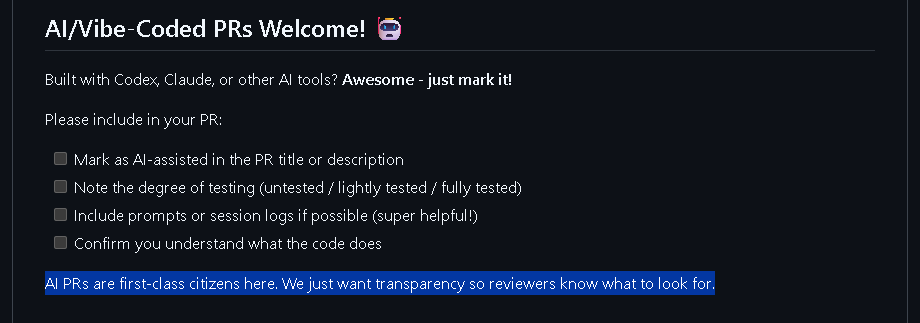
This is part of the @openclaw contribution docs 👍

#Transparency helps reviewers help contributors to better their code, whether you generated it using AI or coded it yourself, the feedback you receive to improve; for the reviewers to communicate that, well you need to be transparent

#software #engineer #code #programming #programmer #openclaw #opensource #job #softwareengineer #clawdbot #clawbot #moltbook #contributor #skill #talent #hiring #job #resume

Openclaw contribution docs, section saying they accept AI generated code as first class citizens, but requires the contributors to be transparent about it, so the reviewers know what to expect for and how to further communicate to help you the contributor to improve your contribution
Dr Pam Russellprserve
2026-02-02

PRS provides God inspired solutions. Whatever you need, if we can't help you, we will assist you in finding someone who can. , , # non-profitdevelopment, , ,

I'm sure similar tools exist, but I had fun building a resume generator that creates a PDF from YAML data, styled with HTML + CSS.

github.com/thwbh/curricu-loom

#python #resume #cv #resumeTemplates

2026-01-28

ProfileOS – Developer Resume Template
A terminal-inspired CV for modern tech professionals

template

ProfileOS – Developer Resume Template
2026-01-28

Mệt vì phải tự viết lại CV cho mỗi vị trí? Một dev đã code công cụ tự động phân tích mô tả công việc và chỉnh sửa bullet points trong CV bằng Next.js + Gemini API, hỗ trợ PDF parser không làm mất định dạng và tốc độ parsing nhanh. Bạn nghĩ sao? #côngnghệ #AI #resume #CV #ATS #NextJS #Gemini #automation #AIđánhgiá

reddit.com/r/SaaS/comments/1qp

dr 🛠️🛰️📡🎧:blobfoxcomputer:davidr@hachyderm.io
2026-01-27

A friend of an aunt interviewed my kid for a job. She then said she'd pass it on to her boss for a potential hire and also her (the friend's) husband for resume advice.

Since then, radio silence

In our house there is disagreement as to next step.

Opinion #1: Just wait. This is a family friend situation--they aren't going to just forget about you. You'll hear back. (Sub-opinion: If you can think of a reason to contact them about something else to remind them you exist, do that.)

Opinion #2: The friend was previously unknown to us and had no particular connection other than the aunt. The boss and husband even less so. If something came up or the email scrolled down their inboxes a ways, it is effectively gone. Send a polite "have you heard anything?" followup ping to the friend.

#management #hiring #employment #job #ettiquette #work #resume

Frank CookiefoxFrankCookiefox
2026-01-27

Comic #5: The Job Market

Frank is on a quest to find work. Unfortunately, as the signs call, the job market in a modern era is a lot harder than you think, and almost no employer wants to hire you.

The fox in overalls and cap is handing over a resume to a tiger who works in the hiring department, only to be rejected immediately after viewing the fox's resume. Then, the fox shed a tear for his loss of a job opportunity.
2026-01-27

Recruiters spend 6–8 seconds on a resume.
This one makes every second count ⏱️

Clean.
ATS-friendly.
Recruiter-ready.

Build yours free in cviya

ui ux designer cv
2026-01-25
Do Recruiters Really Care About the Resume Design?
2026-01-25

Do Recruiters Really Care About the Resume Design?

Visual competence acts as your silent ambassador before you ever enter the interview room. You simply cannot separate the message from the medium in professional communication. Therefore, resume design dictates how a recruiter perceives your professional value within seconds. Most candidates mistakenly believe that content alone carries the weight of their application. However, a messy layout instantly signals a lack of attention to detail. Consequently, the recruiter rejects the application without reading a single bullet point. We call this phenomenon the “Cognitive Friction Index.” This metric measures how much effort a human brain requires to process your document.

High friction leads to immediate rejection. Conversely, excellent resume design smooths the path for the reader. It transforms complex career data into digestible insights. Thus, designers and creatives must prioritize structure over mere decoration. We will analyze the specific mechanics of successful CVs. This article introduces the “Functional Clarity Matrix,” a framework for evaluating your document’s effectiveness. We will also explore why professional tools like Adobe InDesign outperform basic text editors.

Do recruiters really care about the resume design or just the data?

Recruiters absolutely care about resume design, but not for the reasons you might think. They do not look for artistic flair or decorative elements. Instead, they seek efficiency, hierarchy, and immediate readability. A recruiter reviews hundreds of applications daily. Therefore, they develop a subconscious filter against clutter. Your resume design must respect their time.

The “Six-Second Scan Barrier”

Industry data suggests recruiters spend approximately six seconds on their initial scan. We define this critical window as the “Six-Second Scan Barrier.” Your resume design must communicate three things within this timeframe. First, it must show your role. Second, it must display your current company. Third, it must highlight your total years of experience. If your layout hides this data, you fail the test. Consequently, the recruiter moves to the next candidate.

Layout structure serves as the primary tool to break this barrier. You should use a grid-based approach. This technique organizes information into logical zones. For example, a sidebar for skills allows for quick scanning. Meanwhile, the main column details your work history. This separation reduces the cognitive load on the reader. Furthermore, clear section headers act as signposts. They guide the recruiter’s eye exactly where you want it to go. Thus, good resume design effectively manipulates the reader’s attention.

The “Visual ROI” of Typography

Typography constitutes the backbone of effective resume design. However, many creatives choose fonts based on personality rather than legibility. This mistake destroys your Visual ROI (Return on Investment). You must prioritize high x-height sans-serif fonts or sturdy serif fonts. For instance, Helvetica, Proxima Nova, or Garamond work exceptionally well. They remain readable even at small sizes.

Bad typography hurts your credibility. Specifically, tight leading (line spacing) makes text look like a solid block. Recruiters ignore text blocks. Therefore, you must increase leading to let the text breathe. Additionally, kerning (letter spacing) matters. Poor kerning suggests a lack of professional polish. As a creative, you cannot afford these micro-errors. They scream incompetence. Your resume design ultimately proves your mastery of visual communication principles.

Why does ATS compatibility dictate your layout choices?

You face a machine before you ever face a human. Applicant Tracking Systems (ATS) parse your document to extract data. Unfortunately, complex resume design often confuses these bots. If the ATS cannot read your file, the human recruiter never sees it. Therefore, we must discuss the “ATS-Aesthetic Equilibrium.”

The “ATS-Aesthetic Equilibrium”

This framework requires you to balance visual appeal with machine readability. You might want to use infographics to show your skills. However, an ATS sees a graphic as a blank space. Consequently, your skill rating drops to zero. You must use text to describe your skills. A simple bar chart is fine for humans, but back it up with keywords.

Additionally, columns cause parsing errors in older systems. The bot might read straight across both columns, jumbling your text. Therefore, modern resume design favors single-column layouts for the main content. Alternatively, you can use robust header tags to define sections. Professional software handles this tagging better than word processors.

Keywords are design elements

You must treat keywords as vital components of your resume design. They need visual prominence. Do not bury technical skills in a dense paragraph. Instead, list them clearly. Bold your job titles. Use bullet points to separate achievements. This structure helps both the bot and the human. Furthermore, it integrates SEO principles into your personal branding. You are essentially optimizing your paper website for a search engine.

How does Visual Hierarchy influence the recruiter’s decision?

Visual hierarchy tells the reader what matters most. Without it, your resume design becomes a flat, monotonous list. You must establish a clear order of importance. Name and title come first. Experience follows. Education usually comes last for experienced professionals.

Implementing the “Z-Pattern Layout”

Western readers scan content in a Z-pattern. They start top-left, move across, cut diagonally, and read across the bottom. Your resume design should leverage this natural behavior. Place your most critical value proposition in the top-left quadrant. This area acts as prime real estate. Do not waste it on a massive logo. Use it for your summary or current title.

Contrast creates hierarchy. You should use bold weight for titles and regular weight for body text. However, avoid using more than two font families. Too many fonts create visual noise. Consistency creates trust. A chaotic resume design implies a chaotic employee. Conversely, a structured layout implies an organized mind.

White space is a functional asset

White space is not empty space; it is an active design element. It provides the eye with a resting place. Furthermore, it groups related information. Tight margins make a document feel claustrophobic. You should use generous margins to frame your content. This approach elevates the perceived value of the document. It looks sophisticated. It looks intentional. Therefore, mastery of white space defines premium resume design.

Why should you use professional InDesign templates?

Many candidates rely on generic Word templates. However, these tools limit your creative control. They frustrate users with jumping text and rigid formatting. For a truly professional resume design, you need professional software. Adobe InDesign remains the industry standard for layout.

This professional resume template for Adobe InDesign was designed by Roverto Castillo. Download the template from Adobe Stock

The precision of InDesign

InDesign offers pixel-perfect control over typography and grids. You can set global styles for headers and body text. This feature ensures absolute consistency throughout the document. Moreover, InDesign handles PDF export better than any other tool. It preserves layers and text tags. This aids in maintaining ATS compatibility.

Customization vs. Cookie-Cutter

Using a pre-made template is acceptable, provided you customize it. High-quality resume design templates for InDesign provide a strong foundation. They set up the grid and styles for you. Then, you inject your personality. You adjust the color palette. You refine the typography. This process saves time while ensuring a unique result.

Visual creatives must demonstrate their software skills. Submitting a Word document suggests you do not know the Adobe Creative Cloud. Therefore, using InDesign serves as a portfolio piece in itself. It proves you know how to handle professional typesetting.

What are the future trends in resume architecture?

We predict a shift toward “Hybrid-Interaction Resumes.” These documents function as static PDFs but contain live links to deep portfolios. The resume design of the future acts as a portal. It serves as a landing page for your professional identity.

The rise of “Modular Content Blocks.”

Future resume design will rely on modularity. You will swap content blocks based on the specific job application. This approach allows for hyper-personalization. You retain the core design structure but modify the narrative. This strategy aligns with the “Answer Engine Optimization” trend. You answer the specific needs of the employer directly.

Furthermore, we anticipate the decline of the “objective statement.” It will be replaced by a “Value Proposition Header.” This section will focus on what you offer, not what you want. Your resume design must highlight this proposition visually. It needs to pop off the page.

Authenticity through minimalism

Complex visuals will fade away. “Functional Minimalism” will dominate the landscape. This style strips away all non-essential elements. It focuses entirely on data clarity. Recruiters prefer this style because it is honest. It hides nothing. Therefore, the best resume design is often the simplest one.

FAQ: Common Questions About Resume Strategy

Is a two-column resume design bad for ATS?

Modern ATS can parse two-column layouts if the backend structure is correct. However, single-column layouts remain the safest bet for older systems. If you use columns, ensure you use distinct text boxes or tables.

Should I include a photo in my resume design?

In the US and UK, you should generally avoid photos to prevent bias. However, in many European countries, a professional photo is standard. Always research the specific cultural norms of the target company.

Which font is best for a modern CV?

Clean sans-serif fonts like Helvetica, Roboto, or Open Sans offer the best readability. They render well on screens and in print. Avoid decorative scripts or Times New Roman, which looks dated.

How long should my resume be?

For most professionals, one page is ideal. However, senior creatives with extensive experience can use two pages. Your resume design should never sacrifice readability just to fit on one page.

Can I use color in my resume design?

Yes, but use it strategically. Use color to highlight headers or key data points. Do not use color for body text. Stick to dark, professional colors like navy, charcoal, or forest green.

Do creative resumes work for non-creative jobs?

Generally, no. Conservative industries prefer traditional layouts. However, a clean, well-typeset resume design works universally. Good design is invisible; it just looks professional.

How do I check if my resume design is ATS-friendly?

Convert your PDF to a plain text file. If the text stays in the correct order, it is likely readable. If the text jumbles, you need to simplify your layout structure.

Check out WE YND THE COLOR’s Graphic Design and Templates categories for more.

Subscribe to our newsletter!

[newsletter_form type=”minimal”]

#AdobeInDesign #AdobeStock #cv #resume #resumeDesign #resumeTemplate

Professional Curriculum Vitae Template for Adobe InDesignProfessional Curriculum Vitae Template for Adobe InDesign
2026-01-24

Đã ra mắt ResumeLint – công cụ AI kiểm tra CV dành cho lập trình viên. Đánh giá khả năng ATS, điểm phù hợp Full‑Stack, gợi ý từ khoá còn thiếu (Docker, CI/CD, Kubernetes), phản hồi chi tiết từng mục và ví dụ cải thiện câu mô tả. Không lưu dữ liệu, không cần đăng nhập. #AI #Resume #CV #Developer #Côngnghệ #Lậptrình

reddit.com/r/SideProject/comme

2026-01-24

USB Keyboard Wake-Up Causes System Freeze on Resume (Ubuntu 24.04.03) #2204 #suspend #freeze #hibernate #resume

askubuntu.com/q/1563179/612

2026-01-23

Bạn mệt mỏi vì phải sửa CV liên tục? Một lập trình viên vừa phát triển công cụ tạo CV miễn phí, mã nguồn mở, không tài khoản, không phí. Nhập thông tin một lần, xuất nhiều mẫu Classic & Modern, ATS‑friendly. Muốn dùng hoặc có góp ý? #Resume #CôngCụ #OpenSource #ViệcLàm #JobSearch #CV #ResumeBuilder

reddit.com/r/SaaS/comments/1qk

2026-01-22

🛠️ Đã ra mắt AI Resume Tailor: tải lên CV PDF + mô tả công việc, nhận lại CV được tối ưu cho vị trí. Dùng GPT‑4o, giới hạn hàng ngày. Dự định mở nguồn, thêm mẫu, tùy chỉnh giao diện, tự động gửi đơn. Khó khăn: watermark SDK, kiểm soát độ dài trang. CV sẽ lưu trên server 24h và gửi tới OpenAI. Cần phản hồi và hợp tác! #AI #Resume #CôngNghệ #AIResume #CôngViệc

reddit.com/r/SideProject/comme

2026-01-22

🛠️ Một công cụ AI chỉnh sửa CV vừa ra mắt: tải PDF CV + mô tả công việc, nhận CV PDF đã được tùy chỉnh bằng GPT‑4o. Dự định mở nguồn, thêm mẫu, tùy chỉnh giao diện, tự động gửi đơn. Hiện gặp watermark SDK và giới hạn độ dài. Lưu ý: CV sẽ được tải lên server và gửi tới OpenAI, xóa sau 24h. Ai có ý tưởng hoặc muốn hợp tác, inbox nhé! #AI #Resume #CôngNghệ #ViệcLàm #OpenSource #JobApplication

reddit.com/r/SideProject/comme

Stephen Blumstephenblum
2026-01-22

Strong resume, strong profile, still no job, keep applying anyway.

ResumeSolvingresumesolving
2026-01-21

I started ResumeSolving because most resume advice fails exactly when your story gets complicated.

Gaps. Pivots. Crisis chapters.
Not “tips.” Missing pieces.

If your resume feels hard to explain right now, you are not alone.
I write about the parts most sites skip: resumesolving.com/

2026-01-20

🎥 #Resume: Doblete de Gabriel Jesus y liderato del Arsenal en la #ChampionsLeague. ¡Nadie los detiene! ✋🏼😎

Sharing the best of humanity with the world, one story at a time.upworthy.com@web.brid.gy
2026-01-20

Harvard researchers reveal the two-step approach to make an incredible first impression

fed.brid.gy/r/https://www.upwo

Client Info

Server: https://mastodon.social
Version: 2025.07
Repository: https://github.com/cyevgeniy/lmst