
This month, CTCS (IIT Madras) & @PIK_climate present a webinar:
📢: Performance-dependent network evolution for enhanced computational capacity
🎙️: Prof. Sudeshna Sinha, IISER Mohali, India
📅: February 23 | 20:30 IST | 16:00 CET | 10:00 EST
🔗: https://us06web.zoom.us/webinar/register/WN__ioNrqy2S9Kx74NE3Xuj7Q
#Complexsystems #phd #NetworkEvolution #ReservoirComputing #MachineLearning
#ReservoirComputing


For #ReservoirComputing lovers,I found a challenging #attractor, the Thomas':
dx = np.sin(y) - b * x
dy = np.sin(z) - b * y
dz = np.sin(x) - b * z
x += dx * dt
y += dy * dt
z += dz * dt
3k neurons yet 67% correlation. Here is the code for you https://github.com/alecrimi/magic_reservoir/blob/main/thomas_attractor_prediction.py
Li #attractor=chaotic vibes like Lorenz/Chen use its wild dynamics for #ReservoirComputing to process time series.
The truth: just use it because it looks cool⚔🏴☠️🌊
def dequan_li(x,y,z):
dx = a*(y - x) + y*z
dy = b*x - x*z+y
dz = c*z + x*y/3
return dx,dy,dz

Summer ☀️ read on Computo: a new publication on reservoir computing in R!
Reservoir computing is a machine learning approach that relies on mapping inputs to higher dimensional spaces through a non-linear dynamical system (the reservoir), for example using a deep recurrent neural network and training only its final layer.
In this new publication, Thomas Ferté and co-authors Kalidou Ba, Dan Dutartre, Pierrick Legrand, Vianney Jouhet, Rodolphe Thiébaut, Xavier Hinaut and Boris P. Hejblum present the reservoirnet package, which is the first implementation of reservoir computing in R (rather then the existing Python and Julia).
The article also serves as an introduction to reservoir computing and illustrates its usefulness as well as the usage of the package on several real-case applications, including forecasting the number of COVID-19 hospitalizations at Bordeaux University Hospital using public data (epidemiological statistics, weather data) and hospital-level data (hospitalizations, ICU admission, ambulance service and ER notes). On this example, the authors also show how the weights of the connection between the input and the output layers can be used to compute feature importances.
The paper and accompanying R code are available at https://doi.org/10.57750/arxn-6z34
reservoirnet is available at https://cran.r-project.org/package=reservoirnet
#machineLearning #reservoirComputing #Rstats #openScience #openSource #openAccess



Minimal Genetic Circuit for Cellular Anticipation
https://www.biorxiv.org/content/10.1101/2025.04.22.649979v1?rss=1
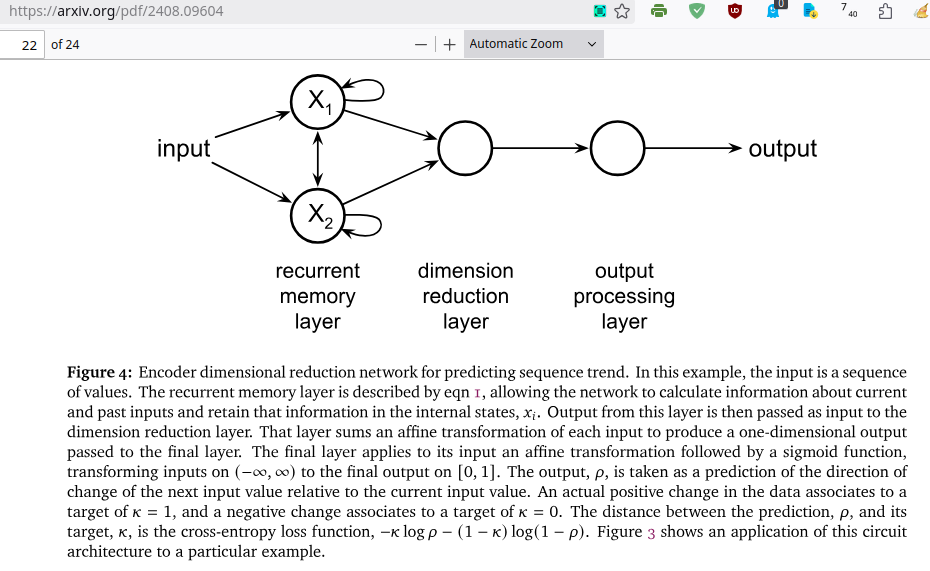
Circuit design in biology and machine learning. I. Random networks and dimensional reduction
https://arxiv.org/abs/2408.09604
Steven A. Frank
https://stevefrank.org/
https://en.wikipedia.org/wiki/Steven_Frank_(biologist)
https://en.wikipedia.org/wiki/Reservoir_computing
Biological circuit to anticipate trend
https://academic.oup.com/evlett/article/8/5/719/7697097
#SyntheticBiology #SyntheticCircuits #ReservoirComputing #EvolutionTheory #ML #DimensionReduction #biocomputing #SteveFrank

Die #DeutschePhysikalischeGesellschaft hat auf ihrer Frühjahrstagung der Sektion #KondensierteMaterie drei Physiker mit Forschungspreisen für ihre wissenschaftlichen Arbeiten an der #UniMainz ausgezeichnet.
🎉 Herzlichen Glückwunsch an Dr. Libor Šmejkal zum Walter-Schottky-Preis 2025, an Dr. Robin R. Neumann zum INNOMAG Dissertationspreis 2025 und Grischa Beneke zum INNOMAG Master-Preis 2025 👉 https://www.phmi.uni-mainz.de/auszeichnungen-auf-dem-gebiet-der-physik-der-kondensierten-materie-fuer-drei-jgu-physiker/
Updates on the 🧠#brain effective connectivity library.
1. Added #Reservoircomputing causality as nonlinear #Granger:
https://github.com/alecrimi/effconnpy/blob/main/effconnpy/nonlinearGC.py
2. Now lables on to the nodes
3. Added directionality shown with colors from blue to white (white as the arrows)
https://github.com/alecrimi/effconnpy/blob/main/effconnpy/vis_effconn_tracts.py
#simplicialcomplex + #Causality +#Reservoircomputing:
"Higher-order Granger reservoir computing: simultaneously achieving scalable complex structures inference and accurate dynamics prediction" https://www.nature.com/articles/s41467-024-46852-1

Energy-saving computing with magnetic whirls: Brownian #ReservoirComputing allows to detect human hand gestures on the basis of diffusion and displacement of #skyrmions // #physics #spintronics #magnetism #computing #TopDyn
@NatureComms @uni_mainz_eng
https://nachrichten.idw-online.de/2024/09/16/energy-saving-computing-with-magnetic-whirls

Erfolg beim energiesparenden Computing mit magnetischen Wirbeln: Brownsches #ReservoirComputing ermöglicht, Handbewegungen mit den Bewegungen eines Skyrmions zu erkennen // #Physik #Spintronik #Skyrmionen #Computing #TopDyn
@NatureComms @uni_mainz
https://nachrichten.idw-online.de/2024/09/16/erfolg-beim-energiesparenden-computing-mit-magnetischen-wirbeln
Physicists @unidue laid the foundation for magnetic #ReservoirComputing 7 years ago. Now, together with Norwegian colleagues, they have developed the idea for a ferroelectric version. @NatRevPhys reports.
https://nachrichten.idw-online.de/2024/07/03/pioneering-study-new-possibilities-for-reservoir-computing
Physicists @unidue laid the foundation for magnetic #ReservoirComputing 7 years ago. Now, together with Norwegian colleagues, they have developed the idea for a ferroelectric version. @NatRevPhys reports.
https://nachrichten.idw-online.de/2024/07/03/pioneering-study-new-possibilities-for-reservoir-computing
Physiker:innen @unidue legten vor 7 Jahren den Grundstein für magnetisches #ReservoirComputing. Jetzt entwickelten sie mit norwegischen Kolleg:innen die Idee zur ferroelektrischen Variante. @NatRevPhys berichtet.
https://nachrichten.idw-online.de/2024/07/03/richtungweisende-studie-neue-moeglichkeiten-des-reservoir-computings
with J.F. Roget, A. Onicas and F.Sarpong we got accepted to present @ #cosyne, see in Purtugal in February: "A systematic approach to unravel causal interactions in large #neuralsystems and #brain networks with #reservoircomputing", an evolution of https://www.biorxiv.org/content/10.1101/2023.06.08.544175v1 #neuro
#Brain #organoid reservoir computing for real world #ArtificialIntelligence .... tell me if this is not real science
https://www.nature.com/articles/s41928-023-01069-w?trk=feed_main-feed-card_feed-article-content
#AI #reservoircomputing synthetic #NeuralNetworks

Looks like advances in neural computing theory might have analog computing back with a vengueance. 🤯
#reservoircomputing #analog #computing #highdimensional #computingspace

"Emergence of a stochastic resonance in machine learning"
https://arxiv.org/abs/2211.09955
#MachineLearning #DynamicalSystems #Chaos #ChaoticSystems #ReservoirComputing #Optimization

Referenced link: https://techxplore.com/news/2022-11-optoelectronic-synapse-reservoir-based-alpha-indium.html
Discuss on https://discu.eu/q/https://techxplore.com/news/2022-11-optoelectronic-synapse-reservoir-based-alpha-indium.html
Originally posted by Phys.org / @physorg_com@twitter.com: https://twitter.com/TechXplore_com/status/1592525341301489665#m
RT by @physorg_com: A promising optoelectronic synapse for #reservoircomputing based on alpha-indium selenide @NatureElectron https://www.nature.com/articles/s41928-022-00847-2 https://techxplore.com/news/2022-11-optoelectronic-synapse-reservoir-based-alpha-indium.html
Referenced link: https://techxplore.com/news/2022-10-efficient-highly-memristor-based-reservoir.html
Discuss on https://discu.eu/q/https://techxplore.com/news/2022-10-efficient-highly-memristor-based-reservoir.html
Originally posted by Phys.org / @physorg_com@twitter.com: https://twitter.com/TechXplore_com/status/1582745553225453568#m
RT by @physorg_com: An efficient and highly performing #memristor-based #reservoircomputing system @NatureComms @NatureElectron https://www.nature.com/articles/s41928-022-00838-3 https://techxplore.com/news/2022-10-efficient-highly-memristor-based-reservoir.html
Client Info
Server: https://mastodon.social
Version: 2025.07
Repository: https://github.com/cyevgeniy/lmst