#ProtestHistory

Peaceful protest worked! The book shows the power of ordinary people against armed guards. Read the Revolution 1989 review.
#ProtestHistory #NonViolentAction #PowerOfThePeople #books
https://thisgrandpablogs.com/revolution-1989/

Summer of Soul: Ahmir “Questlove” Thompson's Oscar-winning documentary about the 1969 Harlem Cultural Festival presents a joyful celebration of Black history, culture and fashion.
Our Summer of Soul curriculum guide includes a history lesson about the civil rights movement, the Black Power movement, and African American activism of the 1960s. (Yes, it also touches on the 1965 Los Angeles Watts Riots.)
The film is for ages 13+ and the soundtrack is epic. The film has lots of international streaming options. 5/n
[Edited to add trailer]
https://journeysinfilm.org/product/summer-of-soul/
#SummerOfSoul #HarlemCulturalFestival #WattsRiots #Protests #ProtestHistory #USHistory #Education #Homeschooling #Documentary @film
Rebel Hearts is a hidden gem. It tells the story of the radical Catholic nuns in 1960s Los Angeles whose faith, defiance and activism turned the Church upside-down. They marched at Selma with MLK and they still fight for social justice today. Their story is incredible and it will fill you and your students with hope and fire. 4/n
https://journeysinfilm.org/product/rebel-hearts/
#LosAngeles #LA #Catholicism #CatholicHistory #Nuns #ChurchHistory #ReligiousHistory #USHistory #Protests #ProtestHistory #CivilDisobedience #Histodons #Education #Homeschooling @film
Americans, particularly white Americans, really need some education on long-form organizing and protests. How protest culture needs to be founded on community care and resilence for long-term resistance.
And such revolutionary work requires building a foundation of community resilence through strategies including street medics, mask blocs, mending and repair libraries, community gardens, mutual aid networks, alternative healthcare options, collective access, transformative justice work, free legal assistance, educating each other, sharing skills, writing and art, and the like.
I can't really sum this up as it's a multilayered topic, but I'll point out past movements that used various community care and resilence strategies in their long-term resistance. Resources at the end.
Civil Rights Movement had built up a lot of community care, educating their people, and alternatives of societal systems for their survival. These were used for some of their biggest actions (Black Panthers and MLK Jr often worked together due to the foundation Black Panthers built).
Disabled and Non-Disabled Miners had built up some mutual aid and distribution of supplies, which is why their wildcat strikes were some of the longest running in US Labor history.
STAR, the trans led revolutionary group, built up similarly before and during some of their biggest actions. They built up housing for each other, food distribution, educating others, as well as disruptive protest.
Indigenous resistance -- see Standing Rock for a recent example -- used mutual aid, community-led healthcare and gardening, cross-movement organizing, housing and food sharing, and other foundational actions to build and continue to build community care and resilence.
The Disabled Sit-in protests and Capitol Crawl had built cross-movement coalitions, such as Butterfly Brigade providing food, Black Panthers offering care assistance, others offering transportation and legal help.
Occupy also built this while it was ongoing. Mutual aids formed (and some still exist today) to distribute supplies and food. Free legal counseling was offered, people shared knowledge together, and even experimented with different styles of decision-making and governance.
Black Lives Matter had built up a lot of this prior from other resistance and tapped it and even expanded the community care strategies in many areas. (Those in my town are still doing this work.)
Yes, the USA turned genocidal and tried to destroy each of these movements, but they failed to stomp us out as many of us survived because of the community built. And many of these movements did win some of their major goals.
A protest with these equitable and often experimental community care foundations is more likely to succeed long-term. It's also a way to build up communities that are resilent and more able to hold firm against the oppressor.
If your praxis does not include these strategies, then that protest isn't ready for the long-term fight. And it'll be more prone to co-option by the state, which will bleed the people dry of our energy for a long-term fight.
And I will always assert that any protest that positions a vulnerable oppressed group as disposable and/or puts them into harms way is actually already co-opted by the oppressors. The protest's message has then been lost, the target the wrong group entirely.
Our goal in this fight against fascism is to build with each other the future we want right now the best we can AND to bring hell to our oppressors.
No one is disposable. Disabled activists, especially those who are multiply marginalized, often say that "We take care of us." That taking care of each other MUST be part of organizing and protesting. It's the best, and historically often the only way to win against our oppressors.
Without community and caring for each other, we won't win.
For more about this:
* Crip Camp documentary
* The Black AntiFascist Tradition by Hope and Muller,
*Emergent Strategy series by Adrienne maree brown,
*Care Work by Leah Lakshmi Piepzna-Samarasinha,
*From Black Lives Matter to Black Liberation by Keeanga-Yamahtta Taylor
* Our History Is Our Future by Nick Estes
* Red Nation Rising by Border Town Violence Working Group and it's follow-up The Red Deal
* White Rage by Carol Anderson
* A Disabled People's History of the United States by Kim Nielsen
* An Indigenous People's History of the United States by Dunbar-Ortiz
* Miss Major Speaks by Miss Major
* Let This Radicalize You by Mariame Kaba and Kelly Hayes
* We Do This 'Til We Free Us by Mariame Kaba
* Beyond Survival by Ejeris Dixon and Leah Lakshmi Piepzna-Samarasinha
* A People's Guide To Abolition And Disability Justice by Katie Tastrom
* Disability Justice Principles by Sins Invalid
* Surviving The Future edited by Branson, Hudsen, and Reed
* How We Show Up by Mia Birdsong
* The Sea is Rising and So Must We: A Climate Justice Handbook by Cynthia Kaufmann
* Mutual Aid by Dean Spade
And I have a whole lot more recommendations, but that should get people started.
#CommunityCare #organizing #MutualAid #WeTakeCareOfUs #Activism #Protest #ProtestHistory #CivilDisobedience #MutualAid
A History Lesson and reminder of the role Disabled people have played in activism, I singled out a few instances, but there's hundreds of thousands throughout America's history. Many of the privileges and rights people have had are due partly to the fight of our disabled ancestors. (A good book on this is A Disabled History of the United States by Kim Nielsen). (Long Post)
A Bit of History, starting in 1800s as an Intro
Through the 1860s through 1940s, the Ugly Laws as they came to be called dominated many of the state and federal laws. These laws made it a crime for a person with a "physical or mental deformity" to be out in public places. Since a large percentage of Civil Wars veterans came home disabled, many of these laws targeted them.
As an example of an Ugly Law, San Francisco in 1867 banned ““any person who is diseased, maimed, mutilated, or in any way deformed so as to be an unsightly or disgusting object” from the “streets, highways,thoroughfares or public places of the city.” Other cities such as Chicago and Portland and many others soon followed suit.
These city officials claimed distinctions based on class, and furthered the demonization of disabled people with anti-begging ordinances. Thus locking out of public sphere and out of jobs many poor disabled people.
However, despite these ugly laws, the public grew fascinated with what they deemed “deviant bodies” and as early as 1840s, traveling “freak shows” in vaudeville, P.T. Barnum’s Museum in New York, circuses, county fairs, and World fairs. Disabled people were put on display based on “physical and mental deformities.” For some disabled people, this was the only way to survive.
Institutionalization and demonizing of “Deviant Bodies”and “antisocial behaviors”
After Civil war, insane asylums began to increase as well, and patients were segregated based on gender, race, and “physical and mental deformities.” These places were often deadly due to poor medical hygiene and care.
Once admitted, it became increasingly difficult to obtain freedom.
For Black patients, medical institutions relied on harmful racial theories, which resulted in even worse care than white patients, increasing the malnourishment and mortality rates.
Historian Jim Downs wrote, “freedom depended upon one’s ability and potential to work... Scores of disabled slaves remained enslaved for decades.” If not trapped in their prior enslavement, they often ended up incarcerated within insane aslyums.
Women also were increasingly admitted for daring to work or engage in feminist activities or because of their husband’s whim. The intersection of class, gender, race, and (dis)ability resulted in the loss of freedom for many within asylums.
Between the increase in insane asylums, ugly laws, and anti-begging laws, many disabled people found it near impossible to exist in public at all. Who was labeled insane or "deformed" shifted and changed to include more people of specific demographics, especially those targeted by city, state, or federal governments. The Medical establishment played a large role in such approaches to anyone that was deemed "deviant" by authorities.
These laws were enforced brutally, but also met with resistance from disabled people of all races and gender. However, many of these ugly laws were not fully repeated in may states until the 1970s and 80s, and in some cities, they were never fully repealed, simply not enforced due to federal anti-discrimination laws.
Repealing the Ugly laws did not happen on a whim. It involved decades of intense protests, sit-ins, and coordinated sets of strikes by disabled union members and their non-disabled union allies, which grew outward from there.
So with that introduction, let's take a look at a few crucial examples that had a large role on the civil rights struggles.
Disabled Miners and Widows and the Mining Strikes of 1970s
In West Virginia 1968, seventy-eight miners died in a mine explosion, which shocked the country and put a spotlight on mining dangers. Regional doctors began to fight back against the mining companies' long medical coverup and denial of black lung disease, and brought that to the union halls.
In 1969, Joseph Yablonski ran against a corrupt “Tony” Boyle to end corruption within the United Mine Workers of America (UMWA). However, they were assassinated by Boyle, per the courts investigations into Yablonski and his wife’s death.
Angered, miners founded Miners for Democracy and together with Disabled Miners and Widows and the Black Lung Association, they led the fight to reform the UMWA.
Robert Payne and other Disabled miners in the 1970s started a five-week strike, where they compelled non-disabled miners to join them until over twenty-five thousand workers adhered to the picket lines. These disabled miners led the charge in reforming the UMWA union. The abled-bodied miners understood they risked becoming disabled themselves via injury or daily intake of coal dust.
Solidarity across class, race, gender
Like prior Disabled activists in the early 1900s, Payne and the members of Disabled Miners and Widows proclaimed themselves worthy citizens. By using terms such as “rights” and “discrimination” the borrowed from earlier anti-war and racial freedom movements.
This fight grew outward from the miners as more activists, advocacy organizations, and ordinary citizens began to put pressure on the government to made disability a protected class. This fight intersected not just disability but also class, race, and gender.
In 1973, one notable activist, Clara Clow, fought for accessible public spaces in her town of Frederick, Maryland. Her husband helped organize the Disabled Citizens of Frederick County United. “Our main focus is architectural and attitudinal barriers,” she told a reporter in August 1990. “In the beginning people really did think we were outrageous. It’s been kind of a long fight. I guess I’m an activist. I think it’s just caring.”
Much of the fights grew outward until pressure from disabled activists and their allies pushed for the American Disability Act to pass. There's a lot of crucial justice work and solidarity that went into that century long fight, so I recommend reading up on it.
For now, I'll focus on one of the important precursors, a fight Disabled activists today are having to face yet again.
Rehabilitation Act and Section 504
In 1972, Congress drafted the Rahabilitation Act, which was driven largely by the needs of Vietnam veterans. However, this act drew the gaze of the civil rights activists largely due to Section 504.
In Section 504, it stated that people with disabilities should not be “be denied the benefits of, or be subjected to discrimination under any program or activity receiving federal financial assistance.”
The bill was first vetoed by Nixon in 1972, however, activists across the country from various disability advocacy groups and many student groups testified before state legislatures and Congress to push for the elimination of architectural, educational, bureaucratic, and other barriers. They argued heavily for elimination of these barriers and for the ability to be considered for jobs.
Despite Nixon vetoing the Rehab Act a second time, it passed in September 1973. Its section 504 gave disabled people legal and cultural frameworks to gain access to the parts of society they’d been denied prior.
However, these laws were not enforced. Through the lawsuit Cherry v. Matthews, activists pushed for enforcement regulations, and in July 1976 a federal judge ordered the Secretary of Health, Education, and Welfare (HEW) to develop regulations.
With the continued federal failure to enforce Section 504, Disability activists staged demonstrations in Washington D.C. and in each of the ten HEW offices across the country. This sit in lasted twenty-five days. Judy Heumann lead one of the largest sit-ins of a federal building in American history.
These protests gathered allies from local and national labor unions who joined protestors and wrote statements of support.
When phone lines were cut, the Butterfly Brigade, who were a group of gay men who patrolled streets to stop antigay violence, smuggled in walkie talkies.
The Black Panthers provided one hot meal a day, and Chicano activists brought food regularly.
Chuck Jackson, who was part of the Black Panthers, joined the protest by provided attendant-care services for Disabled Black Panthers in the sit-ins and other protest members.
Increasing media attention brought the focus of the nation. Images and video of disabled people crawling up the steps to reach the sit-in were heavily publicized.
Four weeks into the occupation, HEW secretary Joseph Califano signed the enforcement regulations, thus ensuring all programs receiving federal funding could not discrimination based on disability.
The Fight for our rights is about access for all
In A Disability History of the United States, Kim Nielsen writes:
“Movement participants argued that disability was not simply a medical, biologically based condition. Indeed, the movement sometimes directly challenged medical authority to define “disability.” Using the work of activists and intellectual theorists such as Erving Goffman, Jacobus tenBroek, and Irving Kenneth Zola, advocates argued that disability is a social condition of discrimination and unmerited stigma, which needlessly harms and restricts the
lives of those with disabilities and results in economic disparities, social isolation, and oppression.
Just as the civil rights movement critiqued hierarchy based on racial differences, and just as the feminist
movement critiqued hierarchy based on sex and gender differences, the disability rights movement critiqued hierarchy based on the physical, sensory, and mental differences of disability.”
Part of that movement involved independent-living and deinstutitionalization of disabled people. In this vein, the disability justice movement slips into the abolition movement neatly. As both movements seek to end the imprisonment and nonconsensual institutionalization of people the state deems ‘less than’ or ‘problematic' or 'too violent.'
Disability Justice developed the model of ‘spaces’ to help explain accessibility. Starting with architectural (physical) space, transportation space, and sensory space, various Disabled theorists and activists expanded upon these to better explain the barriers they faced. Other spaces include digital space, media space, information space, community space, justice space.
Many of these spaces were not just to describe access (or lack thereof) for disabled people (of any race, gender, orientation, citizenship status, parent or non-parent). These spaces we struggled to access also impacted other groups of abled-bodied parents with kids, Black and Indigenous People of Color, LGBTQIA people, immigrants, and those at the intersection of all those identities.
The fight for accessibility and access never ended for disabled folks.
I'll stop there for now. I really need folks to understand the crucial role disabled activists like myself play. And when we are abandoned and left for dead, that means all you currently abled-bodied folks are next, as any of you can become disabled at any time whether by virus, disease, accident, hereditary, born with it, traumatized, or proclaimed so by authorities.
Disability is the one marginalized group anyone can join at any time.
We are in this fight together. Listen to the activists of prior decades, see how the Disabled activists, Black Panther, union members, gay and trans folks all worked together to lay our activist foundation.
"Until all of us are free, none of us are." Please do not forget us. Fight alongside us. Thanks for reading.
#Disability #DisabilityJustice #History #ProtestHistory #accessibility #DisabledHistory
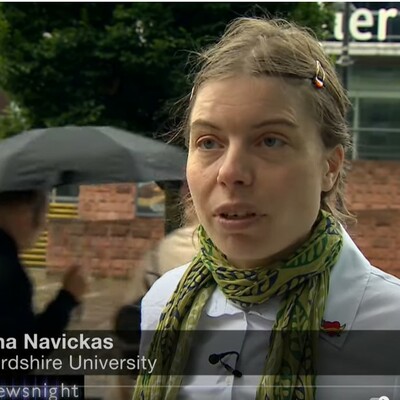
My article on Greenham Common is now available online #ProtestHistory #histodons https://www.sciencedirect.com/science/article/pii/S0305748823000749?via%3Dihub
Client Info
Server: https://mastodon.social
Version: 2025.07
Repository: https://github.com/cyevgeniy/lmst