#NeuralActivity

Fabrizio MusacchioFabMusacchio
2026-02-10

is a central subfield of studying timedependent and its governing . It examines how evolve, how stable or unstable patterns arise, and how reshapes them. Neural dynamics forms the backbone for how & generate complex activity over time. This post gives a brief overview of the field & its historical milestones:

🌍fabriziomusacchio.com/blog/202

Phase plane (left) of an action potential generated by the FitzHugh–Nagumo model. Neural dynamics is largely concerned with understanding how such action potentials arise from the underlying biophysical and network dynamics. However, it also goes beyond and studies the dynamics of, e.g., neuronal populations, synaptic plasticity, and learning. In this post, we provide a definitional overview of the field of neural dynamics in order to situate it within the broader context of computational neuroscience and clarify some common misconceptions.Spiking activity in a recurrent network of model neurons (Izhikevich model). Shown are the spike times of all neurons in a recurrent spiking neural network as a function of time. The network consists of 800 excitatory neurons with regular spiking (RS) dynamics and 200 inhibitory neurons with low-threshold spiking (LTS) dynamics, separated by the horizontal line. Each vertical mark corresponds to an action potential (spike) emitted by a single neuron. In the context of neural dynamics, this representation illustrates how single-neuron events, such as the action potentials described above, combine to form structured, time-dependent activity patterns at the network level. Such spiking rasters provide a direct link between microscopic neuronal dynamics and emerging population activity, which can later be analyzed in terms of collective states, low-dimensional structure, and neural manifolds.Two complementary perspectives on population activity in neural dynamics. The figure contrasts a “circuit” perspective with a “neural manifold” perspective. In circuit models, neurons are organized in an abstract tuning space, where proximity reflects tuning similarity, and recurrent connectivity 
W
i
j
 together with external inputs generates time-dependent firing rates 
r
i
(
t
)
 (panels A–C). In the neural manifold view, the joint activity vector 
r
(
t
)
∈
R
N
 of a recorded population evolves along low-dimensional trajectories embedded in a high-dimensional space (panels D–F). This is illustrated by ring-like manifolds for head-direction representations and by rotational trajectories in motor cortex, both of which can often be captured by a small number of latent variables
κ
1
(
t
)
,
…
,
κ
D
(
t
)
 with 
D
≪
N
. In the context of our overview post here, I think, the figure highlights very well why neural dynamics naturally connects mechanistic network modeling with state-space descriptions of population activity. These are not competing accounts, but complementary levels of description that emphasize different aspects of the same underlying dynamical system. Source: Figure 1 from Pezon, Schmutz, Gerstner, Linking neural manifolds to circuit structure in recurrent networks, 2024, bioRxiv 2024.02.28.582565, DOI: 10.1101/2024.02.28.582565ꜛ (license: CC-BY-NC-ND 4.0)
Fabrizio MusacchioFabMusacchio
2026-02-09

Syeda, …, @computingnature et al., bioRxiv (2026) find that in is dominated by movements, not eye movements. Across darkness and visual stimulation, eye movements explain only a small fraction of neural variance and are largely correlated with whisking and sniffing. Movement signals thus strongly shape activity during free viewing.

📄 doi.org/10.64898/2026.02.04.70

Diagram showing face view and eye tracking data, including keypoints, eye movement, and gaze direction analysis.
2025-11-24

"Kỹ thuật hình ảnh holographic không xâm lấn giúp ghi lại hoạt động não tại mức độ phân tử. Công nghệ mới này cho phép nghiên cứu chức năng não và tín hiệu não bộ. #NãoBộ #Holographic #NãoXâmLấn #KhoaHọc #CôngNghệ #BrainComputerInterface #NonInvasive #NeuralActivity"

reddit.com/r/singularity/comme

Fabrizio Musacchiopixeltracker@sigmoid.social
2025-09-04

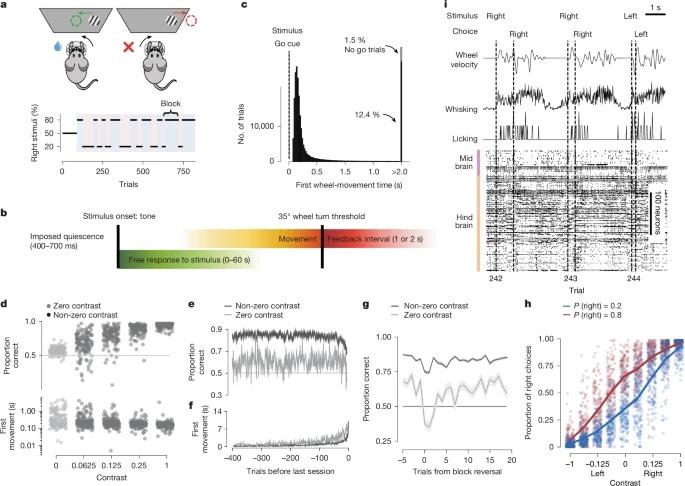
🧠 New landmark study “A #brain-wide map of #NeuralActivity during complex #behaviour” by the #InternationalBrainLaboratory (Angelaki et al., 2025): >600,000 #neurons across 279 regions in 139 mice, unified across 12 labs with #Neuropixels probes.

#DecisionMaking isn’t confined to single hubs but distributed across the brain, incl. #sensory, #motor & #reward areas, showing how #cognitive processes emerge from brain-wide #dynamics.

🌍 doi.org/10.1038/s41586-025-092

#Neuroscience 🧪

Fig. 1: The IBL task, data types and behaviour.
2024-11-21

Ever wondered what happens in your brain during a live gig? 🧠🎸🎶 
Using our wearable Brite family #fNIRS systems, we measured prefrontal cortex activity in real-time. With OxySoft, we tracked changes in brain oxygenation, showcasing how fNIRS reveals neural activity effortlessly. At Artinis, we make optical imaging easy.

Watch it in action: youtu.be/OI6ukzZKnKw

#Neurocognitive #NeuralActivity

2024-05-15

#PupilSize can be used as an indicator of #arousal, but how does it relate to #NeuralActivity? @visioncircuits &co reveal multiple timescales of pupil dynamics and characterize their relationship to neural activity in mice @LMU_Muenchen #PLOSBiology plos.io/44KFGJ0

2023-10-13

In the current issue of Molecular Psychiatry, the ADNP protein image from our previous publication has been published.

doi.org/10.1038/s41380-023-021

rdcu.be/dovsz

Below is the link to the original article describing the functions of ADNP and 14-3-3epsilon on neuronal morphogenesis and neural connectivity during the development of the cortex.

nature.com/articles/s41380-022

#autism #ADNP #Ywhae #neuriteformation #spineformation #synapseformation #neuralconnection #neuralcircuit
#neuralactivity #neurodevelopment #cortex #brain #neuroscience

Fabrizio Musacchiopixeltracker@sigmoid.social
2023-07-03

Charles Micou & Timothy O'Leary discover that representational drift in #neuralactivity and physiological changes, observed over extended periods, suggests the continuous application of a #learningrule at the #cellular and #populationlevel. This phenomenon serves as a measurable signal to uncover system-level properties of biological #plasticity mechanisms, such as precision and effective #learningrates.

📔 doi.org/10.1016/j.conb.2023.10

#computationalneuroscience #compneuro

Fabrizio Musacchiopixeltracker@sigmoid.social
2023-06-14

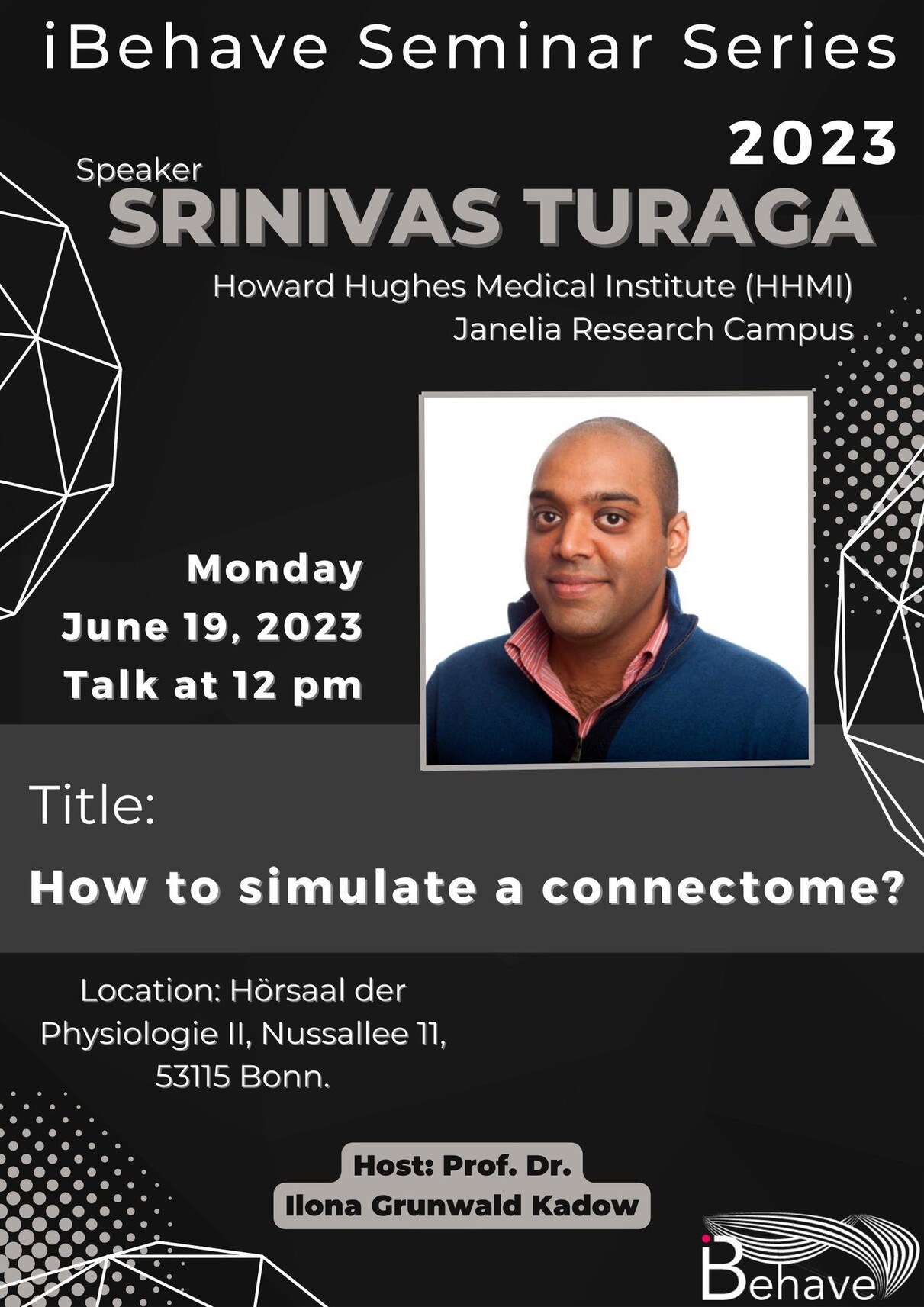
On Monday, there will be a talk on how to simulate a #connectome: discover the potential of connectivity measurements in predicting #neuralactivity and advancing our understanding of #neuralcircuits, by Srini Turaga:

📍 University of #Bonn
⏰ June 19, 2023, 12 pm CET
🌍 email at ibehave@uni-bonn.de for Zoom meeting details

#compneuro #computationalneuroscience #neuroscience

Client Info

Server: https://mastodon.social
Version: 2025.07
Repository: https://github.com/cyevgeniy/lmst