
Scientists once thought the brain couldn’t be changed. Now we know different
#Health #Neuroplasticity #BrainScience #Neuroscience #MentalHealth #BrainHealth #Learning #HumanBrain #Psychology #LifelongLearning #Memory #Stress #Sleep #Exercise #Research
https://the-14.com/scientists-once-thought-the-brain-couldnt-be-changed-now-we-know-different/
#HumanBrain

The Most Bizarre Neurological Conditions You Never Heard Of
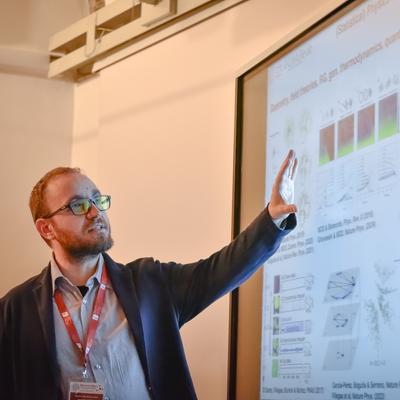
New paper led by Alessandra Corso and @valedand.bsky.social@bsky.brid.gy at @comunelab.bsky.social@bsky.brid.gy just out: www.nature.com/articles/s42... #ComplexSystems #HumanBrain #NetworkScience #CoMuNeLab /fin

From PsyPost.org: How scientists are growing computers from human brain cells – and why they want to keep doing it: A new race is on to build computers using human brain tissue. Fuelled by venture capital and biotech advances, startups are blurring the line between biology and machines. http://dlvr.it/TQHX7L News: bit.ly/3LA2jdQ #Neuroscience #Biotech #HumanBrain #ArtificialIntelligence #Bioengineering

#GutMicrobes Played Role in #Evolution of #HumanBrain, New Study Suggests
https://www.sci.news/biology/gut-microbes-human-brain-evolution-14461.html
No, your brain doesn’t suddenly ‘fully develop’ at 25. Here’s what the neuroscience actually shows
#Science #Neuroscience #BrainDevelopment #FrontalLobe #Psychology #BrainHealth #Neuroplasticity #Research #GenZ #ScienceExplained #MentalHealth #HumanBrain
https://the-14.com/no-your-brain-doesnt-suddenly-fully-develop-at-25-heres-what-the-neuroscience-actually-shows/

Unlocking the Brain's Hidden Learning Blocks
https://techlife.blog/posts/scientists-uncover-the-brains-hidden-learning-blocks/
#HumanBrain #CentralNervousSystem #Brain #Learning #Neuroscience

"A spatial transcriptomic atlas of autism-associated genes identifies convergence in the developing human thalamus", Aivazidis et al. 2025
https://www.biorxiv.org/content/10.1101/2025.11.05.685843v1
"The developing thalamus showed the most prevalent expression of autism susceptibility genes... Within the thalamus, excitatory neurons showed the most enriched expression"
Makes a lot of good sense relative to the hyper- and hypo-sensitivity in autism: the neurons that relay sensory signals to the brain are impacted the most.
Browse the gene expression data:
https://www.stageatlas.org/
Hundreds of genes act differently in the brains of men and women
#Science #Brain #Genetics #Neuroscience #BrainResearch #MenAndWomen #Biology #Health #SexChromosomes #Alzheimers #Parkinsons #Male #Female #Woman #Man #HumanBrain #SexDifferences
https://the-14.com/hundreds-of-genes-act-differently-in-the-brains-of-men-and-women/
Tracking the #neural activity of #undergrads reveals how the #humanbrain learns to #code
https://techxplore.com/news/2025-10-tracking-neural-undergrads-reveals-human.html

Autism may be the price of human intelligence, linked to human brain evolution
https://academic.oup.com/mbe/article/42/9/msaf189/8245036?login=false
#HackerNews #Autism #Intelligence #Evolution #HumanBrain #Research

The #humanbrain runs on less power than a 60-watt light bulb.
https://interestingfacts.com/fact/the-human-brain-runs-on-less-power-than-a-60-watt-lightbulb/

Daniel Yon Explains Why Your Brain Is a Brilliant Illusionist | Scientific American
francescoch/Getty ImagesSeptember 12, 2025
How Your Brain Constructs—And Sometimes Distorts—Your Experience of the World
In his new book, Daniel Yon explains how our brain is constantly constructing reality
By Rachel Feltman, Fonda Mwangi & Alex Sugiura
https://playlist.megaphone.fm/?e=SAM4518074123&light=true&artwork=false
Rachel Feltman: For Scientific American’s Science Quickly, I’m Rachel Feltman.
You probably think you’re listening to my voice right now. But what if I told you that you’re actually experiencing a sophisticated hallucination?
Perception isn’t the passive process that most of us imagine it to be, with our senses simply recording reality and sending it up to our brains for processing. Instead, our brains are constantly constructing theories about what’s going on around us—and sometimes our brains get reality wrong.
Here to explain this mind-bending way of looking at, well, the mind, is Daniel Yon, an associate professor of cognitive neuroscience and director of the Uncertainty Lab at Birkbeck, University of London. Daniel is also the author of a recent book called A Trick of the Mind: How the Brain Invents Your Reality.
Thank you so much for coming on to chat with us.
Daniel Yon: Thank you for having me.
Feltman: So why don’t you start by telling me a little bit about your background and how it led you to write your latest book.
Yon: Yeah, so I’m an experimental psychologist and a cognitive neuroscientist, so that means my day job is to try and understand how your mind and brain work and how what happens inside your skull kind of makes the world that you live in.
So the motivation behind my new book, A Trick of the Mind, is that I think that the work that’s been going on in my lab and that which colleagues have been working on around the world gives us a brand-new way of thinking about how our brains work: that your brain is like a scientist. And I think this new idea …
Feltman: Hmm.
Yon: Can shed a lot of light on both the wonderful things [laughs] that your brain gets right but also the ways that our minds and brains can mislead us and get us to perceive and believe things that may not be true.
Feltman: Right. So you, you say that our brains are constantly hallucinating reality and that this is “a feature, not a bug.” Can you explain more what that means for our listeners?
Editor’s Note: Read the rest of the story, at the below link.
Continue/Read Original Article Here: Daniel Yon Explains Why Your Brain Is a Brilliant Illusionist | Scientific American
#2025 #America #Books #Brain #Education #Hallucinations #Health #Human #HumanBrain #HumanExperience #Libraries #Library #LibraryOfCongress #Memories #Perception #Reading #Research #Science #ScienceQuickly #ScientificAmerican #Technology #UnitedStates


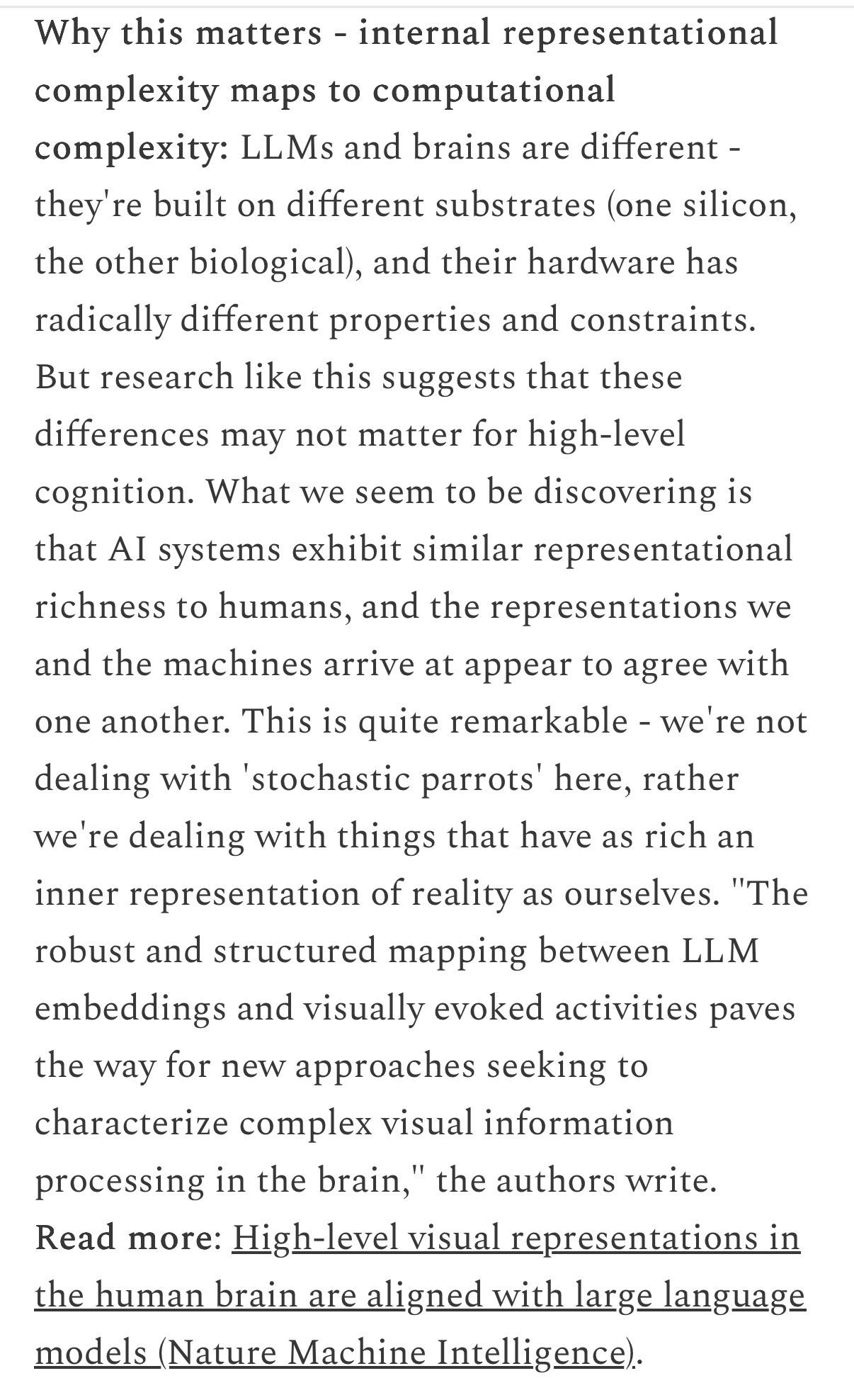
Import AI 424: LLM and human brain similarities https://importai.substack.com/p/import-ai-424-facebook-improves-ads #AI #HumanBrain (similar in some ways)


Import AI 424: LLM and human brain similarities https://importai.substack.com/p/import-ai-424-facebook-improves-ads #AI #HumanBrain (similar in some ways)

How does cerebral #BloodPerfusion map onto micro-, meso- & macro-scale brain structure? @misicbata &co characterize blood perfusion in the #HumanBrain, revealing how it changes with age & in #NeurodegenerativeDisease @PLOSBiology https://plos.io/46AEURS

#Millipede Molecules Scramble #Ants – And Might Help Heal the #HumanBrain
https://scitechdaily.com/millipede-molecules-scramble-ants-and-might-help-heal-the-human-brain/
WRITER FUEL: How much of your brain do you need to survive? Case reports of people with atypical brains reveal the human brain's staggering ability to adapt to damage.
https://www.limfic.com/2025/07/27/writer-fuel-how-much-of-your-brain-do-you-really-need/

L'IA nous facilite la vie... mais à quel prix ?
Nouvel article choc sur l'impact cognitif de ChatGPT :
"Notre cerveau en danger ?"
⚠️ À lire avant votre prochaine requête IA !
🔗 https://sharemania.blog4ever.xyz/pourquoi-chatgpt-pourrait-nuire-a-notre-cerveau-1


Client Info
Server: https://mastodon.social
Version: 2025.07
Repository: https://github.com/cyevgeniy/lmst