Being The Right Best Person: A Conversation with Donna Mae in Minneapolis
#CounterInsurgency
The Final Straw Radio Podcast | A weekly Anarchist Radio Show & Podcastthefinalstrawradio.noblogs.org@web.brid.gy
2026-02-01
The Securitization of Minerals in the EU: Why Europe is Not Immune to the Resource Curse https://www.15-15-15.org/webzine/2025/12/24/the-securitization-of-minerals-in-the-eu-why-europe-is-not-immune-to-the-resource-curse/ #accessenvironmentalinformation #anti-environmentalpolitics #rightsoffuturegenerations #criminalizationofdissent #radicalenvironmentalism #renewableenergysystems #CriminalLawoftheEnemy #Criticalrawmaterials #socialacceptability #communityconflicts #counterinsurgency #corruption

A small glimpse of my wargame shelf.
Just a sincere thank you to all the designers, developers, developers, artists, playtesters and publishers who put so much thought, research and care into these games.
#wargaming #boardgames #historicalgames #GMTGames #COINseries
#conflictstudies #militaryhistory #geopolitics #strategy
#diplomacy #counterinsurgency #designmatters #tabletopgames

Tomsen shows the war's cruel math: For every fighter killed, two more joined. Their brothers. Their cousins. Their friends. You can't kill your way out of tribal revenge.
#CounterInsurgency #WarReality #WeekendRead
https://thisgrandpablogs.com/wars-of-afghanistan/


Very much enjoyed this talk of Adnan Husein with Alana Lentin.
Lentin makes a good case that Zionism is where Western racial fascism and colonialism have always been headed. Clarified a lot to me about the hasbara "the West is next" and the unconditional support of Western governments and the support of fascists for Zionism.
They talk about many things, like CRT, the antisemitism of anti-antisemitism, and how anti-colonial and anti-racism concepts/terminology are used in service of the colonialism and racism of the status quo. Sounds like a very interesting book, good analysis.
https://m.youtube.com/watch?v=3XK8g5U3DnM
@palestine@lemmy.ml @palestine@fedibird.com @bookstodon
#AntiColonialism #Counterinsurgency #RacialCapitalism #books #TheNewRacialRegime #zionism #fascism #democracy

#usa #israel #palestine : #war / #gaza / #protest / #university / #surveillance / #counterinsurgency / #ai
„Officials at the University of Houston used Dataminr to surveil students, while University of Connecticut administrators voiced concerns over protests against a military contractor and major donor.“
https://theintercept.com/2025/11/24/gaza-student-protests-surveillance-uconn-houston/


The Enemy Doesn’t Know How Many We Are: A Proposal for Building An Insurgency
For many decades the movement for liberation in the United States has been on the back foot. Overwhelmed by the struggle to survive, many find themselves and their groups reacting to the brutality of the state through programs like Cop Watch, ICE Watch, and demonstrations or encampments. These initiatives are important, even essential, but always in response to the violent overtures of institutionalized racism. They can mitigate a rough situation, help people in a one-off crisis or show solidarity, but no recent attempt has presented a way to win the war against humanity waged by the US government. Taking example from diverse insurgent forces, this text will look at how to adapt effective organizational models to support an anarcho-communist revolution. Armed with this knowledge and committed to see a revolution through, a nascent movement would have the capacity to build a force that can overturn the state and capitalism while constructing liberatory communities of the future.
PDFs:
TheEnemyDoesntKnow.cleaned
The Enemy Doesnt Know Short Edge Zine.cleaned
Uploads:
https://archive.org/details/the-enemy-doesnt-know https://archive.org/details/the-enemy-doesnt-know-short-edge-zine Full Text:The Enemy Doesn’t Know How Many We Are:
A Proposal for Building An Insurgency
.
.
Contents:
Dedication
Revolutionary pledge
Introduction
The US state is currently at war with its own population, those in the global south and leftist factions
The fight will be won
Rebellions
An insurgency is needed to succeed
What does it take to build an insurgency?
- political and social organizations
- fighting forces
- political education
- revolutionary culture
- material considerations
- strategic timing
Who would support an insurgency
Why an insurgency would succeed in the US
How to start building an insurgency
Until we meet
Further reading
.
.
Dedication
Embarking on this historical mission, it is imperative to pay respects to those who have come before us, fought the most difficult battles and paved the path of struggle with their fortitude. Without them the proposals put forward in this text would not exist, nor the potential of liberation. Specifically we acknowledge Russell Maroon Shoatz, Safiya Bukhari, Carlos Marighella, Lucy Parsons, Kuwasi Balagoon, Lorenzo Orsetti, Yahya Sinwar, Sekou Odinga, Dedan Kimathi, and the many others unnamed for the sake of space, and all those whose names we will never know because they were so brave.
.
Revolutionary pledge
“Positions are seldom lost because they have been destroyed, but almost invariably because the leader has decided in his own mind that the position cannot be held.”i
This observation opens up a world of possibility based on the sheer will not to be deterred. Unlike the paid mercenaries of a state army, liberation forces are gifted with a deep motivation for the struggle. As a guerrilla commander in the KurdishHPG once noted, there can be a successful action with just one fighter if they have the will and determination to succeedii. Fighting a battle is first and foremost a mental feat, and the trials people in the movement face against the armed henchmen of the United States have hardened the resolve of brave political actors. The possibilities that spring steadfastness underpins the following text. This text lays out a strategy for fighting an asymmetrical war against a much better armed and more technologically advanced enemy. The war of the small against the mighty will be won by fortitude and determination.
.Introduction
For many decades the movement for liberation in the United States has been on the back foot. Overwhelmed by the struggle to survive, many find themselves and their groups reacting to the brutality of the state through programs like Cop Watch, ICE Watch, and demonstrations or encampments. These initiatives are important, even essential, but always in response to the violent overtures of institutionalized racism. They can mitigate a rough situation, help people in a one-off crisis or show solidarity, but no recent attempt has presented a way to win the war against humanity waged by the US government.
There are many examples of oppressed people throughout history overcoming their oppressors or colonizers, but not many with a long standing anarcho-communist result. On the other hand, there are a lot of far left groups that currently exist that mean well and have excellent analyses but could benefit from strategic direction in order to become revolutionaries. The question for all those on the side of humanity: how to win the war that has been launched against communities of color? How to effectively overthrow the state? How to organize towards a liberated society? Taking example from diverse insurgent forces, this text will look at how to adapt effective organizational models to support an anarcho-communist revolution. Armed with this knowledge and committed to see a revolution through, a nascent movement would have the capacity to build a force that can overturn the state and capitalism while constructing liberatory communities of the future.
.
The US state is currently at war with its own population, those in the global south and leftist factions
The US was built on human misery, from the slave trade to the genocide of indigenous people. This foundation has seeped through its ideology. With its mentality of domination, the US wants to obliterate its adversaries rather than see people live with dignity or according to revolutionary principles. The COINTELPRO attacks against the Black Panthers and the bombing of the MOVE headquarters line up squarely with its support of the far right in Central and South America. The weight of this reality can be read on the faces of people and felt in day to day interactions: people have to accept the brutality of the United States to live here.
The state makes its war against people of color clear through the development of Cop Cities, the blatantly racist judicial system, routine torture in state and federal prisons, its brutal reaction to uprisings and the military tactics and equipment they bring into city police departments.iii The United States views not only people of color as enemy combatants but those on the left who fight for marginalized people. The legacy of the Red Scare and the execution of Sacco and Vanzetti is alive and well, and visible in the inability of the left to counter ICE raids and police executions. The question isn’t if the movement should start a war with the state. The war is already here. Instead the question is if people of conscience who live under this regime decide to fight back.
Fighting back allows people who have historically been oppressed to fully realize themselves through revolutionary struggle. Contrary to what US propaganda espouses, people are not individualized, separate entities. Everyone rises or falls together. When the state tortures someone in prison, bulldozes families in Palestine, or when a person walks past someone sleeping on the street, pieces of their shared humanity are shaved off. The only way to gain them back is through collective struggle: stopping the perpetrators of violence by fighting back with and for others.Commenting on the self-sacrificing action that HPG fighters took against Turkish Aerospace Industries, one writer noted “It is not an exaggeration to say that the only way to truly live is to wage a continuous struggle.”i
Similarly, Wayne Pharr, a Black Panther Party member, who participated in the firefight against police when they raided the BPP office in Los Angeles, explained how he felt in that moment, “I felt free. I felt absolutely free. I was a free negro. I was making my own route. You couldn’t get in, I couldn’t get out. But in my space, I was the king. In that little space I had, I was the king.”v In this moment the historical degradation by the US was overturned when Pharr and his comrades picked up their guns and shot back.
.
The fight will be won
It is infinitely possible to win this war that has been launched by the US against the population, and humanity in general. What does it mean to win? Winning in this text is defined as: destroying the state structure and capitalism and replacing them with liberatory and egalitarian ways of existing as a society. The organization of a liberated community holds just as true today as it did in revolutionary Spain or the Korean People’s Association in
Manchuria: self-governance through a federation of councils, production by collectives, personal property held by use rather than private property, defense militias structured according to and defending revolutionary values, resources distributed appropriately amongst the population, expropriation of the enemy class: turning the assets of the enemy into the collective wealth of the new society and prohibiting them from rising and exploiting again.
.
Rebellions
Rebellions and uprisings do not have the capacity to change people’s day to day reality. For example, after the Ferguson Uprising, the police returned with a vengeance. With the state empowered and the movement on the back foot, many of the key participants died in suspicious circumstances, presumably executed by the state. There wasn’t sufficient advancement on an organizational level to expel the police from Ferguson, and defense was not commensurate with any of the gains. There are countless examples in the US of rebellions that are an important expression of dissatisfaction, but without organization, people cannot force the state to permanently retreat and create a new reality in their communities. Even a rebellion that overthrows the regime in power does not go far enough. In 2011 Tunisian President Ben Ali left at the behest of protesters but the entire government structure remained, with remnants of the old regime in power. Even though gains were won, such as dismantling the secret police and women’s rights, the same fundamental political structure persisted. Likewise in Egypt, President Mubarak fled in response to uprisings, but after a few shifts in power, an American puppet president, El-Sisi took power. These uprisings of the Arab Spring unseated leaders, however without concerted reorganization of society, a transformation was impossible.
It is essential to formulate the struggle not as a reform of or rebellion against the current system, but as a revolutionary movement with clear goals and outcomes. The state must be completely dismantled and social structures have to be rebuilt from the basis of liberatory values.
.
An insurgency is needed to succeed
Using armed force and social organizations, the goal of an insurgency is to make it impossible for the state to govern its territory, and through political, social and economic organization, effect a liberatory change within that territory. This starts with guerrilla warfare, political polarization, the mobilization of local support, and develops as partisans replace state and capitalist functions with their own.
The objective of an insurgency is to permanently eliminate the state and create long-lasting liberation. This change should replace a capitalist economy with a collective one, change a federal representative government to locally-centered self-governance, remove an exploitative social ethic and instill one that values all members of society and shift from poisoning the land and water to protecting the environment. Fighting forces and political-social organizations are built up simultaneously to, on the one hand, develop liberatory self-governance and collective economies, and, on the other, protect political gains while destroying the state.
Anti-colonial Guinea Bissau shows what an insurgency looks like in practice. Resistance forces built up parallel political and social organizations for years to develop popular support for the struggle. The revolutionary African Party for the Independence of Guinea and Cape Verde (PAIGC) party initiated educational systems, roving hospitals that served fighters and local people and barter bazaars. Amilcar Cabral, the founder of the PAIGC and an agronomist, taught people how to grow food to sustain themselves while also feeding the fighting forces, who would help work the fields with the people. The intertwined growth of revolutionary social organizations and fighting forces made for a complete social transformation within the liberated zones in rural areas that were entirely resistant to Portuguese colonizers. What characterizes an insurgency and differentiates it from a rebellion is that 1) war is waged for abolition of the state, 2) social organizations for self-governance, justice, education, medical care, and other important social projects are built up simultaneously with the war effort, and 3) revolutionary forces work to transform society in the areas they hold.
The remit of an anarcho-communist insurgency is to build a society that is driven by the self-governance of the people. Through the process of engaging in self-governance, people become collectively-minded, self-actualized and responsible for their entire communities. It is ideologically consistent and strategically important to facilitate this type of social organization because: an insurgency is a war for the population. If people agree with the political project, they will want to participate and help the fighters. A salient example is the bank tellers who drove Black Liberation Army (BLA) fighters to Chicago from New York overnight when they needed to hide out, or people from local neighborhoods who would give BLA members their guns if they lost theirs during a firefight.vi This would not have happened without community support and a certain level of organization created by aboveground groups. An insurgency has been described by counterinsurgent experts as 20% military and 80% political;vii another way of articulating the famous Clausewitz quote, “War is a continuation of the policy by other means.” Without people supporting the insurgent forces, it is impossible to have a struggle, and people will support if insurgents are creating sustainable means for true liberation.
This text lays out how the comprehensive process of building an insurgency is integral to engaging many people with a range of capacities and abilities in the revolutionary process, increases the development of all people and creates new economic and political systems, all while materially supporting revolutionary fighters.
.
What does it take to build an insurgency?
There are six main fields to consider: 1) political and social organizations 2) fighting forces 3) political education 4) revolutionary culture 5) material considerations and 6) strategic timing.
.
1) Political and Social Organizations
Political organizations are expansive assemblies of political actors. Political organizations set up armed factions and social organizations and create the ideological and strategic foundation for both, which, due to this connection, follow consistent political objectives.
Political organizations also set up the means for people to administer their own regions. This self-governance can happen through, for example, neighborhood councils, which form the basis for bottom-up style administration. The council is a forum people can use to coordinate to meet their needs, designating groups to handle that work.
Social organizations are responsible for the production and distribution of resources and the creation of infrastructure. Organizations can include food production, hospitals, schools, construction and activities can range from mediating conflicts to providing medical care and education to producing necessities. These organizations are structured in an egalitarian manner and are based on revolutionary perspectives. They displace those of capitalist businesses and the state.
Effective examples of such political organizations had been developed by the DTK in Northern Kurdistanviii. There were neighborhood councils, conflict resolution bodies, and youth and women’s groups. These bodies made the government of the Turkish state less relevant, as Kurdish people would, for example, utilize DTK mediation over state courts.
Self-governance structures and social organizations create the means for people to feel engaged in day to day life, have determination over their environments and create a material impact. Participation allows for a fundamental shift in values from alienation and competition to looking out for other community members. The well-being of the entire society becomes the responsibility of each person. This reflects the political tenets of the movement, creates collectivity and elicits engagement in revolutionary society and its defense.
In Chiapas the healthcare system was developed after significant and lengthy discussions with many different parts of the population, incorporating their knowledge, outlooks and concerns. For example, traditional healers were initially hesitant to share their methods but the proposal to care for the greatest amount of people possible convinced them. The final result was an overwhelmingly successful healthcare system tended by volunteer health providers, who administer traditional and Western medicine at regional hospitals. The hospitals serve community members, who, in turn, support the healthcare providers.ixx
Social organizations also serve the needs of the armed struggle, intertwining the livelihoods of the fighters and the local community. The fruits of this work are exemplified by Hezbollah. Hezbollah had created armed and social components: welfare, schools, hospitals, supporters with rocket launch rooms in Southern Lebanon. They demonstrated that they care about people’s well-being, giving credence to Hezbollah’s armed defense of the region. The ‘Israeli’ pager attacks on Hezbollah members were thus viewed as attacks on the whole population, bringing much of society, even political opponents, together in support of the organization. Immediately following the incident, one prospective eye donor, a taxi-driver named Hussein, explained his motivations to a local broadcaster. “How can I continue to see while they have been blinded?” he said. “The eye that I will donate will protect the nation.”xi
When people participate in the process of building and running social organizations, they are actively eroding the state’s administrative control. Local people become fighters without ever picking up a gun. An insurgency mobilizes support by normalizing revolutionary social organizations so that regular people use them to, for example, go to the doctor, get food and clothes, become educated, etc. Regular people become political partisans when they participate in self-governance as in the neighbor councils and grandma-run food distributions that cropped up during the Estallido Social uprising in Chile. Or, for example, in Barcelona during the Spanish revolution, neighbors were empowered to physically block bailiffs from entering their neighborhoods to conduct evictions.xii
In essence, the battle for administrative functions is what will determine if the state remains in a region or if the insurgent will be successful. Both the insurgent and the state will win legitimacy if people participate in their social organizations. If people call the police when they have a problem, they are strengthening the state, if they call revolutionaries, they strengthen the insurgency.
If the relationship is strong enough, the enemy’s attempt to undermine social organizations will be unsuccessful. The Zionist regime enters Tulkarm Refugee Camp in the West Bank of Palestine to destroy infrastructure to try to erode the support base of the resistance. Al-Quds Brigades reports that the effect is the opposite: “Once the raid is over, many people check in on us and express their gratitude that we are safe. When they look at the destruction of the camp, they just say, ‘better to lose your wealth than lose your children.’”xiii
Starting the armed struggle and ultimately maintaining a territory is based on the consent of the people in it. Truly liberatory political and social organizations are the key. If people agree with what revolutionaries are doing, they will participate in the self-governance of their neighborhoods and protect the guerrillas, if they disagree, they won’t sustain the insurgency.
.
2) Fighting Forces
“The urban guerrilla’s weapons are inferior to the enemy’s, but from the moral point of view, the urban guerrilla has an undeniable superiority.”xiv – Marighella
.
Guerrilla Struggle
The goal of fighting forces is to demoralize the enemy and win popular support. The armed work of an insurgency starts with guerrilla units. Due to flexibility and mobility, the guerrilla has the ability to launch attacks anywhere and disappear. Hidden amongst the population, the insurgent chooses when and where to attack, making their attacks unpredictable.
The tactical advantage is with the insurgent at this stage. The state must prove that it can retain order, whereas the insurgent only has to challenge the authority of the state. The state has to spend a lot of money to protect its assets and chase down insurgents, but insurgents can launch effective attacks very inexpensively at targets which are plentiful and in the open.
Time is on the side of the insurgent. An insurgent force can be assembled long before a single bullet is fired.xv Fighters can prepare for years or decades, striking only when the time is right. The EZLN built its forces for over ten years before attacking the state, presenting revolutionary ideas to villagers and systematically recruiting fighters. Taking time to build armed groups concertedly and growing slowly in qualitative force allows for the development of politically aligned and well-trained guerrillas, ready to take action when the time is right.
Guerrilla units are small groups consisting of only a few people, who independently launch attacks to harass the enemy. They are self-contained cells that pick their own targets, but are connected to other units through the guerrilla code, political objectives and allegiance to the overall mission. There is a role for each member of a guerrilla cell, and these roles should overlap in case one person is captured or killed. They can be assembled into columns or sections for larger attacks like ambushes if the conditions are right.
The purpose of the guerrilla forces is to make it impossible for the state to govern (by overextending the enemy, controlling the pace of the fight, for example), defend the population (by attacking state forces who brutalize people), survive (by planning attacks wisely, evading capture, setting up secure infrastructure), support political initiatives, and eventually to take and defend territory.
.
Beyond theGuerrilla Struggle
Building of social organizations, the solidarity of the population and the strength of fighting forces will allow guerrillas at a certain point to establish bases and expel the state from their strongholds. Insurgent-controlled areas are those where revolutionary organizations and values prevail and the state no longer has control through administration or force. At this point the guerrilla struggle continues in new areas that are now contested, partially governed by the state.
The transition between hit and run guerrilla warfare and the security of a liberated area necessitates a delicate balance. Forces are needed to both defend the area and to contest regions beyond that territory. For revolutionary fighting forces to drive out the state and maintain a liberated territory, there needs to be a higher level of coordination, strategy and organization.
If we look at the example of the Great Dismal Swamp Maroon, it becomes clear that it is difficult to maintain an island of liberated land within enemy territory. Formerly enslaved people who escape plantations took refuge in the forbidding terrain of the Great Dismal Swamp. Here armed groups would coalesce as needed to coordinate on raids, defend their territory and free other enslaved people. At first the Maroon was impossible to broach by enemy forces due to impassible geography, but eventually the state developed the land, making it no longer functional as a refuge.
The state was able to destroy the territory because its economic and administrative structure remained intact. An insurgent movement needs to push the state’s administrative structure into disarray otherwise the enemy will be able to challenge a liberated area through means beyond armed force.
On the other hand, it is not feasible to go to war outside a liberated area without sufficient protection for that region. The Shinmin Prefecture was an anarchist region in Manchuria comprised of 2 million people. The Korean Anarchist Federation had established self-governing institutions such as mutual banks, workers cooperatives, and liberatory education. Their local militia was supplemented by guerrilla fighters and the region supported guerrilla attacks against imperial Japan in Korea from 1929-1931. However these attacks drew the ire of the Japanese, who sent their agents to infiltrate and assassinate key figures and without sufficient defense of the territory to support the guerrilla actions abroad, an invasion was the death blow.
The Great Dismal Swamp was strong on defense, while the Shinmin Prefecture was more focused on destroying their enemies abroad. Both regions had the problem of being stand alone territories where 1) the guerrillas were not hidden within a enemy-administered populations 2) the insurgents were not able to achieve the balance between defense and attack and 3) the growth of liberated territories was not commensurate with balanced defense and offense.
What is also clear from these examples is that forces defending a territory cannot maintain a guerrilla characteristic and expect longterm existence. A different formation is needed to defend a liberated area. The defense of a territory must be sufficient, and include an offensive component to challenge the terrain of the enemy. Offensive actions and their range must be chosen wisely so as not to generate more enemies than a liberated area can handle. There needs to be a high level of strategic coordination between guerrillas and defense forces of a liberated area.
While at the current moment it seems the movement is some time off from taking and holding territory, it is important to consider the structure and participation in the defense of a territory even during the nascent part of building guerrilla forces. More complex forms of organization and coordination are needed. There can be a strong connection between fighters and councils on a local level, tying defense to political will, but there also needs to be a means for fighting forces working together across broad swathes of geography, and much more concerted coordination in terms of strategy, tactics and logistical support. As fighting groups are trained and built, so should the organizational apparatus that will sustain the fight past the guerrilla stage. This stage is very advantageous tactically for the insurgent, but also the most precarious.
Holding territory can be dangerous while the state is still powerful. The guerrillas can ebb and flow from regions, establishing bases when it is politically and militarily feasible, and ceding it temporarily so as not to get into a head-on fight. Often making a stand does not play to the strengths of an insurgent force. When temporarily ceding territory, informants, sleeper cells and political organizations can remain in place to coordinate with returning guerrillas and make it hard for the state to truly regain a foothold.
.
3) Political Education
Insurgencies thrive by being able to address grievances that the state will not. Anarcho-communism presents a range of salient proposals for nearly every facet of life, from collective self-governance to justice to ecology, but there will be strategic moments when putting one or two of those points forward will have the strongest, most wide-spread appeal. Picking the right points to center on at the right times is essential for rallying people toward the cause. For example, the height of the George Floyd Uprising would not be the right time to focus on ecology. The rallying point(s) can change depending on current events and can even be different for different segments of the population. An essential factor is that the points chosen should not be ones the state can fix; they must last the duration of the insurgency.
Propaganda and media serve the important role of isolating the state from the people, making it clear that the hardships people suffer are the unnecessary effects of the US government and capitalist economy. They also work in tandem with revolutionary school curriculum to reinforce a revolutionary narrative.
Revolutionary schools have the important role of helping people understand the role of the state and capitalism, familiarizing people with the history of resistance and building skills that are relevant and useful for a revolutionary society. All subjects taught in these schools are oriented towards creating a better society for all people. For example, Zapatista education provides knowledge about agronomy which helps people in Chiapas become self-sufficient. Or Black Panther schools recounted the history of the United states from the perspective of their communities.
It is impossible for people to get behind a cause when they don’t understand the basic political spectrum. People in the United States are heavily propagandized and most have received poor education. It is essential to build up people’s political understanding and inform them about the histories of oppression and resistance. Political education can take place through multiple mediums such as revolutionary schools, mass propaganda and the guerrilla struggle itself.
Organizing can work as propaganda to draw clear battle lines and create conditions for the struggle. For example, to demonstrate the necessity of guerrilla struggle, revolutionaries can launch a community campaign. Black Liberation Army founder, Dhoruba Bin Wahad, has suggested calling for community control of the police, which is a logical proposal to help solve their rampant murders of black and brown people. However it is a request that the state will never meet. The proposal functions to organize communities of opposition on a local level and the intransigence of the state demonstrates the necessity for revolutionary defense forces to step in.
.
4) Revolutionary Culture
A fundamental cultural shift is essential for revolutionary work in the US. Political and social organizations and fighting forces embody this culture, creating goodwill within local communities.xvi
Revolutionary culture requires a collective approach to the struggle. Political actors should be selfless, stand up, steadfast, hold true to their word and show respect for themselves and those who are most disadvantaged in bourgeois society. These qualities are fundamental for achieving a society where every member cares for and is responsible for all the others. The welfare of those who are the most vulnerable become the obligation of all. A leftist revolutionary movement demonstrates a commitment to life and community.
Revolutionary culture runs counter to acculturation in the US, which has indoctrinated people to act against their self-interest. People are socialized from a young age to distrust their neighbors, turn their backs on people in need and look out for themselves before anyone else. This may be the hardest aspect to overcome for developing an effective movement in the US.
The evidence of US culture permeating the movement lies in the thousands of failed political groups, the constant fractures and insurmountable conflicts between comrades, people using the movement to fundraise or do research for their careers, individuals demanding social credit for their revolutionary contributions, an ideological emphasis on isolated, personal initiatives to drive political work and political groups whose policy it is to instrumentalize people in order to achieve their goals.
It is important for people involved in revolutionary work to shed the alienating and competitive ways that have been forced on people by the US regime, in order to build effective collaboration and trust. Cooperation and trust are the bedrock of the the movement, holding it together through difficult situations, and demonstrating the types of relationships that unite a liberatory political project. When people join the movement, they will be acculturated to cooperating with each other.
.
5) Material Considerations for Success
Infrastructure requirements include access to and control over communications, food, finances, arms, transportation, means to disseminate information and the ability to supply resources to insurgents and the population.
Logistic and communication networks, independent of the state, serves fighting forces and the population. They are set up with the consideration that the state will try to surveil and disrupt, fully understanding that removing pipelines of resources and information is a good way to incapacitate the insurgent force.
Arms and tactics training are key. This can happen with a supportive army. For example, in 1982 Islamic Revolutionary Guard Corps (IRGC) set up a training camp in the Beqaa Valley in Lebanon in response to ‘Israel’s’ invasion.xvii Many insurgent groups such as PFLP, Hezbollah, Asala, the Red Brigades and the PKK trained there.Armed training can also happen within the army of the enemy state. Many of the great militants of the Black Liberation Army, like Kuwasi Balagoon were trained by the US army.
Intelligence on state capacity, enemy figures in key position, arsenal and plans of action is essential. Infiltration of the police and armed forces can be established prior to the initiation of the armed struggle and provide pertinent information. The state has contingency plans for crises and responding to attacks, which are readily available. Insurgents use this information to set traps to use their own plans against them.
An important part of a revolutionary insurgent struggle is that it intends to build a different economic system. This alternative system begins at the outset of a struggle as a way of circulating resources to those who are participants. However money will certainly be necessary. Funding can be planned well in advance of the beginning of the armed struggle, diversifying sources and obscuring where they are held. Funding can come in the form of external support, draining that of the enemy, and community support.
With these factors in mind, it is clear why an analysis of multiple insurgencies suggests that the likelihood of success will increase based on 1) the remoteness from the center of the counterinsurgent’s power 2) the ability for the insurgent to move across an international border 3) international alliances and 4) a local administrative vacuum. In consideration of the physical demands of an insurgency a temperate climate and a spread out population add an advantage.xviii While all these conditions may not necessarily be met in every case where political organizations form, they are useful to consider when launching a struggle.
6) Strategic Timing
An insurgency has the tactical advantage of being able to wait, building up sufficient forces and popular support and striking at a time and location of its choosing. Training and organization can be developed to a high degree before the armed struggle begins.
A crisis or weakening of the state is helpful for launching an insurgency. For example, anti-colonial insurgencies didn’t succeed before 1938, when World War II weakened European states. The insurgent can wait for a moment when the US is tied up in military conflicts and has exhausted its resources, or is lacking popular support. A war on its own soil against an external enemy could, for example, provide the right conditions. Or engaging in multiple armed conflicts abroad would weaken the US state and diminish its international standing, creating an opening for the insurgent.
Strategic timing does not just refer to selecting an appropriate time for the initiation of armed action, but also choices made throughout the conflict.
Once armed action begins, it is important to keep up the pacing and pressure. The state will have the strongest chance of stamping out an insurgency during the initial period, the guerrilla struggle, due to functioning administrative control. To quash an insurgency, the state needs to arrest guerrillas, regain the trust of the population and instate compliant leaders through elections. For this work the state depends on pre-existing civil structures like the police, non-profits, local representatives and social services. This administrative power is very effective at stifling rebellions. The momentum of the George Floyd Uprising was successfully derailed by coordinated civil actions including elected representatives speaking out at marches, legal proceedings being issued against Derek Chauvin and city-to-city coordinated police action against demonstrators.xix
It is important for the insurgent to make the state’s civic bodies unable to function, drawing the conflict into a military terrain. The US Army Marine Counterinsurgency Manual confirms: “Controlling the level of violence is a key aspect of the struggle. A high level of violence often benefits insurgents. The societal insecurity that violence brings discourages or precludes nonmilitary organizations, particularly [administrative proxies of the counter-insurgent]”, which the Manual identifies as, “diplomats, police, politicians, humanitarian aid workers, contractors, and local leaders.”xx The guerrilla, Carlos Marighella confirms, “The role of the urban guerrilla, in order to win the support of the population, is to continue fighting…heightening the disastrous situation within which the government must act.”xxi
Marghiella also emphasizes that, “keeping in mind the interests of the people,” during this process is essential. The insurgent must precisely balance the need to combatively overwhelm the administrative capacity of the state with the need to maintain the goodwill of the population. During the early stages, the insurgent can control the pacing and tenor of the fight and can time it to best suit the social and strategic conditions at each moment.
However launching the armed attack is not just about watching and waiting for an opening, but creating the conditions for the struggle to flourish. It is essential to undermine US civic institutions, eroding popular faith in them, sowing dissent within their ranks and drawing people toward revolutionary social organizations. Increasing distrust in US civic bodies is not a difficult proposal. With dissatisfaction already quite high, insurgent social organizations have fertile ground to grow.
The considerations about strategic timing demonstrate that an insurgency requires a lengthy investment of time. From comprehensive training and research to creating the ideal social conditions for the armed struggle, it is a longterm commitment on the part of the insurgent.
.
Who would support an insurgency
In counterinsurgency theory the population is broken down into a perhaps overly simplistic, yet useful, formula: an active minority on the side of the state, an active minority on the side of the insurgent, and a large group of people in the middle that want to go about their daily lives with reasonable stability. Victory will theoretically tilt in favor of the side that can provide the better life.xxii
Currently, without an institutionalized left, and with the lack of general political understanding, the politics of the center produce an acceptance for a brutal and degraded life. It is impossible to talk about a war for the population without acknowledging that the political tenor in the US is by and large extremely right wing.
The question is how to move people further to the left. Part of the answer lies in the armed struggle itself. Armed action from the radical left moves the center further left. It galvanizes people, forcing them to take sides and it creates a new pole of far left politics. When the seriousness of the demands is expressed by the requisite force to achieve it, it is more convincing than rhetoric.
This precedent is reflected in the boom in membership in the Black Panther Party following their armed protest on the floor of the California state Capitol. It can also be observed in the public assistance for armed struggle groups in the 1960’s-1980’s, and the support of radicals in the US for the events of October 7th in Palestine.
Furthermore, during uprisings, sympathy for radical change becomes far more widespread. The George Floyd Uprising elicited support from many sectors of society. Both potential political actors and unpoliticized people were won over by the widespread demonstration of popular sentiment and the virulence of the uprisings. As demonstrators began challenging the police, support for their initiative grew and acceptance of the police fell dramatically.
Being very clear and open about armed struggle can quickly bring in participants. In Chiapas, the EZLN started their work by explicitly building a guerrilla force and clearly expressing their intention to initiate an armed struggle to potential supporters. This drew people towards the struggle by demonstrating a commitment to success and means for people to effect a material change within their communities. There already exists an impetus to take armed action against colonial adversaries, like Willem van Spronsen’s attack on ICE. These public displays demonstrate a groundswell of popular sentiment that could be organized into a cohesive force.
While armed action pushes prevailing opinion further left, armed action complemented by social organizations becomes a thoroughly convincing force. Social programs indicate the genuine intention of political actors to better people’s lives and facilitate people joining the effort.
The combination of armed struggle and social organizations counteract the feeling of helplessness that the state wants to project on people. In the US, there are many communities that are targeted or sidelined by the state, but no one wants to accept a victim role. In fact, this is a dynamic that helps the state control people, and also one that the non-profit industry preys on. Creating an alternative where people can live with dignity, cultivating a culture of respect and creating the capacity to win is key for building self-actualization through struggle. The genuine self-sufficiency of revolutionary communities is an attractive proposal to people who have historically been oppressed.
One of the greatest examples of US brutality is the prison system. It is also the most concentrated population of politicized people in the country. This legacy is thanks to prison organizers like the Nation of Islam, George Jackson, the Black Panthers and incarcerated members of armed struggle groups like the United Freedom Front and the Black Liberation Army. The teachings of comrades from previous generations set the stage for continued work in this vein and for prison uprisings like Attica, Lucasville, and the Vaughn Prison Uprising and the multitude of prison strikes set in motion by Jailhouse Lawyers Speak and many others. People locked up and terrorized daily by the state forces understand the force required to stop them. The proliferation of George Jackson style study groups in many prisons today, some named after him, is testament to this continued political legacy.
Many of those organizing inside would like to participate in movements on the outside but have to deal with the very real problem of securing housing, food, etc. once released. The infrastructure inherent in building an insurgency has the capacity of creating a support structure for these militants, as well as counteracting the state’s intention to rob people of their means of survival. In revolutionary Spain, for example, it wasn’t just liberated fighters reuniting with the battalions who broke open prisons; many people they had politicized joined as well.xxiii
People in prison are an acute example of people who support an insurgency, but there are many others who are routinely terrorized like young people of color, migrants, people lacking money and resources and politicized young people. An insurgent strategy offers a path towards stability and respect.
It is clear is that through an insurgent struggle not everyone will shift further to the left or change their views. While armed leftist action brings the political center toward the left, it also serves to further entrench elements of the right in its anti-social positions. There will always be the minority that supports reactionary objectives. There are two points to consider: Balkanization and suppression.
A common misconception in revolutionary work is that the entire territory of the US needs to be liberated. This is a difficult proposal given many people’s right-wing views and vastness of the geography. A more realistic idea is akin to the proposal of the Republic of New Africa to section off a part of the South – a Balkanization of the territory occupied by the United states.
There remains the question: how protect the movement from actors with a right wing political ideology. First, getting people to sympathize and participate in the movement will create fewer enemies. While there is a right-wing political bent currently throughout the US, this should not be considered a static fact. It is important to consider that the many communities that vocalize right wing views didn’t always do so and do so now because of concerted propaganda efforts on the part of state actors. Being a proactive political movement means engaging in activities and messaging that will effect a change in this failing perspective. Yet it is important to note at this point that reactionaries should not be the focus of efforts. Propaganda efforts can be far reaching enough that they happen to reach right wing people, driving a wedge between those who are deeply racist, xenophobic, etc, and those who actually care about others.
The ideologically hardened right wingers are essentially enemy combatants. Whether they are currently active is not so much a question. If allowed to remain in a territory, they may be or could become agents of the counterinsurgent. They must be thoroughly disabled and removed from liberated territories. It is important to begin considering how to deal with these factions from the perspective of an abolitionist movement. Complete annihilation is essential.
.
Why an insurgency would succeed in the US
The strengths of the US become its weaknesses in the face of an insurgency.
The US is hubristically proud of its military might. Military spending far outpaces any other nation, with its spending in 2020 amounting to the same as the next nine highest nations. Equipment and tactics developed in the military are deployed in local police departments as well. From SWAT teams to the FBI to the Department of Homeland Security to militarized police, local residents are bombarded with highly technological and militarized state force.
Within the dynamics of asymmetrical warfare, these are the conditions where the insurgent has the advantage. A more technologically advanced and equipment-laden enemy is too cumbersome to counter guerrilla fighters. Complex apparatuses become a hindrance and the top-down structure can’t pivot quickly enough. Even the Marines agree, “A modern military force capable of waging war against a large conventional force may find itself ill-prepared for a ‘small’ war against a lightly equipped guerrilla force.”xxiv Meticulously recorded videos of the resistance in Palestine show fighters emerging from tunnels to plant bombs on tanks that are not equipped to counter such a close and agile combatant. The modern military is weighed down by its own equipment and structure. Tanks become lumbering death traps. The tactical advantage is with the fighters who don’t have their assets in the open and have the ability for evasion. An insurgent has the capacity to remain invisible on its home terrain and arise at unexpected points to attack and quickly disappear.
An insurgency is cheap for the insurgents, while it is expensive for the state. To appear in control, the state must do its best to stamp out fighters, which takes a great deal of resources, manpower and equipment. Insurgents can use cheaply made weapons to precipitate a great expense for the state. For example, drones made from styrofoam are able to evade detection or tiny drone boats in the Red Sea can damage an aircraft carrier many more times their size and cost. Handmade explosives have the capacity to destroy a tank. Small, cheap and effective devices make it difficult for the counterinsurgent to avoid attacks.
Counterinsurgency doctrine of the Army and Marines is considered to be the most forward thinking treatise on this type of military strategy. Even with lessons learned from military debacles in Iraq and Afghanistan, the US doctrine still demonstrates a fundamental lack of understanding about the motivations of an insurgent. Given the extreme lack of empathy for people’s lives, it is seemingly impossible for military strategists to fathom that others may be driven by genuine concern for their fellow humansxxv. The lack of compassion for the people coupled with a misreading of their adversary makes it difficult for the institutions of the US state to respond appropriately to challenges.
For example, in Afghanistan, US soldiers stationed in Restrepo held a weekly meeting with local elders meant to create connections to win them over and solicit their help routing out insurgents. When questioned by an elder about someone they detained, the soldier in charge became frustrated and finally exclaimed, “You’re not understanding that I don’t fucking care!”xxvi This poignant example illustrates the overall military culture, not to mention US culture, that demonstrates a fundamental disinterest in effective counterinsurgency tactics, even when they are in its best interest.
For its own sake, the counterinsurgent should not respond to guerrilla attacks with overwhelming force, as it risks alienating people and driving them further from its cause.
For example, Safiya Bukhari astutely noted that the New York Police Department made her a member of Black Panther Party. Bukhari was a middle class college student who got involved in the movement after she was arrested for defending a Black Panther from police harassment. She learned from this episode that she had no rights, which galvanized her to join the Party and eventually the Black Liberation Army.
Trump’s execution of Michael Reinoehl in cold blood when he was on the run for shooting a fascist, South Carolina bringing back the firing squad for ‘legal’ executionsxxvii, the popularity of the shooting of a healthcare CEO, the impunity of police to shoot people of color, masked ICE agents tearing families apart, all show that the US state is dead set on losing the war for the population. The overriding indifference of the US government to recognize the humanity of people, particularly people of color, within its borders creates a situation where people want to rid themselves of its hegemony.
The oligarchic nature of the US state, coupled with massive wealth disparity creates the potential ground for class war.xxviii The US’s dependence on capitalist infrastructure further exacerbates its problems. This is a major issue for the state in the face of internal armed struggle, and a huge field of potential for the insurgent. Without a social safety net, the population in the US is vulnerable to natural and economic catastrophes. This is quite apparent with the supply-chain disruptions during the COVID-19 pandemic or the aftermath of Hurricane Katrina. Even day to day social problems, like lack of access to medical care, are severe, creating questions about the state’s ability to administer its population.
The very existence of an insurgency necessitates the development of functional and revolutionary supply chains – a direct challenge to the administration of the state. This is understood by US government and the reason why it felt threatened by Black Panther Party breakfast program, ambulance services, health clinics and education programs. Yet its policy of deprivation continues, creating a need for what insurgents have to offer.
Currently, western civilization is catapulting itself towards impending demise. The failure of Ukraine to gain the upper hand against Russia despite the US pouring money into the conflict and the success of the Axis of Resistance against ‘Israel’, particularly Ansar Allah’s defeat of the US Navy, demonstrate that Western military might is waning. The rise of anti-colonial, anti-West movements in the Sahel and West Asia would not have been possible without this weakening. The BRICS alignment is forcing the West to reckon with a new geopolitical order. Seemingly grasping at straws to try to retain its dominant position, the US has been threatening to start a plethora of wars without clear ability to succeed. Furthermore, internal politics in the US have never been more contentious and divisive. With the rise of fascism, and it’s conspiracy-prone base, those who care about people and approach social organization logically are looking for alternatives. The perfect conditions for an insurgency are amassing: the US is waning as a global power, it hosts a wildly divided population and has no plan in place for people’s survival.
The potential success of an insurgent struggle is greater now than ever before. The global order will look very different in the span of a few years to decades. The fall of the brutal hegemony of the US could lead to a restructuring of political and economic relations around the globe. It would be ideal if new forms of society had a liberatory characteristic and to do that comrades in the US can start laying the groundwork for an insurgency.
.
How to start building an insurgency
The first step is to set up political organization(s). Members should be aligned in terms of ideology, strategy and, most importantly, around revolutionary rather than radical or reformist goals.
Participants can form either one large organization or facilitate a network of aligned groups. The choice between a network or organization depends on the dispositions of those involved and currently existing formations. Political groups should agree on a structure for their organization and roles of the members, while networks should agree on how organizations will communicate effectively with each other and roles of each group. Both should agree on revolutionary outcomes, codes of behavior, political outlook and ways of measuring success
The political position of this proposal is intended for the revolutionary left, following an anti-capitalist and anti-colonial perspective. Political groups should be fully committed to the destruction of the United States and its racist history and culture. The guiding question that should inform debates is: what would improve the lives of those who have been and are currently most disadvantaged by white supremacist American society: people of color and those who lack money and resources?
Political organizations can focus their work on building militant, political and economic infrastructure. To do so they should start developing social organizations and fighting forces. There are two ways to start: 1) identify the material needs of an insurgency and comrades with the skills to create those organizations and 2) take stock of groups and resources that already exist that could be aligned to further develop the strategic goals.
While social organizations can be based on the skills and abilities of current members, they shouldn’t be exclusively determined on that basis. Consideration should be given to needs of the fighters and needs of community members. For example, some basics needed to support an insurgency include: logistics and infrastructure, communication networks, sources for food and goods for living, community decision making bodies, medical care, and revolutionary education. Likewise, political organizations can consider the acute needs of the people in their areas.
Political education is a foundational aspect of developing the struggle because propaganda and classes can bring in new comrades. Political classes about revolutionary struggle and ideas can attract people who would like to join the political organization, and practical workshops can give them the skills to build out social organizations. Classes and schools can be both for potential organization members and for broader society.
The intention for the social programs is that they should be of far better quality than those of capitalist society. For example, food should be more delicious and wholesome; medical care should be more preventative, caring and accessible; classes should be conducted with the highest level of preparation and research, showing respect for all involved.
There are many revolutionary projects that exist currently that translate well to an insurgent strategy. Food distributions can expand their operations and be further developed to become supplied by comrade farms, for example, increasing self-sufficiency. Conflict resolution groups could be made available to the public to create a body for justice outside of the court system. Medics could receive further training to help build out community health programs and provide medical care for fighters. Always resist the temptation to work with nonprofits. They are structurally aligned with the state.
Even though much groundwork needs to be done before fighting forces start their work, it would be ideal to recruit and train as many people as possible and as early as possible to be ready to act when the time is right. To do this correctly requires a lengthy process. A few members of political organizations can be tasked with doing this. It is important to keep a separation between fighting forces and social organizations.
Building out the fighting forces must be done with the highest level of discretion. Only comrades who are well known to the recruiter should be invited to participate. Comrades with combat experience can train others. This can happen at ranges but also it will be useful to find and utilize surreptitious training areas. A training program for skills and study can de developed to make sure fighters have the skills they need to do actions and resist entrapment. These skills should be practiced regularly.
Many nighttime affinity groups currently exist whose structure and actions mirror that of a guerrilla unit, as a guerrilla warrior doesn’t have to wait for orders to be able to make decisions.xxix They are relatively independent, politically well-versed, conduct hit and run strikes, are fluid and flexible, secure because they don’t necessarily have to know who comprises other groups and able to produce their own propaganda materials. These groups can be a source of fighters.
It is important however to note the differences between nighttime groups and a developed guerrilla struggle. The extensive tunnel networks in Gaza and Vietnam, for example, could not have been constructed without major coordination and organization. Fighting forces need to decide on a secure structure and a means for coordination from the start. Guerrillas don’t need to necessarily know who is in other cells but should have a way to communicate. There should also be a way to communicate between political organizations and fighting forces that should includes ways of determining a greater war strategy. Its important from the outset to also develop plans for sizing up formations in the later stages of the struggle.
Field Marshall DC counsels: “In organizing self-defense groups… the most important consideration is whether or not the person to be incorporated into the group understands fully that what he or she is doing is the right thing to do.”xxx Those who hold guns and are fighting the state should embody the most stand up characteristics of a revolutionary. Fighters should be motivated by the political outcomes, embody what it means to be a political actor and carry a full commitment to the struggle because, just like all political organizations, fighting forces should be a prime example of their own liberatory politics. This is conveyed by how guerrillas treat each other and the people, the types of actions taken and the messaging around actions. Independent motivation is also important because guerrilla units need to act without direction, deciding their own missions and developing their own propaganda.
Finding resolute and committed revolutionaries to become guerrillas is essential, but also the act of participating in revolutionary war builds the characters of those involved. “[T]o be an assailant or terrorist is a quality that ennobles any honorable man because it is an act worthy of a revolutionary engaged in armed struggle against the shameful military dictatorship and its monstrosities.” (Marighella) The sheer engagement in fighting back against the brutal state, and the motivation of love for oppressed people, is enriching for the participants. Even more so, through the participation in collective armed action, fighters develop qualities such as steadfastness and circumspection, which are ideal qualities for people participating in a revolutionary society. The necessary collectivity of an armed unit increases the fighters’ collaborative spirit and ability to think about the whole.
Selflessness is an important quality for a revolutionary, but it is not to indicate a rush towards death. The next sentence that follows the opening Marighella quote for this section is, “Thanks to it, the urban guerrilla can accomplish his principle duty, which is to attack and survive.”xxxi This is not just pragmatic, being that there are far less insurgents than there are of the enemy, but more importantly, it reflects a value system spread throughout all the insurgent forces and organizations. The well-being of the overall community must be synonymous with fighting prowess. Revolutionary culture is a culture of life.
.
Revolutionary Culture
The tenure of revolutionary work is presented to the greater public through the culture of political actors. Revolutionary culture should be built on a foundation of participants who are humble, genuine, true to their words and share a longterm commitment to the political struggle. This culture should permeate every activity of a political organization.
All members should be clear, open, honest and hold themselves to the highest standards in terms of their treatment of others. It is important for all political actors to evaluate their motivations: are they doing political work for the sake of their ego, do they have insecurities or are they dealing with mental health challenges? There is role for everyone in developing an insurgency and it is essential that everyone is very honest with themselves and others about their abilities, limitations and personal challenges to know what their role should be. This self-knowledge is essential. Marighella suggests that, “[Guerrilla warfare] is a pledge which the guerrilla makes to himself. When he can no longer face the difficulties, or if he knows that he lacks the patience to wait, then it is better for him to relinquish his role before he betrays his pledge.”xxxii
In order to begin developing revolutionary culture collectively, it is important to forge agreements on expected behaviors of comrades towards each other and towards the public, their commitments to the organization, what qualities to look for in people who want to join and the process and expectations for people leaving the organization.
Collectivity may be atypical for anyone who was acculturated in the US, but active steps can be taken to develop this skill and set a new standard for revolutionary work. Look to members who did not grow up in the US for advice on this matter. They will often have a better model for sociability. Conduct active listening workshops where members practice hearing each other out on matters that don’t have high stakes.
A forum for discussing and resolving disagreements is essential. Conflicts can be headed off by principled critique/self-critique sessions, and handled after the fact by mediation teams, for example. Any critique that is issued should come from a place of trust, commitment and belief that the other member is also committed and open to change.
.
Funding
In the beginning stages multiple and diverse sources of funding should be established. Political work may be supported through monetary and in-kind donations, self-sustaining projects, international funding, kidnapping, extortion and expropriation of the enemy class.
Social organizations can be sustained through donations of the participants and supporters. For example, a school or collective kitchen can take sliding scale or monthly donations.
Comrade businesses can have a dual use of making money for comrades but also, when needed, offering logistical support. For example, companies that use trucks or warehouses will one day be useful for storing and moving materiel. Members who have a clean record can apply for a Federal Firearms License in order to sell arms for their livelihood but also offer a friendly place for comrades to acquire them at cost.
Social organizations can be developed for self-sustainability like growing food, producing clothes, building internet mesh networks, weapons or fuel production. As the US economy continues its downward trajectory, these resources will be necessary not just for supporting the fighters but for broader society.
International support can be sought. Ideologically close allies are ideal for trade and funding. There are many enemies of the US who would be eager to support an insurgency in the US but this must be weighed out with the potential of becoming their proxy.
Kidnapping, extortion and expropriation can be used with caution. They should have the dual purpose of putting pressure on the enemy while also gaining funds. These endeavors should be undertaken in the safest way possible, when the odds are stacked in favor of those doing the actions. It is important not to get too many fighters caught up by activities that should support the growth of the insurgency. For example, digital bank robberies are safer and potentially more lucrative than ones in person or extortion can be based out of another country to decrease the risk.
.
Summary
- Decide on the goals, commitments and community agreements of the political organization(s).
- Determine organizational structure, means of communication and a plan for growth.
- Create a plan for developing revolutionary culture and conflict resolution.
- Assign specific duties to each member, making sure these duties overlap.
- Develop a method for bringing in new members.
- Develop a metric for measuring success.
- Develop a multi-pronged fundraising strategy, with proposed expansion for different stages of the struggle.
- Identify existing social organizations and decide which essential ones need to be developed.
- Develop a plan for recruiting and training fighters.
- Decide on a structure for units.
- Decide on a means for secure communication.
- Develop a means to confer between political groups and fighting cells on political direction and strategy.
- Decide what issues to focus on for widespread propaganda.
- Develop social organizations.
- Members with key skills and knowledge start building agreed upon social organizations.
- Assigned members speak with already existing projects about joining forces.
- Offer political education for potential new members and/or the public.
- Develop a comprehensive educational program.
- Have a clear system in place for new members to join.
- Recruit fighters.
- Develop a training regimen and assign members to carry out this program.
- Put material needs in place: safe houses, armories, training areas, workshops.
- Develop a plan for weapons procurement.
Until we meet
Setting out to build an insurgency in the US from the current state of the movement might seem like a monumental task but it is important to keep some precedents in mind.
Every organization and every armed struggle had to start from nothing. Many began in even less favorable conditions and with much less support. Know that it is possible to fight through extreme adversity when our organizations are strong, and always remember that it is possible to create the best conditions for the movement.
The situation in the US makes it ripe for political change. The US is flailing politically and economically. People are searching for solutions for basic survival and want to see the development of a capable struggle. Concerted and functional organization creates confidence in people and an insurgency has the capacity to turn a sustainable and humanizing society into a reality.
The tides of political change have been decisively shifting within the last 20 years. The veneer of civil society has eroded, making activism essentially useless. Where previously many on the far left have vocalized a more tempered political vision, now they are taking their cues from the most serious insurgent forces like the Resistance in Palestine. The fact that this is one of the last Western colonial bastions materially connects our struggles, giving political actors psychological fortitude and demonstrating how to fight a more militarized enemy. People in the movement in the US are no longer presenting themselves as radicals, but as revolutionaries, a fundamental perspective necessary to transform a wavering movement into a solid and impenetrable insurgency.
We are never too few and it is never too late to start building. Our determination and steadfastness will lead to our success.
This text is written with love for fellow revolutionaries and belief in our collective capacity. Though many will never know who wrote this document, we convey our respect for everyone who chooses this path.
See you on the battlefield!
Written with love by Sofia Valencia
.
Further reading
Warfare Manuals
The Art of War, Sun Tzu
On Organizing Urban Guerrilla Units, Field Marshall D.C.
Handbook for Volunteers of the Irish Republican Army
On Guerrilla Warfare, Mao Tse-Tung
Guerrilla Warfare, Che Guevara
The Minimanual of the Urban Guerrilla, Carlos Marighella
The Life and Death of the East Asia Anti-Japan Armed Front, Max Res
Experiences in the Struggle
My Life in the Black Panther Party, Field Marshall D.C.
Maroon the Implacable: The Collected Writings of Russell Maroon Shoatz
Democratic Autonomy in Northern Kurdistan
The Fire and the Word: A History of the Zapatista Movement, Gloria Muñoz Ramírez
Mau Mau From Within a book by Karari Njama, Donald L Barnett
The War Before: A True Life Story, Safiya Bukhari
Counterinsurgency
The Other Side of COIN Kristian Williams
Counterinsurgency Warfare: Theory and Practice, David Galula
Learning to Eat Soup with a Knife: Counterinsurgency Lessons from Malaya and Vietnam, John A. Nagl
The U.S. Army and Marine Corps Counterinsurgency Field Manual, David Petraeus
Warfighting, US Marine Corps
Theory
The Philosophy of the Urban Guerrilla, Abraham Guillen
.
.
.
Further reading
iUS Marine Corps. Warfighting, 2018. iiThe People’s Defence Forces (Kurdish: Hêzên Parastina Gel, HPG) iiiWilliams, Kristian. The Other Side of COIN: Counterinsurgency and Community Policing, 2011. ivAxîn, Tekoşin. Understanding the self-sacrificial fighters marching to victory and changing the course of history, 2024. https://anfenglishmobile.com/features/understanding-the-self-sacrificial-fighters-marching-to-victory-and-changing-the-course-of-history-76052 vNelson, Stanley. Black Panthers: Vanguard of the Revolution, 2015. viBlack Liberation Media. Soldiers Stories, 2021. https://www.youtube.com/watch?v=u1Tz0ZEiprQ vii Galula, David. Counterinsurgency Warfare: Theory and Practice, 1964. pp 63.viii TATORT Kurdistan. Democratic Autonomy in Northern Kurdistan, 2013.
ix Villarreal, Ginna. Health Care Organized from Below: The Zapatista Experience, 2007. https://www.narconews.com/Issue44/article2502.html
x Warfield, Cian. Understanding Zapatista Autonomy: An Analysis of Healthcare and Education, 2014. https://theanarchistlibrary.org/library/cian-warfield-understanding-zapatista-autonomy
xi Abouzeid, Rania. Are Israel and Hezbollah Headed Toward an “Open-Ended Battle”? 2024. https://www.newyorker.com/news/the-lede/are-israel-and-hezbollah-headed-toward-an-open-ended-battle?utm_source=pocket-newtab-en-us
xii Ealham, Chris. Anarchism and the City, 2010. https://theanarchistlibrary.org/library/chris-ealham-anarchism-and-the-city
xiii Hanaysha, Shatha.‘Our freedom is close’: why these young Palestinian men choose armed resistance, 2024. https://mondoweiss.net/2024/10/our-freedom-is-close-why-these-young-palestinian-men-choose-armed-resistance/
xiv Marighella, Carlos. Minimanual of the Urban Guerrilla, 1969. xv Galula, David. Counterinsurgency Warfare: Theory and Practice,1964. xvi Tse-Tung, Mao. On Guerrilla Warfare, 1937. xvii Ali, Mohanad Hage. Hezbollah and Syria From 1982 to 2011: Power Points Defining the Syria-Hezbollah Relationship, 2019, pp. 3-8. xviii Galula, David. Counterinsurgency Warfare: Theory and Practice, 1964. xix Schoots-McAlpine, Martin. Anatomy of a counter-insurgency: Efforts to undermine the George Floyd uprising. 2020 xx Petraeus, David. The U.S. Army and Marine Corps Counterinsurgency Field Manual, 2006. pp 54. xxi Marighella, Carlos. The Minimanual of the Urban Guerrilla, 1969. xxii Galula, David. Counterinsurgency Warfare: Theory and Practice, 1964. pp 53. xxiii The Iron Column. A Day Mournful and Overcast, 1937. https://files.libcom.org/files/Uncontrollable-A_day_mournful-read.pdf xxiv US Marine Corps. Warfighting, pp 2-7. xxv Petraeus, David. The U.S. Army and Marine Corps Counterinsurgency Field Manual, 2006. pp 27-28. xxvi Hetherington, Tim and Sebastian Junger. Restrepo, 2010. 40:58. https://watchdocumentaries.com/restrepo/ xxvii Sottile, Zoe, Devon M. Sayers, Michelle Watson and Ryan Young,. South Carolina inmate executed by firing squad for first time in US since 2010, 2025. https://www.cnn.com/2025/03/07/us/brad-sigmon-south-carolina-firing-squad-execution xxviii Galula, David. Counterinsurgency Warfare: Theory and Practice,1964. xxix Devillé, Jozef. No Friends but the Mountains, 2018. 13:30. https://vimeo.com/257718365 xxx Field Marshall D.C. On Organizing Urban Guerrilla Units, 1970. xxxi Marighella, Carlos. The Minimanual of the Urban Guerrilla, 1969. xxxii Marighella, Carlos. The Minimanual of the Urban Guerrilla, 1969.
https://abolitionmedia.noblogs.org/?p=23059
#anarchism #anarchocommunism #antiColonialism #antiImperialism #burkinaFaso #communism #counterinsurgency #guineaBissau #insurgency #palestine #resistance #revolution #westernHegemony


"The Internet is a Psyop"—We're in Hell >
#video #social_science #counterinsurgency #social_control #computer_science #history #counter_insurgency #resistance #coup_machine #Rand_Corporation #SAGE #Project_Camelot #privacy #Liberation_Movements #civil_rights #The_Cambridge_Project #DARPA #social_programs #internet #USA #ARPANET #intelligence #MIT #Joseph_Carl_Robnett_Licklider #Ithiel_de_Sola_Pool #Jerome_Wiesner #Big_Tech #Simulmatics_Corporation #surveillance #think_tank #cybernetics #the_internet #computing #psyop #spying #war_crimes #tech #US_imperialism
#psy_op #Mind_Control #BackRub #convergence #technology #Students_for_a_Democratic_Society #networks #cold_war #propaganda #Special_Operations_Research_Office #mass_surveillance #USA #psychology #JCR_Licklider #GUI #interactive_computing #AI #data_pooling #psychoacoustics #IPTO #MK_Ultra #social_movements #convergence #cold_war

In retrospect it was naive not to realize that the various "#counterinsurgency" tactics the US inflicted on other countries wouldn't come home to its citizens, too. Chickens coming home to roost.
Meanwhile, Dem leaders are *still* bringing rhetoric to a fucking #civilwar. #fascism
Continued Updates about the Indonesian Uprising & the Rise of Private Intelligence Agents
10th September
Java, Indonesia: Comrade arrested and accused of running anarchist counter info site
A comrade in Java has been arrested and accused of adminstrating ‘blackbloczone‘ ,an Indonesian focused anarchist website, a few days ago. The comrade is still being detained. The media scum have been up to their old tricks of degenerating our comrades’ name. Fire to the prisons! Free the comrade.
Bremen, Germany: In Rage and Solidarity with the Uprising in Indonesia
Attack on the Indonesian Honorary Consulate in Bremen. Against the rise of militarism and neo-fascism in Indonesia and everywhere!
On September 7, 2025, at around 2:15 a.m., we attacked the Indonesian Honorary Consulate in Überseestadt, Bremen, with paint fire extinguishers. With the slogan “Tantang Tirani!¹” we disappeared into the night.
On August 25, massive protests and unrest began in many parts of the Indonesian archipelago, triggered by the planned massive increase in salaries for the parliamentary elite. The protests were militant from the outset, but after the cops ran over and killed 21-year-old delivery worker Affan Kurniawan on August 28, the protests exploded into a massive uprising. Delivery workers, anarchists, and youth looted and burned down police stations, politicians’ homes, and government buildings. President Prabowo Subianto deployed the military, and at least six people have been killed by police and military forces so far.
Against militarism and oppression in Indonesia and everywhere
It is with great concern and anger that we follow the authoritarian turn in Indonesia toward increased and ongoing militarization of the government. At the same time, we find inspiration and strength for our struggles here in the determined fight of the people against this development and for a life in freedom.
The recent uprising against corruption and police violence is part of a long series of mobilizations and aggressive confrontations. Between February and April of this year, various groups, organizations, and activists from student unions and labor unions, ultras, and anarchists organized across regions to fight, riot, and demonstrate against the Indonesian National Armed Forces Law (UU TNI) passed in March. The law paves the way for a recurring and dangerous shift towards militarism and the rise of neo-fascist forces by (once again) securing an enormously important and influential position for the military in areas of civilian life. Members of the military now have access to public offices and can exert massive control and influence over state and civilian services. It is one of many steps towards the normalization of authoritarian practices and the tightening of state authority.
Looking further back, in 2019 there were a whole series of large-scale protests against corruption and authoritarian changes to the criminal code. In 2020, we saw a similar movement against the “Omnibus Law.” This law massively curtails labor rights, environmental protection, and indigenous rights in favor of neoliberal reform. In 2022, there were large protests against the extremely repressive new criminal code, rising food prices, and a possible third term for Widodo. In 2024, we saw massive protests and riots against the new election law in Indonesia. All this against the backdrop of the riots that ended 31 years of military dictatorship under Suharto in 1998 and are deeply engraved in the collective consciousness.
Relations between the Federal Republic of Germany and the Indonesian state
Suharto came to power after a military coup in 1965-1966. In the course of this, between 500,000 and 3 million people were killed in massacres. Due to its explicitly anti-communist character, the coup was not only viewed positively by Western governments, but also supported. In 2014, documents were made public proving that the German Embassy in Indonesia and the BND knew about the coup plans and massacres at an early stage, approved them, and authorized economic exports to the military. German arms manufacturers began exporting weapons of war to Indonesia as early as the 1970s, and by the 1990s, Indonesia had become the largest importer of German weapons. Even today, the German Armed Forces directly supports the training of Indonesian military personnel.
In a call (https://tumulte.org/2025/03/ articles/indonesia-rises-up-against-militarism/#) for international solidarity with the struggle against militarism in Indonesia, dated March 20, 2025, an obvious comparison is drawn with the military powers of the 1960s under the dictatorship of President Suharto, who came to power through a military coup supported by the West. At that time, there were countless human rights violations, anti-democratic actions, police and state violence, and oppression of minorities. The fear in the collective consciousness of a repeating dynamic and similar repression within a military dictatorship was a driving force for many people who fought against the UU TNI.
Overall, the parallels to the authoritarianism that is forming here and around the world are obvious and worrying. Germany is rearming, with the military, the state, and arms companies skimming billions in taxpayer money. The gradual introduction of conscription is no longer just a fantasy of old warmongers, but has found its first expression in the mandatory questionnaire. Germany wants to keep up with the big players in the arms race again.
The recent visit by Foreign Minister Wadephul shows that the German government sees Indonesia as a source of cheap raw materials and is seeking a strong strategic relationship between the two countries.
The Bremen Tobacco Exchange
Our attack also hit the building of the Bremen Tobacco Exchange. The Bremen Tobacco Exchange has been trading Indonesian tobacco since 1959 and was an important factor in the emerging diplomatic and economic relations between Germany and Indonesia. There were also good relations with the military apparatus of the Federal Republic of Germany and thus, from the outset, good relations with Suharto’s military dictatorship. Helmut Kohl, for example, maintained a close friendship with the dictator and often emphasized how well the two countries worked together.
It is clear that we need internationalist responses to repression, human rights violations, surveillance, oppression, and silencing through killing, kidnapping, or imprisoning left-wing, anti-authoritarian, civil society activists, and marginalized groups.
We send our solidarity greetings to the fighters in Indonesia!
Against the rise of militarism and neo-fascism in Indonesia and everywhere!
Tantang Tirani!
From the call:
We rise, not in silence, but in raging fire.
A wildfire of defiance, fueled by the love of freedom,
and the unyielding spirit of those who refuse to kneel.
This is not just a fight for Indonesia,
but a battle cry for every soul who dares to dream
of a world unchained, unbowed, unbroken.
We reject the chains of militarism,
the cold steel of authoritarianism,
and the suffocating grip of neo-fascism.
We are the voices of the oppressed,
the hands that build barricades,
the hearts that beat for anarchy—
the chaos, and the beautiful disorder of liberation.
We will not let the shadows of Suharto’s regime
darken the skies of tomorrow.
We will not let Prabowo’s militaristic dreams
trample the gardens of democracy.
We are the storm, the reckoning,
the ungovernable force that says:
Enough is enough.
To the tyrants, the enforcers, the architects of oppression:
Your walls will crumble,
Your laws will burn,
Your power will dissolve like ash in the wind.
For we are the people,
wild, untamed, and free.
And we will fight,
not just for Indonesia,
but for the boundless, anarchist love of freedom
that lives in us all.
1. Tantang Tirani – English: “Fight tyranny” Slogan in the fight against militarization and neo-fascism
Source: https://de.indymedia.org/node/536930
Indonesia: Repressive raids continue around the archipelago
Extensive raids in Java and Jakarta, Bandung, Makassar. There are still clashes and conflicts taking place across the archipelago. Media scum parade the hostages on television as they try to regain the narrative but it just fuels the hatred and rebellion by the population.
Hostile American ‘semperincolumem.com’ & the rise of private intelligence agents
It has been brought to our attention that a hostile agency clearly anti-leftist, anti-anarchist, generally anything it deems as ‘extremist’ and ‘terrorist’, has been reporting about the Indonesian insurrection even linking the call out from anarchist comrades in Indonesia to certain counter-information websites. These utter voids are sign of a rise in recent years of have a go private counter intelligence agents. With the rise in the use of new technologies and the increase of academia environment being employed for state security purposes, comrades must be wary of how their actions online and actively in the world are not just being traced by the obvious security sources but also by private cops.
Examples recently have been the use of image search apps powered by AI and facial recognition to track down Daniele Klette, the Red Army Faction member who spent many years underground.
We have seen an increase in youtube video private journalists turning up especially at our demos and also counter demos to their fascist mates.
Another website we are aware of that has been running for many years trackingterrorism.org, keeping tabs on many groups and comrades in the past. They blatantly advertise themselves to not only the academics but also to capitalist entities as well, showing the overarching role these ‘private agents’ fulfill.
Another more recently relevant example, that has also been running for a long time has been antifawatch.net/, which runs in the USA and UK.
Against the state and its cops, but also against all private counter intelligence agents!
– Comrades from Dark Nights
https://abolitionmedia.noblogs.org/?p=21381
#anarchist #asia #counterinsurgency #europe #germany #indonesia
The Anti-Drug Farce Again
Comandante Antonio García
Since the post-pandemic period and the most recent global economic crisis, which put in check the supremacy of the United States as the only global potential, it has been leading an alliance with the international extreme right, to reposition its imperialist strategy in Asia (Palestine, Syria, Iraq), while promoting a new counterinsurgency plan for Latin America.
In its strategy it presents its enemy to be fought as a demon carrying the worst vices and defects of humanity, it is the old imperialist weapon to wage its wars. The United States has allocated huge amounts of resources and propaganda to this end, since the counterinsurgency wars of the 1960s, the first war on drugs in 1971, Plan Colombia in 1999 and the war on terrorism that began in 2001.
In almost 70 years promoting invasions, dictatorships, genocides and coups d’état in the region, they have not managed to reduce the demand and consumption of drugs in their society, which massively resorts to cocaine, heroin, fentanyl and other synthetic drugs, to escape from existence and its consequences that capitalism has shown and taught as a “Model of Non-Life”, today in complete decline.
The United States is not interested in its citizens, who die abandoned in the streets from overdoses. Its false anti-drug fight of more than 50 years, and the bombastic version of the operations against Mexico or the fleets that advance towards the Venezuelan Caribbean, are the usual excuses to guarantee control and domination over Latin America, which in the end synthesize the agony of its influence and supremacy over the region.
The great drug trafficking market is in the United States and European countries, who really profit from this business, are the ones who control these large massive markets. That is why the DEA, if it persists in the use of repression to combat this phenomenon, should focus its efforts on putting an end to this large market and to “dollar launderers”; but since it does not, it continues to accumulate failures by inventing culprits that do not exist.
Today we are witnessing the moment when the claws are shown, in a war of intimidation against the Venezuelan people, as well as for a few months against the Mexican people and government, reinforced by new and strong intelligence and surveillance strategies sponsored by international agencies, which often act from Colombia and the Colombian-Venezuelan border.
This war of intimidation resorts to delegitimization and discredit, wanting to falsely make the insurgency look not only as a drug trafficking cartel, in perfect coincidence with President Petro’s statements, but also inventing the existence of a drug trafficking cartel within the Venezuelan government.
The purposes: to intimidate, generate panic, pressure, a feeling of defeat, delegitimization, in the face of a society that condemns drug trafficking as one of the worst crimes against humanity. For what? To regain lost control in the region in the face of the strengthening of new international players such as Russia, China or Iran; to increase pressure and aggression against leftist governments and to diplomatically isolate those who refuse to obey the imperialist mandates of the United States.
Today in the world, drug trafficking is one of the main businesses of capitalism. If the United States had a true commitment to its eradication, it would be working on drug demand reduction, prevention and public health approaches, and the investigation and punishment of its officials and businessmen, who profit from drug trafficking and allow tons of cocaine to enter the United States. Or why doesn’t the DEA declare the Gulf Clan, responsible for the largest transnational drug trafficking from Colombia, a narco-terrorist organization? Why are we only falsely accused of being drug traffickers, the insurgency and leftist governments?
Today the great counterinsurgency war machine is once again directed towards the peoples of Latin America. It is not only towards the ELN or the government of Venezuela. This onslaught is aimed at bleeding the stakes of sovereignty and social and political transformation in our region, and therefore, generates rejection of the imperialist war in all its formats throughout Latin America. If aggression occurs, there is no other way but resistance.
Regarding the ELN’s relationship with drug trafficking, once again, we ratify our proposal and invitation to carry out a great conversation and investigation on the drug problem, with the accompaniment and commitment of the international community, in which the world can demonstrate with evidence our policy of demarcation with drug trafficking. The ELN has never been linked to drug trafficking, in the future all these lies will fall. That time will come.
Source: https://eln-voces.net/2025/09/01/la-farsa-antidrogas-otra-vez/
https://abolitionmedia.noblogs.org/?p=21229
#AntonioGarcía #colombia #counterinsurgency #eln #latinAmerica #southAmerica #usImperialism #venezuela #warOnDrugs

Global Actions Blast Marcos’ Sham Peace
On August 26, organizations and allies of the Friends of the Filipino People in Struggle (FFPS) staged a Global Day of Action to denounce the Marcos government’s intensifying repression. Coordinated actions in more than 10 countries, participated by over 30 organizations, called out the administration’s sham ‘peace’ agenda and rallied in solidarity with the Filipino people.
“How can Marcos claim to champion ‘peace’ when he is the number one sower of unpeace?” said Robert Reid, chairperson of FFPS. “While the Filipino people endure landlessness, low wages, rising prices and other systemic problems under Marcos’ presidency, the government relentlessly attacks anyone who dares dissent. We should call it for what it is: a war of suppression. Massacres, murders, military control and bombings of rural communities have become the policy of this government.”
As of June 2025, human rights watchdog Karapatan has documented 51,206 victims of bombing; 67,204 victims of indiscriminate firing; and 45,097 victims of forced evacuation, all in the course of the Marcos regime’s counterinsurgency war.
Reid denounced Marcos’ so-called peace programs and also criticized the role of the US and other international support to the Philippine government. “Foreign military aid and political support fuel Marcos’ war crimes. The only ‘peace’ they are buying is a peace of the grave. A just and lasting peace requires addressing the root causes underlying the armed civil conflict.”
Under Marcos, PH-US ties have deepened, with the US heavily embroiled in the counterinsurgency war. Examples include the $5.58 billion US arms sale in 2025 and direct involvement in spy-plane operations and ground patrols during Balikatan exercises.
From the capitals of Europe to cities across North America, and across the world from Hong Kong to New Zealand, activists echoed the call for a just and lasting peace. At mobilizations outside Philippine embassies and consulates solidarity activists voiced out their condemnation against the war of suppression, whilst other groups organized film screenings, teach-ins, postering and wheat-pasting, graffiti, and other creative actions to show their support to the Filipino people’s struggles for national and social liberation.
“The revolutionary movement represented by the National Democratic Front of the Philippines (NDFP) offers the most genuine path to change,” said Lidia Rodenburg, Coordinator of Maya Solidarity in the Netherlands. “Its program addresses the real problems driving the Filipino people to take up arms. A just and lasting peace can only come when the people’s desire for national liberation and social change is fulfilled.”
Activists also slammed Marcos’ State of the Nation Address claim that no guerrilla forces remain and vowed their continued support to the revolutionary fighters.
“If there were no more guerrillas, why are Marcos’ bombs raining down on communities and his battalions occupying villages?” asked Jonathan Bagot, Chairperson of FFPS-CST in Vancouver. “These claims are part of counterinsurgency tactics, and are directly and daily contradicted by the reality of continuous counter-revolutionary violence on the one hand and expanding revolutionary armed resistance by the Filipino masses on the other.”
Rei X of the Canada-Philippine Solidarity Organization in Toronto added, “We reject US-Marcos’ fake peace and call on people worldwide to support the Philippine revolution until victory. The national democratic revolution is the expression of the Filipino people’s will for genuine change, and the people’s war waged in the countryside is a legitimate means to achieve it.”
Coni Ledesma of the NDFP emphasized the ongoing struggle: “Today we continue to commemorate the Cry of Pugad Lawin, the cry for freedom and liberation, because we are still struggling and fighting for the full liberation of the Philippines. The revolutionaries that are building a new Philippines are building peace.”
“History has proven that no amount of fascist suppression will succeed in extinguishing the revolutionary fire of the Filipino people’s democratic revolution,” Reid concluded. “As internationalists, we have to also be irrepressible and intensify our support to contribute meaningfully to their struggle.”
About Friends of the Filipino People in Struggle (FFPS):
Friends of the Filipino People in Struggle (FFPS) / Friends of the National Democratic Front (FNDF) is a global organization that supports the Filipino people’s struggle for genuine national liberation as outlined in the 12 point program of the NDF. For more information, visit https://ffps.info.
Received by email.

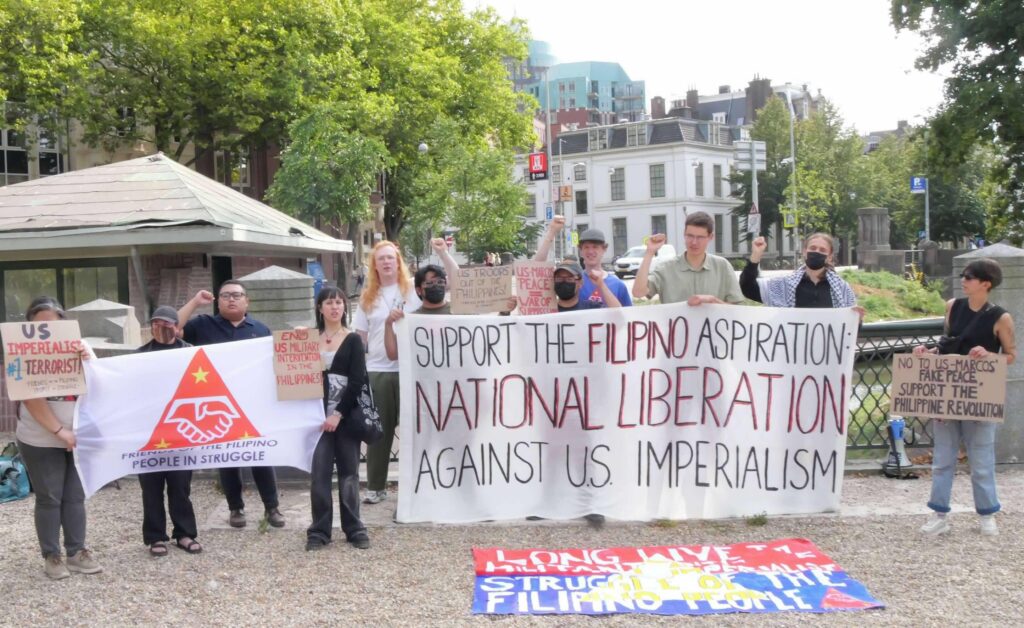

@jwildeboer
#Military & #police are merging in most countries
In appearance, weaponry, and their view of the people they are send against
And in tactics. #counterinsurgency or #COIN strategies, developed to oppress #resistance against military #occupation , are used against citizens
It is not the name that makes the difference btw military & police
It is if they see you as citizens or foe, as human being or as a legitimate target
The difference if #dissent is seen as legitimate or as crime

“#CounterInsurgency” using bombings, strafing, intimidation against #Indigenous communities under the guise of “#peace” to open #Philippines lands and resources to large businesses
https://kilusangmayouno.com/resist-the-de-facto-martial-law-in-mindoro-defend-human-rights/
#business #union #unions #HumanRights #IHL #Mindoro #AFP #PNP #IBPA #JuanSumilhig #NPA #PoliceState #RedTagging #JerwinDimapilis #capitalism #exploitatoin #ClassWar
Very much enjoyed this talk of Adnan Husein with Alana Lentin.
Lentin makes a good case that Zionism is where Western racial fascism and colonialism have always been headed. Clarified a lot to me about the hasbara "the West is next" and the unconditional support of Western governments and the support of fascists for Zionism.
They talk about many things, like CRT, the antisemitism of anti-antisemitism, and how anti-colonial and anti-racism concepts/terminology are used in service of the colonialism and racism of the status quo. Sounds like a very interesting book, good analysis.
https://m.youtube.com/watch?v=3XK8g5U3DnM
#AntiColonialism #Counterinsurgency #RacialCapitalism #books #TheNewRacialRegime #zionism #fascism @bookstodon @palestine @israel
From COINTELPRO to Project Esther: The Evolution of Domestic Counterinsurgency in the U.S.
Counterinsurgency against U.S. social movements has evolved since the 1960s. What was once the exclusive domain of state agencies has now been privatized. This is seen perhaps most clearly in the ongoing campaign to neutralize the Palestine movement.
By the time DHS agents showed up at Mahmoud Khalil’s door, a full-spectrum campaign had already marked him as a target. Columbia professor Shai Davidai had posted Khalil’s name and image online, called him a terrorist, and urged Secretary of State Marco Rubio to deport him. The smear was picked up by a network of doxxing accounts like “Documenting Jew Hatred on Campus,” which publicly lobbied for the revocation of Khalil’s visa. Rubio repeated the call, Khalil received death threats, and the university stayed silent. Then, federal agents arrived. A professor’s tweet had become a trigger for federal enforcement. A tweet, a tag, a dossier — these were the new informant files. This time, professors, NGOs, and anonymous social media accounts were the new operators.
This episode captures a defining feature of our current conjuncture: counterinsurgency is no longer the exclusive domain of state intelligence agencies. It has been privatized, digitized, and reframed as “civic action,” with Zionist nonprofits, right-wing law firms, and data-harvesting platforms organizing in concert with universities and police departments to neutralize Palestine organizing.
Though today’s tactics may look different, they reflect a familiar story. The FBI’s Counter-Intelligence Program (COINTELPRO) was a covert program aimed at surveilling, infiltrating, discrediting, and disrupting domestic political organizations deemed subversive. It is often remembered for its attacks on civil rights and Black liberation movements, but was also part of a broader Cold War strategy to suppress anti-imperialist, anti-Zionist, and internationalist movements in the U.S, especially among youth.
Today, COINTELPRO’s framework has been rescripted in Project Esther, an initiative launched by the Heritage Foundation in October 2024 that frames pro-Palestinian advocacy as “terrorism” and seeks to dismantle the broader left by branding critics of Zionism as threats to national security. It calls for purging universities, defunding institutions, deporting foreign students, and weaponizing law enforcement to suppress dissent. Though marketed as an anti-antisemitism strategy, it ignores right-wing antisemitism and recycles antisemitic conspiracy theories in the service of political repression.
Thus, while these tactics may appear new, putting COINTELPRO and Project Esther in conversation reveals a continuity of structure and intent, especially vis-à-vis the targeting of solidarity with movements abroad as a threat to national coherence. While COINTELPRO relied on federal secrecy and classified directives, today’s repression develops through public-private coordination, open-source surveillance, and layers of plausible deniability. The outcome is a more privatized, legally ambiguous, and digitally mediated mode of disruption that launders the violence of the state through university codes, NGO reports, and data-mining activism.
This piece traces the throughlines between then and now — not to flatten their differences, but to expose the structural consistency of U.S. counterinsurgency across decades and geographies, and to show how it has adapted to new legal regimes, digital technologies, and ideological terrains. In doing so, it frames history not as a mirror, but as a weapon that reveals patterns, clarifies stakes, and helps us chart a way through.
COINTELPRO’s campus war
On February 21, 1967, the FBI sent a memorandum to all of its field offices, directing agents to enhance their counterintelligence capabilities at colleges and universities. From the late 1960s through the 1970s, university campuses became central sites of COINTELPRO operations designed to neutralize leftist campus politics. Identified as incubators of revolutionary consciousness, universities were surveilled, infiltrated, and manipulated by the FBI. At UCLA, the agency’s covert efforts to inflame tensions between the Black Panther Party (BPP) and the rival U.S. Organization culminated in the 1969 assassination of Panthers Bunchy Carter and John Huggins. The suppression of radical student alliances, particularly those linking local racial justice demands with global liberation movements, became a template for future state efforts to fragment and delegitimize youth-led political coalitions.
COINTELPRO aggressively tried to infiltrate, discredit, and destroy the Student Nonviolent Coordinating Committee (SNCC), which had grown into one of the most radical and influential youth organizations in the U.S. As SNCC aligned itself with Black Power ideologies and international liberation movements, U.S. intelligence agencies became increasingly alarmed. Amid concerns that SNCC might attend the 1965 World Youth Festival in Algiers, NSA staff proposed creating a private group to counter their potential impact.1 To destabilize SNCC from within, the FBI exploited tensions within SNCC’s leadership, pacified key figures through legal pressure, and sent forged letters to donors and community leaders, aiming to cut off financial support and damage the organization’s credibility.
COINTELPRO also sought to sow division between groups. To capitalize on tension between the Panthers and SNCC, the FBI circulated a fake memo with text that reads, “According to zoologists, the main difference between a panther and other large cats is that the panther has the smallest head.”2 The FBI memo goes on to say that “[The statement] is biologically true. Publicity to this effect might help neutralize Black Panther recruiting efforts.” In 1968, the FBI began telling informants that Stokely Carmichael, a prominent SNCC leader who would later change his name to Kwame Ture, was a CIA informant and to spread the message accordingly. In one incident, FBI agents posing as concerned friends called Carmichael’s mother to inform her that Panther members wanted to kill him and that he needed to go into hiding. The decisive split between the groups was solidified by September 1970, when Huey Newton publicly announced that “We…charge that Stokely Carmichael is operating as an agent of the CIA.”
Counterinsurgent invocations of antisemitism against Black radicals grew after SNCC became the first major Black organization to publicly adopt an anti-Zionist line. The FBI frequently accused SNCC and the Black Panthers of antisemitism to destroy their reputation among liberal sympathizers. The New York Office of the FBI proposed targeting Rabbi Meir Kahane, leader of the Jewish Defense League, as the recipient of a fabricated letter from a supposed older Black veteran whose son had joined the Panthers. The letter falsely claimed the son and other Panthers planned to bomb Jewish stores and spread antisemitic propaganda in churches. The goal was to manipulate Kahane, whose media connections could amplify the disinformation, and incite him to act against the Panthers. The FBI planned to follow up with staged “evidence” like Panther publications and photographs to further bait Kahane into a confrontation. Kahane, a former member of the fascist-aligned Betar youth movement and ideological forefather to Israeli politicians like Itamar Ben-Gvir and Bezalel Smotrich, led groups (Kach and Kahane Chai) that remained on the U.S. Foreign Terrorist Organization list for decades without a single prosecution — until they were quietly delisted in 2022, just ahead of Ben-Gvir’s rise to power.
The New Left’s presence on college campuses made groups like SDS another prime target of COINTELPRO operations. As it holds today, Columbia’s visibility, location, and history put the campus at the forefront of both rebellion and repression. Columbia SDS emerged as the most influential student chapter in the country, playing a central role in the 1968 campus uprising that challenged university complicity with the Vietnam War and its occupation of Harlem. In response, the FBI launched a coordinated disinformation campaign to disrupt organizing and isolate student radicals from their families and communities. Field offices were directed to disseminate forged materials anonymously, taking “all necessary steps…to protect the Bureau as its source.” One fake letter, sent to the parents of students arrested during the 1968 Columbia uprising and signed “father of a ‘busted’ ex-student,” encouraged recipients to cut ties with SDS: “It’s your child and your money. Help throw SDS off the campus.” Another forged postcard advertised a fake event: “Attend the Cultural Bag of the Year—1968 SDS Crap Out. Do your thing. Bring your own grass, pot, whatever. Extra: Meet and gas with Mark Rudd!” These hoaxes aimed to discredit the movement through crude caricature, sow confusion among student ranks, and stoke moral panic among middle-class families already rattled by their children’s radicalism. Through psychological operations and manipulation of public perception, the state sought both to dismantle SDS and delegitimize the broader student movement at its most explosive and visible node.
Yet even at the peak of its campaign, the Bureau recognized that its grip on campus life was incomplete. “In the recent past,” one report acknowledged, “informant coverage of New Left organizations, particularly SDS, has been limited to off-campus informants and sources.” Most on-campus sources were “limited to various college officials who cooperated with this Bureau.” The lack of direct access to student organizers posed a strategic roadblock. “The penetration of SDS chapters by high-quality informants who are in a position to report on the plans of student activists remains a different problem,” the memo continued.
In response, the Bureau leaned even more heavily into counterintelligence like anonymous letters, fake publications, hoaxes, and provocations designed to provoke schisms and disillusionment. “The institution of instant counterintelligence programs,” one report notes, combined with “the certain disavowal of the New Left on the part of the vast majority of college students and officials,” was expected to increase informant access and turn the tide of campus sentiment. When direct infiltration fell short, the FBI relied on disinformation and sabotage to shape outcomes.
Though campus-based counterinsurgency during the COINTELPRO era focused largely on the Black liberation struggle and the New Left, it also laid the foundation for the surveillance of internationalist movements that would heighten in the following decade. As the state pivoted to confront new forms of dissent shaped by anti-colonial and anti-Zionist politics, its counterintelligence strategies adapted, expanding beyond Black, Puerto Rican, Indigenous, and New Left radicals to include Arab and Palestinian organizers.
The long arm of anti-Palestinian repression
The aftermath of the 1967 war marked a turning point in the surveillance of Arab American political activity. As Palestinians and other Arabs in the diaspora began organizing more visibly in solidarity with the Palestinian struggle, they became immediate targets of federal surveillance. While Black, Puerto Rican, and Indigenous radicals had long been monitored under COINTELPRO, the state repression of Arab activists post-1967 added a layer of anti-Palestinian racism and Cold War geopolitics fused to conflate Arab dissent with foreign subversion.
In the early 1970s, the Nixon administration launched Operation Boulder, a coordinated campaign of surveillance, interrogation, and intimidation targeting Arabs and Arab Americans, particularly students, under the guise of national security. While publicly framed as a response to the events in Munich in 1972, Boulder had roots in a longer history of repression that began years earlier, driven by Zionist lobbying in the wake of 1967.
Surveillance of Arab students began in earnest after Palestinian immigrant Sirhan Sirhan assassinated Robert F. Kennedy in 1968. That same year, the FBI began monitoring the Organization of Arab Students (OAS) and the Association of Arab American University Graduates (AAUG). Flagging student support for Palestinian resistance and Third World anti-imperialist movements as cause for alarm, Congress member Gerald Ford stoked fears of “Peking-trained agitators from the Middle East.” The Anti-Defamation League (ADL) played a leading role in this counterinsurgency, often infiltrating the OAS conventions and meetings. One ADL intelligence report concedes that “The political activity of the Arab students in the United States will increase significantly in the coming school year (1969–70) with increasing effectiveness. They are beginning to display a much greater understanding of how to present their arguments to the various levels of the American public…and any successes are certain to increase their confidence and, hence, their activity.” As Arab organizers became more visible, the state’s response shifted from observation to preemptive disruption. The fact that Arab student politics were becoming more legible, compelling, and harder to dismiss provoked immense fear amongst intelligence agencies.
Although both the CIA and FBI fell short on evidence, they continued to frame the OAS as a conduit for “fedayeen propaganda,” warning that their political organizing could accelerate. This speculative threat justified placing Arab students under the scope of COINTELPRO. By 1970, “potential Arab saboteurs” were officially added to the program’s targets, citing potential for future violence as grounds for surveillance.
As the surveillance of Arab political activity escalated with COINTELPRO, Operation Boulder operationalized this intelligence framework into a formalized immigration enforcement campaign. The Immigration and Naturalization Service (INS) began systematically interrogating thousands of Arab students under the pretense of checking visa compliance. They routinely asked invasive questions about political views, factional affiliation, and opinions on Zionism. Some were searched, surveilled, or referred to the FBI. Minor visa infractions, typically ignored for other students, became grounds for deportation if the student expressed pro-Palestinian sentiments. This repression was often carried out in coordination with Israeli intelligence and Zionist organizations, a long-term partnership that continues to this day.
In tandem with state repression, far-right Zionist organizations attempted to physically intimidate and silence Palestinian organizing. Most notably, the Jewish Defense League (JDL) carried out a campaign of bombings and harassment throughout the 1970s and 1980s, targeting Arab American individuals and institutions across Los Angeles. These included the 1972 bombing of Palestinian immigrant Mohammed Shaath’s apartment, attacks on the Lebanese consulate, and the 1985 assassination of Alex Odeh, the West Coast director of the American-Arab Anti-Discrimination Committee (ADC), killed by a pipe bomb at his Santa Ana office. Despite strong suspicion of JDL involvement and public statements of support for the attacks by its leader, Irv Rubin, none of this vigilante violence was ever prosecuted.
In the 1980s and 1990s, this repression expanded beyond individual targets into broader Palestinian communities. The Los Angeles 8 — a group of seven Palestinians and one Kenyan arrested in 1987 — were long-term residents and community organizers in Southern California. They were initially charged under the McCarran-Walter Act with “promoting world communism,” based on their alleged support for the Popular Front for the Liberation of Palestine (PFLP). After successfully challenging these charges on constitutional grounds, the government pivoted to using immigration and anti-terrorism laws to continue pursuing them. At the same time, the Reagan administration proposed secret concentration camps to detain tens of thousands of Arabs in a hypothetical “national emergency.”
One of the lesser-known FBI operations during this era was Operation Vulgar Betrayal, which focused on Bridgeview, Illinois, a predominantly Palestinian suburb outside of Chicago. Launched in the early 1990s and running for over a decade, the operation subjected mosques, community centers, and individuals to extreme FBI surveillance, often with no publicly stated basis beyond vague claims of “terrorism financing.” A central target was Muhammad Salah, a Palestinian Bridgeview resident, who in 1993 became the first U.S. citizen placed on a terrorist watchlist. He was later the first U.S. citizen designated as a Specially Designated National (SDN) by the Treasury Department, a designation that was ultimately withdrawn following a legal challenge.
After the signing of the Oslo Accords, the FBI began to monitor and wiretap conversations of members of the Palestine Committee in the U.S., a network of Palestinians engaged in Islamic political organizing and community work, which, at the time, operated legally within the U.S. and predated the State Department’s formal terrorist designation system. When the Palestine Committee held a three-day meeting in Philadelphia later that year, the FBI placed wiretaps inside the Marriott hotel and later introduced these transcripts as evidence during the Holy Land Five trials in 2007 and 2008.
During this period, federal agencies increasingly collaborated with private actors and entities engaged in surveillance and ideological warfare against Palestinian and Muslim communities. Chief among them was Steve Emerson, a self-styled terrorism expert and founder of the Investigative Project on Terrorism (IPT). Emerson played a pivotal role in the 1990s targeting of the Palestine Committee and Sami al-Arian and has continued to work as a key purveyor of Islamophobic disinformation. In recent years, his operations have come under renewed scrutiny. In 2021, the Council on American-Islamic Relations (CAIR) revealed that multiple individuals had been paid by Emerson and IPT to infiltrate Muslim organizations and secretly record prominent community leaders, one of whom was compensated over $100,000 across four years.
This counterinsurgency was soon followed by far-reaching legislation designed to criminalize support for Palestinian political groups and factions. Although the 1996 Antiterrorism and Effective Death Penalty Act initially limited “material support” to traditional forms like money and arms, the 2001 PATRIOT Act greatly expanded this to include vague categories such as “expert advice” and “personnel.” The Supreme Court upheld this expansion in the 2010 decision Holder v. Humanitarian Law Project, effectively criminalizing any advocacy in coordination with blacklisted groups. These laws have been used to target groups like Hamas, the PFLP, and the Palestinian Islamic Jihad (PIJ)—notably in the cases of Sami al-Arian and the Holy Land Foundation Five, whose leaders were imprisoned amid secretive and politically charged trials.
The state’s surveillance and repression of anti-imperialist Arab and Palestinian political work, which gained traction in the wake of 1967 and expanded through operations like Boulder and Vulgar Betrayal, laid the foundations for what would become the post-9/11 security state. These earlier campaigns combined immigration enforcement, domestic intelligence, and foreign policy interests to proactively target political dissent. After 9/11, these tools were revived and vastly intensified. Practices that had once been exceptional or covert became normalized and institutionalized, as the program of campus surveillance and political suppression was reactivated under the mandate of counterterrorism. The War on Terror should be understood as a continuation of the domestic warfare of COINTELPRO, inheriting its toolkit and applying it with broader reach, deeper coordination, and the legitimizing language of national security.
The War on Terror period
U.S. intelligence agencies have long exploited university resources, global reach, and access to young people. During the height of COINTELPRO, FBI and CIA operatives surveilled foreign students, monitored leftist faculty, and infiltrated student organizations. Church Committee hearings in the 1970s exposed the scale of these operations, with hundreds of university personnel found to be collaborating with the CIA, some knowingly, many under the pretense of “national interest.”
Though the public exposure of these programs temporarily forced agencies to scale back their operations, the groundwork remained largely intact. In the years following September 11, 2001, U.S. intelligence agencies strengthened their presence on college campuses, reinstating Cold War and COINTELPRO-era tactics under the banner of counterterrorism. However, unlike previous decades, when such action often sparked public scandal or internal pushback, the post-9/11 period saw the university increasingly reimagined as a willing partner in the project of domestic national security. Administrators formalized liaisons with intelligence and law enforcement agencies, launched degree programs in security, and competed for federal designations as “centers of excellence” in intelligence, cyber-operations, and surveillance technology. Entire research labs were devoted to government-funded projects with classified components, often hosted off-campus in facilities shielded from public scrutiny.
In short, what changed after 9/11 was not so much the tactics but the terms of cooperation. Where there was once scandal and subterfuge, there is now formal partnership. Surveillance is no longer framed as exceptional, but as responsible management of an uncertain world.
The NYPD’s infiltration of Muslim Student Associations (MSAs) across New York City illustrates a staggering expansion of this kind of surveillance into academic life. On the basis of “public safety,” the NYPD’s Intelligence Division, through its Cyber Intelligence, Demographics, and Terrorist Interdiction Units, undertook a dragnet surveillance program that treated religious identity itself as inherently suspicious. Between 2002 and the early 2010s, MSAs on at least 31 campuses were subjected to systemic surveillance, including the deployment of undercover officers, cyber monitoring, and the coercive recruitment of informants. Public campuses under the City University of New York (CUNY) system were a primary focus. These schools, often serving low-income and immigrant students, became saturated sites of observation, where ordinary student activities were reinterpreted through the lens of state paranoia. Accordingly, the NYPD logged paintball trips as paramilitary training exercises and religious expression, such as prayer or wearing a hijab, as radicalization indicators in government databases.
The NYPD’s Cyber Intelligence Unit routinely monitored chat rooms, blogs, email listservs, and Yahoo groups, tracking content and interpersonal connections. In one case, an NYPD informant embedded himself so deeply in MSA activities that he slept over at fellow students’ homes, prayed with them, and was entrusted with spiritual guidance, only to be later revealed as an informant whose original recruitment stemmed from a minor drug charge. For many students, especially those from immigrant families for whom higher education represented opportunity and upward mobility, the risk of being labeled a suspect was enough to retreat entirely from campus life.
Project Esther and the rise of civic counterinsurgency
While government agencies have long surveilled and repressed dissent on campuses, today’s moment marks an evolution in the form of a network of privatized and semi-autonomous actors engaging in what could be called civic counterinsurgency.
A rhizomatic anti-antisemitism industry emerged in the 2010s, composed of groups like Canary Mission, Betar USA, StopAntisemitism.org, JewBelong, and other donor-funded watchdogs and legal outfits. These organizations share a common objective of criminalizing and delegitimizing Palestine solidarity activism by portraying it as foreign-backed, antisemitic, and dangerous. They comb through social media, compile anonymous dossiers, and collaborate with law enforcement to surveil and suppress Palestine organizing, especially on campuses. Whereas the Anti-Defamation League (ADL) once served as the primary arbiter of acceptable political speech on these issues, that role has increasingly been assumed by this diffuse network of private actors engaged in a broader project of civic repression.
The civic counterinsurgency model makes this repression harder to trace. We now see students surveilled, harassed, and disciplined not only by the state but by an entire ecosystem of privatized enforcers who disguise their repression using the language of safety, civility, and anti-extremism.
Project Esther represents the newest cornerstone of the anti-antisemitism industry. Created by the Heritage Foundation, Project Esther declares its mission as identifying and dismantling what it calls a “highly organized, global Hamas Support Network (HSN).” This network, as they define it, includes “people and organizations that are both directly and indirectly involved in furthering Hamas’s cause in contravention of American values and to the detriment of American citizens and America’s national security interests.”
In Project Esther’s framework, the HSN is both antisemitic and fundamentally “anti-American.” The threat is framed in explicitly civilizational terms. “For al-Qaeda and all others of their ilk, including Hamas,” its founding document declares, “there is never any distinction between the West, the United States and Christians, and Israel and Jews: all are targets.” From this premise follows the conclusion that “Project Esther cannot be a solely ‘Jewish’ effort — it must be an American effort.” This represents a notable shift from earlier iterations of anti-Palestine solidarity groups such as Canary Mission and others, which were largely assumed to be rooted within Jewish community networks. Project Esther, by contrast, explicitly frames itself as a broad national initiative, distancing itself from being solely a Jewish communal project and openly embracing a broader right-wing coalition.
Project Esther relies on digital monitoring, facial recognition, AI-assisted data mining, and social media scraping to map associations between individuals, organizations, and actions. It uses behavioral modeling and predictive policing to repress resistance before it can coalesce. Surveillance is not limited to public behavior; it includes the collection of social media posts, protest footage, travel records, and group chats. These data are shared among campus police, university administrations, the Department of Homeland Security, and private security firms, creating a vertically integrated surveillance network.
Fracturing the movement from within is central to Project Esther’s strategy. Drawing directly from counterinsurgency manuals, it aims to sow distrust among organizations, isolate so-called “radicals,” and generate internal divisions. As its founding document plainly states, the goal is to ensure that “HSOs do not trust each other.” This also indicates their clear knowledge that they are fabricating a narrative, as it would be far more challenging to foster such distrust among actual, closely knit organizations. In the wake of high-profile incidents like the Elias Rodriguez case, federal agencies are likely monitoring how groups respond and flagging differences in tone or language as indicators of political fault lines to exploit.
Infiltration is a reality that cannot be ignored at this stage of the struggle. Student organizations have been secretly recorded and leaked to administrators and the police. In some instances, internal organizing materials have been circulated to media outlets within hours. In one leaked recording from a closed-door briefing, Jonathan Greenblatt of the ADL admits that “Our analysts are in their groups,” he said, referencing SJP and Jewish Voice for Peace. Beyond collecting intelligence, these tactics are meant to sow distrust and stall momentum.
At the University of Michigan, the privatization counterinsurgency has enabled a new level of invasive, targeted repression against Palestine solidarity organizers. Between 2023 and 2025, the university spent over $3 million contracting a private security firm, City Shield, to infiltrate and monitor pro-Palestinian student groups. Undercover agents followed students across campus and into their neighborhoods, recorded them without consent, and in some cases faked disabilities or staged confrontations to provoke them. Surveillance footage collected by these agents was shared with law enforcement and used by the university in disciplinary proceedings. Multiple students were charged, some jailed, and at least one was sentenced based on City Shield’s fabricated or unverified claims.
Legal repression forms another core component of Project Esther’s strategy. Project Esther advocates the use of racketeering statutes (RICO), the Foreign Agents Registration Act (FARA), material support for terrorism laws, and selective enforcement of immigration law to target individuals and organizations associated with Palestine solidarity work. In particular, the initiative supports stripping tax-exempt status from nonprofit organizations deemed sympathetic to Palestinian liberation, an effort sometimes referred to as the “Nonprofit Killer Bill.”
These legal tools are most aggressively used against non-citizens, as we have seen with the attempted targeted deportation of pro-Palestinian students based on political activity. The political function of Project Esther becomes even clearer when read alongside efforts by Republican attorneys general to investigate or revoke the visas of international students protesting the genocide in Gaza.
This legal repression works in conjunction with discursive maneuvers that cast Palestine solidarity as a national security threat. In 2024, right-wing think tanks and Zionist legal groups launched a coordinated campaign to discredit National Students for Justice in Palestine (NSJP), accusing the organization of supporting terrorism and acting as an agent of a foreign power. These claims, heavily promoted by the Middle East Forum, the Institute for the Study of Global Antisemitism and Policy (ISGAP), and the Capital Research Center, try to materially connect the activities of SJP chapters to those of the Axis of Resistance, mainly Hamas. The aforementioned ADL leak alleges “a dramatic change in the language” in the rhetoric of student organizers, leading Greenblatt to the assertion that “something is happening with Iran,” whose “language and tactics seem to be bleeding into the American activist space.” These allegations operate less as claims of fact than as instruments of suspicion that racialize and securitize dissent by associating it with an external “enemy.”
Much like COINTELPRO leveraged Cold War anti-communism, Project Esther uses the pretext of “foreign influence” to criminalize anti-imperialist organizing. Anti-communism has long served as an ideological framework and a rationale for the disruption of networks connecting radicals in the imperial core to the Global South. The American Indian Movement, the Young Lords, Brown Berets, SDS, SNCC, and the Black Panther Party were viewed as domestic threats specifically because they called U.S. sovereignty into question. Today’s rhetorical assault on NSJP invokes this equation of international solidarity with subversion, only now, Islamophobia and anti-terrorism are the primary vectors of legitimacy.
The central allegation is that NSJP was founded by American Muslims for Palestine (AMP), a U.S.-based nonprofit that has long been subjected to Zionist lawfare for its advocacy. Critics of NSJP point to the fact that AMP’s founders were previously involved in organizations like the Holy Land Foundation and KindHearts, charities that were dismantled through protracted legal campaigns in the post-9/11 era after being accused of funneling money to Hamas. The attempt to tie AMP and NSJP to Hamas relies on tenuous connections — shared individuals, decades-old affiliations, ideological opposition to Israeli state policy, and speculative legal theories.
Some of the more extreme claims suggest that Hamas provided advance notice of the October 7 attack to NSJP, an assertion so blatantly absurd that it exemplifies absolute impunity from truth. Given the extreme secrecy surrounding the operation, which was deliberately concealed even from key Axis of Resistance partners and other Hamas bureaus, the notion that such sensitive information would be shared with a U.S. student organization is entirely illogical and ludicrous.
Columbia University: a case study in converging crackdowns
During the 2024–2025 school year, Columbia University’s Palestine student movement faced intensified repression across physical, legal, and digital fronts. Social media platforms, acting as privatized arms of state surveillance, began systematically shutting down key nodes of communication: Columbia Students for Justice in Palestine’s Instagram account, with over 100,000 followers, was banned by Meta; the Columbia University Apartheid Divest (CUAD) account was disabled ahead of a planned protest at Barnard; and the Columbia Palestine Solidarity Coalition’s account was removed without warning in May 2025. These synchronized takedowns point to a pattern in which corporate platforms function as algorithmic enforcers of political orthodoxy, responding to pressure campaigns from alumni, donors, and Zionist NGOs embedded in the anti-antisemitism industry.
This digital censorship was shaped by direct intervention from Jordana Cutler, Meta’s policy chief for Israel and a former senior Israeli government official, who has used her position to push for the removal of pro-Palestinian content under Meta’s “Dangerous Organizations and Individuals” policy. Cutler, who has publicly described herself as “a voice of the [Israeli] government” within the company, personifies the merging of platform governance and foreign policy interests that operate through byzantine, asymmetrical mechanisms. While Israelis are granted a dedicated liaison within Meta, no such representation exists for Palestinians.
The Columbia administration created the Office of Institutional Equity (OIE) at the start of the 2024-25 academic year as a separate channel for handling discrimination and harassment complaints that bypasses standard student conduct procedures. Under an expansive interpretation of Title VI of the Civil Rights Act, the office treats generalized criticism of Zionism as “discriminatory harassment.” Dozens of students have been targeted through secretive proceedings initiated by anonymous complaints submitted via a public web portal. Columbia students familiar with the OIE report that the office frequently relies on complaints submitted by Zionist student groups or ideologically aligned individuals elsewhere in the university. Upon being notified they are under investigation, students are required to sign restrictive non-disclosure agreements to view the unredacted evidence against them. Former prosecutors staff the OIE and operate with little transparency or due process, enabling provisional punishments such as suspension or diploma holds even before any finding of misconduct. Students can also be punished for “failure to report” perceived discrimination.
On March 7, 2025, the U.S. Departments of Justice, Education, Health and Human Services, and the General Services Administration jointly announced the termination of nearly $400 million in federal contracts and grants to Columbia. The order was issued by the Trump administration’s newly formed Joint Task Force to Combat Anti-Semitism, a multi-agency body with broad enforcement authority. Officials emphasized this was only the “first round” of revocations and floated the possibility of placing Columbia under a federal consent decree. University officials quickly passed the consequences down the line: over 180 employees whose positions relied on federal funds were laid off, which redirected public anger toward student organizers rather than the federal agencies and political actors engineering the crackdown. This redirection is a hallmark of counterinsurgency that seeks to fracture solidarity, isolate the movement, and mystify the source of repression.
The counterinsurgency campaign extended beyond Columbia’s institutional sphere to target individual students, with Mahmoud Khalil emerging as the public face of this crackdown. In January 2025, Canary Mission, an anonymous blacklist site reportedly linked to Israel’s Ministry of Strategic Affairs, created a profile on Khalil. Within days, Betar USA publicly named him as a deportation target and claimed to have shared his information with ICE. After a March 5 protest at Barnard, Columbia Business School professor Shai Davidai tagged Senator Marco Rubio in a tweet demanding Khalil’s deportation: “Illegally taking over a college in which you are not even enrolled and distributing terrorist propaganda should be a deportable offense, no? Because that’s what Mahmoud Khalil from @ColumbiaSJP did yesterday at @BarnardCollege.” The claim was false. Khalil is not a member of Columbia SJP, and Columbia SJP had no role in organizing the protest. However, it circulated widely and helped catalyze a broader smear campaign. The day before ICE detained him, with assistance from Columbia’s administration, Documenting Jew Hatred on Campus picked up Davidai’s framing on X. The sequence of events suggests a coordinated effort between federal agencies, online Zionist advocacy groups, and university collaborators to orchestrate Khalil’s targeting. On May 29, his legal team filed a FOIA request seeking records of communications between the Trump administration and figures in the anti-antisemitism industry, including Canary Mission, Documenting Jew Hatred on Campus, and affiliated individuals.
In early 2025, the Department of Justice launched a sweeping investigation into CUAD and affiliated student organizers. Led by Trump appointee Emil Bove III, the probe sought membership lists, Instagram data, and explored coordination with ICE. A federal judge twice rejected search warrant requests, citing constitutional concerns. Nevertheless, the Department of Justice continues to press its case.
On April 11, 2025, the U.S. Department of Justice filed a sealed motion asking the Southern District of New York to override a magistrate judge’s denial of a search warrant targeting the Instagram account @cuapartheiddivest. Prosecutors argued that a March 14 post from the account constituted a criminal violation of 18 U.S.C. § 875(c), which prohibits interstate threats to injure.
The post featured a photo of Columbia President Katrina Armstrong’s residence marked with red paint, graffiti reading “FREE THEM ALL,” and a black inverted triangle. Its caption read in part: “The Columbia President’s mansion has been redecorated…Katrina Armstrong you will not be allowed peace as you sic NYPD officers and ICE agents on your own students for opposing the genocide of the Palestinian people.”
According to the DOJ, the post met the legal threshold for a “true threat” and was not protected by the First Amendment. Prosecutors claimed there was “probable cause to believe” the post was made “with the intent to place the administrator in fear of bodily harm.”
Magistrate Judge Sarah Netburn had rejected three iterations of the warrant, ruling that the post likely constituted protected political speech. In its appeal, the DOJ faulted Netburn for narrowing her analysis to “the statement ‘you will not be allowed peace’ and the inverted triangle,” arguing she ignored the “full context” of CUAD’s rhetoric and actions. The filing reads: “An email reading simply ‘we plan to visit you soon’ has one meaning if the sender is a door-to-door sales agency, and quite another if it is the Ku Klux Klan.”
The DOJ is now asking District Judge John Koeltl to find the denial “clearly erroneous” or to issue the warrant directly. If granted, Meta would be compelled to hand over account data for @cuapartheiddivest. A ruling is pending.
On May 7, 2025, 81 students and community members were arrested by the NYPD’s Strategic Response Group after establishing the Basel al-Araj Popular University inside Columbia University’s Butler Library. In the days following the protest, Senator Marco Rubio called for a full review of the visa status of all students involved. Shortly after, the Columbia administration escalated its response, sending a questionnaire to students facing disciplinary action. The questionnaire asked pointed questions like, “How did you become aware of the planned demonstration?” “Did you make a conscious decision to remain in the room after being instructed to disperse? Please explain.” and “Did you bring any materials related to the protest on May 7, 2025 (e.g., banners, stickers, drums, megaphones) into the library? If yes, what materials did you bring, and how did you obtain these materials?” This line of questioning shows the administration’s effort to punish the students while also mapping political networks, assessing intent, and preempting future mobilizations.
The convergence of state power and civil society proxies—university boards, tech platforms, media outlets, philanthropic foundations, donor-funded lawfare groups, consulting firms, and think tanks—brings to the fore counterinsurgency’s privatization. These forces are not only parallel but increasingly coordinated, as universities have hired private security, devised new codes of conduct, and shared student data with law enforcement. The anti-antisemitism industry has become a vehicle for ideological enforcement through financial coercion, reputational sabotage, and lawfare. In this feedback loop, civic actors generate the justification, and the state supplies the force.
The domestic arm of Empire
Repression reveals what the state fears most. If we understand the U.S. state as fundamentally imperial, then its domestic repression cannot be disentangled from its foreign policy. Counterinsurgency at home mirrors U.S. strategies abroad. COINTELPRO functioned as a domestic arm of imperial war, designed to neutralize liberation movements that posed a material threat to U.S.-led imperialism. Today, Project Esther attempts to do the same to the Palestine solidarity movement, this time with the help of civil society proxies.
Project Esther’s preoccupation with “anti-Americanism” is noteworthy. Although it claims to target what it deems antisemitic, the deepest threat, in the eyes of the state, is anti-imperialism. The same fear that animated the FBI’s war on SNCC, SDS, and the Black Panther Party now animates its repression of students organizing for Gaza. Anti-imperialist internationalism is dangerous to the U.S. because it breaks the isolation on which repression depends.
The accusations leveled against student organizers of foreign coordination, terrorist affiliation, or espionage are fabricated and politically motivated. But they also reflect an underlying truth that Palestine solidarity, in its more radical formations, poses a real threat to the legitimacy and continuity of U.S. empire. When students reject the settler logic of the Zionist state, they are also rejecting the broader scaffolding of U.S. military hegemony, settler colonialism, and permanent war. It is precisely this alignment with a global resistance to imperial power that renders such movements dangerous, not because they are orchestrated from abroad, but because they articulate a domestic refusal of the geopolitical status quo.
Project Esther is not COINTELPRO 2.0. It is, however, part of the same infrastructure of counterinsurgency, updated for the age of digital repression. Recognizing these continuities helps us build a strategic response grounded in historical movement memory that refuses fragmentation, cultivates discipline, and sustains struggle across generations.
In order to resist effectively, we must remember that we are not the first to be targeted. There is a lineage of struggle beneath our feet. Through understanding the script, we begin to uncover the means to resist it. We begin to remember how our elders fought back, and how we can as well.
Carrie Zaremba
Carrie Zaremba is a writer and organizer based in Brooklyn whose work focuses on student movements, internationalism, and counter-repression. She is a member of the Black Alliance for Peace (BAP) Solidarity Network and a proud Students for Justice in Palestine alum.
Notes
1. p. 299 of Patriotic Betrayal: The Inside Story of the CIA’s Secret Campaign to Enroll American Students in the Crusade Against Communism ↩︎
2. G.C. Moore to W.C. Sullivan, Oct. 10, 1968. also cited in Agents of Repression The FBI’s Secret Wars Against the Black Panther Party and the American Indian Movement Second Edition by Ward Churchill ↩︎
https://abolitionmedia.noblogs.org/?p=20135
#antiImperialism #cointelpro #counterinsurgency #northAmerica #palestineSolidarity #projectEsther #repression #studentMovement #warOnTerror #zionism

Everyone who has ever said or thought: "Why are you complaining about, scolding, making a big deal out, this word? There are more important things to worry about, like this fascist takeover!"
needs to listen/watch Dylan Rodríguez on Lexical Warfare. He shows how words are part of the fight, or even are the fight. Look e.g. how the right fights with "antisemitism" or "DEI." In this example, due to my limited skills, I used the words as weapons, while building a lexicon goes much further: they shape our realities, also on a material level!
Plus loads of other good food for thought and for actions.
https://m.youtube.com/watch?v=I7XMGrYtMSI
#LexicalWarfare #DylanRodriguez #ClassWar #MAKCapitalism #Counterinsurgency #project2025 #BlackFeminism #Democrats #BlackRadicalTradition #AntiFascism @palestine
I need some antidote after all that capitalist democracy corruption, necropolitics, and necrocapitalism of only today.
Yesterday I listened to MAKCapitalism episode “Individual Acts of Resistance Can Lead to New Terrains of Struggle” with Garrett Felber on their latest book A Continuous Struggle: The Revolutionary Life of Martin Sostre, which made me wanting to learn more.
Now listening to Dylan Rodríguez on Lexical Warfare & Counterinsurgency at Millennials Are Killing Capitalism.
We are not alone, and there are more of us.
https://m.youtube.com/watch?v=I7XMGrYtMSI
#counterInsurgency #ClassWar #MAKCapitalism #DylanRodriquez #AntiCapitalism
The Zionist Entity’s Proxy Forces in Gaza
‘Israel’ has long used undercover forces posing as Palestinians to sow strife. Today, it is using this strategy again in Gaza in the form of the gangs taking control over humanitarian aid. The goal is to fragment and dismember Palestinian society.
In the long and bitter history of Palestine’s confrontation with Zionism, few figures have produced such a deep epistemic and affective rupture as the unit of undercover special forces that pose as Palestinians. Known as the “Arabized unit,” or the “musta’ribeen,” the undercover ‘Israeli’ agent, operates not as a visible settler but as a native double. Fluent in Palestinian dialect and mannerisms, the Arabized agent moves among Palestinians as a ghostly presence that mimics and surveils from within while also conducting surprise operations meant to catch the “prey” off guard, either for arrest or assassination. He does not merely collect data; he unsettles community trust and the possibility of collective self-recognition. In this way, the musta’ribeen are not just a tactical force, but a weaponized mode of infiltration that shatters the mirror through which Palestinians see themselves.
‘Israel’ first developed these “Arab” units to carry out rapid operations within Palestinian camps, dense urban spaces that are otherwise inaccessible to uniformed soldiers, with hardly any chance of catching their targets off guard. The musta’rib was an answer to the question of how to reach the “target” before they were aware of the army’s presence.
This logic of infiltration, long a part of Israel’s colonial strategy, has reemerged in the present moment. In a recent video from Hamas’s Qassam Brigades, a Palestinian unit working with the ‘Israeli’ military was designated by the resistance as musta’ribeen. In using that term to designate Palestinian collaborators – which would typically be referred to as collaborators or spies, jawasees – rather than undercover Israelis, Hamas was deliberately destabilizing the boundary between collaborator and enemy.
One of the most infamous figures among these newly anointed Israeli proxies in Rafah is Yasser Abu Shabab, a former prisoner once sentenced for drug smuggling by the Hamas government, who has headed a group of hundreds of armed men looting aid convoys in Gaza throughout the war. His ascent exemplifies how the interplay of clan loyalties, material survival, opportunism, and tacit support from elements within the Palestinian Authority coalesces to open the space for such gangs to emerge. Their presence seeks not only to fracture the social fabric but to suture a new wound atop the open wound of genocide.
‘Israel’s’ use of these collaborator units serves various goals.
First, they serve to obstruct and reroute the flow of humanitarian aid, transforming relief into a mechanism of control.
Second, they act as informal tax collectors, extracting rents from the very economy of suffering they help sustain, thereby positioning themselves as intermediaries — not only with the occupying force, but with the increasingly privatized apparatus of international relief.
Third, they are also used as a mechanism of embezzlement, exploiting desperation to lure Gaza’s hungry and its youth. This power emerges from what they are permitted to offer: a bag of food, a promise of access, a possible exclusion from massacres. These offerings are not benign; they function as levers of control, operating within the tension between the survival of the individual family and the collective endurance (sumud) of the entire community. By inserting themselves as brokers between ‘Israel’ and the population, they allow informal and formal networks of dependency, and authority to fester and grow. They become a native address that mediates with ‘Israel’.
Fourth, and perhaps most insidiously, they function as protagonists in a choreography of propaganda. Carefully staged videos — men in uniform unloading sacks of flour or gesturing at queues of the displaced — are circulated to suggest the emergence of alternative Palestinian governance, one ostensibly more “pragmatic” or pliant, and more willing to sing Netanyahu’s song.
Their role is not merely to sow chaos, but to gesture toward the possibility of another order. Their very presence foments distrust, interrupting the fragile solidarities that form under siege. They are, in a sense, the first to take the bait: the first to imagine a future nested within the apparatus of extermination. But what they are offered is not life, only its mimicry — a managed survivability within a landscape engineered to extinguish Palestinians’ presence — and to extinguish the need for them as well.
And like many such collaborationist phenomena, they disguise their brute turn against their people with mantras such as “popular forces,” the same title Abu Shabab uses to style his band of looters.
But here’s the catch: while these groups may be tactically useful to Israel — convenient for rerouting aid, disciplining hunger, and unsettling the already frayed cohesion of Gaza’s social fabric — their utility remains fundamentally limited. They are not strategic actors in any transformative sense. Their geography is narrow, their influence parasitic, and their existence tethered entirely to the protective shadow of ‘Israeli’ power. They are collaborators. They live, quite literally, off the war: off the aid convoys they loot, off the weapons selectively handed down to them — and off the ‘Israeli’ military’s indulgence.
But what matters most to ‘Israel’ is not their success, but their spectacle. The point is not that they will win Gaza — no one, including their handlers, imagines that they might — but that they serve as a living performance of infiltration. They become symbols of fracture, carrying with them the suggestion that Palestinian society in Gaza is penetrable, divisible, and corruptible. It shows that resistance has its counter-image.
Their real function is not to govern, but to haunt the boundary between opposition and collaboration. They circulate doubt to render the very idea of a collective will to endure suspect. In this sense, the collaborator militia is less a military asset than a narrative device — an actor in Israel’s ongoing effort to narrate Palestinian disintegration as endogenous, inevitable, and perhaps, in Zionist eyes, also “deserved.”
However, their expunged social standing — their exclusion from the communal imaginary — marks their failure to be naturalized into the Palestinian social body, unlike traditional mafias that often root themselves in kinship, neighborhood, or class solidarities. Instead, these collaborators exist in a zone of negative sovereignty: feared, but not respected, known, but not claimed, present, but disavowed. They are best understood as a colonial technology of fragmentation.
This technology of fragmentation is, again, not novel. ‘Israel’ has long cultivated alliances with local actors to manage and disrupt Palestinian cohesion. The convergence of tacit Israeli backing, particularly from intelligence apparatuses, as well as the deliberate failure of policing and broader economic shifts, has produced new, more embedded structures of organized crime.
These groups are not mere byproducts of social decay; they are symptoms of a managed disorder, cultivated and tolerated insofar as they displace collective agency and re-channel violence inward even among those ‘Israel’ touts as its own citizens, and employs them happily as propaganda tools to say, “look, we have Arabs who walk the beach. Therefore, we are not racist.”
The same applies to the Palestinian Authority in the West Bank, which today represents the most advanced form of such a gang-like political culture. Cannibalizing the para-state apparatus, the PA governs not only through ‘Israel’s’ shadow but also through its own weaponization of nationalist history. It redraws the boundaries of loyalty and treason, of friend and enemy, in ways that permit it to conceal its dispositions.
But perhaps this is what is most central in the context of Gaza: like humanitarianism and the obscene genocide, like the ‘Israeli’ soldier’s delight and his festivity in the killing of Palestinians and the destruction of their homes — everything is now laid bare. It is a war without coverings. No sheets, no veils, no ideological blinders. The social form of this collaboration, its crude emergence into public visibility, reveals something fundamental about the nature of this war.
It is not only genocidal — it is obscene and shameless, demanding nothing of the world but passivity. What we are witnessing is not merely a military campaign, but a theater of collapse — not of Gaza, but of the ideological blinders, discourses, and moral claims of a world no longer capable of justifying itself.
https://abolitionmedia.noblogs.org/?p=19682
#counterinsurgency #hamas #palestine #QassamBrigades #YasserAbuShabab

Client Info
Server: https://mastodon.social
Version: 2025.07
Repository: https://github.com/cyevgeniy/lmst