Labor Inspectors Warned to Intensify Child Labor Crackdown
https://newsletter.tf/karnataka-inspectors-child-labor-india-2024/
Karnataka labor inspectors are warned to find more child labor cases and give bigger fines, or face action.
Labor Inspectors Warned to Intensify Child Labor Crackdown
https://newsletter.tf/karnataka-inspectors-child-labor-india-2024/
Karnataka labor inspectors are warned to find more child labor cases and give bigger fines, or face action.

Karnataka Officials Tell Inspectors to Find More Child Labor Cases
Officials in Karnataka, India, have told labor inspectors to work harder to find and stop child labor. They are worried that not enough cases are being found and that the fines are too small. Inspectors will face trouble if they do not do better.
https://newsletter.tf/karnataka-inspectors-child-labor-india-2024/
Bill seeks to lower the minimum wage for minors in Missouri
#Minecraft #ChildLabor #ChildLabour #Coal #CoalIndustry #TheCoalIndustry #CoalMine #CoalMines.
#MinecraftMeme #MinecraftMemes #VideoGame #VideoGames #Gaming #GamingMeme #GamingMemes #Meme #Memes

"Damn, gotta buy a new chimney sweep to get the old one out now"

#Roblox is already in violation of several states' laws on #ChildLabor and other issues. :blobshrug:
#News #Technology #Gaming #PublicPolicy #NewYork #NewYorkState
https://www.theverge.com/policy/860727/new-york-governor-hochul-roblox-kids-online-safety
New exhibit at Lawrence (MA) History Museum.
“A considerable number of the boys and girls die within the first two or three years after beginning work,” wrote Dr. Elizabeth Shapleigh, a Lawrence physician. “Thirty-six of every 100 of all men and women who work in the mills die before or by the time they are 25 years of age.”
Today in Labor History December 28, 1907: The New York Rent Strike began in the Lower Eastside, in response to proposed rent increases during the Panic of 1907, when tens of thousands lost their jobs. The organizers were Jewish immigrant women, but leadership was eventually taken over by the Socialist Party of America. One of the early organizers of the rent strike was Pauline Newman, who had been working at the Triangle Shirtwaist Factory since age 11. By age 15, she was active in Socialist organizations. She survived the deadly fire at the Triangle factory in 1911, which killed 146 young women and girls, mostly Jewish and Italian immigrants, and became an effective organizer with the ILGWU. She helped organize a 1909 General Strike among women garment worikers. Her organizing earned her the moniker “East Side Joan of Arc.”
The Lower Eastside rent strike soon spread to other parts of Manhattan and Brooklyn, with roughly 10,000 tenants taking part. The landlords ultimately broke the strike through mass evictions and police brutality. Nevertheless, approximately 2,000 people did successfully block rent increases. The rent strike was the larges the city had ever seen until then, and it helped to spawn decades of radical tenant organizing in New York.
#workingclass #LaborHistory #housing #rent #rentstrike #strike #police #policebrutality #evictions #jewish #immigration #socialism #paulinenewman #feminism #ilgwu #triangleshirtwaist #childlabor #GeneralStrike

Today in Labor History December 26, 1828: Dover, New Hampshire Mill Girls’ Strike began to protest the slashing of their already abysmally low wages. 75% of the workers walked out. They were girls and young women, aged 12-25, forced to work 12 hours per day, six days per week, for the salary of 45 cents per day, plus room and board. And they were paid in company scrip, redeemable only at the overpriced company store. They were forbidden from talking during the long work day. They were given only one break per day. And the conditions were so treacherous that the girls and women often lost limbs, and occasionally their lives on the job. The company hired scabs and threatened to fire the striking workers, who returned to work a few days later, except for those identified as “ringleaders” by the bosses, who were fired.
#workingclass #LaborHistory #mill #women #children #childlabor #childexploitation #strike

Funny thing about #ChildLabor, #Nebraska...
RE: https://bsky.app/profile/did:plc:eclio37ymobqex2ncko63h4r/post/3maqucldft22a
Today in Labor History December 20, 1790: The first American cotton mill began operation in Pawtucket, Rhode Island. The mill, owned by Samuel Slater, employed children aged 4-10. He also hired entire families, forcing them to live in his company housing and buy all their living necessities from his company store. Ann Arnold, aged 9, was Slater’s first employee. In 1810, he introduced the power loom, which was too much for young children to handle. So, he started hiring the next cheapest labor: young women. By 1835, 55% of all millworkers in the U.S. were children. In the New England mills, the children worked 12-hour days, 6 days per week in the winter. In the summer, they were forced to work 16 hours per day. On Sundays, he forced them to attend his Sunday school, where he indoctrinated them in “Christian values” like hard work and subservience to one’s masters. The children spent twice as many hours in the mill than kids spend in the classroom today. Kids were fined for not working hard enough. But they resisted the abuse whenever they could, sabotaging the factory, setting fires, and stealing property. In 1814, the mill owners petitioned the state to organize a police force to subdue the increasingly rebellious child workforce. 30 years later, on May 26, 1824, 102 young women and children at Slater’s mill initiated the first factory strike on U.S. soil. They, along with sympathetic community members, blockaded access to Slaters mill, shutting down operations and inspiring workers at other nearby mills to join their strike. They also went to the homes of the mill owners, shouting insults and breaking their windows. In early June, the mill owners and the workers came to an agreement, the details of which have been lost to history, and the workers returned to the mills.
Congress tried several times to enact child labor laws in the early 20th century, eventually passing the Fair Labor Standards Act of 1938, which prevented bosses from employing children during school hours, and in dangerous tasks. This law, and some of the earlier attempts, came in the wake of active organizing to protect children, including Mother Jones’s famous March of the Mill Children, in 1903, when she led a contingent of children and supporters from Philadelphia to President Teddy Roosevelt’s summer home, on Long Island, to “ask him to recommend the passage of a bill by congress to protect children against the greed of the manufacturer. We want him to hear the wail of the children, who never have a chance to go to school, but work from ten to eleven hours a day in the textile mills of Philadelphia, weaving the carpets that he and you walk on, and the curtains and clothes of the people.”
Another important contribution to the movement to end child labor came from photograph Lewis Hine, who published a series of photographs of children doing dangerous work in coal mines, glass works, and textile mills. I used his powerful photograph of colliery Breaker Boys for the cover of my first novel, Anywhere But Schuylkill. My protagonist, Mike Doyle, started work in the colliery at age 13. If interested, please send me $25 via Venmo (@Michael-Dunn-565), along with your mailing address, and I will send you a signed copy!
The U.S. never actually protected all children from exploitation. For example, the child labor laws always had exemptions for agricultural labor. And bosses often violated the existing laws, without consequence, including today. Meanwhile, growing numbers of states have passed new laws over the past five years that make it easier for bosses to exploit children and employ them in dangerous jobs.
#workingclass #LaborHistory #children #childlabor #mill #exploitation #cotton #childexploitation #childabuse #lewishine #motherjones #strike #union #books #fiction #novel #writer @bookstadon

Postal Telegraph Messengers, Indianapolis, (Indiana has no age limit for mes'grs.) Location: Indianapolis, Indiana.
Indianapolis, colloquially known as Indy, is the capital and most populous city of the U.S. state of Indiana and the county seat of Marion County. Indianapolis is situated in the state's central till plain region along the west fork of the White River. The city's official slogan, "Crossroads of America", reflects its historic importance as a transportation hub and its relative proximity to other major North American markets.
#PostalTelegraphMessengers #Cablegrams #CommercialCables #Indianapolis #Commercial #Boys #EarlythCentury #PostalTelegraph #Cablegram #HistoricalPhotograph #ChildLabor #ChildLabour #LewisHine #Photography
https://www.loc.gov/pictures/item/2018673749/

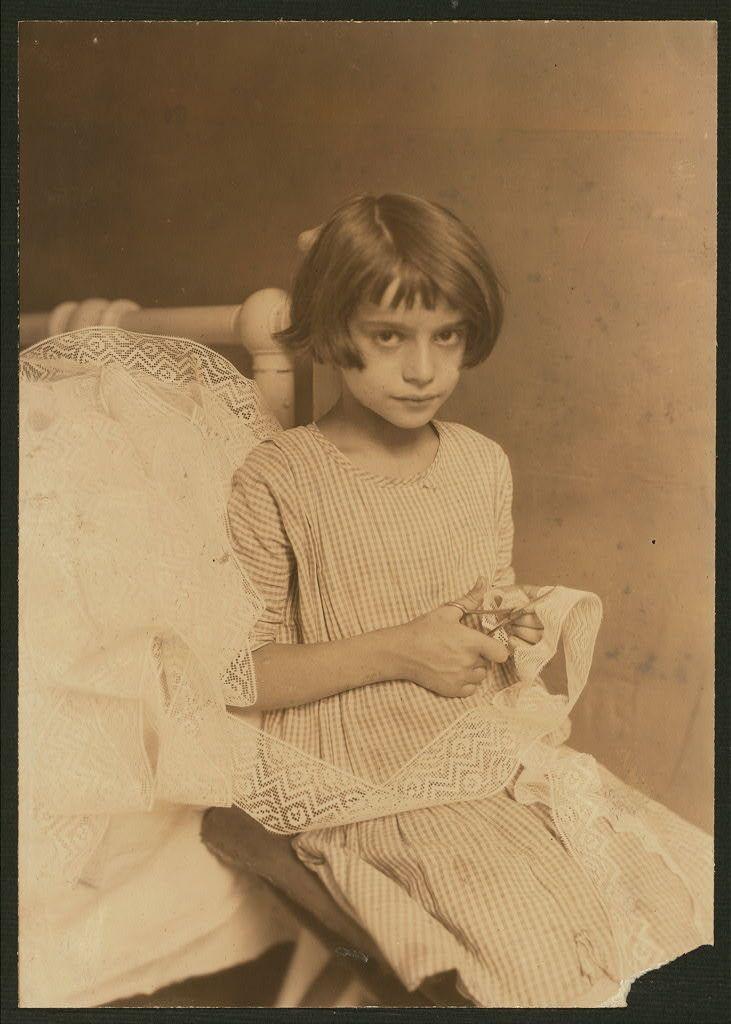
Homework pictures taken in connection with investigation (see report TE-NY-39). Location: New York, New York (State)
#Photograph #Sepiatoned #Earlythcentury #Nostalgic #Child #NewYork #Girl #Scissors #Dress #ChildLabor #ChildLabour #LewisHine #Photography #NewYorkNewYork
https://www.loc.gov/pictures/item/2018678677/
"Heiney"? one of Dallas' young news-boys. Many of them here. Location: Dallas, Texas.
Dallas is a city in the U.S. state of Texas. Located in the state's northern region, it is the ninth-most populous city in the United States and third-most populous city in Texas, with a population of 1.3 million at the 2020 census, after Houston and San Antonio. The Dallas–Fort Worth metroplex it anchors is the fourth-most populous metropolitan area in the U.S. and the most populous metropolitan area in Texas, at 7.5 million people. Dallas is the core city of the largest metropolitan area in the Southern U.S. and the largest inland metropolitan area in the U.S. that lacks any navigable link to the sea. It is the seat of Dallas County, covering nearly 386 square miles (1,000 km2) and extending into Collin, Denton, Kaufman, and Rockwall counties.
Texas is the most populous state in the South Central region of the United States. It borders Louisiana to the east, Arkansas to the northeast, Oklahoma to the north, New Mexico to the west, and an international border with the Mexican states of Chihuahua, Coahuila, Nuevo León, and Tamaulipas to the south and southwest. Texas has a coastline on the Gulf of Mexico to the southeast. Covering 268,596 square miles (695,660 km2) and with over 31 million residents as of 2024, it is the second-largest U.S. state by both area and population. Texas is nicknamed the "Lone Star State" for the single star on its flag, symbolic of its former status as an independent country, the Republic of Texas.
#Newsboy #Historicalphotograph #Dallas #Texas #Early20thcentury #Heiney #News-boy #newsboy #historicalphotograph #newspapers #ChildLabor #ChildLabour #LewisHine #Photography
https://www.loc.gov/pictures/item/2018677627/

Young Driver in Mine, (W. Va.) Over 10 hours a day, underground. Sept. 1908. Location: West Virginia.
West Virginia is a landlocked state in the Southern and Mid-Atlantic regions of the United States. Mountainous, it is bordered by Pennsylvania and Maryland to the northeast, Virginia to the southeast, Kentucky to the southwest, and Ohio to the northwest. West Virginia is the 10th-smallest state by area and ranks as the 12th-least populous state, with a population of 1,769,979 residents. The capital and most populous city is Charleston with a population of 49,055.
#mining #underground #YoungDriver #Mine #WestVirginia #Horse #Railway #Mining #Underground #ChildLabor #ChildLabour #LewisHine #Photography
https://www.loc.gov/pictures/item/2018673773/

A.D.T. Messenger Boy, Indianapolis, 10 P.M. Location: Indianapolis, Indiana.
Indiana is a state in the Midwestern region of the United States. It borders Lake Michigan to the northwest, Michigan to the north and northeast, Ohio to the east, the Ohio River and Kentucky to the south and southeast, and the Wabash River and Illinois to the west. Nicknamed "the Hoosier State", Indiana is the 38th-largest by area and the 17th-most populous of the 50 states. Its capital and largest city is Indianapolis. Indiana was admitted to the Union as the 19th state on December 11, 1816.
Indianapolis, colloquially known as Indy, is the capital and most populous city of the U.S. state of Indiana and the county seat of Marion County. Indianapolis is situated in the state's central till plain region along the west fork of the White River. The city's official slogan, "Crossroads of America", reflects its historic importance as a transportation hub and its relative proximity to other major North American markets.
#Photography #Bicycle #Indianapolis #20th-century #Vintage #MessengerBoy #Night #ChildLabor #ChildLabour #LewisHine #Indiana #Indianapolis,Indiana
https://www.loc.gov/pictures/item/2018673752/

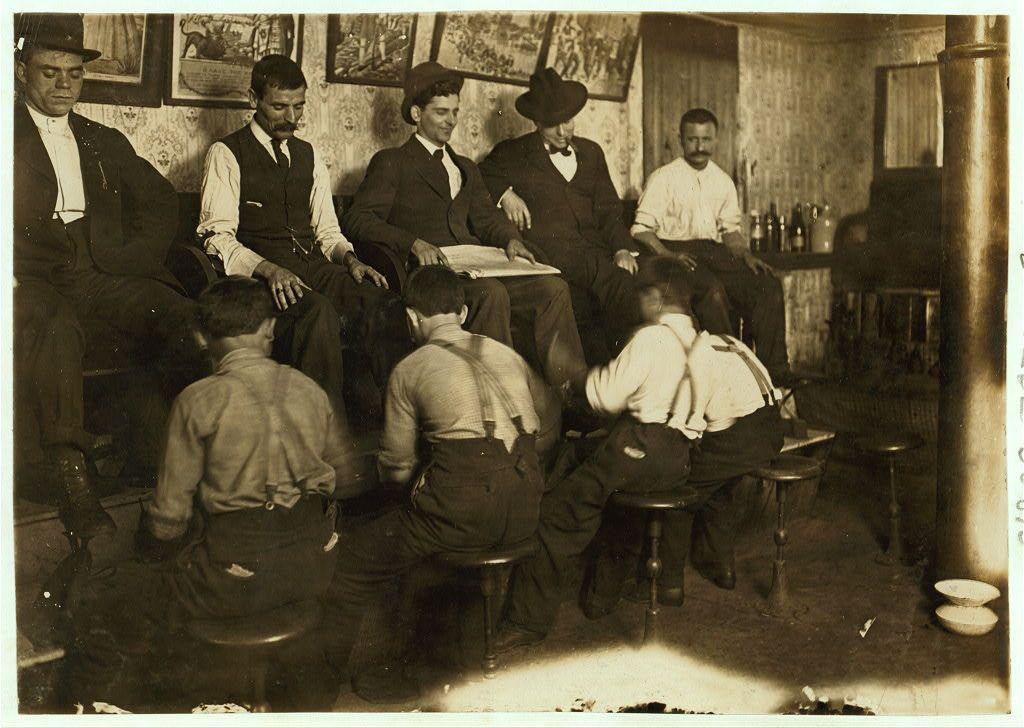
Greek Bootblacks in Indianapolis, Ind. Witness, E.N. Clooper. Location: Indianapolis, Indiana.
North is one of the four compass points or cardinal directions. It is the opposite of south and is perpendicular to east and west. North is a noun, adjective, or adverb indicating direction or geography. https://en.wikipedia.org/wiki/North
Indiana is a state in the Midwestern region of the United States. It borders Lake Michigan to the northwest, Michigan to the north and northeast, Ohio to the east, the Ohio River and Kentucky to the south and southeast, and the Wabash River and Illinois to the west. Nicknamed "the Hoosier State", Indiana is the 38th-largest by area and the 17th-most populous of the 50 states. Its capital and largest city is Indianapolis. Indiana was admitted to the Union as the 19th state on December 11, 1816.
Indianapolis, colloquially known as Indy, is the capital and most populous city of the U.S. state of Indiana and the county seat of Marion County. Indianapolis is situated in the state's central till plain region along the west fork of the White River. The city's official slogan, "Crossroads of America", reflects its historic importance as a transportation hub and its relative proximity to other major North American markets.
#GreekBootblacks #Indianapolis #Indiana #Meeting #Bar #Greek #Photograph #Bootblacks #ChildLabor #ChildLabour #LewisHine #Photography #Clooper #N #Indianapolis,Indiana
https://www.loc.gov/pictures/item/2018673702/
A.D.T. Messenger Boy, Indianapolis, 10 P.M. Location: Indianapolis, Indiana.
Indianapolis, colloquially known as Indy, is the capital and most populous city of the U.S. state of Indiana and the county seat of Marion County. Indianapolis is situated in the state's central till plain region along the west fork of the White River. The city's official slogan, "Crossroads of America", reflects its historic importance as a transportation hub and its relative proximity to other major North American markets.
#Photograph #Bicycle #Cap #Bird #StreetLamp #Indianapolis #Cyclist #ChildLabor #ChildLabour #LewisHine #Photography #Indianapolis,Indiana
https//www.loc.gov/pictures/item/2018673752/

A.D.T. Messenger Boy, Indianapolis, 10 P.M. Location: Indianapolis, Indiana.
Indiana is a state in the Midwestern region of the United States. It borders Lake Michigan to the northwest, Michigan to the north and northeast, Ohio to the east, the Ohio River and Kentucky to the south and southeast, and the Wabash River and Illinois to the west. Nicknamed "the Hoosier State", Indiana is the 38th-largest by area and the 17th-most populous of the 50 states. Its capital and largest city is Indianapolis. Indiana was admitted to the Union as the 19th state on December 11, 1816.
Indianapolis, colloquially known as Indy, is the capital and most populous city of the U.S. state of Indiana and the county seat of Marion County. Indianapolis is situated in the state's central till plain region along the west fork of the White River. The city's official slogan, "Crossroads of America", reflects its historic importance as a transportation hub and its relative proximity to other major North American markets.
#A.D.T. #Photograph #Man #Bicycle #Night #Indianapolis #MessengerBoy #Vintage #ChildLabor #ChildLabour #LewisHine #Photography #Indiana
https//www.loc.gov/pictures/item/2018673752/


Punjab’s new plan aims to end child labor
https://fed.brid.gy/r/https://dailytimes.com.pk/1412535/punjabs-new-plan-aims-to-end-child-labor/