
AmigaNET Speed Boost: RobSmithDev Doubles BlueSCSI Wi-Fi Transfers
#Amiga #BlueSCSI #ZuluSCSI #RetroComputing #SCSI #WiFi #Homebrew #OpenSource #Commodore #VintageComputing
https://theoasisbbs.com/amiganet-speed-boost-robsmithdev-doubles-bluescsi-wi-fi-transfers/?fsp_sid=1913
#BlueSCSI


Newer FASTER #Amiga Internet Access from your #BlueSCSI
https://youtu.be/awwRFWpfL-4
Commodore Key Stem Fix: James Rescue Finale with C128, C64, and Amiga 500
#Commodore128 #Commodore64 #C64 #Commodore1541 #Amiga500 #Amiga #RetroComputing #VintageComputers #ComputerRestoration #BlueSCSI #VCFPNW
https://theoasisbbs.com/commodore-key-stem-fix-james-rescue-finale-with-c128-c64-and-amiga-500/?fsp_sid=1036

Just watched the ActionRetro video on getting the Mac Plus online with a BlueSCSI [1]. I got mine setup last year with the help of Basilisk II, but it was relatively convoluted.
Seems like using Infinite Mac makes us the process of creating disk images and downloading software much easier now. The Snow emulator [2] also is promising.
With recent improvements by @jcs.org to the BlueSCSI appear to speed up networking, this years #marchinosh is going to be even more fun than last year.
1. https://youtu.be/nlT8aRMm-cE
2. https://snowemu.com/
3. https://hachyderm.io/@BlueSCSI/115890032103613775
#macintosh #retrocomputing #macintoshgarden #bluescsi
Commodore Ranger Monitor and the Dream Amiga 3000 Rebuild
#Amiga3000 #CommodoreMonitor #CRTRepair #BlueSCSI #RetroComputing #AmigaRestoration #ClassicComputers #WHDLoad #SCSI #AmigaHardware
https://theoasisbbs.com/commodore-ranger-monitor-and-the-dream-amiga-3000-rebuild/?fsp_sid=731


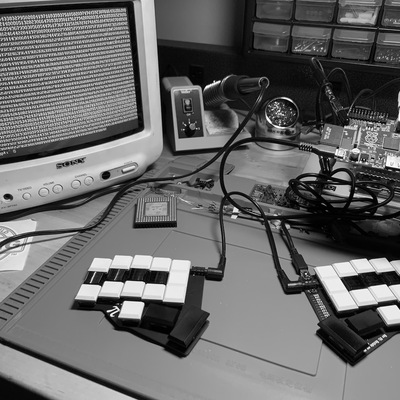
Got to see a couple #VintageMac computers that I restored doing work in 2026 sending data to a 4-axis mill to make parts (with help from #bluescsi of course)


Great work by @jcs.org for a HUGE improvement to #BlueSCSI Wi-Fi Speed- will be in the next release but did a quick pre-release build with his branch if you want to try it out today!
> The result of all that debugging is a 691% speed-up in #EtherTalk speed when going over BlueSCSI Wi-Fi - via jcs
Oh and @twvd already merged these fixes into SnowEmu for a much faster experience there as well!
https://github.com/BlueSCSI/BlueSCSI-v2/releases/tag/jcs-wifi-speed-test
#opensource #retrocomputing #daynaport #vintagemac #globaltalk

The BlueSCSI is supposed to use image files, .hda files, for virtual hard drives on it's SD card. Discovered by accident that it seems to able to use the SD card directly as a hard drive as well, without any image files. Was able to format and partition the whole SD from HDtoolbox in AmigaOS 3.2, seemingly without issue. Of course, the BlueSCSI can't read the configuration file or write it's log files to the card anymore, so there's that! #BlueSCSI
Testing my BlueSCSIv2 with obscure Amiga hardware - this is the Masoboshi MasterCard MC-702, a combined SCSI and IDE controller for the Amiga 2000 from 1992 or thereabouts. I'm trying to get this to play nice with N2630 accelerator card I recently built. In theory I guess it should be ok to run the lide.device IDE driver on the N2630 along the MASOBOSHI.device driver from this card, but I'm running into a few snags. Some games installed on the BlueSCSI won't run, but I can store stuff and run simple programs. At this point I'm not sure if what I'm seeing is the MC-702 having issues with the BlueSCSI, or trouble on the Amiga side of things. Next up is to try out what I really want to use the BlueSCSI for in this setup - CD images and transferring files to the system via the SD card. #Amiga #amiga2000 #retrocomputing #BlueSCSI


Le BlueSCSI passe à l'Ultra Wide SCSI grâce à la puce du Raspberry Pico 2 http://dlvr.it/TQDb1G #BlueSCSI #RaspberryPi

The new #BlueSCSI Ultra Wide SCA EVT board arrived today (and this time the PCB was the right color!)
Already working with the standard Ultra Wide firmware, and now I get to implement SCA SCSI ID detection.

Announcing #BlueSCSI Ultra, Ultra Wide and (coming soon) SCA.

For all you CD Audio fans out there, get ready: #BlueSCSI V2 is going to support audio output soon, on hardware versions 2023.09a and later!
Over the Christmas break I took a look at the two audio output options available to the framework (I2S and S/PDIF). I2S unfortunately doesn’t pan out for V2 because we only have two spare GPIO, and I2S needs three. S/PDIF on the other hand requires only a single signal line.
With a cheap S/PDIF converter box in hand, I have successfully updated the framework to make it functional on Pico and Pico 2. Currently only one clock speed is supported for S/PDIF but we might be able to make it work in other modes.
The primary changes are:
* Not using the SPI peripheral (it’s not available on our two spare pins), switched to PIO
* Getting the clock divider right
Next Steps:
* Software release
* Hardware design, to make something which plugs into the QWIIC port for ease of use

Why the retro-computing scene matters
https://wiesmann.codiferes.net/wordpress/archives/42054
#BlueSCSI #ClassicMac #DIY #MacSE/30 #Restauration #Retrocomputing #RightToRepair #Tooling


Looking into replacing the optical drives in some of my vintage PCs with emulators. Considering my main use case will be CD images which may have redbook tracks and/or copy protection, should I...

RE: https://oldbytes.space/@flexion/115702384368353515
#ZuluSCSI, #BlueSCSI and the like (and soon #PicoIDE) are godsends for old systems!

A BlueSCSI não é só para Macs.
https://retropolis.com.br/2025/11/17/a-bluescsi-nao-e-so-para-macs/

I actually got a BlueSCSI device with a WiFi module. What todo with a Classic Macintosh and Internet?
Also how to get Apps on it? I used Disk Jockey from @onegeekarmy but I got no clue how to install apps on it beside the OS.
#bluescsi #vintagemac #retrocomputing #apple
…and back in action. The HDD is definitely fried but thanks to @BlueSCSI and @onegeekarmy it got life again.
#vintagemac #retrocomputing #apple #bluescsi


Client Info
Server: https://mastodon.social
Version: 2025.07
Repository: https://github.com/cyevgeniy/lmst