#Aug25

2025-10-27

Stuck in the Filter: August 2025’s Angry Misses

By Kenstrosity

The heat persists, but now the humidity comes in full force as storm systems wreak havoc upon the coasts. I hide in my cramped closet of an office, lest I be washed out once again by an unsuspecting deluge. However, I still send my minions out into the facility, bound by duty to search for those metallic scraps on which we feast.

Fortuitously, most all of those imps I sent out came back alive, and with wares! BEHOLD!

Kenstrosity’s Galactic Gremlin

Silent Millenia // Celestial Twilight: Beyond the Crimson Veil [August 26th, 2025 – Self-Release]

Have you ever seen such a delightfully cheesy cover? Probably, but it’s been a while for me. I bought Celestial Twilight: Beyond the Crimson Veil, the second raw symphonic black metal opus from Finnish one-man act Silent Millenia, on the strength of the artwork alone. Little did I know that what lay beyond this crimson veil was some of the most fun melodic black metal this side of Moonlight Sorcery. The same low-fi roughness that personifies Old Nick’s work grounds Silent Millenia’s starbound songwriting as it traverses the universe with an energetic punch reminiscent of Emperor or Stormkeep (“Awaken the Celestial Spell,” “Daemonic Mastery”). To help differentiate Silent Millenia’s sound from that of their peers, a gothic atmosphere ensorcells much of this material to great effect, merging eerie Victorian melodies with galactic adventurism in an unlikely pair (“Enthrone the Spectral”). Swirling synths and sparkling twinkles abound as well, creating blissful moments of interest as frosty tremolos and piercing blasts take full advantage of the false sense of security those entrancing clouds of synthetic instrumentation create (“Benighted Path to Darkness Mysterium,” “Reign in Cosmic Majesty”). Simply put, Celestial Twilight is an unexpected gem of a symphonic black metal record, bursting with killer ideas and infinite levels of raw, unabashed fun. You should hear it!

Kronos’ Unexpected Unearthments

Street Sects // Dry Drunk [August 15th, 2025 – Self Release]

Dry Drunk sticks to your inner surfaces, draining down like cigarette tar along paralyzed cilia to pool in your lungs until the cells themselves foment rebellion. Once it’s in you, you feel paranoid, wretched, and alone. So it’s the proper follow-up to Street Sects’ visionary debut, End Position. Like that record, Dry Drunk plumbs the most mundane and unsavory gutters of America for a cast of protagonists that it dwells in or dispatches with a mixture of pity and disgust, with vocalist Leo Ashline narrating their violent crimes and self-hatred in a mixture of croons, shrieks, and snarls that cook the air before the speakers into the scent of booze and rotten teeth. And like that record, Shaun Ringsmuth (Glassing) dresses the sets with a fractal litter of snaps, squeals, crashes, gunshots, and grinding electronics, caked in tar and collapsing just as soon as it is swept into a structure. And like End Position, Dry Drunk is a masterpiece. The impeccable six-song stretch from “Love Makes You Fat” through “Riding the Clock” ties you to the bumper and drags you along some of the duo’s most creative side-roads, through the simmering, straightjacketed sludge of “Baker Act” to the chopped-up, smirking electronica of “Eject Button.” Swerving between addled, unintelligible agony and unforgettable anthems, Dry Drunk, like End Position before it is nothing less than the life of a junkie scraped together, heated on a spoon, and injected into your head. Once you’ve taken a hit, you will never be quite the same.

Thus Spoke’s Frightening Fragments

Defacement // Doomed [August 22nd, 2025 – Self Release]

There’s music for every vibe.1 The one Defacement fits is an exclusively extreme metal flavor of moody that is only appreciable by genre fans, made tangibly more eerie by their persistent idiosyncratic use of dark ambient interludes amidst the viciously distorted blackened death. Audiences—and reviewers—tend to disparage these electronic segments, but I’ve always felt their crackling presence increases the analog horror of it all, and rather than being a breather from the intensity, they prolong the nausea, the sense of emptiness, and the abject fearfulness of head-based trauma. This latter concept grows more metaphorical still on Doomed, where the violence is inside the mind, purpose-erasing, and emotionally-detaching. The ambience might be the most sadly beautiful so far (“Mournful,” and “Clouded” especially), and the transitions into nightmarish heaviness arguably the most fluid. And the metal is undoubtedly the most ambitious, dynamic, and magnificent of Defacement’s career, combining their most gruesome dissonance (“Portrait”) with their most bizarrely exuberant guitar melodies (“Unexplainable,” “Unrecognised”). Solos drip tangibly with (emotional) resonance (“Unexplainable,” “Absent”) and there’s not a breath or a moment of wasted space. Yes, the band’s heavier side can suffer from a nagging sense of homogeneous mass, but it remains transporting. While I can appreciate why others do not appreciate Defacement, this is the first of their outings I can truthfully say mesmerised me on first listen.

ClarkKent’s Heated Hymns

Phantom Fire // Phantom Fire [August 8th, 2025 – Edged Circle Productions]

While I waded through the murky depths of the August promo sump, Steel implored me to take the eponymous third album from Phantom Fire. “The AMG commentariat love blackened heavy metal,” he said. I disregarded his advice at my peril, and while I ended up enjoying what I grabbed, it turns out this would have been solid too. Featuring members from Enslaved, Kraków. Hellbutcher, and Aeternus, Phantom Fire play old school speed metal that harks back to the likes of Motörhead and Iron Maiden’s Killers. Thanks to healthy doses of bass and production values that allow the instruments to shine, each song is infused with energetic grooves. The music sounds fresh, crisp, and clear, from the booming drums to Eld’s “blackened” snarls. Early tracks “Eternal Void” and “All For None” show off the catchy blend of simple guitar riffs and a hoppin’ bass accompanied by energetic kit work. While placing a somewhat lengthy instrumental track in the middle of a record usually slows it down, “Fatal Attraction” turns out to be a highlight. It tells a tragic love story involving a motorcycle with nothing but instruments, an engine revving, and some police sirens. The second half of Phantom Fire gets a bit on the weirder side, turning to some stoner and psychedelia. There’s a push and pull between the stoner and Motörhead speed stuff on songs like “Malphas” and “Submersible Pt. 2,” and this blend actually works pretty well. It turns out that they aren’t phantom after all—these guys are truly fire.

Burning Witches // Inquisition [August 22nd, 2025 – Napalm Records]

With six albums in eight years, Swiss quintet Burning Witches has really been burning rubber. While such prolific output in such a short time frame generally spells trouble, Inquisition is a solid piece of heavy/power metal. Burning Witches dabbles in a mix of speedy power metal and mid-tempo heavy metal, often sounding like ’80s stalwarts Judas Priest and Def Leppard. With Laura Guldemond’s gruff voice, they produce a more weighty, less happy version of power metal than the likes of Fellowship or Frozen Crown. While the songs stick to formulaic structures, tempo shifts from song to song help keep things from growing stale. We see this variety right from the get-go, where “Soul Eater” takes a high-energy approach before moving into the more mellow “Shame.” There’s even a pretty solid ballad, “Release Me,” that grounds the back half of the record. Songs of the sort that Burning Witches write need catchy choruses, and fortunately, they deliver. “High Priestess of the Night” is a particular standout, delivering a knock-out punch in its delivery. It helps that the instrumental parts are well-executed, from crunchy riffs to subdued solos to booming blast beats. Anyone looking for a solid bit of power metal that’s not too heavy on the cheese will find this worth a listen.

Deathhammer // Crimson Dawn [August 29th, 2025 – Hells Headbangers Records]

Celebrating 20 years of blackened speed, Deathhammer drop LP number six with the kind of energy that exhausted parents dread to see in their children at bedtime. This is my first foray with the band, and I am in awe of the relentless level of manic energy they keep throughout Crimson Dawn’s 39 minutes. If science could learn how to harness their energy, we’d have an endless source of renewables. The two-piece out of Norway channels classic Slayer on crack and even has moments reminiscent of Painkiller-era Judas Priest. They play non-stop thrash cranked to 11, with persistent blast beats and some dual guitar parts that leave your head spinning from the rapid-fire directions the riffs fire off in. The heart of the mania is singer Sergeant Salsten. His crazed vocals are amazing—snarling, shouting, and shrieking in a way that took me back to the manic pitch Judge Doom could reach in Who Framed Roger Rabbit? He sings so fast that on the chorus of “Crimson Dawn,” it sounds like he says “Griffindor,” which had me searching confusedly for the Harry Potter tag. This was probably my favorite song, not just because of the Griffindor thing, but because that chorus is so catchy. Either way, it’s tough to pick a standout track because they all grip you by the throat and don’t let go. Crimson Dawn is a ton of fun and a must listen if you like your music fast.

Grin Reaper’s Bountiful Blight

Kallias // Digital Plague [August 14th, 2025 – Self Release]

Machine gun drumming, spacey synths, Morbid Angel-meets-Meshuggah riffing, Turian-esque barking and Voyager-reminiscent vocal melodies…what the fuck is going on here? The only thing more surprising than someone having the moxie to blend all these things together is how well they work in concert. Kallias doesn’t hold back on sophomore album Digital Plague, and the result is a rocket-fueled blast through forty-four minutes of eclectic, addictive prog. The mishmash of styles keeps the album fresh and unpredictable while never dipping its toes in inconsistent waters, and staccato rhythms propel listeners through eight tracks without losing steam. As with any prog metal worth its salt, Kallias brandishes technical prowess, and their cohesion belies the relatively short time they’ve been putting out music.2 The mix is well-suited to spotlight whoever needs it at a given time, whether the bass is purring (“Exogíini Kyriarchía”), the drums are being annihilated (“Pyrrhic Victory”), or a guitar solo nears Pettrucian wankery (“Phenomenal in Theory”). The end result is three-quarters of an hour filled with myriad influences that fuse into a sound all Kallias’s own, and it’s one I’ve returned to several times since discovering (also, credit to MontDoom for his stunning artwork, which helped initially draw my attention). Check it out—you’ll be sick if you avoid this one like the Plague.

Luke’s Kaleidoscopic Kicks

Giant Haze // Cosmic Mother [August 22nd, 2025 – Tonzonen Records]

Whereas many of my colleagues are bracing themselves for cooler conditions and harsh winters to come, in my neck of the woods, things are warming up. While my own wintry August filter proved scarce, there was one particular summery gem to lift moods with burly riffs and fat stoner grooves. Unheralded German act Giant Haze seemingly emerged out of nowhere during a random Bandcamp deep dive. Debut LP Cosmic Mother channels the good old days of ’90s-inspired desert rock, featuring grungy, doomy vibes via a groovy batch of riff-centric, hard-rocking and uplifting jams, evoking the nostalgic spirit of Kyuss, Fu Manchu, Clutch and perhaps even a dash of Danzig. Punching out raucous, groove-soaked hard rockers with skyscraping hooks (“Geographic Gardens Suck,” “King of Tomorrow,” “Panic to Ride”), summery, funk–psych jams (“Sunrise”), and bluesy, punk-infused fireballs (“Crank in Public,” “Shrink Age”) Giant Haze get a lot of things right on this assured debut. The songwriting is deceptively diverse and punchy, bolstered by solid production, tight musicianship, and the swaggering, ever so slightly goofy vocal charms and powerful hooks of frontman Christoph Wollmann. Inevitably, a few rough spots appear, but overall Cosmic Mother showcases oodles of budding potential, an impactful delivery, cheeky sense of humor, and infectious, feel-good songcraft.

Spicie Forrest’s Foraged Fruit

Bask // The Turning [August 22nd, 2025 – Season of Mist]

Last seen in 2019, Bask returns with fourth LP, The Turning, a concept album following The Rider as she and The Traveler traverse the stars. They still peddle the unique blend of stoner rock and Americana Kenstrosity reviewed favorably in 2019, but 2025 sees them looking up for inspiration. The Turning incorporates a distinct cosmic bent (“The Traveler,” “The Turning”) and post-rock structures (“Dig My Heels,” “Unwound”). These augmentations to Bask’s core sound are enhanced by the masterful pedal steel of new official member Jed Willis. Whether floating through the firmament or tilling earthly pastures, Willis creates textures both fresh and intensely nostalgic. The infinite shifting vistas of The Turning’s front half coalesce into singular timeless visions on the back half, supporting its conceptual nature in both content and form. Like a combination of Huntsmen and Somali Yacht Club, Bask weaves riffs and melodies heard across the plains and through the void above with an unguarded authenticity felt in your soul.

Dolphin Whisperer’s Disseminating Discharge

Plasmodulated // An Ocean ov Putrid, Stinky, Vile, Disgusting Hell [August 1st, 2025 – Personal Records]

Stinky, sticky, slimy—all adjectives that define the ideal death metal platter. Myk Colby has been trying to chase this perfect balance in a reverb-wonky package with projects like the d-beaten Hot Graves and extra hazy Wharflurch, but vile death metal balance is hard to achieve. However, An Ocean ov Putrid, Stinky, Vile, Disgusting Hell contains a recklessly pinched Demilichian riffage, classic piercing whammy bombs, and spook-minded synth ambience that places Plasmodulated with an odor more pungent than its peers. With an infected ear that festers equally with doom-loaded, Incantation-indebted drags (“Gelatinous Mutation ov Brewed Origin,” “Trapped in the Plasmovoid”) and Voivod-on-jenkem cutaways to foul-throated extravagence (“The Final Fuckening”). An air of intelligent tempo design keeps An Ocean from never feeling trapped in a maze of its own fumes, with Colby’s lush and bubbling synth design seguing tumbles into hammering deathly tremolo runs (“Such Rapid Sphacelation”) and Celtic Frosted riff tumbles (“Drowning in Sputum”) alike, all before swirling about his own tattered, trailing vocal sputters. Steady but slippery, elegant yet effluvial, An Ocean ov Putrid, Stinky, Vile, Disgusting Hell provides the necessary noxious pressure to corrode death metal-loving denizens into pure gloops of stained-denim pit worship. Delivered as labeled, Plasmodulated earns its hazardous declaration. We here at AMG are not liable for any OSHA violations that occur as a result of Plasmodulated consumption on the job, though.

#2025 #Aeternus #AmericanMetal #Americana #AnOceanOvPutridStinkyVileDisgustingHell #Aug25 #Bask #BlackMetal #BlackenedDeathMetal #BurningWitches #CelestialTwilightBeyondTheCrimsonVeil #CelticFrost #Clutch #CosmicMother #CrimsonDawn #Danzig #DarkAmbient #DeathMetal #Deathhammer #DefLeppard #Defacement #Demilich #DigitalPlague #Doomed #DryDrunk #DutchMetal #EdgedCircleProductions #Emperor #Enslaved #Fellship #FinnishMetal #FrozenCrown #FuManchu #GermanMetal #GiantHaze #Glassing #Hardcore #HeavyMetal #Hellbutcher #HellsHeadbangersRecords #HotGraves #Huntsmen #Incantation #Inquisition #IronMaiden #JudasPriest #Kallias #Kraków #Kyuss #MelodicBlackMetal #Meshuggah #MoonlightSorcery #MorbidAngel #Motörhead #NapalmRecords #NorwegianMetal #OldNick #PersonalRecords #PhantomFire #Plasmodulated #PowerMetal #ProgressiveDeathMetal #RawBlackMetal #Review #Reviews #SelfRelease #SilentMillenia #Slayer #Sludge #SludgeMetal #SomaliYachtClub #SpeedMetal #StonerRock #Stormkeep #StreetSects #StuckInTheFilter #StuckInTheFilter2025 #SwissMetal #SymphonicBlackMetal #TechnicalDeathMetal #TheTurning #TonzonenRecords #Turian #Voivod #Voyager #Wharflurch

2025-09-25

Rauhnåcht – Zwischenwelten Review

By Grin Reaper

For the uninitiated, Rauhnåcht isn’t just a one-man, pagan black metal band—it’s the time between worlds as one year transitions to the next.1 This is a quiet, contemplative period drenched in folklore, when the veil between unseen, spiritual worlds and our own is thinnest, the Wild Hunt prowls the night skies, and furry, horned beasties trudge through snowcapped, picturesque villages trading offerings for luck and warding off evil. Rauhnåcht’s latest offering, Zwischenwelten, poetically translates to “the worlds between worlds,” and posits reality as a series of crossroads between antitheses, creating worlds unto themselves. Though much of reality is defined in black and white, we all exist in shades of gray. Do Zwischenwelten’s high-minded ruminations manifest in the music, or do they get lost in translation?

Rauhnåcht’s oeuvre consistently melds black metal with folk trappings. Man-behind-the-curtain Stefan Traunmüller employs a broad assortment of instruments in Zwischenwelten to charming effect, ensuring that while you’ve almost certainly heard distorted tremolos over blast beats before, there are twists here that keep the style fresh and unique. The sum total rubs elbows with Saor and Árstíðir Lífsins without imitating either. Zwischenwelten is Rauhnåcht’s fifth album overall and the first proper metal release since Grier reviewed Unterm Gipfelthron at the tail end of 2018.2 After listening to previous albums, it’s clear that Zwischenwelten is the darkest thus far. Shedding the most ebullient facets of Unterm Gipfelthron, Zwischenwelten cuts to the core and delivers an album unmistakably black metal forward. Despite that, the folk rudiments still exist; they’re just more inconspicuously assembled in this eclectic yet coherent package.

Each song on Zwischenwelten is punctuated with subtle and evocative moments. From the accordion’s airy hum in “Das Mark des Lebens” (The Marrow of Life) that conjures a fleeting, sleepy respite against freezing gusts, to the twinkle of a glockenspiel suggesting bright, piercing stars in a clear night sky (“Der Spalt zwischen den Welten” [The Gap between the Worlds]), Rauhnåcht vividly infuses traditional folk instruments into second wave fury. The vocals are a varied affair, with standard black metal screams and howls mixed with cleans that could have been pulled straight from Fear Factory’s Obsolete (“Eines Tages Seid Ihr Frei” [One Day You Will Be Free]). Throughout Zwischenwelten, choral chanting ebbs and flows (“Der Spalt zwischen den Welten,” “Das Mark des Lebens”), serving as a restrained musical theme that culminates in closer “Alleinsamkeit” (Solitude). Throughout the final track, blackened rasps trade lines with gang and choral chanting and singing, vaguely reminiscent of the interplay from “Duel of the Fates.” Through most of the song, there’s a back and forth, with tension building between half-step transitions and minor harmonies. Near the end, the two parts coalesce into a united refrain, playing in concert rather than at odds. It’s a beautiful resolution that took me several listens to pick up on, but once revealed, it was a delight to have discovered.

There’s much to unravel in the tangled knot that Rauhnåcht delivers. Zwischenwelten is protective of its secrets, but patient listeners are rewarded with a cohesive and introspective journey. Perhaps a victim of its own seamlessness, Zwischenwelten requires multiple listens to unfold, presenting a deceptively long time investment despite the reasonable forty-one-minute runtime. From the fuzzy synth pangs and flute accompaniment in “Naturgewalten” (Forces of Nature) to the black ‘n’ roll bop near the end of “Letzter Pfad” (Last Path), the variety and interweaving of disparate elements is ambitious and well-executed. Yet its understated nature makes it elusive without a focused, active listen, and could go unappreciated by more casual audiences. Another minor gripe is that occasionally the distinctive features (like the accordion in “Das Mark des Lebens”) appear in a pocket outside the black metal onslaught, but never integrate fully like the chanting in “Alleinsamkeit.” On its own, this is hardly worth a mention. Given the theme of Zwischenwelten and embracing the gray in worlds between black and white, we sometimes glimpse the extremes of sonic spectrums without a clear picture of the intersection, which feels like a missed opportunity.

Though Rauhnåcht has been absent from proper metal albums for nearly seven years, the intervening time was put to effective use. Rauhnåcht operates in a world between worlds, bound in a layered nexus of dichotomous spheres: meditative and aggressive, harsh and tender, universal and intimate. For anyone with a passing interest in black metal, and certainly anyone who enjoys folk with it, Zwischenwelten demands a listen. This is an album that requires attentiveness to appreciate it, but it is well worth the investment and a great demonstration of what a polished concept can sound like in black metal.

Rating: Very Good!
DR: 7 | Format Reviewed: 320 kb/s CBR MP3
Label: Antiq
Websites: Zwischenwelten Bandcamp | Rauhnåcht Bandcamp3 | Facebook
Releases Worldwide: August 25th, 2025

#2025 #35 #AntiqRecords #ArstidirLifsins #AtmosphericBlackMetal #Aug25 #AustrianMetal #BlackMetal #FolkBlackMetal #Rauhnåcht #Review #Saor #Sturmpercht #UntermGipfelthron #Zwischenwelten

The album cover for Zwischenwelten by Raunåcht, out August 25th on Antiq Records. The artwork shows a horned, shaggy figure perched on a snowy mountain cliff, gazing down at a moonlit alpine village below. The scene is rendered in dark blue and gray tones, evoking wintry black metal atmosphere and folklore imagery.Rauhnåcht mastermind Stefan Traunmüller, photographed in a hooded cloak with smoke curling in front of him, giving the image a mysterious, atmospheric feel. Unfortunately, it's in color so he's obviously a poseur.
2025-09-16

Burning Sun – Retribution Review

By Angry Metal Guy

By: Nameless_n00b_607

It has been a much slower year for power metal than I would like. There have been a couple of fun releases here and there, but the volume of quality output has been very low. The classic ‘90s style of guitar-forward and keyboard-minimalist power metal has been significantly lacking in particular, and Burning Sun is looking to change that. Naming themselves after a Helloween song,1 this half-Hungarian, half-Chilean duo is on a mission to tell a classic fantasy story through a legacy sound. Burning Sun’s sophomore album, Retribution, lands only two years after their debut, Wake of Ashes, continuing the story of a paladin named Emaly.2

Burning Sun pays homage to various ‘90s European power metal bands well. While the debut was all about breakneck brightness, Retribution sets its sights towards the guitar grit of Iron Savior and Primal Fear (“Cold Winds,” “Fight in the Night”). The anthemic qualities of Helloween dominate across the board (“Open Your Eyes,” “Shadows Undone”),3 and the occasional Iron Maiden-informed gallops and choruses are a welcome presence. Of the duo, Zoltán Papi4 handles the bass and lyrics, whereas Pancho Ireland doubles as vocalist and guitarist. Ireland has a knack for emulating the classic style of power metal riffage they’re no doubt both fans of, opting for rhythmic hooks rather than lighting up the fretboard. He has upped his vocal game, too, navigating wail and grit in Zak Stevens fashion. Furthermore, he is now the only lead vocalist. Where the debut disoriented itself, juggling three voices, Retribution relies solely on Ireland’s pipes and is better for it. Reducing the number of hands on deck reinforces both vocal and instrumental cohesion.

Burning Sun’s focus on guitars over keyboards is a welcome change from current norms. Power metal of the European variety is often mischaracterized as the over-the-top synth-laden side of the genre, even though it’s never been that simple.5 I love a good mission to Mars, but sometimes remaining at ground level is a better option, and Retribution largely sticks to German conventions. Burning Sun enforces a guitar-first attitude and swears by the triumvirate of soaring anthemic vocals, triumphant guitars, and charming choruses. The culmination of this approach is the stunning Primal Fearesque lead guitar melody on “Cold Winds.” Unfortunately, Retribution does stray from its own design philosophy at times. For example, the moodier ‘80s synth stomper “Aftermath” features some vocal fumbles and feels out of place so early into the album. The voice acting at the end of “Cold Winds” is unintentionally hilarious and breaks immersion—once again confirming that storytelling works best when left to the music and lyrics. The album’s minor drawbacks fortunately never snowball into any major issues, and it never loses its critical fun factor.

Retribution is short and sweet but could pack a bigger punch. I’m a big fan of the trend of younger (and even some older) bands starting to write tight and concise records again, and Retribution is no exception. Below 40 minutes and sans the gargantuan epics that often characterize the genre, it’s a highly replayable breeze. But it feels like Burning Sun is still holding back its full potential. The record does its job well but lacks ambition, and I wouldn’t mind it flying a bit closer to the sun—just a bit more heft, speed, and drama to spice things up throughout. Retribution doesn’t need more songs; its material just needs to rip and tear more. It lacks a true barn burner, the likes of “Steel Tormentor,” or indeed, “Burning Sun.” Cuts like “Heart of Darkness” and “By the Light” are damn close to fortune and glory. Likewise, further production improvements can only help. The sound is better than on the debut, but it could still use punchier drums and more prominent bass. I’m content with what the album delivers, but the flame can and should burn brighter.

Retribution is a fun throwback to the glory days of power metal. Burning Sun isn’t doing anything extraordinary, but they’ve accomplished their goals of writing a good, earnest tale of swords and sorcery. It’s the sort of comfort food that I can never have enough of. The trajectory looks promising for Burning Sun, and I’m curious to see if they can enchant their blades in the future and set aflame the ground beneath.

Rating: Good!
DR: 9 | Format Reviewed: 320 kb/s CBR MP3
Label: Metalizer Records
Websites: Bandcamp | Facebook | Instagram
Release Date: August 22nd, 2025

#2025 #30 #Aug25 #BurningSun #ChileanMetal #Europower #Helloween #HungarianMetal #IronMaiden #IronSavior #MetalizerRecords #PowerMetal #PrimalFear #Retribution #Review #Reviews #WorldOfWarcraft

The album cover for Retribution by Burning Sun, out August 22nd on Metalizer Records. The artwork depicts a female warrior in steel armor standing in snowy mountains, holding a bloodied sword. A slain figure lies at her feet, while in the foreground, a hand crackling with green magical energy reaches toward her, emphasizing a scene of battle and vengeance.
2025-09-15

Hexrot – Formless Ruin of Oblivion Review

By Angry Metal Guy

By: Nameless_n00b_604

What’s past and what’s to come is strew’d with husks / And formless ruin of oblivion;1

Hieronymus Bosch’s triptych masterpiece The Garden of Earthly Delights is iconic, but like Dante’s Divine Comedy, it’s mostly for the Hell part. It’s not hard to see why: it’s a singularly surreal, oppressively grim piece. Scholars aren’t certain about Bosch’s religious beliefs, but the consensus is that he painted this panel to warn viewers to steer clear of temptation or endure everlasting torment in Hell. Avant-garde duo Hexrot has chosen to adorn their debut LP Formless Ruin of Oblivion with a portion of this panel, but they don’t buy Bosch’s dilemma. Promising in its promo a “stylistic mélange of death, black, and thrash metal with inventive electronic experimentation,” Hexrot has woven an abstractly grim tale of a world rejecting Heaven and Hell by plunging reality into empty Oblivion. Classical in theming, modern in sound, it sounds like quite the undertaking.

Formless Ruin does a lot, and all of it contributes to Hexrot’s impeccable sense of exploration and adventure. The sales pitch doesn’t lie about Hexrot’s sound, but it omits the unpredictable, jazzy feel. Along with Deathspell Omega-esque discordant black and Ulcerate-like dissonant death metal, the duo of drummer/vocalist/electronics producer Melmoth and guitarist/bassist/vocalist Arkain possesses a bombastic, improvised-feeling chemistry akin to Imperial Triumphant. From the skittering drums and bass of “Consecrating Luminous Conflagration” to the trash-canned climax of the fifteen-minute monster title track to “What Lies Veiled” riffing on and modifying Death’s opening “Symbolic” riff like a jazz standard, Formless Ruin of Oblivion rages and writhes in jazz fashion as often as it does in metal. Hexrot’s rhythmic talents are top-notch, serving obscenely busy drumming on “Heavenward” and immense, thrumming bass on “Clandestine Haunt” at odd and changing time signatures. Meanwhile, winding leads on “Consecrating Luminous Conflagration” and jarring electronics on the title track keep Formless Ruin’s melodic identity difficult to pin down. It’s a wild ride down to Oblivion.

Hexrot plays heavy stuff, conceptually and sonically, but Formless Ruin is surprisingly easy listening. Across its thirty-five-minute runtime, Hexrot seamlessly ties its songs together to form a continuous stream of consciousness, like a live suite. Every song besides the interludes is replete with movements and ideas without committing riff salad, while containing just enough repetition to cement hooks into memory. Vocals sound raw and upfront, consisting of a twin attack of bellowing roars and banshee screams that—while they probably would become monotonous alone—duel and complement each other, adding variety to Hexrot’s palette. And everything just sounds great: Formless Ruin sports rich production and dynamic mixing that allows every wild and disparate idea to breathe. Despite its avant-garde nature, Formless Ruin feels immediate through its grounded, live feel.2

Sometimes this album doesn’t even sound real at all. Because Hexrot established such an organic sound, every instance of electronic music creeping into the mix is surprising and even unnerving. “Consecrating Luminous Conflagration” ends and gets absorbed and rewound by the following “Ghostly Retrograde I,” synths join arpeggiated guitar on “Heavenward” to build its eerie elegance, and the title track collapses into crushed static. If there’s one aspect in which Formless Ruin isn’t totally enthralling, however, it’s sometimes when the synths and electronics stand alone. “Ghostly Retrograde II” drags by the end, as does the droning conclusion to “Formless Ruin of Oblivion”; these are the only times my mind wanders. But when they work, they elevate Hexrot, lending haunting qualities that at times remind me of the atmospherics of Cryptic Shift’s excellent Visitations from Enceladus. Hexrot’s push and pull between the organic and artificial is captivating: aptly put on the title track’s lyrics describing a curtain of stars “entering stage right,” Formless Ruin of Oblivion draws attention to its own artifice, revealing the artifice of its story’s reality, justifying Oblivion.

Formless Ruin of Oblivion demands your attention. I’ve begun so many casual spins of this album, and almost all of them turned into deep listens by track three. Hexrot has that touch to take the most seemingly unapproachable stuff and somehow make it addictive. Grandiose, volatile, unconventional, and surreal, Hexrot drummed up some Hell on this one, and I for one will be diving straight into whatever Oblivion they open up next.

Rating: Great!
DR: 10 | Review Format: 320 kb/s mp3
Label: Transcending Obscurity
Website: hexrot-label.bandcamp.com | facebook.com/hexrot
Release Date: August 29th, 2025

#2025 #40 #Aug25 #AvantGarde #AvantGardeDeathMetal #BlackMetal #Death #DeathMetal #DeathspellOmega #FormlessRuinOfOblivion #Hexrot #Review #TranscendingObscurity #TranscendingObscurityRecords #Ulcerate

The album cover for Formless Ruin of Oblivion by Hexrot, out August 29th, 2025 on Transcending Obscurity Records. The artwork is a section of Hieronymus Bosch’s famous painting, depicting surreal, nightmarish figures moving across jagged ruins under a dark, smoky sky. The band’s intricate logo appears in gold at the top right, with the album title written in gothic script at the bottom.
2025-09-14

Barbarous – Initium Mors Review

By Angry Metal Guy

By: Nameless_n00b_603

Death metal boasts a lush buffet of subgenres. From mind-flaying technicality to chilling dissonance to wanton mirth, there’s something for everyone. Unmoved by how much the genre has evolved, some folks just want the straightforward, grass-fed variety that defined American death metal in the late ‘80s and early ‘90s. And what bloodsport that was—Cannibal Corpse hammer-smashed listeners to paste, Deicide seared anti-religious sentiment into their collective hide, and Morbid Angel infected them with tainted melody. Barbarous slides comfortably into the fray, wielding debut Initium Mors, but does it pack enough punch to survive the melee?1

Inspiration plays an immediate role in Barbarous’s sound. Though they hail from Oakland, California, it’s the Tampa Bay scene that casts the longest shadow. Cannibal Corpse’s influence is undeniable, providing the blueprint for punishing grooves and six-string savagery (“The Tomb Spawn,” “Conscious Decomposition”). Vocalist Travis LaBerge retches and roars somewhere between Deicide’s Glen Benton and Hate Eternal’s Eric Rutan,2 while the music also harkens to early Deicide at times (compare “By Lead or Steel” with “Serpents of the Light”). There are additional influences, too, including Necrot and Skeletal Remains, two bands heavily influenced by Death and Morbid Angel, proving all roads lead to Tampa.3 This isn’t to say that Barbarous doesn’t flex their own brand of muscular death metal. The title track does a fabulous job of baking Slaughter of the Soul-esque melody into the chorus while staying true to the Floridian Sound Machine’s jackhammering boogie.4 I see flashes of a distinct identity in Initium Mors, but more refinement would serve Barbarous to forge their own path out from the shadows of giants.

Throughout Initium Mors, Barbarous pounds and pummels with neck-snapping fury and brawny chugs. Any track would effortlessly slot into a respectable workout playlist, with “By Lead or Steel” and “Tools of the Trade” being my choice cuts. Opener “Injection of the Exhumed” storms out the gates with a phlegm-rattling gut punch buoyed by aggressive riffing and blast beats, followed by a Slayer-laced wail. And that’s just the first twenty seconds. Hostile grooves and pulverizing paces drive the momentum across Initium Mors’s fleeting runtime, never surrendering a moment to catch your breath. Barbarous’s unflinching imperative is to carve listeners to the root, evidenced by the album’s razor-sharp guitar-playing (“Tools of the Trade,” “Conscious Decomposition”) courtesy of Zach Weed and Thomas Belfiore. Solos set fire to tracks when they kick in, whether it’s via soulful swagger (“By Lead or Steel”) or finger-blistering fury (“Coup de Grace”). Either way, they’re unfailingly fun. Travis Zupo’s dynamic drumming bludgeons with teeth-rattling thunder (“Conscious Decomposition”) while LaBerge stays the course with calculated, vomitous barks. The only underseasoned component is Zach Jakes’s bass guitar, which is a commentary on audibility rather than skill. Listening for bass in Initium Mors reminds me of Tantalus—the more I crank the volume to hear what that sweet bottom end is doing, the murkier the wall of sound becomes.5 Considering the meaty through-line that bass provides in many a death metal casserole, elevating its heft would push Barbarous’s recipe to gloriously heinous heights.

Production and mastering are a mixed bag, presenting opportunities and highlights. The album is LOUD, and while that’s generally how I like to listen to death metal, a more spacious mix would have improved the overarching balance. For an album brimming with balls-out belligerence, such an oppressive production creates an exhausting listen despite the twenty-nine-minute runtime. Still, there’s plenty to praise. Guitars and drums are front and center, so it’s easy to appreciate their intricacies and chops. LaBerge’s vocals are also conspicuously comprehensible,6 which is refreshing for extreme gutturals. While I initially noted his gurgles as monotonous, over repeated listens, I’ve come to appreciate LaBerge’s nimble work as he juggles spewing growls and coherence.

Initium Mors is a triumphant debut and should appease death metal aficionados without qualification. Barbarous is loud, ugly, and here to melt your face in just under half an hour. There’s a lot to like on Initium Mors, even if it’s not breaking any molds. If Barbarous can give the mix a bit more room and firmly establish an identity that transcends their influences, their next release could be an absolute banger. For now, Initium Mors is a solid addition to the annals of meat ‘n’ taters death metal, leaving Barbarous to unapologetically smash skulls and shatter eardrums while delivering a veritable smörgåsbord of protein and spuds.7 Bon appétit!

Rating: Good!
DR: 4 | Format Reviewed: 320 kb/s CBR MP3
Label: Creator-Destructor Records
Website: barbarousband.bandcamp.com
Releases Worldwide: August 1st, 2025

#2025 #30 #AmericanDeathMetal #AtTheGates #Aug25 #Barbarous #CannibalCorpse #Death #Deicide #FloridaDeathMetal #HateEternal #InitiumMors #MorbidAngel #Necrot #Review #Reviews #SkeletalRemains #SlaughterOfTheSoul

The album cover for Initium Mors, the upcoming record by Barbarous, out August 1st on Creator-Destructor Records. The artwork shows a dark, gothic yet classically death-metal scene: a swamp littered with gravestones and twisted trees in the foreground, where a lone armored figure wades through murky water. In the distance looms a massive fortress carved into a volcanic mountain, glowing with orange firelight from its many windows. Smoke and flame rise from the crater at its peak. The landscape is ringed by jagged, skeletal forests, creating a sense of menace and grandeur. The band’s logo appears in the top right in jagged orange lettering, while the album title Initium Mors is written in gothic script at the bottom.Band photo of Barbarous, shot in black and white. The five members pose in a mausoleum-like setting, wearing death metal shirts and serious expressions. No unicorns spotted.
2025-09-13

Sowulo – Niht Review

By Twelve

It’s been a minute since I’ve got a chance to review some folk music around here. It’s not super common that we get these promos, but when a sample of dark folk, spiritually, resembles our heavy metal world, we occasionally find some sent our way. Today’s sample is Niht, the sixth full-length release from Dutch Sowulo (“sun” in proto-Germanic), which takes a philosophical approach to the histories of northern Europe. It’s got everything you could ask for in dark folk on paper: lyrics written in a language no one (to the best of my knowledge) speaks anymore, a small army of instruments that I can’t picture by name alone, and an inscrutable cover with a vague runic shape on it. Sowulo are, on paper, set up for success with Niht already; how does the music itself fare?

Like most works of dark folk in a similar vein—Urferd, Forndom, Wardruna, as examples—Niht draws strength from its reaches at authenticity. Sole band member Faber Horbach (Myrkvur) sings, plays nyckelharpa, carnyx, bouzouki, and acoustic percussion, with guest musicians contribution violins, harps, horns, and more to the work. The stringed instruments create an orchestral-Nordic-folk atmosphere for Sowulo to thrive in, and Niht has a lot of great moments in this vein, from the dramatic “Full Mōna,” featuring hypnotic throat singing at rising intensity, to the eerie, expansive “Swefnian.” Horbach’s gruff, throaty singing, complemented by guest singing from Micky Huijsmans (End of the Dream), brings the Anglo-Saxon lyrics to life; their duet in the stirring chorus of “Nihtēagan” is one of the best moments on Niht, owing largely to their emotional delivery (though the strings work does a lot of heavy lifting too).

Of course, there’s no metal here, and very little in the way of electric influence. Distortion is a distant dream; instead, the music and production are clean and airy, for the most part. “Mōnaþblōd” is a notable exception, with elements of electronica meshing against Sowulo’s natural folk leanings. But generally, you can hear every instrument and enjoy a comparatively quiet listen with atmospheric influence. “Miċele Steorran” is a fantastic example, a peaceful track that uses gently strings to create dream-like soundscapes that complement Horbach and Huijsmans’s singing. It’s not “purely” dark folk or neofolk, but the influences are strong enough that its power comes largely from orchestral highs and emotional vocal melodies, rather than any kind of heaviness.

Despite these terrific qualities, Niht still feels held back, as if it’s a restrained version of Horbach’s original intention—at least to my ears. Niht has on it a lot of tracks that contain a lot of repetition, which makes it feel artificially long. “Carnyx,” for example, is a nearly four-minute exploration of the eponymous wind instrument that doesn’t do much of anything except add ambience, all but halting Niht halfway through. Both the intro and closer share this approach. On the other side of the coin, “Seolfren Sicol” is dominated by its chorus, to the point that it’s the only thing I ever remember about the song. This is, perhaps, the drawback of writing your songs in a dead language—the two verses in the song resemble each other so closely that the song feels like it’s been copied and pasted in several places. With thirteen tracks, it feels as if Sowulo brought too many ideas to Niht—as if there is simultaneously too much album and too little.

Niht does a good job of building an authentic-feeling, atmospheric Nordic folk experience. It is, at varying times, complex, mesmerizing, and passionate. It does have its moments that don’t quite land as they should, but the whole is enjoyable and moving. I hadn’t heard of Sowulo before Niht, but it’s the kind of album that makes me want to hear more. If you need a break from our usual fare, you could do a lot worse than Niht.

Rating: 3.0/5.0
DR: 7 | Format Reviewed: 320 kb/s mp3
Label: Season of Mist
Websites: sowulo.bandcamp.com | sowulo.nl | facebook.com/Sowulo
Releases Worldwide: August 29th, 2025

#2025 #30 #Aug25 #DarkFolk #DutchMetal #EndOfTheDream #Forndom #Myrkvur #Neofolk #Niht #Review #Reviews #SeasonOfMist #Sowulo #Urferd #Wardruna

2025-09-12

The Final Witness – Beneath the Altar Review

By Angry Metal Guy

By: Nameless_n00b_607

In a genre long since matured, a common way to avoid retreads is to combine multiple subgenres.1 Contemporary thrash in particular is difficult to get right without the proper guitar assault required to break necks. Hence, many opt to go for one of its offshoots instead. One newcomer looking to explore the avenue of genre blending is The Final Witness, the solo project of multi-instrumentalist Josh Henderson. Debut Beneath the Altar promises to deliver death and thrash in progressive form to the unwashed masses. I dove into Beneath the Altar with caution, having seen how often this combination of terms gets misused, but hoping The Final Witness would fulfill its promise.

Inspired guitar work and appropriate variety are the main strengths of The Final Witness. The majority of Beneath the Altar involves two core components: progressive thrash (“Coronation,” “The Blood”) and death/thrash (“Sanctum of the Holy”). Plentiful melodic leads further color the album, with “Testimony” even evoking the Gothenburg sound. Lastly, quieter semi-acoustic passages bridge these individual pieces together with varied levels of success. The compositions are vivid and frenetic, alternating between traditional breakneck drumming and rhythmic trickery. Henderson’s distorted vocals lack a bit of thrash attitude, but they do a fine job of punctuating the compositions with barks and snarls. Beneath the Altar’s best moments take inspiration from Coroner and Vader, and I wish those moments were much more frequent, because the sound leans a bit too close towards the groove school of guitar chugging on occasion (“Negative World,” “Principalities”). Nevertheless, the foundation of the album holds, and Henderson’s performances are impressive.

Beneath the Altar’s experimental side comes at the expense of its strengths. On top of the album’s bread and butter, most tracks differentiate themselves with eccentricities. For example, the title track’s electronic break with an almost hip-hop-like beat is memorable and surprisingly well-made, but it doesn’t exactly fit. “Testimony” ends with a dramatic organ layer that could sound excellent if the mix didn’t turn it into an ear-piercing inconvenience. Many of these one-off gimmicks are fun, but they are either misused or discarded before leaving an impact. Worse, they are a distraction. Beneath the Altar really shines when exploring the rhythmic and melodic sides of death/thrash. Diverging from this path trades depth for breadth; a tighter track like “Sanctum of the Holy” proves that The Final Witness would only benefit from holding onto a theme for longer.

The disparate ideas of Beneath the Altar are greater than the sum of their parts. Its foundational pillars work wonders individually, but interact too infrequently, and one-off experimental touches are fun but out of place. The somber semi-acoustic parts—while well done—hinder song flow when utilized too frequently (“Principalities”) and blend together after multiple listens. Good ideas feel haphazardly assembled. The foregoing is exacerbated by its production, overseen by Jason Wisdom of Becoming the Archetype. The sound is both sterile and rough, with Wisdom prioritizing guitars over vocals and drums—both of which are loud and distracting. Its qualities conjure a strange illusion of metalcore adjacency, further contributing to the album’s incoherent identity. All that being said, I don’t mind listening to Beneath the Altar again. There’s a lot to like, and a brief 36-minute runtime makes sure the record doesn’t overstay its welcome. Yet I feel more compelled to revisit individual parts of songs rather than any particular song in full.

Beneath the Altar is an interesting but unfocused prototype. Getting a solo project this far is already respectable, but I reckon Mr. Henderson is still capable of much more. With more coherent composition and a unified vision, the ideas on this record could form a powerful message. There are exciting bits and pieces here to digest, even if they don’t necessarily form a cohesive whole, and the result is that Beneath the Altar feels like a starting point for better things to come. But for the time being, The Final Witness is still trying to find its sound—and I find myself craving some Coroner instead.

Rating: Mixed
DR: 9 | Format Reviewed: 320 kb/s CBR MP3
Label: Rottweiler Records
Websites: Bandcamp | Facebook | Instagram
Release Date: August 15th, 2025

#25 #2025 #AmericanMetal #Aug25 #BecomingTheArchetype #BeneathTheAltar #Coroner #DeathThrash #ProgressiveThrashMetal #Review #RottweilerRecords #TheFinalWitness #ThrashMetal #Vader

The album cover for Beneath the Altar by The Final Witness, out August 15th on Rottweiler Records. The artwork shows a towering gothic cathedral rising from mist, bathed in radiant light from a crucifix above. Legions of armored figures gather below, while ghostly demons and tormented faces swirl in the skies, creating an apocalyptic, dark-fantasy atmosphere.Josh Henderson of The Final Witness, photographed in black and white. Standing in a weathered, half-collapsed building, he wears a Tribulation shirt and jacket, looking directly at the camera. Henderson is the driving force behind The Final Witness, handling the band's creative and musical direction.
2025-09-09

KHNVM – Cosmocrator Review

By ClarkKent

While it looks like a jumble of consonants, KHNVM actually has an easy pronunciation: Kha-noom. Their sinister new album, Cosmocrator, derives its title from a Greek word that roughly translates to “ruler of the world” and can also refer to Satan. However, these guys aren’t Greek. Rather, KHNVM is based out of Germany, and frontman Obliterator was born in Bangladesh. Though there are three members pictured in the band photo below, Obliterator does the Billy Corgan thing and records everything but the drums.1 KHNVM released their first album, Foretold Monuments of Flesh, in 2019, and now six years later, Cosmocrator marks their fourth record. In that short span of time, KHNVM has gradually shifted from putrid death metal to a more nuanced death-doom sound. It’s time to find out if KHNVM goes kaboom!

Cosmocrator alternates between speedy death tremolos and slow, sludgy guitar riffs. The result comes off somewhat like Mother of Graves or Tomb of Finland minus the melodicism. “Fetid Eden” best illustrates this death-doom dance. Its bookends contain up-tempo drumming and tremolos amidst Obliterator’s low, whispery growls, but the middle of the song slows to a near funeral doom pace. This makes for a varied, interesting listening experience, and one that’s particularly rewarding when KHNVM ramps up the energy following a bout of doom. Opener “Purgatorial Pyre” similarly straddles this line to great success. Once you get past the lengthy instrumental passage,2 the song gets the heart pumping with some energetic riffs and a Kvaen-like chorus in “Pyre! Purgatorial pyre!”

KHNVM also toys with progressive song structures, which is wise considering four of the seven tracks are over five minutes long. While the progressive structure prevents them from growing stale to repetition, not all movements within each song are equally compelling. This leads to some inconsistent songwriting. For example, “Cosmocrator” has a rough start but ends well. The early dissonant counter-harmonics play out awkwardly, yet the latter half shifts to blast beats and tremolos that create a smoother, more enjoyable listen. On the other end of the spectrum is the longer “Venom Spawn.” The first five minutes are easily my favorite on Cosmocrator. It opens with riffs of an Eastern tinge and plays at a slow but enjoyable plod. Unfortunately, the final two minutes lose the hook and become a tedious plod. I admire the desire to change it up, but when you have a good thing going, it’s best not to mess with it.

At a DR 8, the sound quality is admirable, yet the mix produces some questionable choices. The guitar plays loudly and drowns out some of the other elements. This is most noticeable on “Haunting Blight,” where the bass features prominently in the early goings and combos nicely with the drums. Yet when the lead guitar starts up, the bass disappears. Sometimes, the guitar even muffles Obliterator’s own voice—I strained to pick up his growls on “Fetid Eden.” The loudness also amplifies the awkwardness of the dissonant notes. I found these notes jarring, but not in a way that enhanced the songs. The use of dissonance seems to be a new skill set added to Obliterator’s repertoire, and I felt those were the parts that worked the least. Outside of that, the instruments sound good, and Obliterator and drummer Autokrator handle them with skill. They deftly weave between death and doom, and when the bass is able to shine through the haze of the guitars, everything sounds that much better.

KHNVM has plenty of good things going for them, and they keep the album nice and short at 36 minutes. Unfortunate inconsistencies hold Cosmocrator back, but I admire Obliterator’s ambition. Stripped of the dissonance and some pointless instrumental portions, Cosmocrator could have been a good or very good record. A jarring dissonance risks snapping listeners from their reverie if not done correctly. Amidst the varied tricks Obliterator employed, it was the one that stuck out like a sore thumb. At times, it felt like KHNVM was trying too hard to create a menacing sound when they already had all the elements needed to create a solid record. KHNVM has room to bring more boom, and I believe they can.

Rating: 2.5/5.0
DR: 8 | Format Reviewed: 320 kbps mp3
Label: Testimony Records
Websites: Bandcamp | Facebook
Releases Worldwide: August 29th, 2025

#25 #2025 #Aug25 #Cosmocrator #DeathDoom #DeathMetal #DoomMetal #GermanMetal #KHNVM #Kvaen #MotherOfGraves #Review #Reviews #TestimonyRecords #TombOfFinland

2025-09-08

IHLO – Legacy Review

By Owlswald

The creation of an album is a long, arduous process—a truth UK prog trio IHLO knows well. After five years of painstaking work, the group has returned with their sophomore album, Legacy. Over the years, IHLO has shared glimpses of their meticulous creative process via Patreon, revealing the humorous temporary names they gave to demos—like “Szechuan Sauce” and “Banana Pants”—while showing just how demanding the journey has been. Unlike their debut, Union, where they admit they “stumbled into” its dark, brooding atmosphere, IHLO approached Legacy with clear intent, determined to bring the same melancholic, emotional core with them and challenging themselves to craft complex compositions that seamlessly blend their progressive metal, electronic, and pop influences. With Legacy finally here, it’s time to discover if IHLO’s hard work was worth the effort.

Whereas Union was a solid slab of Tesseract worship, Legacy finds IHLO forging a more distinct voice of their own. To be sure, the trio still operates on the djenty side of the prog spectrum, but Legacy is more ambitious, polished and patient, with through-composed songs1 that ebb and flow between intricate passages to monumental crescendos. The trio remains rich in talent. Singer Andy Robison gives Daniel Tompkins (Tesseract) a run for his money, with buttery smooth tones (“Source,” “Replica”), soaring choruses (“Cenotaph,” “Empire”) and sultry crooning (“Source,” “Mute”) that binds Legacy together, grounding IHLO’s progressive experimentation in accessibility. Robison, along with guitarist Phil Monro, provides bright, well-matched layers of harmony with their keys and synths over bouts of Monro’s djent-laden guitar stammers. Drummer Clark McMenemy’s polyrhythms and ghost-noted backbeats create hard-hitting tempos with Neil Peart-esque fills (“Cenotaph,” “Storm,” “Wraith”) and shimmering cymbal work. Clocking in at a hearty 68 minutes and bolstered by slick production that lets every facet of IHLO’s sound shine, Legacy is an investment, but a worthy one where the creative juice is worth the squeeze.

Legacy is structured into two main movements, with interlude “Storm” serving as a natural midpoint. The first half—from “Wraith” to “Empire”—showcases IHLO’s progressive strength through intricate musicianship and dynamic songwriting as the trio weaves diverse influences into a painter’s palette of emotional and musical payoffs. Their willingness to subvert typical song structures and build an engrossing mood from scratch is a hallmark of their songwriting that works to their advantage. “Source” demonstrates this genre-interlacing talent, beginning with a trip-hop Massive Attack feel before launching into tight, percussive grooves with Robison’s excellent vocal harmonies. After building anticipation with a drawn-out, electronic intro, “Wraith” drops into a stuttering, palm-muted verse before an airy chorus and a fantastic guitar solo envelop the listener in a blanket of warm tones. Despite its length, the track never loses purpose, with each evolution feeling deliberate. Radio hit “Empire”—with its striking guitar chords, glittering synths, and vibrant rock beat—and “Replica’s” powerful and infectious songwriting anchor the album’s first twenty-five minutes with Robison’s memorable sing-along hooks and melodies endlessly captivating.

The second movement—from “Mute” to “Signals”—reveals IHLO’s more sensitive, introspective side. The somber and melancholic “Mute,” with its arpeggiated guitars and silky, smooth singing, is a clear departure from Legacy’s earlier, more aggressive qualities. While it reveals a new facet of the group’s sound, it lacks the hooks of earlier tracks, causing a dip in momentum. Thankfully, “Cenotaph’s” strong, driving pulse largely gets things back on track with powerful rhythms and atmospheric guitar building to an epic, hard-hitting conclusion. “Haar”—serving as a would-be closer—jumps right into a triumphant homecoming that leverages a tight rhythmic groove and shimmering keyboards. But then, for some reason, the album keeps going. Closing tracks, “Legacy” and “Signals,” lack purpose and unnecessarily extend the runtime by twenty minutes. The Between the Buried and Me-influenced “Signals” starts strong but suffers from a repetitive, four-minute outro, while the latter lacks gripping hooks, making for an anticlimactic end.

While it may not stick the landing, Legacy is an ambitious and emotive album that largely justifies the group’s five-year creative journey. It evidences IHLO’s evolution, finding their voice in an ever-growing progressive metal landscape. For prog fans who appreciate intricate musicianship and poignant songwriting, Legacy is a rewarding listen and a testament to the fact that some creative journeys are worth the wait.

Rating: Good
DR: N/A | Format Reviewed: Stream
Label: KScope
Websites: ihlo.bandcamp.com | ihlo.co.uk | facebook.com/ihloband
Releases Worldwide: August 29th, 2025

#2025 #30 #Aug25 #BetweenTheBuriedAndMe #BritishMetal #Ihlo #KScope #Legacy #MassiveAttack #MelodicMetal #ProgressiveMetal #Review #Reviews #TesseracT

2025-09-08

Lotan – Yetzer Hara Review

By Samguineous Maximus

It’s always interesting to follow a band’s career arc through AMG reviews. The last time Lotan appeared in the hallowed halls of this fine site was in 2023, when my superior Thus Spoke took a righteous hammer to their debut. She found the Danish band’s take on the “trvest of stvles” underwhelming—citing unfocused black metal stylings, monotonous pacing, and lackluster production as key shortcomings. Now, Lotan is back with Yetzer Hara, a slab of blackened death inspired by Cain and Abel, with the intent to explore and embody “the destructive urges that define Humanity’s fall from grace.” Can Lotan surpass their debut and carve a name for themselves on the black/death pantheon’s gnarled mural?

Yetzer Hara is remarkably consistent in both ferocity and misanthropic grandeur. Lotan have found their own sound by splitting the difference between mid-period Behemoth and Mgla while leaning into the knuckle-dragging heft of blackened death’s slower moments. This record consists of more than just blast beats and tremolos, with every song oscillating fluidly between satisfyingly ignorant chugs, wintery minor chord arpeggios and even Panzerfaust-flavored atmospheric pullbacks. These pieces are deployed sensibly and arranged with a keen sense of pacing that makes each tune’s blackened bounty a joy to partake in. Subtle differentiations like a menacing clean break (“Scorched Tyranny”), a thrash-infused breakdown (“Heksenat”), and a harmonized tremolo-led climax (“Violent End”) help inject just enough variety to prevent Lotan’s aural assault from growing too stale, though many of the songs tread fairly similar territory.

It helps that this vile batch of tunes is aided by a stunning production job that sounds modern and massive but not overproduced. Lotan clearly took the criticisms of their debut to heart and have corrected course with a Jakob Gundel (Blazing Eternity, Ethereal Kingdoms) mix and master that maintains brutality without sacrificing clarity. This allows vocalist Martin Rubini’s venom-drenched snarls to cut through with particular force on repeated choruses like “Crown of Rope” and “Righteous Fury.” Bassist Philip Kaaber provides a thick, grounding low end, while drummer Jon Elmquist shines with a dynamic, full-bodied drum tone that gives his blistering blasts and agile tom work a serious punch. This makes tracks like the 1914-tinged blood-pumping opener “Minenwafer” and blackened riff showcase “Omnicide Manifest” hit that much harder. Yetzer Hara sounds so great as to nearly mitigate its potential weaknesses.

I only wish Lotan brought a tad more originality or creativity in the construction of the parts themselves. Guitarists Lasse Heiburg and Andy Dragsberg deliver a solid showcase of riffs and offer some nice interplay between each other, but they lean too heavily on genre comfort zones. Yetzer Hara features no fewer than 5 distinct riffs that are only slight variations of the classic Emperor “Ye Entrancempereum” motif. This isn’t necessarily a cardinal sin (it’s a great riff to crib from and plenty of bands have), but alongside the occasional generic tremolo run or faceless chug, it can leave certain stretches of the album feeling somewhat anonymous. There are points where this approach works—like the “so-dumb-it’s-good” Oppenheimer “I have become death” sample into satisfyingly ignorant breakdown on closer “Righterous Fury”—but overall Yetzer Hara could use just a touch more inventiveness in its riffcraft to differentiate Lotan from the unwashed ranks of blackened death hopefuls.

Lotan have stepped up from their disappointing debut to deliver a solid slab of bludgeoning blackened death metal. Yetzer Hara is equal parts barbaric and treacherous, and its brisk 40-minute runtime makes it ideal for concentrated blasts of “kvlt” injections. It doesn’t reinvent the wheel, but it sharpens the spokes and sets it on fire, which is sometimes enough. If on a future record, Lotan can bring more originality to their writing without sacrificing their newfound focus, they might just carve their name into the obsidian stone they’re so eager to chisel.

Rating: Good
DR: 9 | Format Reviewed: 320 kb/s mp3
Label: Emanzipation Productions
Websites: facebook.com/lotanband
Releases Worldwide: August 15th, 2025

#1914 #2025 #30 #Aug25 #Behemoth #BlackMetal #BlazingEternity #DanishMetal #EmanzipationProductions #Emperor #EtherealKingdoms #Lotan #MelodicBlackMetal #Mgła #Panzerfaust #Review #Reviews #YetzerHara

2025-09-07

Ancient Torment – Follow the Echo of Curses Review

By Spicie Forrest

“Between grief and nothing, I will take grief.” –William Faulkner, The Wild Palms

How do you grieve? Do you cry? Do you seek comfort in familiar places? Perhaps you bury yourself in busy work, hobbies, or your career. However you grieve, it is a deeply personal and taxing process. I suspect, though, that many reading this blog turn to music. And thusly grounded, I introduce Ancient Torment’s debut, Follow the Echo of Curses. Forged in the crucible of Finland’s gloom and Quebec’s triumphant misery, these Rhode Island black metallers offer an introspective journey through suffering and sorrow to the threshold of death’s doors. Nothing will ever cure grief, but this might help the darkest nights pass a little quicker.

Ancient Torment is firmly rooted in the second wave. All the standard hallmarks appear. Zealot (Witch King) provides a foundation of furious blast beats upon which Tormentum (Witch King) and Apparition (Cruciamentum) build walls of haunting tremolo. The occasional well-placed lead breaks free of the mortar, adding texture and tension (“Hanging by a Dead Star,” “Rotting Temperament”). Czarnobóg’s bass isn’t all too noticeable, but in this house of black metal, that wall is rarely load-bearing anyway. Decorating the interior is left to vocalist Stygal, who peddles in howls so tortured and haunted that even without a lyric sheet, his anguish is clear. It is around these despairing vocals that Ancient Torment builds their ode to suffering.

If Follow the Echo of Curses were just trve black metal, it would collapse in the first summer storm, but that’s not the case. Each successive spin unveiled hidden rooms and secret passages I had missed at first. On my second visit, I discovered choral arrangements building anticipation (“Spectre at the Crossroads”) and dissonant vistas crafted by microtonal variance between guitars (“Dejected Dreams Molested in Purgatory”). My third listen revealed the Bathory-worship of “Under the Guise of Virtue” and the Fate of Norns-adjacent opening riff of “Sorrow Verses.” A week spent in these halls highlighted the Ancst-flavored crust—evinced in plentiful d-beats and matching guitars—that adorns the baseboards. My favorite hidden treasure was found on “Rotting Temperament,” where Ancient Torment alters a recurrent riff throughout the track. What starts as an urgent and hectic melody slowly rots away to a simple four-note riff by the midpoint and settles there, a mere shell of its former self.

At this point in the tour, you might be tempted to look for mold under the floorboards or cracks in the windows of this coastal cottage Ancient Torment has built. The bass could be more forward in the mix, as could the lower end of the drums.1 You might pause at an average track length of seven minutes and ask about bloat. But each of Follow the Echo of Curses’ six songs is dynamic and energetic, keeping me engaged from start to finish. Longest players and closing pair, “Under the Guise of Virtue” and “Rotting Temperament,” fly by with an urgency which makes me doubt that nearly 17 minutes have actually passed. My only major complaint is the spoken word passage in “Under the Guise of Virtue.” It’s awkward and atonal, and its timing almost ruins the song. But flaws notwithstanding, after the album closes, I feel satisfied with my time spent here.

Follow the Echo of Curses grew on me. My initial impressions were of safe, boilerplate black metal, but I was mistaken. With each listen, I found more to enjoy. For those willing to dig in, Ancient Torment adeptly augments their core sound to create something uniquely their own. This house has faults, but it’s no fixer-upper. It stands confidently on its own. Like a home that screams the absence of a loved one in every unswept corner and every silent hallway, Follow the Echo of Curses is indeed the journey through suffering that was promised.

Rating: 3.0/5.0
DR: 8 | Format Reviewed: 320 kb/s CBR MP3
Label: Eternal Death
Websites: Bandcamp | Instagram | Facebook
Releases Worldwide: August 1st, 2025

#2025 #30 #AmonAmarth #AncientTorment #Aug25 #Bathory #BlackMetal #Cruciamentum #DefeatedSanity #EternalDeathRecords #FateOfNorns #FollowTheEchoOfCurses #Review #Reviews #WitchKing

2025-09-04

VOID – Forbidden Morals Review

By Iceberg

Pinpointing a band’s style of metal is becoming an increasingly difficult task these days. Amidst the sub-sub genres and metal-adjacent infusions, its refreshing to find a band sporting the trad metal tag. Louisiana’s VOID has been kicking swamp-ass and taking names since 2021, self-releasing their thrashy debut Horrors of Reality in 2023. Forbidden Morals leans further into VOID’s horror atmosphere, with the long shadow of a certain European count presiding over the record. Recently picked up by Shadow Kingdom, and buoyed by aggressive touring of their region of the Deep South, VOID seem primed to pour their potent brew of technical thrash and trad metal into my sublimating earholes.

In a crowded world of metal bands trying to be the next big thing, VOID are unapologetically throwback. Along with leather and hair that won’t quit the 80’s, the sound of the band hearkens back to the halcyon years of metal. VOID’s brand of thrash leans more Bay Area than Germanic, and often is simply high-energy heavy metal, evoking the pre-Load era of Metallica, classic Mercyful Fate, and a whiff of Judas Priest. Catchy, horns-up riffs abound in Forbidden Morals and the guitar solos in particular are worthy of the thrash solo pantheon (“Forbidden Morals,” “Beneath…Lives The Impaler”). Jackson Davenport’s vocals are a standout here, running up and down his larynx with abandon in both clean singing and gruff barks. The rhythm section doesn’t slouch either, with a springy bass tone that is an unexpected highlight in the record’s more spacious moments (“Judas Cradle”). A murky production job compliments the album’s concept, but when the riffs pick up the pace and intricacy, I found myself missing the clarity of the low end.

What Forbidden Morals lacks in studio sheen, it makes up for in sheer enthusiasm. The album’s ten tracks cover a large swathe of ground, and VOID aren’t content to confine themselves to one side of metal. Progressive inclinations pop up in odd time signatures (“Beneath…Lives The Impaler”) horror atmospheres (“Apparition”) and rapid fire tempo changes (“Forbidden Morals”). The voice-over intro of “A Curse” comes off on the cheesy side, but when paired with a recap in “Beneath…Lives The Impaler” and the very obvious Andrew Lloyd Webber reference in “Return Of The Phantom” VOID make a convincing case for Forbidden Morals as a horror-inspired album. The Priest-esque power ballad “By Silver Light” is one of the album’s strongest tracks, featuring a throat-shredding performance by Davenport, and tasteful flamenco guitar that makes for a nice change of pace. After spending a few weeks with Forbidden Morals, it occurred to me the further VOID move from traditional thrash, the better they get.

Forbidden Morals is a raucous good time, and quite ambitious, but I can find a few dents in VOID’s Transylvanian armor. The back of the half album (beginning with gorgeous acoustic guitar instrumental “Valeria”) is much more engaging than the front, and this lopsidedness makes album relistens something of a chore. While the individual tracks here have an impressive array of structures, using repeating guitar motifs as connective tissue, there’s a frustrating lack of memorable, or even perceptible, choruses. When combined with progressive song layouts (not simply verse/chorus/bridge) finding one’s place in the song is difficult, and the songs feel much longer than they are (“Gateways of Stone,” “Judas Cradle”). VOID also abuse the fade-out, with four of the eight proper tracks on here featuring this listless ending. Longform closer “Beneath…Lies The Impaler,” which is otherwise a commendable achievement of progressive thrash, is saddled with not just a fade-out but a fade-in as well, an unforced error in my book of album production choices.

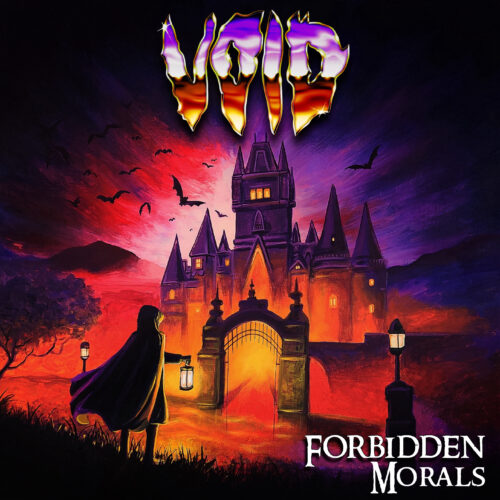
The cartoonish quality of Forbidden Morals’ album cover had me worried this would be an amateur outing into thrashy trad metal, but I’m happy to report VOID have put my worries to rest. If the back half of Forbidden Morals were packaged as an EP I’d be hawking VOID’s wares up and down the n00b cells on my weekly guard rotation. With a bit of work on clarifying their song structure, and the will to end their songs with an exclamation point versus ellipses, I hope to see big things from the Louisiana quintet. As it stands, Forbidden Morals is a solid album for those who like their metal a bit thrashy, a bit classic, and a lot of fun.

Rating: 3.0/5.0
DR: 6 | Format Reviewed: 320 kb/s mp3
Label: Shadow Kingdom
Websites: Bandcamp | Website | Facebook
Releases Worldwide: August 29th, 2025

#2025 #30 #Aug25 #ForbiddenMorals #HeavyMetal #JudasPriest #MercyfulFate #Metallica #Review #Reviews #ShadowKingdom #ThrashMetal #USMetal #Vøid

2025-09-03

Proscription – Desolate Divine Review

By Dear Hollow

Last we met Finland’s Proscription, an overwhelming amount of promise was almost as intense as their blackened death attack. While rerecorded songs from their 2017 demo such as “I, the Burning Son” and “Blessed Feast of Black Seth” singlehandedly tamed the experience with jarring simplicity and excessive repetition killing momentum, tracks like “Conduit” and “To Reveal the Word Without Words” were elite blackened death. The promise was insane, causing a bigger stir in the underground than the music itself. While Conduit was solid, Desolate Divine promises even bigger and better – and delivers.

Proscription in a way, feels like a blackened death metal underdog story. The band’s constituents are assembled from the fringes of Finnish black/death, most prominent likely being formidable vocalist/guitarist Christbutcher of Maveth, Cryptborn, and Excommunion fame, although caliber from Brutal Torment, Tramalizer, and Ominous offer their relentless services. This background in more brutal stylistic tendencies pairs neatly with the mountain of sound that Proscription offers. Unlike its predecessor, which dwelt in hints of insanity and riffy mid-tempo crunch, Desolate Divine is a streamlined and no-holds-barred brutalizer of an album, bordering on war metal. Paired with a uniquely blackened death obscurity that appears in haunting leads and hints of atmosphere, Proscription offers a winning formula that is slightly held back by its brickwalled production but ultimately improves upon its predecessor in every way.

If it’s intensity you want, Proscription has it in droves. Haunting leads and blackened tremolo are often the only tether to sanity, their only sense of tangible in their blasting of Behemoth-through-the-war-metal-machine. Bottom-heavy beatdowns are aplenty, with an old school riffy death metal template a la Morbid Angel or Bolt Thrower with the insanity of blastbeats and panicked rhythms (“Bleed the Whore Again,” “Behold a Phosphorescent Dawn”), while overlapping leads, flaying technicality, and wild solos cut through tremolos both down-tuned and blackened (“Gleam of the Morning Star,” “Entreaty of the Very End”). Centerpiece “The Midnight God” (a previously released track in a 2023 split with Sulphurous) and closer “The Great Deceiver” (also from a previously released 2023 demo) offer nearly perfect overlapping of relentless beatdown, blackened grime, and riff – both expertly placed throughout the album. It’s refreshing that previously released material is a highlight rather than a hitch.

Desolate Divine is a bit of a tale of two halves. Proscription goes off the rails in the first half, forsaking every act of subtlety for sheer violence, while the second half is a much more ominous affair. Don’t get me wrong, these tracks will rip you a new one, but at their core is a much more plodding and stable approach, focusing on an almost marching rhythm throughout, making their more obscure and haunting qualities that much more impactful and downright epic when the technical insanity and rhythmic heft collide (“Heave Ho Ye Igneous Leviathan,” title track). Even synth makes appearances in haunting, spacious overtones in this second act (“Behold a Phosphorescent Dawn,” “Not But Dust”), capitalizing on the more haunting attack.

Desolate Divine is dense and unforgiving and certainly imperfect. The brickwalled production and the jarringly start-stop songwriting (not uncommon for other acts like Belphegor or Adversarial) make it difficult to uncover the treasures amid the muck; the central melody of “Behold a Phosphorescent Dawn” sounds too much like Inspector Gadget, and ambient interlude “Not But Dust” feels out of place. However, it’s a step up from Conduit in that its previously released material is a highlight, and there are no bad songs aboard this uncompromising album. It seamlessly blends deathened viscera and blackened flaying in ways that few else can, with stunning brand-setting performances across the board from largely unrecognized Finnish black/death veterans. The potential on Desolate Divine is almost as suffocating as the blackened death metal Proscription wields.

Rating: 3.5/5.0
DR: 4 | Format Reviewed: 320 kb/s mp3
Label: Dark Descent Records
Websites: proscription.bandcamp.com | facebook.com/proscriptionhorde
Releases Worldwide: August 29th, 2025

#2025 #35 #Adversarial #Aug25 #Behemoth #Belphegor #BlackMetal #BlackenedDeathMetal #BoltThrower #BrutalTorment #Cryptborn #DarkDescentRecords #DeathMetal #DesolateDivine #Excommunion #FinnishMetal #Maveth #MorbidAngel #Ominous #Proscription #Review #Reviews #Sulphurous #Tramalizer

2025-09-02

Finnr’s Cane – Finnr’s Cane Review

By Killjoy

Finnr is an Old Norse name that loosely translates to “wanderer” in English. Whether or not this was the inspiration for Finnr’s Cane, it’s an apt moniker for an atmospheric black metal act. Hailing from Sudbury, Ontario, Canada, this studio-only group has three prior albums under its belt, the last of which, Elegy, won the overall approval of Ferrous Beuller in 2018. Until now, Finnr’s Cane was a trio consisting of guitarist/vocalist The Bard,1 drummer The Peasant, and cellist The Slave. At some point, The Slave either escaped or was set free, as she no longer appears in the lineup. And now, Finnr’s Cane seems to signal a new era with the release of self-titled album number four.

In terms of overall atmosphere, Finnr’s Cane is more like gray metal than black metal. Its dreary demeanor hews closer to contemplative post-black than the blackened doom metal of Elegy. If the fellow on the album artwork had been so inclined to place a cooking pot over his campfire to make a stew, he might have tossed in melancholic Cascadian black metal ingredients such as Alda, Skagos, and, of course, Agalloch. For seasoning, he might also add a pinch of older Falls of Rauros’ guitarwork and the winking keyboards of Eldamar. Though the release date of Finnr’s Cane doesn’t quite coincide with the autumn temperatures that I long for, it’s been refreshing to listen to throughout August as it mentally transports me to a colder place.

Unfortunately, much of this setting is drab and desolate beyond the typical genre aesthetics. The vocals usually take the form of flat intonations or dispassionate spoken word, sapping the music of energy and emotive impact. Additionally, the instrumentation, while solid, feels like it’s missing a crucial element. Finnr’s Cane has historically distinguished itself by the usage of a cello in place of a bass guitar, and Ferrous acknowledged The Slave’s subtle yet outsized hand in the successes of Elegy. Now, her absence feels like the removal of a linchpin, rendering Finnr’s Cane more nondescript. Granted, the cello is not gone completely—whether taken over by The Bard or previously recorded by The Slave. Its blazing undertones warm up “Awaken the Sleeping Forest” and “The Everwinter Grey” and afford much-appreciated bright spots in the blizzard.

Nevertheless, when the right mood strikes, the winter storm of Finnr’s Cane can be hypnotic and immersive. “In Shadows” uses eerie keyboard sounds and delicate guitar plucks to great effect. The same thick, plucking guitar tone returns with greater enthusiasm and intricacy in the final two tracks, “The Spell of the Change of Seasons” and “Harvest.” However, other promising moments feel awkwardly tacked onto their respective songs. The outros of “Twilight Glow” and “Harvest” abruptly accelerate in tempo and urgency for a few seconds and then end just as quickly, feeling more like a tease than a natural culmination of what came before. This could be due to the fact that The Bard and The Peasant conceive their music through intuitive improvisation but in any case, Finnr’s Cane is mainly concerned with conveying feeling over coherence.

It saddens me to write that Finnr’s Cane mostly left me cold, and not just in its intended way. Even though I was not yet familiar with Finnr’s Cane’s back catalog, I immediately couldn’t shake the feeling that something was missing. Now having spent time with prior records, I can’t say Finnr’s Cane is wildly different from them, but it seems like an intangible spark was lost sometime between now and Elegy. Maybe it’s just the diminished cello presence but the songwriting also sounds more listless to my ears. I can appreciate many of the disparate components of Finnr’s Cane when I listen in the right state of mind, and other atmoblack fans may derive more enjoyment than I did. For those more willing to become lost in its atmosphere, Finnr’s Cane might just be your companion in the coming months.

Rating: 2.5/5.0
DR: 7 | Format Reviewed: 320 kbps mp3
Label: Nordvis Produktion
Websites: finnrs-cane.bandcamp.com | facebook.com/finnrscaneband
Releases Worldwide: August 29th, 2025

#25 #2025 #Agalloch #Alda #AtmosphericBlackMetal #Aug25 #BlackMetal #CanadianMetal #Eldamar #FallsOfRauros #FinnrSCane #FractalGenerator #NordvisProduktion #PostBlackMetal #Review #Reviews #Skagos

2025-09-01

Record(s) o’ the Month – August 2025

By Angry Metal Guy

I said last month (well, last week, but who’s counting) that everything had been leading to that point. That’s true, because I was so stoked to make Calva Louise the Record o’ the Month for July in a somewhat relevant fashion that I did a mad dash to get that out before they were off to their tour in the USA. And then I was left there, feeling empty. I had worked so hard. I had come so far. But in the end, I wondered if it really even mattered.1 In my malaise, I turned to August releases. And realized something: «No, Doctor Metalero Enojado», me dije, «aún no todo está perdido. Ahora puedes subir el/los Disco(s) del Mes a tiempo. Y así les cierras la boca a todos esos progres llorones de los comentarios para que sepan quién manda.»2 Said differently…

WE DID IT! WE’RE #1! WE’RE #1! USA! USA! USA! USA! BOOORTLES!!!

Angry Metal Guy didn’t yet exist when I got into In Mourning. In 2008, I got caught in the hype machine for a little record called Shrouded Divine. Following its release in 2008, the band went through a period when it felt like they were still establishing an identity, but in recent years, In Mourning has been on a low-key tear. While both 2019’s Garden of Storms and 2021’s The Bleeding Veil were very good records, In Mourning has outdone themselves on The Immortal [Bandcamp], which was released August 29th, 2025, from Supreme Chaos Records. Without mincing words, The Immortal is clearly the band’s best record since its debut, and I would submit that it’s the best melodeath record since Insomnium’s Winter’s Gate.

When faced with an exceptional record, it can sometimes be difficult to explain exactly why it’s exceptional.3 The melodies are beautiful and rich, hitting you right in the feels whether carried by voice (“Silver Crescent”) or on trem-picked guitars (“As Long as the Twilight Stays”). The riffs are punishing with a good balance of chug (“The Sojourner”) and trem (“Staghorn”), resulting in something that alternates between death and black in feel, if not in orthodoxy. These slight evolutions of sound help to keep In Mourning’s approach fresh, but it’s here that the dark matter of composition can be deduced, but not directly observed. None of this is totally novel in the band’s sound. But sometimes shit just works. There’s a lot of work that goes into writing. And no matter how good you are, not every minor key melody you write is going to be a tear-jerker, not every chunky riff is going to be quite as hooky or head-bangable as others, not every closer is going to be a Song o’ the Year candidate like “The Hounding”. But sometimes, you just keep rolling natural 20s.

The Immortal feels like one of those records blessed by the Metal Gods. Things that aren’t so different from what has gone before, but it all just hits a little harder. This makes The Immortal unquestionably one of the best records released in 2025, and everyone around here agrees with Kenstrosity’s eminently reasonable—arguably even understated—take that “with The Immortal, In Mourning further solidifies its status as an elite act in the melodeath pantheon.” The Immortal is on par with the best records in the genre,4 and “you owe it to yourself to hear it.” I think he underrated it.

Runner(s) Up:

Blackbraid // Blackbraid III [August 8th, 2025 | Self-release | Bandcamp] — Black metal is not an easy genre to make vital in the Year of Angry Metal Overlord 2025. But Blackbraid has a sound that feels vital. There’s a no bullshit intensity that Sgah’gahsowáh brings with III’s blast beats, croaks, and the trem-picked wall of sound that brings me back to falling in love with Emperor. Like the very best black metal, however, Blackbraid is not afraid of dropping into groove and synchronized-guitar-swing-friendly riffing that makes the blasts hit harder. There’s also something undeniably slick about Blackbraid. Digging through the potential standout albums from August, I kept coming back to III, because it gives me the things that I love about black metal: the intensity, the feel, the Ulveresque atmosphere without the obvious plagiarism. And it accomplishes this while avoiding the traps of so many modern black metal bands. As Doom_et_al so aptly summed it up: “Blackbraid III is everything a fan of either the band or this style of music could want. Like the land that inspires it, it is infused with violence and beauty and complexity. But it’s the ability to combine these disparate concepts with epic scope and intense vulnerability that sets it apart.” Say what you will, Blackbraid III is a real accomplishment.

Farseer // Portals to Cosmic Womb [August 22nd 2025 | Self-release | Bandcamp] — Farseer has its roots in stoner and sludge, and my eyes just shut of their own accord while I wrote that. So, it should come as no surprise to you that a self-released stoner/sludge release didn’t exactly jump off the page at me when reading about it. But thanks to some fine writing by Tyme and a well-placed bundle of cash in my freezer, I gave Portals to Cosmic Womb another listen. And another listen. And another listen. Turns out, these cats have some riffs in them. When their soupy riffs hit, they hit with the kind of splat that kills. Portals to Cosmic Womb has a drive that adds life to the thick guitar sound and the not-particularly-complex riffs, and for 39 minutes, it holds the listener in its grip without breaking a sweat. Our very own Tyme waxed poetic about Portals to Cosmic Womb, writing, “Farseer basting in their creative juices over the past six years has resulted in a vastly improved product, as Portals to Cosmic Womb shatters any notions of a sophomore slump. As if constructed from a blueprint of Opethic design, Farseer crafted Portals to Cosmic Womb with a near effortless flow. Its six songs—spanning a very manageable forty minutes—find Farseer merging the best parts of meandering instrumentals into rock-solid compositions that, like spring and neap tides, rise and fall with dramatic intensity.” Yeah, he’s saying it’s really good, y’all. Keep up!

Anchorite // Realm of Ruin [August 1st, 2025 | Personal Records | Bandcamp] — Anchorite is one of those bands that I shouldn’t be expected to like. The blues-infused doom roots here are strong, and yet, Realm of Ruin makes a surprisingly convincing case for itself. As is often the case when working with doom metal, the vocalist tends to drive whether a band is good or bad. In this case, Leo Stivala does a great job of balancing the aesthetics of Metal Voice™ and actually being able to sing with power. He’s got a pretty keen sense for melody, and his performance stands out. With that in place, Anchorite’s riffmeisters get to work writing a solid post-Candlemass doom that hits a place in my sadboi soul when I listen to it. And yet, part of what makes Realm of Ruin work is that it’s also surprisingly immediate at times. There’s a vibe like US power metal or thrash metal that suffuses the whole album, and with its unique production—that snare drum actually feels punchy, guys, so that’s weird—and its idiosyncratic songwriting, it all starts to feel special. Serial overrater and all-around softy Steely D put it like this: “Realm of Ruin is one of those albums you enjoy on the first go-through, and with each spin, it reveals more of itself until you’re fully submerged in the band’s craftwork. Anchorite has writing chops, and Realm of Ruin is an immersive stroll through the ruins with moments of genuine brilliance and grandeur.” So, there’s that.

#2025 #Anchorite #Aug25 #Blackbraid #BlackbraidIII #BlogPosts #Farseer #GardenOfStorms #InMourning #Insomnium #PortalsToCosmicWomb #RealmOfRuin #RecordOTheMonth #RecordSOTheMonth #RecordsOfTheMonth #TheBleedingVeil #TheImmortal #WinterSGate

2025-08-30

God’s Funeral – El Despertar Dels Morts Review

By Angry Metal Guy

Written By: Nameless_n00b_605

Metal is full of niche genres, and within that sphere, doom metal is full of unique variations. Funeral doom, doom metal’s basement-dwelling offspring, is as impenetrable a metal genre as some of the nastiest bands in the business. Trudging, droning song structures, distorted, bellowing vocals, and (as the genre tag suggests) the vibe of being at a funeral can make for a taxing listen on a good day. Nailing all these individual elements isn’t so much a challenge as a rite of passage, but truly meshing these staples together is a skill few bands possess. God’s Funeral joins the cacophonic dirge on their first LP, El Despertar Dels Morts. Hailing from Tarragona, Spain, can their brand of Catholic-guilt-infused funeral doom make a splash in the cesspool of sadness, or is it merely a teardrop in the bucket of filth?

El Despertar Dels Morts has all the hallmarks of great funeral doom; roomy production offers space for naturalistic string arrangements and atmospheric organ playing. Lead singer Abel nails the classic funeral doom tone, with vocals that sound like they are recorded in the roomy basement of a moldy castle. The riffing from guitarists Naila and Juan is suitably churning and ominous, and Sergi’s drumming fills the deliberate void with hard-hitting playing. The kicker is that God’s Funeral nails production and musicianship, but misses the mark on nearly every level otherwise. From songwriting to editing, and from pacing to variety, El Despertar Dels Morts fumbles at every turn. In a five-track album spanning nearly fifty minutes, it is a struggle to find standout moments in a sea of nearly identical song structures, played-out riffs, and tedious vocals.

Where God’s Funeral bucks trends is in the most unfortunate places. Genre stalwarts like Ahab, DOOM:VS, and Shape of Despair feature similarly deliberate song structures, but break these up with vocal variety, melodic sections, left turns into death metal, and more. God’s Funeral eschews all of that, and the only notable moments of reprieve from the grinding, one-note style on El Despertar Dels Morts are the wonderfully rich-sounding string work that are a staple across the album, an epic organ section at the end of “Ara Que Torna El Silenci,” and the militaristic marching drum intro to “La Processó De Les Ombres.” It is telling that you have to reach for points of interest on this LP; they act like life rafts in a never-ending storm of monotony.

The back half of El Despertar Dels Morts is the strongest part of the album, if only for the fact that the songs stay under ten minutes. These last three tracks at least offer a glimpse at what God’s Funeral could be capable of with a lot more editing. “Fossa Comuna” is the standout track that exemplifies the best of what the band can do. An atmospheric bass intro leads to an actual beat that surpasses the downright sleep-inducing tempo of previous tracks, and the drumming sounds alive for once, finally helping a track rise above the sub-50 bpm droning that drags across the entire LP. While having an album that sounds similar throughout isn’t necessarily a negative, especially when that one song is a ripper, God’s Funeral missed the memo. Telling apart individual tracks on El Despertar Dels Morts is downright challenging. It pains me to be so negative about a band that is invested in their craft and obvious worshippers at the doom altar. God’s Funeral is so close on many levels, but it leans into genre tropes so intensely that they become repellent.

El Despertar Dels Morts is, finally, a monotonous listen that feels more like prepping for bed as opposed to reveling in the big sleep. Funeral doom is slow, it is atmospheric, it is crushing, and God’s Funeral does an admirable job attempting to turn these elements into a cohesive album. But the band draws from the same well too often, leaving El Despertar Dels Morts stylistically empty. In a genre that is already difficult to break into as a band and a listener, God’s Funeral has all the makings of a great addition to the pantheon, but it fails in the most fundamental elements. The band can play well, and the album sounds great from a production standpoint, but the most important part, the songwriting, sags at every turn. Fans of funeral doom may find some choice moments or good background listening with El Despertar Dels Morts, but unless you love the genre, this album won’t change any hearts.

Rating: 2.0/5.0
DR: 6 | Format Reviewed: 320 kb/s mp3
Label: Meuse Music Records
Websites: godsfuneral.bandcamp.com | instagram.com/godsfuneral.band
Releases Worldwide: August 15th, 2025

#2025 #Ahab #Aug25 #DoomMetal #DoomVS #ElDespertarDelsMorts #FuneralDoom #GodSFuneral #MeuseMusicRecords #Review #Reviews #ShapeOfDespair #SpanishMetal

2025-08-29

Imperishable – Revelation in Purity Review

By Tyme

As I prepare to flip the calendar over to what looks like a pretty stacked September,1 I took a moment to reflect on my Angry Metal August. Forays into the sump pit this month yielded several better-than-good releases that I was lucky enough to snag and pen words for. My final entry for this last month of summer2 comes by way of South Carolina’s Imperishable. Formed in 2020 as a side gig by Nile’s Brian Kingsland and Olkoth’s Alex Rush, Imperishable didn’t become a three-piece until 2023, when drum aficionado Derek Roddy (ex-Hate Eternal, ex-Malevolent Creation) entered the fold. Imperishable’s 2024 EP, originally titled Demo’s, caught the ear of Everlasting Spew Records, who signed on to release the band’s debut album, Revelation in Purity. With no question as to the metal cachet of its constituency, the only thing left for me to do was determine if Imperishable’s first outing would signal the end of my August hot streak.

With a blackened death metal heart, Revelation in Purity pierces several veils, tossing traces of groove, doom, and ’90s grunge into the mix. Within moments, album opener “Oath of Disgust” evokes strong Emperor vibes, its eddying riffs and clean, choral-like vocal section landing somewhere between the mighty Anthems3 and IX Equilibrium. These blackened moments are a red thread running throughout Imperishable’s death metal tapestry, expertly woven into a single style, rather than a collection of either-or compositions. As much as Olkoth and newer Nile (“Where Dead Omens Croon”) nestle in the nooks of Imperishable’s sound, there’s some Morbid Angel crouched in the crannies as well (“The Enduring Light of Irreverance”). Kingsland’s grasp of tension and melody, especially evident in his excellent solo work, provides a guitar tour de force of towering tremolos, whirlwind riffs, and bright, splashy chord harmonies (“Revelation in Purity,” “Spewing Retribution”). His vocals, whether gutturally growled, blackly screamed, or cleanly harmonized, are also impressively discernible as Rush’s sinister bass lines, crisp as Cliff Burton’s and full of malice, hold sway over Revelation in Purity’s nether realm alongside Reddy’s devastating drum work—a maelstrom of stormy snares, deadly double-kicks, and fancy fills.

Revelation in Purity navigates many twists, turns, and serpentine paths without getting lost, Imperishable’s songwriting filling the role of expert trail guide. As deftly merged as their black and death metal elements are, it’s the seamless incorporation of those disparate offshoots that helps Revelation in Purity stand out. On the heels of tremolodic leads and some chaotic verse accompaniment, “Exclusion Continuum” hits a nice little groove at the two-minute mark that continues as it slows to a very satisfying, chuggy crawl before re-igniting with one of Kingsland’s sustained yawps. And it’s the doomy atmospheres of “Iniquity,” with its “Where the Slime Live” feel, that, along with follow-up track “Where Dead Omens Croon,” incorporate vocal harmonies straight out of Alice in Chains’ Staley/Cantrell playbook of old, making this late round, one-two punch my favorite section on Revelation in Purity.


Imperishable
dispels atmospheric, interludial frivolity by packing Revelation in Purity’s thirty-two-minute runtime with let-our-music-do-the-talking decisions, outperforming any of the recent output from their main gigs. Jamie King’s mix and master, though slightly muted, still allows every single performance to shine in a way that highlights the musical talent of each member, while Ronnie Bjornstrom’s re-amped rhythm guitars lend an organic air to Kingsland’s performance that never detracts from the cohesiveness of the whole. My biggest gripe with Revelation in Purity is that nearly half of the songs have been circulating in some form or fashion since late 2020, when the first raw versions of “Exclusion Continuum” began to appear. A mostly minor, personal disappointment that Imperishable didn’t keep more of their cards a tad closer to the vest.

Imperishable’s all-killer, no-filler approach makes for some impressive blackened death metal, and while Revelation in Purity isn’t doing anything particularly groundbreaking, what it does do is very good. While I was pleasantly surprised by last year’s Nile album and am wholly looking forward to Olkoth’s follow-up, Imperishable is now on Tyme’s list of things to watch for. I’m eager to hear what a batch of fresh new ideas and songs will sound like from this crew, because, as evidenced by Revelation in Purity, Imperishable has a bright future ahead of them.

Rating: 3.5/5.0
DR: 6 | Format Reviewed: 320kbps mp3
Record Label: Everlasting Spew Records
Websites: Bandcamp | Facebook
Releases Worldwide: August 29th, 2025

#2025 #35 #AmericanMetal #Aug25 #BlackMetal #DeathMetal #Emperor #EverlastingSpewRecords #Imperishable #MorbidAngel #Nile #Olkoth #RevelationInPurity #Review #Reviews

2025-08-29

Blutsauger – Nocturnal Blood Tyrants

By Alekhines Gun

Raw black metal is a tricky proposition. There’s an extremely thin line to walk between production choices designed to add mood and atmosphere to compositions via a wall of auditory fog and production choices that sound like someone threw their equipment down….wait, haven’t we done this already? We sure have, and boy oh boy have we landed on the opposite side of the coin. While Italy is most known for its symphonic (Fleshgod Apocolypse) and tech death (Hour of Penance) scenes, its black metal collective is also alive and well, doing their own thing in their dark corner of the world. Today’s offering is the debut release by duo Blutsauger (German for “Bloodsucker”), coming hot off the heels of sole demo Path of the Bleeding Dead. A gander at that colorless, bleak art aptly spells out the whole mission statement, as Nocturnal Blood Tyrants comes to land blackened crowbars to your very glass jaws, with not a dollop of fun to be found.

How raw is raw? Nocturnal Blood Tyrants is an abrasive, loud, violent listen, with treble turned up wide into a blast furnace of sound over Archgoat-esque drum savagery and not a glimmer of bass (instrument or tone) detected in the ensuing fallout. Utilizing the searing, caustic approach of Dethroned, Conquered and Forgotten era Judas Iscariot with the gain cranked up to 11, Blutsauger aren’t here to be memorable as much as overwhelming. “The Black Hunters” shows the album’s blueprint in all its blackened glory, with a flood of chords collapsing from one quick shift to the next as the drums1 charge relentlessly underneath the tornado of tones. In terms of presentation, Nocturnal Blood Tyrants never lets up, with no chords ever obtaining warmth and vocals maintaining a Blasphemous perpetual pitch throughout the release.

Wisely, Blutsauger make up for this uninviting presentation with a good variety in their riff approach. On average, Nocturnal Blood Tyrants uses an A/B phrasing, where a song comes out blasting and shredding with blood and vinegar before using tempo shifts to craft moments of individuality and personality. “Black Shroud Ritual” is a key example, with a sudden swerve of a slowdown that evolves into straightforward headbangability with the drums presenting some brief moments of real rhythmic transitions and one to two-measure fills. This approach is developed over the course of the album, where what begins as a clear and concise formula starts to grow roots and blossom into something more mature and layered the deeper into the listen you go. This variety in riffing is a welcome reprieve for what would threaten to be a completely flavorless haze of a listen.

Curiously, this results in the more interesting ideas of Nocturnal Blood Tyrants being located in the back half. Title track “Nocturnal Blood Tyrants” flirts with sustained, depressive open chords for a prolonged passage, with the drums presenting military style rolls and staccato-heavy fills. “Wash Them With Fire” sports the album’s first actual lead and consequently stands out like a lightning bolt in a clear sky, particularly when the drums switch their stylings into china-heavy accents and fills before dropping into a vintage Tsjuder tank-plodding attack. Blutsauger even try their hand at the greatest trope in all genres of metal (Le epic grand finale track) with a doomy tempo and a complete lack of the speed and ruthless assaults of the preceding 27 minutes. This exhausted display, the sound of an outfit spent of all their energy and wrath, but never of their sardonicism and anger, makes for a surprisingly efficient album closer by contrast, even if the samples used are wasted in the mix.

Much like a really well-made horror movie, I can’t see myself returning to Nocturnal Blood Tyrants often unless the mood strikes, but only because of how well it accomplishes what it sets out to do. Blutsauger crafted a release that is utterly devoid of anything that could be called beautiful, attractive, or endearing. Its production is violent on the ears, its chord progressions never become softer than “melancholic”, and its tonal palette is as warm as your ex’s heart. But for the spirit of raw black metal, such traits are ringing endorsements. A careful attention to riffcraft and refusal to let the production overtake the importance of actual songwriting have conjured forth an album of genuine quality, if not of approachability. Raw black metal is a tricky proposition, and if you’re on team No Fun in metal2. I cannot imagine this leaving anything but a blackened frown on your face.

Rating: 3.0/5.0
DR: 103 | Format Reviewed: 320 kbps mp3
Label: ATMF
Website: Album Bandcamp
Releases Worldwide: August 29th, 2025

#2025 #30 #Archgoat #ATMF #Aug25 #Blasphemous #Blutsauger #DeTenebrarumPrincipio #FleshgodApocalypse #HourOfPenance #ItalianMetal #JudasIscariot #NocturnalBloodTyrants #Review #Reviews #Tsjuder

2025-08-28

Incite – Savage New Times Review

By Steel Druhm

Written By: Nameless_n00b_602

Within metal circles, one does not simply invoke the Cavalera name. Its crest is adorned with more than just the seminal works of Sepultura. There is ambition there that does not sleep. That great name is ever pushing boundaries, creating new sounds. This is no barren wasteland riddled with fire and ash and dust. There is no poisonous fume for inspiration to choke on. Not with 10,000 artists could you accomplish what those brothers have done; it is folly. Thus, it is with great interest—and a little skepticism—that I was assigned Incite’s seventh LP. Fronted by Max Cavalera’s stepson, Richie Cavalera, Savage New Times promises to be the band’s truest-to-self offering yet. Let’s see how deep the roots go.

For those unfamiliar, Incite majors in groove metal. A familiar southern aggression suffuses Layne Richardson’s axe work and Cavalera’s contentious lyrical delivery. Mid-paced tracks like “Used and Abused” or “Savage New Times” take a cue from Lamb of God or Exhorder, while rager “No Mercy, No Forgiveness” could easily fit on an early DevilDriver record. Bassist EL knows his craft well, building tension and promising violence with well-placed, threatening basslines (“Chucked Off,” “Never Die Once”). The instruments make room in verses for Cavalera’s vocal aggression to brew before crashing together in a choral release, and it is here that drummer Lennon Lopez shines. His energetic drumming steals the spotlight on the choruses of “Used and Abused” and “Chucked Off.” With such strong adherence to the tenets of groove metal, Savage New Times makes it clear that Incite has never missed a class at Pantera’s Vulgar School of Power.

Incite meets with mixed success when they venture outside their core sound. Richardson shows real prowess on “Used and Abused,” where he evokes both Amon Amarth in the bridge and the spiraling tones of System of a Down in the chorus. “Savage New Times” features leads reminiscent of Cannibal Corpse in the verse and, like “Feel This Shit (I’m Fired Up),” sports a militant burst fire tempo around the midpoint. On the other hand, “Doubts and the Fear” falters with a murky, pseudo-psychedelic bridge and nasally Agnostic Front-tinged vocals. Longest song “Dolores” also struggles. Unlike Phil Anselmo’s softer cleans that match the verses of Pantera’s “This Love,” Cavalera barely dulls his edge for the parallel sections of “Dolores,” creating a sonic disconnect between the instruments and himself. This is exacerbated by a similar divide between the rhythm section and the sprawling, idyllic solo recalling “Hotel California.”

More generally, Savage New Times suffers from unambitious songwriting. Except for the neoclassical intro of “Chucked Off” and the solo in “Used and Abused,” Richardson’s lead sections feel lethargic and unremarkable. Song structures feature minimal variation and fall into cyclical verse-chorus-verse-chorus patterns. While this isn’t a problem individually, ten songs of it feels repetitive. Additionally, several tracks lack a satisfying conclusion and feel half-baked. “Dolores” ends with a well-performed piano melody, but it feels tacked on after such a strong finish from the band. Similarly, by cutting their outros, “Lies,” “Feel This Shit (I’m Fired Up),” and “No Mercy, No Forgiveness” could have all ended powerfully rather than aimlessly.

While Savage New Times isn’t a terrible album, because of its deficiencies, I often found myself listening to Incite’s influences rather than Incite themselves. There’s plenty to critique between unmoving songcraft and mixed experimentation, but the final nail in the coffin is the production.1 There’s a slight sibilance and several artifacts throughout Savage New Times. It’s most egregious on “Used and Abused,” ruining one of the record’s best cuts.2 This is the common trend of the album—otherwise good tracks flawed by preventable missteps. I’ve spun this record dozens of times, and I’m sure that with more confidence and a clearer vision, Incite has a good record in them. Savage New Times just isn’t it.

Rating: 2.0/5.0
DR: 8 | Format Reviewed: 192 kbps mp3
Label: Reigning Phoenix Music
Websites: Bandcamp | Instagram | Facebook
Releases Worldwide: August 15th, 2025

#20 #2025 #AgnosticFront #AmericanMetal #AmonMarth #Aug25 #CannibalCorpse #DevilDriver #Exhorder #GrooveMetal #HeavyMetal #Incite #LambOfGod #Pantera #ReigningPhoenixMusic #Review #Reviews #SavageNewTimes #Sepultura #SystemOfADown #ThrashMetal

2025-08-28

In Mourning – The Immortal Review

By Kenstrosity

Swedish sadboi staples In Mourning have had quite the journey over the 25 years since their founding. From the early days of doom-laden, gothic-tinged pall to the current era of dramatic, crooning melodic death, In Mourning’s trajectory arcs over one of the more unsung careers in a world filled with Insomniums, Be’lakors, and Omnium Gatherums. Yet, theirs is the one that stuck with me. I witnessed the majesty of Monolith as a breakout high-water mark, the uncertainty of transitional records like Afterglow, and the resurgence of Garden of Storms followed by an absolute triumph in The Bleeding Veil. And through it all, In Mourning always delivered material of rich depth, considerable nuance, and highly developed songwriting. Their seventh, The Immortal, is no exception.

Immediately identifiable as an In Mourning special, The Immortal sees these Swedes expanding and elevating their repertoire of sound and style further than ever, but still grounding themselves in the chunky riffs, multifaceted vocals, and soaring melodies I’ve come to expect. Integrating a mild proggy slant that reminds of The Meaning of I-era Voyager (“Song of the Cranes,” “The Sojourner”); scorching the flesh with second-wave black metal melodies that recall …and Oceans and Mare Cognitum (“Staghorn” and “The Hounding,” respectively); and utilizing a wide gamut of rhythms and percussive patterns pulling from all over the metallic spectrum1 mark a few key ways In Mourning play with this more varied palette, and to great effect. Pulling it all together, The Immortal’s crisp and clear mix showcases every performance, spotlights each vibrant tone and stimulating texture, and deftly balances soft ruminations against ferocious outbursts.

To my great delight, In Mourning’s best compositions here are those which challenge what I expect to experience. In particular, “As Long as the Twilight Stays” and “Staghorn” elicit intense frisson in my system as I cycle through each spin. In the former’s case, it is the chorus’ tremolo melody tumbling to the foreground from a wonderfully smooth percussive fill that lights up my skin. In the latter, the shock of an aggressive old-school black metal riff surprises me with a most enticing burst of velocity. Yet, each song offers much more than just a single moment of radiating pleasure. Smartly written, honed compositions like those aforementioned highlights writhe between shapes and styles in such a way as to create excitement and intrigue at every turn. Other contenders like “Silver Crescent,” “The Sojourner,” and “North Star” offer reminders of what In Mourning always excelled at, balancing syncopated riffs with weeping guitar melodies and clean vocals that evoke a synesthetic vision of sepia-toned fields of wheat brushing against a gentle breeze. More importantly, though, the effectiveness of these cuts illuminates how successfully closer “The Hounding” compiles all of In Mourning’s strengths, both proven and newfound, into a shimmering tearjerker that demands my rapt attention.

At a tight 47 minutes, The Immortal flies by with an effortless grace, leaving very little opportunity for me to capture and identify negatives. With persistence, however, I started noticing that gentle quasi-ballad quasi-interlude “Moonless Sky” is the only number that leaves my memory all too quickly. It’s gorgeous, just like everything The Immortal exhibits, but simply lacks staying power. In a similar vein, I call into question the function of opening intro “The Immortal.” It’s so short and blends so seamlessly into first track proper, “Silver Crescent,” that I wonder why the two aren’t merged into one. To reach for another nit to pick, “Song of the Cranes,” while a rock-solid song on its own, does feel less inspired and more in line with the majority of In Mourning’s existing catalog than its neighbors. It’s not so stark an outlier that it feels out of place in the tracklist. Rather, it simply feels a touch weaker by comparison.

With The Immortal, In Mourning further solidify their status as an elite act in the melodeath pantheon. It is well known to the readers and writers here that they have become my personal favorite in this particular subset, but I was still pleasantly surprised. A modest, but notable departure from their usual approach, and still unquestionably rooted in their established identity, The Immortal is on par with In Mourning’s best work. You owe it to yourselves to hear it.

Rating: Great!
DR: 7 | Format Reviewed: 320 kb/s mp3
Label: Supreme Chaos Records
Websites: inmourning.bandcamp.com | facebook.com/inmourningband
Releases Worldwide: August 29th, 2025

#AndOceans #2025 #40 #Aug25 #BeLakor #InMourning #Insomnium #MareCognitum #MelodicBlackMetal #MelodicDeathMetal #OmniumGatherum #ProgressiveDeathMetal #Review #Reviews #SupremeChaosRecords #SwedishMetal #TheImmortal #Voyager

Client Info

Server: https://mastodon.social
Version: 2025.07
Repository: https://github.com/cyevgeniy/lmst