

El Negroni, el Dry Martini y el Tom Collins resisten más de un siglo en las barras del mundo https://www.vinetur.com/2025112593656/el-negroni-el-dry-martini-y-el-tom-collins-resisten-mas-de-un-siglo-en-las-barras-del-mundo.html?utm_source=dlvr.it&utm_medium=mastodon #CóctelesClásicos #Negroni #DryMartini #TomCollins #Barcelona
#tomcollins


https://medium.com/@jeannetteaustin261/690ca54cd15d
#irish #TomCollins
Find your ancestors on https://georgiapioneers.com
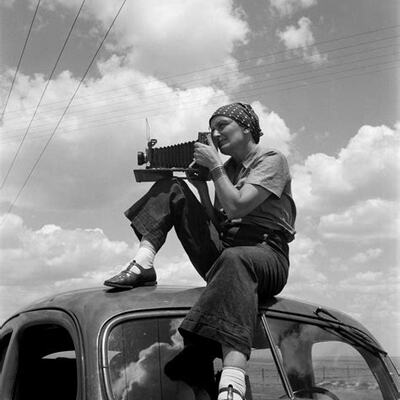
Tom Collins, manager of Kern County migrant camp, California
#TomCollins #KernCounty #California #DorotheaLanges #America #Loenernl #DorotheaLange’s #theGreatDepression #undefined #photography #DorotheaLange
![The image is a black and white photograph featuring an older man standing against a plain, light background. The subject appears to be middle-aged or elderly with graying hair styled in a slightly wavy manner that recedes at the temples. His eyebrows are thick and his expression is neutral but somewhat stern.
He wears a dark-colored tie loosely knotted around his neck, over an open collar white shirt. Over this outfit, he has on a light gray cardigan sweater, unbuttoned to reveal both his chest hair and part of his abdomen beneath the shirt. The man's posture suggests casualness as one hand appears in his pocket.
The image is labeled with text at the top right corner reading "MJ15 STARTIM A302" which might be a reference number or code related to its cataloguing, possibly by an organization like the Farm Security Administration (FSA) or Guggenheim Foundation. There's also handwritten notation on the negative border: “M1J 8697 - F2” and "A5." The latter likely indicates this photograph is part of a series with a specific identification number.
There are no visible distinctive features that would immediately identify him as Tom Collins, manager of Kern County migrant camp in California. However, the context provided suggests it may be related to his role or work within that capacity during Dorothea Lange's photography project documenting the lives and conditions of migratory workers on America’s western coast.
It is im [...]](https://files.mastodon.social/cache/media_attachments/files/114/339/845/311/819/582/original/75f1a0e3129168ba.jpeg)

#PollyGeist and #JoyJohnsonJohjima from #monsterprom !
#fanart #bodypositive #bodypositiveart #ghost #raver #nightclub #neon #goth #witch #platformboots #tomcollins #teapot #helsinkimetro #MastoArt #indiegame


If you don’t feel like pulling a prank for #AprilFoolsDay yourself, maybe you’d enjoy learning about some historical pranks and how they connect, surprisingly, to the Tom Collins cocktail: https://www.youtube.com/watch?v=OylCDk2Fcog
#Etymology #Video #WordNerd #Linguistics #Words #HistoricalLinguistics #TomCollins #Cocktails
Tom Collins, manager of Kern migrant camp, with drought refugee family. California
#TomCollins #California #DorotheaLange #KernCounty #undefined #photography #DorotheaLange
![The image depicts a black and white scene from what appears to be the mid-20th century, showing an outdoor setting with makeshift tents. In the foreground, there is a woman standing next to two seated men; one of them seems to be adjusting his footwear while engaging in conversation or offering something to the child he's holding by hand. The tent structure behind suggests a temporary settlement for people who may have been displaced due to drought conditions.
The surrounding area features various objects indicative of daily life and activities, such as buckets, pots, and what looks like cooking implements on makeshift stands. In the background, other tents are visible, hinting at an encampment with several families or groups staying together in close proximity. The overall atmosphere conveys a sense of hardship but also community among those living there.
The caption "Tom Collins, manager of Kern migrant camp, with drought refugee family" suggests that this photograph was taken by Dorothea Lange and is part of her extensive work documenting the lives of migrants during times of crisis such as droughts. The image serves to provide a historical context for understanding how people coped with displacement due to natural disasters like droughts in California's Kern County, which has been an area affected by water scarcity issues over time.
Given this background information and the visual cues within the photograph, one c [...]](https://files.mastodon.social/cache/media_attachments/files/113/793/853/147/351/258/original/194f8d6ca5a8cf88.jpeg)
Tom Collins, manager of Kern migrant camp talking with drought refugee and her four sons. California
#TomCollins #California #undefined #photography #DorotheaLange
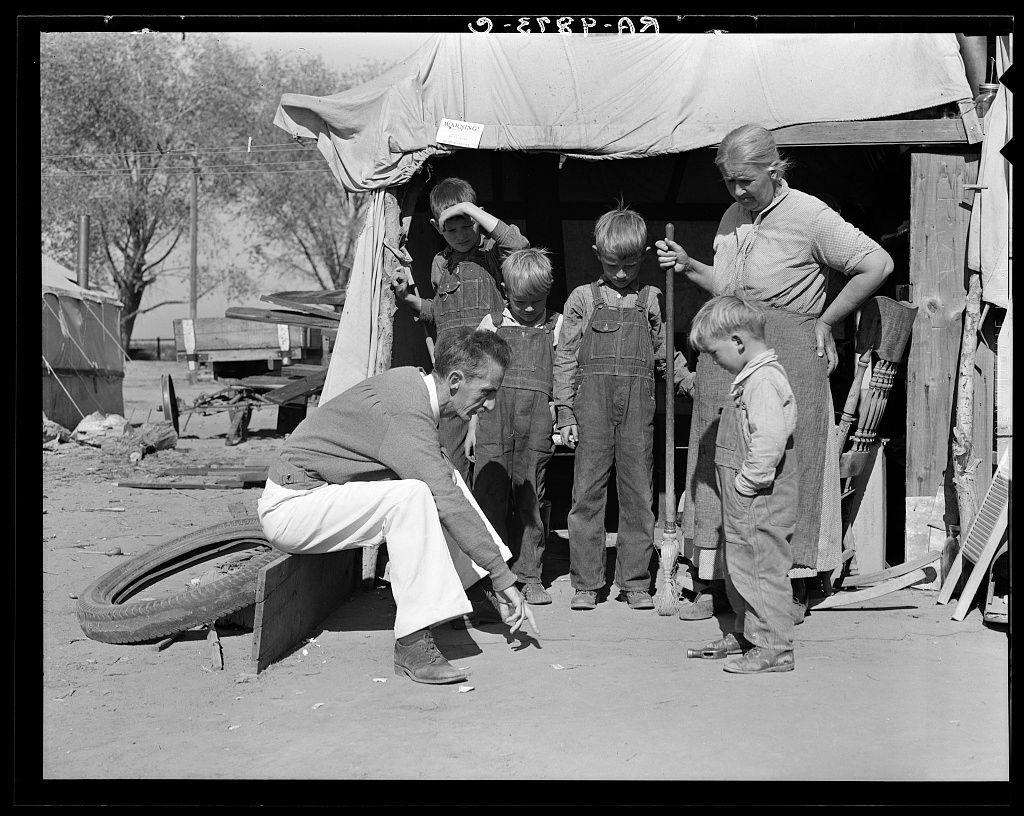
Tom Collins, manager of Kern migrant camp, California, with migrant mother and child
#TomCollins #California #America #undefined #photography #DorotheaLange
![The image depicts a black-and-white photograph of three individuals, presumably from the early to mid-20th century based on their clothing and hairstyle. A man stands prominently in the foreground wearing a light-colored sweater over a dark collared shirt paired with white trousers; his expression is serious as he gazes directly at the camera.
Behind him, slightly to the right, there's an older woman who appears to be holding a baby wrapped snugly against her chest with one arm. The mother wears a long-sleeved dress and has short hair brushed back from her face, suggesting modesty in attire appropriate for daily chores or travel during that era.
On the far left stands another young girl, likely around 12-14 years old judging by her height compared to the adults; she's wearing a sleeveless blouse with long sleeves over what seems like an apron and has dark hair tied back. She appears contemplative yet somewhat resigned as she looks off into the distance.
The backdrop reveals a makeshift tent or temporary dwelling, indicative of rural life possibly on a farm where such structures were common for living quarters during that time period. Various items are scattered around outside the tents, including buckets, pots, and what seems to be laundry hanging out to dry which gives an impression of daily domestic activities being conducted amidst modest surroundings.
The atmosphere conveyed by this photo suggests hardship or dis [...]](https://files.mastodon.social/cache/media_attachments/files/113/499/649/585/304/322/original/b23a855d541e2f58.jpeg)
Tom Collins, manager of Kern migrant camp, talking with one of the members. California
#TomCollins #California #undefined #photography #DorotheaLange


And it's time to #ShowUsYourCocktail ...Golden Years is playing catch up...Valerie made us this delicious classic #TomCollins
#BlackLiverProject #Chicago #cocktails

If you don’t feel like pulling a prank for #AprilFoolsDay yourself, maybe you’d enjoy learning about some historical pranks and how they connect, surprisingly, to the Tom Collins cocktail: https://www.youtube.com/watch?v=OylCDk2Fcog
#Etymology #Video #WordNerd #Linguistics #Words #HistoricalLinguistics #TomCollins #Cocktails
Stopped by our #LiquidPlayground Ward Eight for a #TomCollins. They did not disappoint. Never do. #LemonSpiral #SoFancy #ShowUsYourCocktail #BlackLiverProject #Chicago #cocktail

The Pleasant House Pub #TomCollins made by Juan. Dig the presentation. Made with Hayman's #ShowUsYourCocktail #BlackLiverProject #Chicago #cocktail

Stopped off at a #FancyCocktailBar Best Intentions for a couple of #TomCollins with a friend. Requested one with standard Holland Gin (Hayman's) and one with Old Tom Gin (Ransom) from Aubrey. Both great but Old Tom is always so great. Love the orange accent to their gin drinks! #ShowUsYourCocktail #BlackLiverProject #Chicago #cocktail

Here is the #TomCollins at Beard & Belly made for me by Drew one Sunday afternoon. Delicious and Refreshing. https://on.soundcloud.com/dQrTuMWGGmKqTFmp9
#ShowUsYourCocktail #BlackLiverProject
#chicago #cocktail
Some origins on the #TomCollins: https://blackliverproject.com/tom-collins-origins/
#BlackLiverProject #cocktail #history

#TomCollins, manager of #KernCounty migrant camp, #California

Client Info
Server: https://mastodon.social
Version: 2025.07
Repository: https://github.com/cyevgeniy/lmst