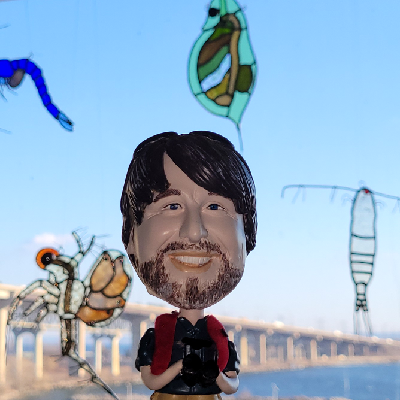
Marine copepod are small aquatic crustaceans.
Photograph: Zachary Sanchez/Nikon Small World
Marine copepod are small aquatic crustaceans.
Photograph: Zachary Sanchez/Nikon Small World

#NewSpecies!
New copepod from #southchinasea just surfaced:
Monstrilla pseudograndis
Treatment: https://treatment.plazi.org/id/9851EEA4-949C-5DAF-9365-08704BAE1098
Publication: https://doi.org/10.3897/zookeys.1232.144830
#ZooKeys #MonstrillaPseudograndis
#FAIRdata
#science #OA #openaccess #biology #taxonomy #ecology #biodiversity #nature #wildlife #conservation #animals #invertebrates #arthropods #crustacea #copepods #zooplankton

27-Jun-2025
Tiny ocean migrants play a massive role in #SouthernOcean #carbonStorage
A groundbreaking study has revealed that small but mighty #zooplankton—including #copepods, #krill, and #salps—are key players in the Southern #Ocean’s ability to absorb and store #carbon.
https://www.eurekalert.org/news-releases/1089054 #science #ecology #climateCatastrophe
Weekend #Plankton Factoid 🦠🦐
Did you know some #copepods can "porpoise" out of the water, even though they are only mm sized? The forces required for them to break the significant surface tension of the water is enormous, 10x larger than other animals scaled to size. This requires swimming escape velocities > 1 m/s!
Surface dwelling copepods (neustonic) doing this is one thing, but so can pelagic ones. Full paper in link 📕.
#science #oceans #MarineBiology
https://www.oceanlifecentre.dk/news/nyhed?id=b2d38ca9-df5f-4c7d-b4c2-320cd3c16890
Weekend #Plankton Factoid 🦠🦐
Mating by copepods is a complicated process since they are always at risk of predation by other plankton or fishes. Male #copepods carefully mechanically and chemically track a receptive female, capture them, and deposit an adhesive spermatophore near the genital opening, all assisted with their specially modified antennae. The "bent" geniculate antenna in Calanoids are usually characteristic for identification.
#science #zooplankton


Weekend #Plankton #Factoid 🦠🦐
I've always been impressed by this video from New Scientist about #copepods, the planet's most abundant multicellular organism, with interviews from several UK universities, including Exeter and Southampton. Prof Daniel Mayer & others give a lovely explaination on why these #zooplankton, and their poo, are so important to the #ocean ecosystem and #carbon cycling, and why #ClimateChange size shrinkage could have such an impact. #Science 🎥
https://youtu.be/60DRMH9QdV4

Weekend #Plankton #Factoid 🦠🦐
Some #copepods have resin and silica lined "opal" teeth called gnathobases - which is a great word! These hardened mandibles are used to crunch open the silica frustules of #diatom algae (viewed as co-evolutionary pressure). They are replaced at molt, but adults only get the one set, and they wear down. Eventually, they must settle for #feeding on less crunchy diatoms, smaller cells, or the softer cellulose covered dinoflagellates.
#Science
https://www.pnas.org/doi/10.1073/pnas.2407876121


Weekend #Plankton #Factoid🦠🦐
#Neuston refers to organisms that live at the interface between water and air. They can float on the surface like by-the-wind sailors, use #water tension like water striders, or live near the surface like Pontellid #copepods. Many of these organisms use bright blue astaxanthin pigment for protection from #UV radiation. They are patchily distributed and are an oasis of biomass in low productivity #oceans, yet are still poorly studied. #science
https://amp.theguardian.com/environment/article/2024/jun/30/neuston-sea-creatures-ocean-surface-science-study
Whale sharks given a health check with #ultrasound imaging technique https://phys.org/news/2024-07-whale-sharks-health-ultrasound-imaging.html
Internal organs and body tissues of free-swimming whale sharks imaged using underwater ultrasound https://www.frontiersin.org/journals/marine-science/articles/10.3389/fmars.2024.1285429/full
"when they started to scrape the parasitic #copepods off their lips, the whale #sharks slowed down, hung vertically in the water and treated them like giant cleaner #fish... While the #WhaleSharks were in this position, the researchers were able to use underwater ultrasound"

Weekend #Plankton #Factoid 🦐🦠
There is a well-known ecological relationship called Bergmann's Rule which states that populations & species of larger size tend to be found in colder environments at higher latitudes. This pattern also holds true for #phytoplankton and #zooplankton. Polar #copepods like Calanus hyperboreus (~5 mm) are relative giants compared to tiny tropical Parvocalanus crassirostris or Oithona spp. (300-400 µm). These tiny copepods were regularly missed by coarse mesh nets.
Weekend #Plankton #Factoid 🦐🦠
Microplastics are in the news a lot as a pollutant, but what exactly is the impact on #zooplankton? #Microplastics are a similar size to the #algae they graze on, so either they have to expend energy sorting through plastics to find a food item, or plastics are consumed and can block guts or limit absorbtion of actual food. This study looks at #amphipod predation on #copepods with microplastics.
Full paper in STE https://doi.org/10.1016/j.scitotenv.2023.167301
Weekend #Plankton #Factoid 🦐🦠
While #copepods are familiar as a common #zooplankton, it isn't widely known that Copepoda orders can be #parasites (Siphonostomatoida). Some are absolutely wild looking, but the 600 species of "sea lice" definitely look like copepods. Naturally ectoparasitic on wild fishes, eating skin and blood, their numbers skyrocket in farmed #salmon pens. Controls aren't simple, and as this @thetyee article points out, national regulations vary widely.
https://www.thetyee.ca/News/2023/12/26/Canada-Sea-Lice-Limits/
#Copepods are one of the most numerous metazoans on the planet. They are also capable of insanely fast #swimming escape speeds (20 cm/s) and super sensitive to their environment through mechano- and chemosensors on their antennae. Something not as well known is that their nerves are coated in myelin (often thought found only in vertebrates). This gives them 3x faster reponses to predators. Very sophisticated for a 1-2 mm long #zooplankton.
https://www.researchgate.net/publication/12518174_The_need_for_speed_II_Myelin_in_calanoid_copepods
#Parasite of the Day: Diexanthema hakuhomaruae http://dailyparasite.blogspot.com/2023/07/diexanthema-hakuhomaruae.html
D. hakuhomaruae sp. nov. (#Copepoda) from the #HadalZone in the Northwestern #Pacific https://link.springer.com/article/10.1007/s11686-023-00676-z
"Parasitic #copepods come in all kinds of shapes that would defy most people's idea of what a #crustacean is 'supposed' to look like. And D. hakuhomaruae is no different - its tiny body is ROUND and if anything, it looks like a legless tick. And much like a tick, it attaches itself stubbornly to the leg of its host"

While most are familiar with green and productive tropical land, many don't know it can be opposite in the #ocean, with fertile polar regions. When sunlight returns to the poles, oceans bloom with #phytoplankton, which many large (almost a cm long!) #copepods in the Calanus genus and krill (euphausids to be fancy) take advantage of. Baleen #whales 🐋, commercially important fish and shrimp come to feed on these short, efficient #FoodWebs.
https://www.polarpod.fr/en/encyclopaedia/arctic/4-ocean-and-marine-life/3-arctic-plankton
Starting the week with a new #preprint! This one's got a little bit of everything:
- #copepods , #parasites , and opportunistic thermal limit measurements
- #DIY lab equipment
- #metaanalysis
#NewSpecies!
New copepod from the Pacific Ocean just surfaced:
Echinolaophonte musa
Treatment: http://treatment.plazi.org/id/1550C93D-4255-4830-9B5C-6952A27BA0BB
Publication: http://doi.org/10.3897/zse.99.90114
#Zoosyst_Evo
#FAIRdata
#science #taxonomy #ecology #biodiversity #nature #wildlife #conservation #animals #copepods #pacific #ocean

Sunday #Plankton Factoid 🦠🦐
#Zooplankton have amazing abilities to sense their environment. The setae on long extended antennae have mechanoreceptors & chemosensors (aesthetascs). #Copepods can smell and track a pheromone plume of many body lengths, or detect particular prey items. Very sophisticated behavior for this ecologically important uncharismatic microfauna.
This is an excellent review article on the chemical ecology of copepods. Highly recommended read. 📖
https://academic.oup.com/plankt/article/36/4/895/2963073
Mind blown right here: a marine photographer capturing the bright-colored plankton in a drop of seawater.
#oceanlife #seawater #copepods #photography #marinelife #marinephotography #tinystuff #microscopic