#WomanArtist

Laura G, Sassy 70’sLauraJG@deacon.social
2026-02-27

By African-American artist and educator Hilda Wilkinson Brown (1894-1981), Portrait of a Girl. I could find little specific information about this painting, nor could I find a better photo; however, it appears on the website for the short documentary film “Kindred Spirits: Artists Hilda Wilkinson Brown and Lilian Thomas Burwell.” The film explores the relationship between Brown and her niece, also an artist. #arthistory #BlackHistoryMonth #blackart #blackartist #womanartist

From Paul Richard, “Drawing on the District: The Neglected Art Of Hilda Wilkerson Brown,” The Washington Post, November 14, 1983:

“Like the finest works she left us, Hilda Brown herself was sophisticated, genteel, charming, modest, tough. In the '20s and the '30s, she was one of the few painters capable of linking this city's black community to the world of modern art.

Her best paintings are delightful. Her subjects are familiar. She painted what she saw here--the lights of Griffith Stadium, brick Victorian row houses, the streets of Le Droit Park. Her oils please at once, and after pleasing unfold slowly. They have quiet truths to give us. Hers are images that teach.

When it suited her intentions she would borrow from the moderns. She fully understood the space-declaring brushstrokes of Ce'zanne, Lyonel Feininger's light rays, and the sweet, domestic scale of the paintings at the Phillips. But her style is her own."


A portrait of a black woman, seated, one hand in her lap, one resting on a table. She is wearing a light blue with red trim long sleeved top.
LePliLePli
2026-02-27

"Oyez Oyez" performance de scomparo, dans le cadre de l'exposition « La pluie qui cache son jeu ». Jeudi 11 avril 2024.

Dans le cadre d'une programmation Art&Autodéfense.

"Oyez Oyez" Affiche de la performance de scomparo, dans le cadre de l'exposition « La pluie qui cache son jeu ». Jeudi 11 avril 2024.
Vue de l'installation de la performance "Oyez Oyez" de scomparo.
LePliLePli
2026-02-27

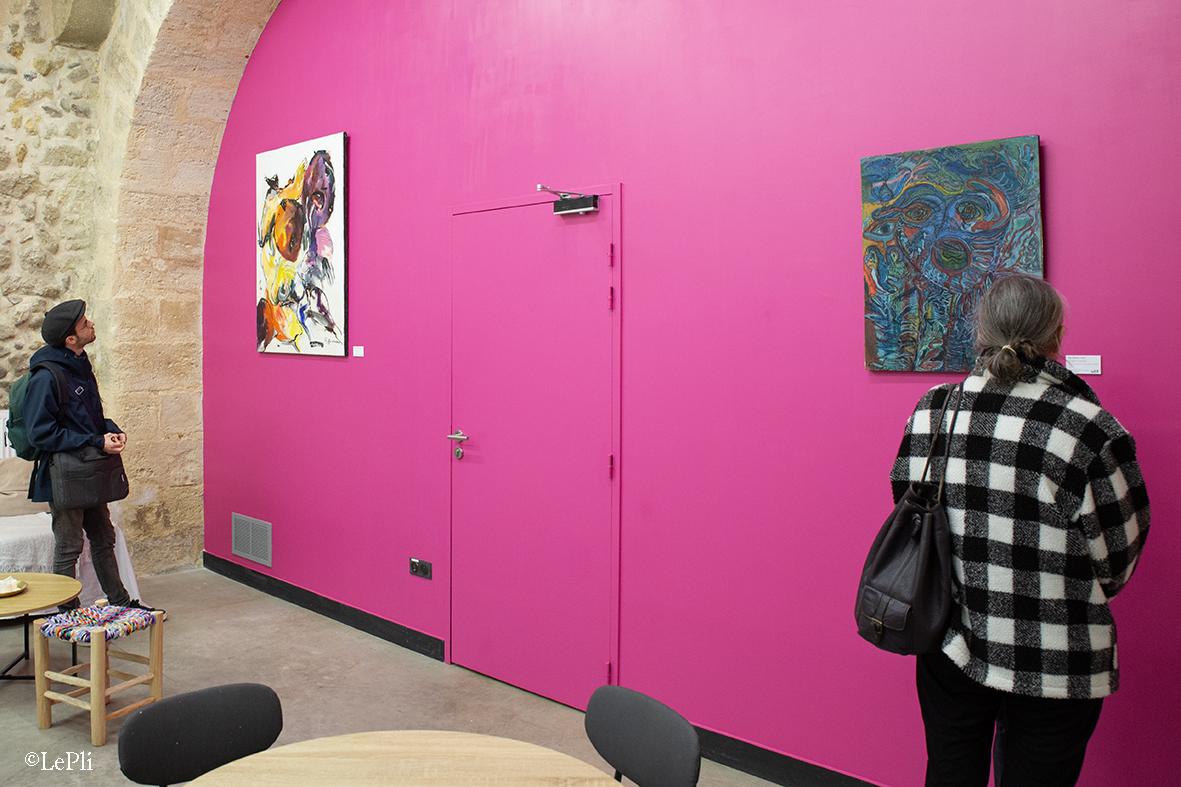
Exposition « La pluie qui cache son jeu », du 10 avril au 26 mai 2024. Avec les œuvres de Stéphanie Buttay, Audrey Buzzolini, Blandine Daurios-Clerc, Catherine Dupire, Martha Grünenwaldt, Marie Hénocq, Rosemarie Koczÿ, Marie-France Lacarce, Danielle Le Bricquir, Esperanza Partal, Marilena Pelosi, Evelyne Postic, Raâk, Lys Reygor, Ody Saban, Chantal Sore, artistes de la collection du musée de la Création Franche - scomparo,  IanE Sirota.

Affiche de l'exposition "La pluie qui cache son jeu"Vue de l'exposition "La pluie qui cache son jeu"Vue de l'exposition "La pluie qui cache son jeu"Vue de l'exposition "La pluie qui cache son jeu"
LePliLePli
2026-02-27

"J'assume mes origines" performance de Norah Benarosch Orsoni. Dans le cadre de l'exposition "Le mot iel est une bombe", vendredi 15 février 2024.

Affiche de la performance de "J'assume mes origines" de Norah Benarosch Orsoni. Dans le cadre de l'exposition "Le mot iel est une bombe", vendredi 15 février 2024. performance de "J'assume mes origines" de Norah Benarosch Orsoni. Dans le cadre de l'exposition "Le mot iel est une bombe", vendredi 15 février 2024. performance de "J'assume mes origines" de Norah Benarosch Orsoni. Dans le cadre de l'exposition "Le mot iel est une bombe", vendredi 15 février 2024. performance de "J'assume mes origines" de Norah Benarosch Orsoni. Dans le cadre de l'exposition "Le mot iel est une bombe", vendredi 15 février 2024.
LePliLePli
2026-02-27

Exposition "Le vivier des vivant·es" du 16 septembre 2023 au 4 novembre 2023 - Installation réalisée en collaboration avec les apprenant·es en FLE du Centre social Bordeaux Nord. À l'ancienne prison de La Réole.

Vue de l'installation. Caynotypes sur pierre (lauze de toiture). Exposition "Le vivier des vivant·es" du 16 septembre 2023 au 4 novembre 2023 - Installation réalisée en collaboration avec les apprenant·es en FLE du Centre social Bordeaux Nord. À l'ancienne prison de La Réole.Zoom sur l'installation. Caynotypes sur pierre (lauze de toiture). Exposition "Le vivier des vivant·es" du 16 septembre 2023 au 4 novembre 2023 - Installation réalisée en collaboration avec les apprenant·es en FLE du Centre social Bordeaux Nord. À l'ancienne prison de La Réole.Zoom sur l'installation. Caynotypes sur pierre (lauze de toiture). Exposition "Le vivier des vivant·es" du 16 septembre 2023 au 4 novembre 2023 - Installation réalisée en collaboration avec les apprenant·es en FLE du Centre social Bordeaux Nord. À l'ancienne prison de La Réole.
LePliLePli
2026-02-27

Exposition "Le vivier des vivant·es" du 16 septembre 2023 au 4 novembre 2023 - Installation réalisée en collaboration avec les apprenant·es en FLE du Centre social Bordeaux Nord. À l'ancienne prison de La Réole.

Texte d'exposition "Le vivier des vivant·es" du 16 septembre 2023 au 4 novembre 2023 - Installation réalisée en collaboration avec les apprenant·es en FLE du Centre social Bordeaux Nord. À l'ancienne prison de La Réole.Affiche de l'exposition "Le vivier des vivant·es" du 16 septembre 2023 au 4 novembre 2023 - Installation réalisée en collaboration avec les apprenant·es en FLE du Centre social Bordeaux Nord. À l'ancienne prison de La Réole.
Laura G, Sassy 70’sLauraJG@deacon.social
2026-02-26

By African-American sculptor May Howard Jackson (1877-1931). “Slave Boy,” 1899, bronze. Today, the title is offensive. He’s a young man who is enslaved, not a boy.

As cast bronze, the sculpture is in more than one collection, public and private. #arthistory #BlackHistoryMonth #blackart #blackartist #womanartist

From Black Art Story: ‘Jackson expressed a fascination with the wide variety of features among African Americans and this became evident in her work. Pieces that expressed this love are works such as “Head of a Negro Child” (1916), “Mulatto Mother and Child” (1929), and “Shell-Baby in Bronze” (1929). These three pieces defined her sculptures. Jackson was a unique representative of the Weltzensang of the Jazz Age that embraced and exalted Black Beauty.’

A portrait bust in bronze of a handsome young black man.
Laura G, Sassy 70’sLauraJG@deacon.social
2026-02-24

By African-American sculptor Beulah Ecton Woodard (1895-1955), "Maudelle," fired terra-cotta painted brown, ca. 1937-1938, 12x12 1/4x8 inches (approximately 305x310x202 mm), Museum of Art and Archaeology, University of Missouri, Columbia, Missouri. #arthistory #blackart #blackartist #BlackHistoryMonth #sculpture #womanartist

From Jill Renae Hicks in a review of the exhibit "Black Women in Art and the Stories They Tell” at the University of Missouri Museum of Art and Archaeology: ‘One of the most incandescent works in the exhibit is "Maudelle," the bust of Maudelle Weston, a black woman who once was a New York dancer. Maudelle modeled for many artists, including Beulah Ecton Woodard, who carefully fashioned the terra cotta sculpture. Woodard, skilled at bringing life to clay, seems to poke fun at the stiff, arched busts traditionally seen in society by creating one infused with dignity, joy and clear African roots, as exemplified by Maudelle's braided hair and exquisitely captured features.

The sculpture testifies to "Woodard's belief that accurate depiction of African costume and features could enhance African American pride," said Diana Burgess Fuller and Daniela Salvioni in the book "Art/Women/California, 1950-2000: Parallels and Intersections." It is an excellent example of one black woman telling another black woman's story, Pixley said.’ (Jill Renae Hicks, Columbia Daily Tribune, Feb. 19, 2012.)

Portrait bust of a black woman, almost in profile, with braided hair swept back. She wears a large silver earring. The color is terracotta.
Laura G, Sassy 70’sLauraJG@deacon.social
2026-02-19

By African-American artist Alma Thomas (1891-1978), Hello Dolly, 1967, oil on canvas board, 24 x 18 in. (60.9 x 45.7 cm.), photo: Christie’s New York, 14 Dec 2023. Very different from her more well known abstract works. #arthistory #art #blackart #womanartist #blackartist #BlackHistoryMonth

A quote from the artist: “I’ve never bothered painting the ugly things in life. People struggling, having difficulty. You meet that when you go out, and then you have to come back and see the same thing hanging on the wall. No. I wanted something beautiful that you could sit down and look at. And then, the paintings change you.”
–– Alma Thomas

The lot essay: “Radiating against a glowing pink and yellow background, Pearl Bailey stands firmly at the center of Alma Thomas’s Hello Dolly. There is no question of focus: Bailey is unequivocally the star of this painting. With her hands held wide, she is frozen in the middle of a song, suspended just for a moment on to the canvas. Her gaze extends beyond the pictorial plane, mimicking how she would have appeared in the play’s iconic staircase scene. The background is rendered impressionistically, with painterly brush strokes heightening the sense of movement and theatricality within the work. Though the audience is not within view, the dynamic brush strokes capture the energy and liveliness of the theatre. Painted after Thomas attended the National Theatre’s all-Black rendition of the infamous musical, Hello Dolly!, the present lot is a token of history as well as a journey into a rare section of the artist’s oeuvre.”
Laura G, Sassy 70’sLauraJG@deacon.social
2026-02-18

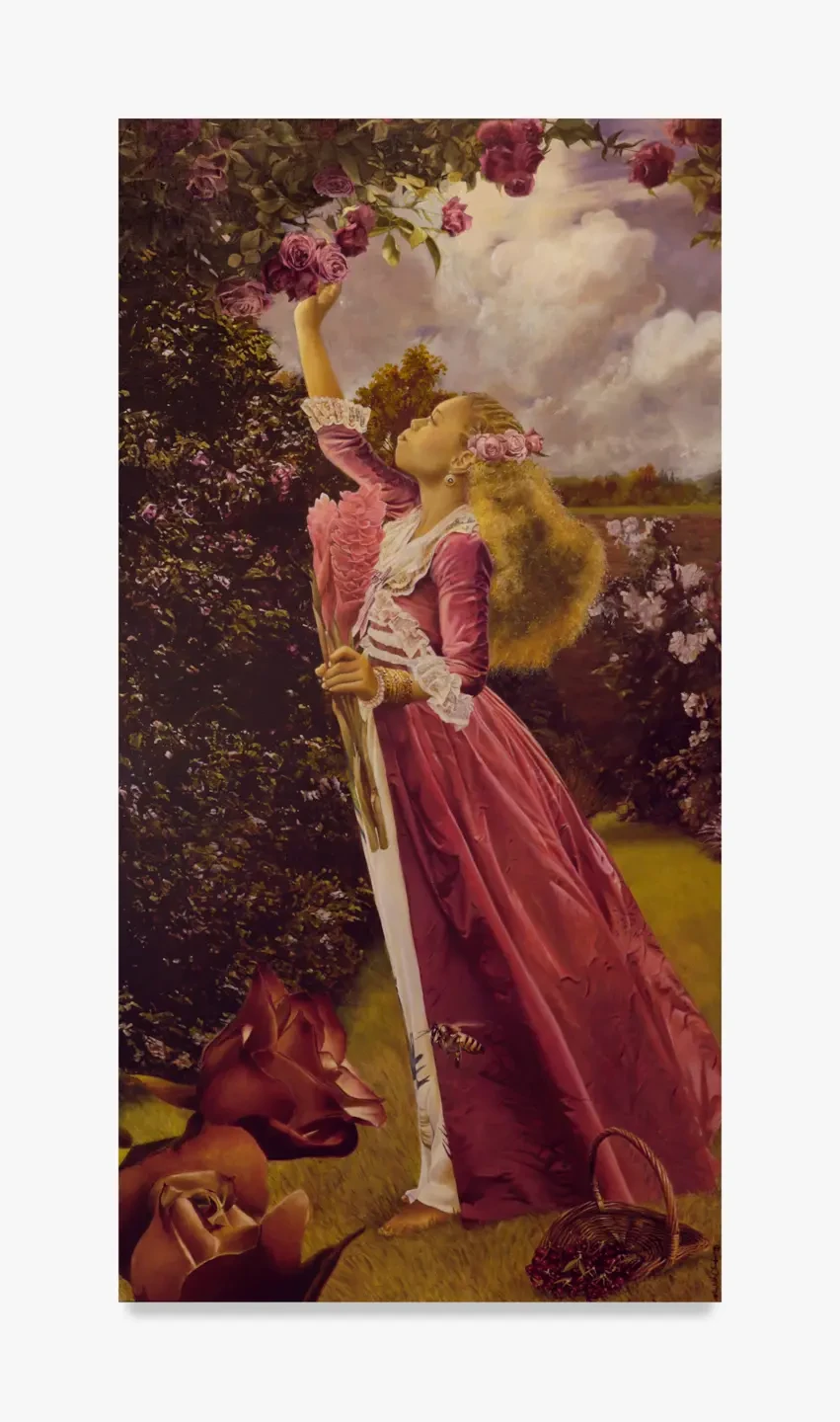
Your Black History Month art post for today: by Elizabeth Colomba (born 1976), Spring, 2018, oil on canvas, 72 x 36 inches, ©️Elizabeth Colomba. #BlackHistoryMonth #blackart #blackartist #womanartist #womenartists

From the The Metropolitan Museum of Art, New York: ‘Colomba’s work centers stories of Black women, drawing on her extensive knowledge of art history and her academic training to complicate Western notions of beauty. As she explains, "I . . . start from a story that exists and remake it in a way that is appealing to me . . . making it more about my roots, which are a mix of French and Caribbean."’

A girl who appears to be of mixed race wears a long red gown with white accents. She is barefoot, in an outdoor rose garden, reaching up for a flower to add to the bouquet she holds in her other hand.
2026-02-13
Laura G, Sassy 70’sLauraJG@deacon.social
2026-02-13

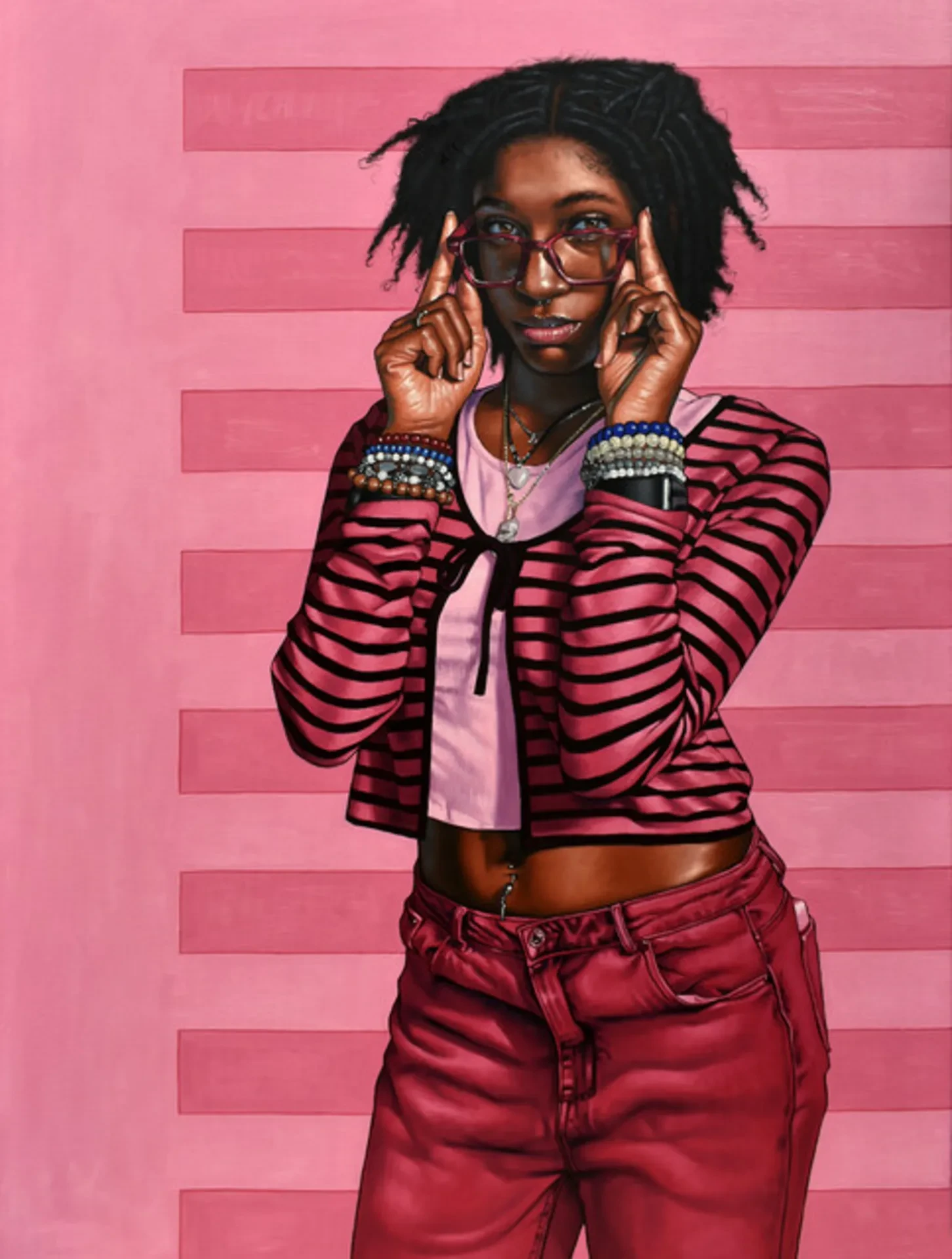
By African-American artist Monica Ikegwu, born 1998, “Brea,” 2023, oil on canvas, 48x36 inches, Muskegon Museum of Art. #blackart #blackartist #womanartist #art #painting #BlackHistoryMonth

The artist’s Instagram: instagram.com/monica165/

From the museum: “Monica Ikegwu's work is structured upon the portraiture of African Americans. The main idea of the work is to focus on the perception of individual people. Perception is the way that people are viewed and how they want to appear. The work brings to focus the attitude of people. She sets in time the trends that different people follow in terms of their appearance. She aims to produce work that is a culmination of people, not as subjects to paint, but as people with their own sense of self.”

A young black woman, wearing garnet red framed glasses, a black and deep pink striped shirt,  and garnet colored jeans. Behind her a pink striped background.
Laura G, Sassy 70’sLauraJG@deacon.social
2026-02-12

By African-American artist Bisa Butler (born 1973), The Tea, 2017, quilting (cotton, silk, lace, and netting), approximately 54 x 80 inches, private collection. From Katonah Museum of Art: “Butler, a formally trained African American artist of Ghanaian heritage, broaches the dividing line between creating with paints on canvas and creating with fiber by fashioning magnificent quilts and elevating a medium hitherto designated as craft into one that is clearly high art.“

#blackart #blackartist #womanartist

From Katonah Museum of Art, Katonah, New York: ‘‘The Tea’ is based on a photograph taken on Easter Sunday outside the still-extant St. Edmund’s Episcopal Church on the South Side of Chicago by the photographer Russell Lee in 1941. Butler abstracts the original photograph’s background and brings the women to the fore as poised and distinct individuals. Her addition of rich, striking colors and patterns help characterize them as part of a thriving, black middle-class in Chicago. The women’s shared comfort with one another and their intimate bonds are suggested by the close circle they form as they spill “the tea”—an African-American vernacular term synonymous with gossip or hidden truth. Butler creates a beautiful moment of strong black female friendship and community, leaving us to wonder if we can be included in the tea, or not.”’
Laura G, Sassy 70’sLauraJG@deacon.social
2026-02-09

By African-American artist Meta Warrick Fuller (1877-1968), “Ethiopia,“ painted plaster, 67 in. high, Schomburg Center for Research in Black Culture, New York Public Library. #arthistory #sculpture #blackart #blackartist #womanartist #womenartists #BlackHistoryMonth

From Kimberly Henderson, Digital Curator, Schomburg Center for Research in Black Culture, “Meta Warrick Fuller: Her Eyes Were Ever Opened Unto Beauty, and All The World Was Art,” New York Public Library blog, April 11, 2024:

‘Meta Vaux Warrick Fuller was born in Philadelphia, PA on June 9, 1877. Her parents were successful entrepreneurs within the hair care industry and prominent members of Philadelphia's high society. She attended the Pennsylvania School of Industrial Art, for which she won a scholarship. In 1899, the young student went to Paris where she became acclaimed for the "audacity" of her sculptures. While there, she had a rapport with the famed sculptor, Rodin, and sought his critique of her work—to which he proclaimed, "Mademoiselle, you are a sculptor' you have the sense of form in your fingers."

In 1909, Meta Vaux Warrick married Dr. Solomon C. Fuller; the first Black psychiatrist in the U.S. and a pioneer in neurological studies. She later had three sons and made a home with her family in Framingham, MA. In 1910, a disastrous fire destroyed some of her most valuable artworks held in storage in Philadelphia. Only a few examples of her early work remain.

Through the years she kept many diaries, often writing about her daily life, art-making, and poetry. Despite losing most of her early work, she persisted as an artist and went on to receive many awards and commissions during her career.’

A woman wearing an ancient Egyptian headdress. She stands, one hand to her heart. The lower half of her body wrapped like a mummy. 

A quote from the artist: “Here was a group who had once made history and now after a long sleep was awaking, gradually unwinding the bandage of its mummied past and looking out on life again, expectant but unafraid and with at least a graceful gesture.”

For the exposition America’s Making ‘W. E. B. Du Bois, the noted writer, philosopher, and editor… commissioned sculptor Meta Vaux Warrick Fuller (1877–1968) to create an artwork that would symbolize the musical and industrial contributions of African Americans to the development of the United States. Fuller, who had studied both in Paris and at the Pennsylvania Museum School of the Industrial Arts, opted to take a different conceptual direction with her allegorical sculpture Ethiopia.’ ~ 
The National Museum of African American History and Culture
Laura G, Sassy 70’sLauraJG@deacon.social
2026-02-08

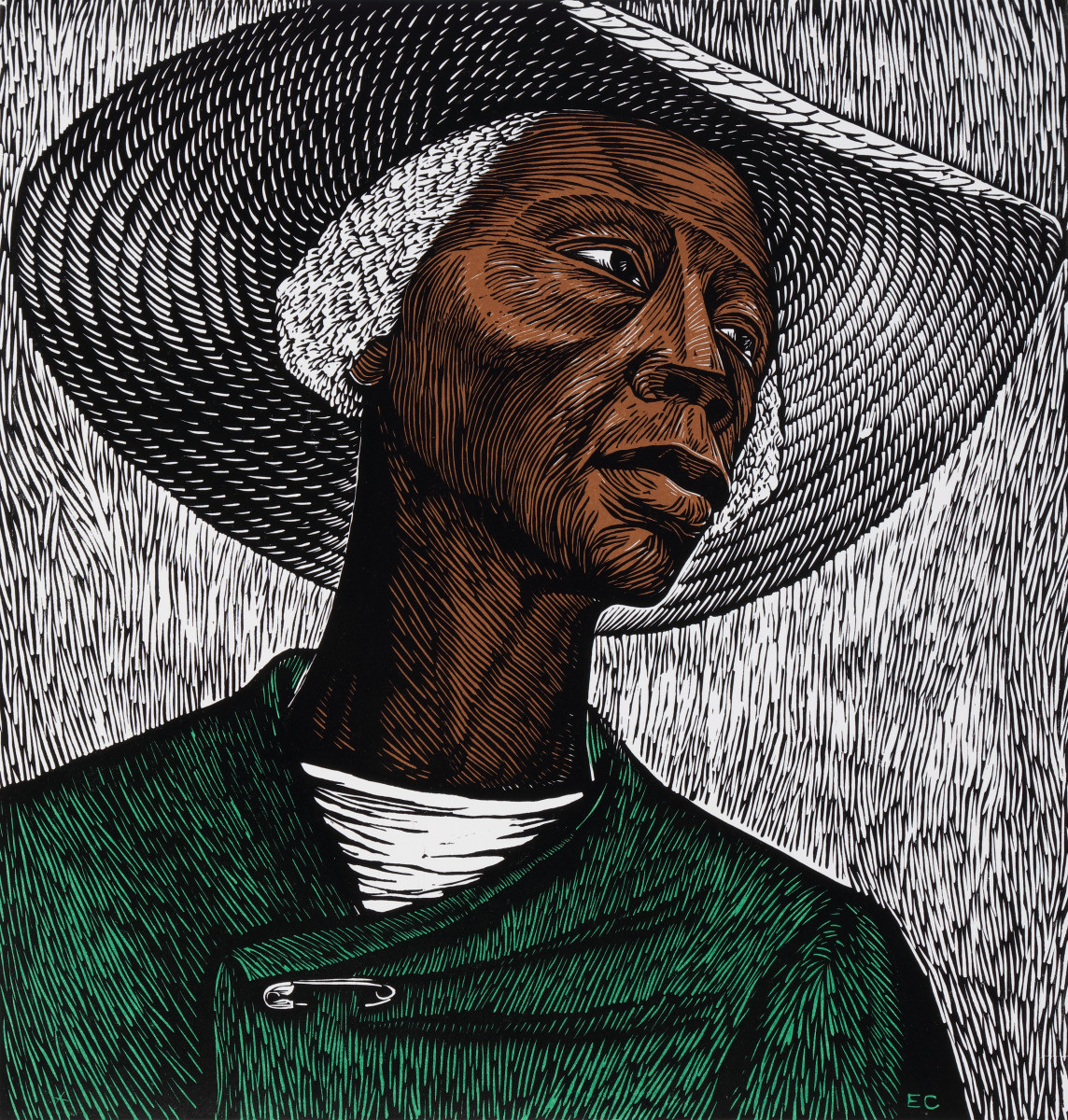
Your art history post for today, by African/Mexican-American artist Elizabeth Catlett (1915–2012), Sharecropper, 1970, color linocut on paper. As a print, it appears in many collections, both public and private. #arthistory #blackart #blackartist #womanartist #womenartists #printmaking #BlackHistoryMonth

Excerpts from her obituary, in the Washington Post, April 3, 2012, written by Matt Schudel: ‘Ms. Catlett, who was born in Washington, was a sculptor and printmaker who followed her own determined vision to become what poet Maya Angelou once called a “queen of the arts.”

“I have always wanted my art to service black people — to reflect us, to relate to us, to stimulate us, to make us aware of our potential,” Ms. Catlett told author Samella Lewis in her 1978 book “Art: African American.”…

“I want the ordinary person to be able to relate to what I am doing,” she told New Orleans magazine in 1984. “Working figuratively is the dues I must, want and am privileged to pay so that ordinary people can relate to my work and not get lost trying to figure out what it means.”..

When Ms. Catlett was a graduate student in Iowa, her primary teacher was Grant Wood, who painted "American Gothic." Wood told Ms. Catlett that she should concentrate on making art about what she knew best.
“The thing that I knew the most about,” Ms. Catlett said in a 1993 NPR interview, “was black women, because I am one, and I lived with them all my life, so that’s what I started working with.”’

Description from her obituary in The Washington Post: “In her 1952 linoleum print "Sharecropper," a woman with white hair and a lean face framed by a wide straw hat gazes off to the side, with her blouse fastened by a safety pin. The static image acquires an internal sense of motion from the thousands of tiny cuts in a linoleum block made by Ms. Catlett.”
Laura G, Sassy 70’sLauraJG@deacon.social
2026-02-07

By African-American artist Augusta Savage, portrait of Gwendolyn Knight, ca. 1934–35, bronze. As a bronze cast, it appears in more than one collection, both public and private. More info in ALT. #arthistory #blackart #blackarthistory #BlackHistoryMonth #womanartist #womenartists #sculpture

A quote from the artist, who was also a teacher: "I have created nothing really beautiful, really lasting, but if I can inspire one of these youngsters to develop the talent I know they possess, then my monument will be in their work."

A portrait bust in bronze of a lovely black woman, her hair upswept. From Anastasia Tsaleza, “Augusta Savage: The Woman Who Defined 20th-Century Sculpture,” Daily Art Magazine, November 3, 2025: ‘Augusta Savage’s sculptures stood out because they depicted a real, humane face of African Americans, instead of perpetuating the racist stereotypes that were commonplace in the art of the time, bolstered by movements like primitivism. Being African American herself, the depictions of people from Savage’s community were authentic and realistic. She paved the way for a new kind of sculpture; one that was intimate and representational instead of distant and merely observational.  Augusta Savage is a modern artist and should be more widely celebrated as such. She introduced something completely novel and “foreign” to 20th-century sculpture; the idea that Black people’s lives and artistic voices are of equal significance, beauty and righteousness to everyone else’s. She proved that there were other aspects, outside of the popular white imagination, that occupied the Black American’s mind; there was religion, love, family, poverty and, oftentimes, fun.’
Laura G, Sassy 70’sLauraJG@deacon.social
2026-02-06

Your art history post for today: by Laura Wheeler Waring (1887–1948), Girl in Pink Dress, ca. 1927, oil on canvas, 32 1/4 × 21 in. (81.9 × 53.3 cm), The Metropolitan Museum of Art, New York. #arthistory #blackart #blackartist #womanartist #BlackHistoryMonth More info in ALT.

From the museum: “Laura Wheeler Waring’s portrayals of Black women across the social spectrum often transcended class norms and disrupted prevalent stereotypes. Here, her young sitter is presented as an icon of the Jazz Age, with the sleek, bobbed coiffure and elegant drop-waisted flapper dress that were emblematic of the period. The artist’s skillful portraits of Black figures drew praise from an initially skeptical Alain Locke, the philosophical leader of the Harlem Renaissance, who later acknowledged the modernity of her subjects. Portraits such as this one solidified her stature as the foremost Black female painter of the Harlem Renaissance.”
Margo De Weerdtmargodeweerdt
2026-02-06

A bird and a sleeping woman.

Painting made in ecoline and black ink, sized A2.

A painting made in ecoline and black ink. The main colours are blue, purple and a yellow-orange. The painting is oriented horizontally. On it you can see a woman lying down, her eyes closed, her arms folded on her belly, and her legs crossed. On her chests stands a large bird. He is looking down at her, with his beak close to her face.
Laura G, Sassy 70’sLauraJG@deacon.social
2026-02-03

Your Black History Month art post for today features quilting: by Beverly Y. Smith (born 1957), “Minerva,” mixed media quilt, graphite portrait, vintage flour sacks, ticking fabric, vintage bow-tie quilt patterns, drunkard’s path and patchwork quilt design, 71x40inches, completed 2022, ©️Beverly Y. Smith. #BlackHistoryMonth #quilting #blackart #blackartist #womenartists #womanartist

beverlysmithquiltart.com/artis

instagram.com/quiltbev

From the artist’s Instagram: “After the Civil War, freed slaves placed wanted information ads in newspapers to find family members separated by slavery. The ads verify the persistent efforts made to reunite with love ones. Through my quilts, my ancestors beckon me to find family members separated as early as the 1700s and to call them by their names.
1. I found her…my gg- grandmother’s twin Minerva! They were born in 1821 and were separated during slavery.
2. The rocks which serve as headstones reveal a secret yet conscious coding system that the living slave community designed for their deceased. These small stones surrounded Minerva’s gravesite.
3. Cherokees believed that cedars contained powerful spirits, including the spirits of the departed buried beneath them. Eastern red cedar is known as the “graveyard tree.
4. My gg-grandmother Moriah born enslaved, owned by Jeremiah Blaylock
5. Toni Morrison speaks on connecting with the ancestors.”

An artwork using quilting techniques to depict a young black girl, looking at the viewer, against a quilted background.

Client Info

Server: https://mastodon.social
Version: 2025.07
Repository: https://github.com/cyevgeniy/lmst