Last voyage of the battlecruiser “Moltke”: the thread about how a German warship almost destroyed the Forth Bridge
On a recent (2022) trip to Orkney we visited the excellent and newly refurbished Scapa Flow museum and I bought a fascinating book on the subject of the internment, scuttling and salvage of the German Hocheseeflotte – the Imperial German Navy’s “High Seas Fleet” , after WW1. (The author, Dan Van Der Vat, is very readable, being a journalist by trade.) So naturally I’ve managed to find an exciting and little known of local history angle to this.
The SMS Moltke (Seiner Majestät Schiff, His Majesty’s Ship) was a 25,000 ton battlecruiser of the Imperial German Navy. She was 612 feet long, 96.5 feet wide, could make 25.5 knots on the 51,000 horsepower produced by her engines and was armed with ten 11 inch guns in five turrets. Battlecruisers were the pride of contemporary fleets, as well armed as the main battleships but able to reach the sort of speeds usually reserved for smaller ships. Big, well armed and fast, Moltke was every bit the equal for her Royal Navy equivalents.
Moltke in New York, 1912
At the end of the war the Hocheseeflotte was still largely materially intact, but organisation and discipline was another matter. It was forced under the terms of Armistice by the Allies into a humiliating internment under the watchful eye of the Royal Navy. It had been hoped by the Germans that the fleet would be dispersed to neutral ports but instead it ended up imprisoned in the bleak confines of Scapa Flow, the principal wartime anchorage of the Royal Navy’s Grand Fleet. Its remaining ships arrived at Scapa after a rendezvous with the Grand Fleet in the Firth of Forth, from where it was escorted into a miserable internment.
The German Fleet at Anchor off Inchkeith, Firth of Forth: After the Surrender, IWM ART 1926
The German ships were disarmed and made incapable of war or even escape, but legally they remained the property of the German state. They were supplied by German provision ships sent by the German government from German ports. Although their crews were not officially prisoners, they were not allowed to leave the confines of their ships and no British personnel were allowed aboard apart from small official delegations pertaining to the administrative niceties of exile. As the signing of the Treaty of Versailles approached, the German Admiral in charge at Scapa – Ludwig Von Reuter – found himself in an impossible position.
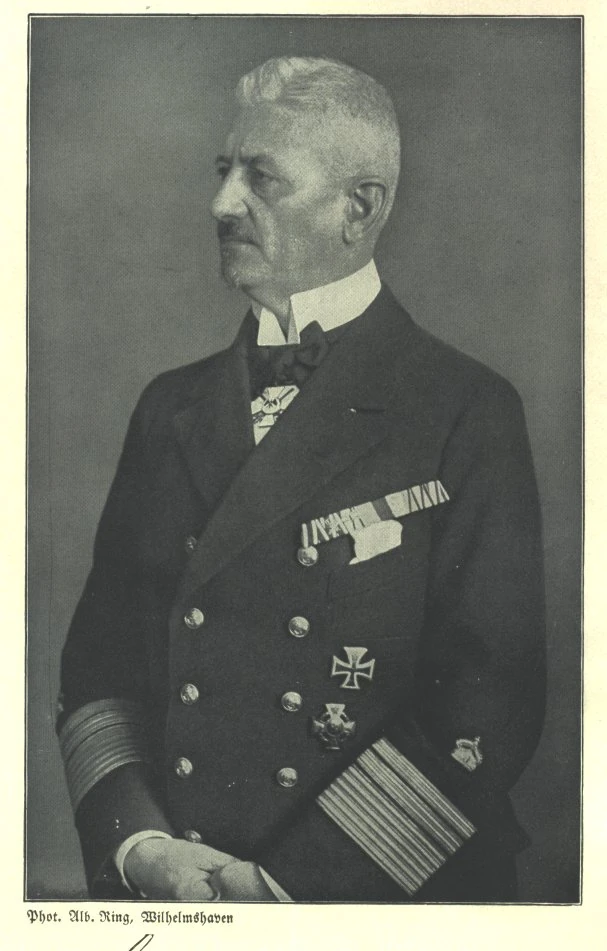
Vizeadmiral Hans Hermann Ludwig von Reuter
Von Reuter was caught between the national honour of the Prussian officer class; his mutinous and non-compliant crews; British belligerence and overwhelming Allied political pressure. His fear, not without reasonable, was that the British would try and seize the German fleet on the signing of the treaty. He gathered around him a select circle of loyal officers and right under the nose of the watchful Royal Navy and his own suspicious and resentful sailors, managed to organise a mass scuttling of almost his entire fleet.
The battleship Bayern sinking in Scapa Flow, the same image as used on the cover of Dan Van Der Vat’s book.
On 21st June 1919 the conspirators managed to scuttle fifteen of the sixteen battleships and battlecruisers, five of the eight fleet cruisers and thirty-two of the fifty destroyers at Scapa. The cream of the German Navy was turned into the half a million tons of scrap metal on the seabed in a matter of hours. Publicly the British were furious (the Royal Navy doubly so as it had been totally humiliated), but Von Reuter had actually done everyone involved a favour and simplified negotiations over the fate of the fleet – If the German Navy lay at the bottom of Scapa Flow then nobody could have it: not the British, the Germans, the French, the Americans or even the Italians.
Seydlitz on her side in Scapa Flow
Scapa Flow was now littered with over fifty German wrecks in various states of submersion, posing quite the navigation hazard – as demonstrated ably by the government whaler Ramna which got stuck fast on top of the capsized hull of the Moltke. The world soon moved on from the scuttling as shattered countries sought to begin rebuilding themselves post war.
The Admiralty whaler Ramna, high and dry on the Moltke’s partially submerged hull
Enterprising locals (often unofficially) stripped what they could access above waterline for scrap until an enterprising Shetland shipowner and councillor – J. W. Roberston – proved that you could salvage wrecks from underwater and brought a number of torpedo boats ashore for their scrap value. Enter now stage left the enterprising, irrepressible and energetic figure of Ernest Frank Guelph Cox. Cox was a self made engineer and metal dealer from the Midlands who had the vision to believe he could access and salvage the five hundred thousand tons of best German steel located at the bottom of Scapa Flow. Now that the price of scrap metal had started to rise after the immediate postwar slump, his backers believed that it would now be financially worthwhile.
Ernest F. Cox, from the book Cox’s Navy by Tony Booth
Cox’s business partner in his firm – Cox & Danks – was his cousin, the capital behind the operation. Together they bought the rights to salvage the Hocheseeflotte from the Admiralty and set to work at Scapa in the mid 1920s. Cox had the foresight to hire Tom McKenzie, a Glaswegian naval salvage diver who would pretty much write the book on naval salvage diving.
Tom McKenzie
Although all involved were practical, skilled and experienced men, they were starting from almost nothing and had to largely invent, improvise and improve all the required techniques for marine salvage on this scale. Overcoming setback after setback, they were driven along by Cox’s indefatigable determination and Danks’ deep pockets. They made rapid progress and the first torpedo boat – V70 – was raised after less than 2 months work in 1924. Moving on to the next boat and then the next one after that, they honed their techniques and were soon raising ships at a rapid rate. Within two years, all twenty six torpedo boats that Cox had the rights to take had been raised.
Salvaging a destroyer
Cox now turned his attention to the big ships on the bottom, the battleships and battlecruisers. In May 1926 he started on the SMS Hindenburg, but even though she reached the surface the operation proved a disaster and she had to be quickly resunk. The precarious situation of the salvagers at Scapa was saved by the discovery of huge stocks of coal in the bunkers of SMS Seydlitz; it was found these could be accessed and “mined” from the surface and this free source of fuel tided the operations over. Cox now set his sights on the Moltke. The basic technique was relatively simple. Divers were sent down to plug the holes in the hull and it was pumped full of compressed air, displacing the water aboard. As it leaked and bubbled out through the holes that had been missed, these two were plugged. Eventually air could be pumped in quicker than it escaped and slowly the hull would start to float.
Salvage at Scapa. Cox’s men, aboard the deck of a partially raised destroyer, man the pumps filling the hull with compressed air.
I say relatively, in practice it was tremendously difficult and verging on the impossible. They were working at – or beyond – the limits of contemporary diving skills and technology. Conditions were harsh and the environment of Scapa Flow was unforgiving as any British sailor ever sent there would attest, but Cox’ determination and McKenzie’s skill drove them forwards. The Germans had efficiently and effectively wrecked the watertight integrity of the ships’ inner bulkheads so before they could be raised in a controlled manner, divers had to go in and restore it by welding and plugging any gaps they could find. To make this possible, airlocks – like huge submarine chimneys – were built down into each compartment. From these, divers could access the innards and get to work under intense air pressure, working upside down on ships encased in marine slime, often in complete darkness.
These jaunty cylinders breaching the surface of Scapa Flow are the air lock towers, reaching down to the sunken ship below
Cox was a bit of a showman, always on site and always hands on. His men respected him and the press loved him. He made sure the latter were around whenever anything interesting was happening. The Scotsman filed almost weekly progress reports on the salvage of the Moltke.
- October 21, 1926. Compressed air pumping operations commence on the hull of the Moltke.
- December 10, 1926. Moltke is rising unevenly and the divers are forced to sink her in case she is caught by the winter gales.
- Feb. 15, 1927. Work restarts after winter storms, the first airlock is fitted and almost 100 men are at work on the Moltke.
- Feb. 24, 1927. The difficulties are described of working in a 15PSI atmosphere where cutting torches burn up the oxygen as fast as it can be pumped in
- May 30, 1927. Work resumes again after 2 months of gales. A disaster is narrowly avoided when the wrong valve is closed and compressed air rushes through the ship from stern to bow, blowing the 16 divers at work inside through the ship with it.
- June 13, 1927. Cox has the Pathé newsreel men on site to witness the triumph of the Moltke breaching the surface in a controlled manner and refloating after 8 years on the seabed.
June 13th 1927,
Moltke breaches the surface and stays there. Cox and his men are triumphant
But don’t just look at those grainy thumbnails, watch the whole clip on the Pathe website! Over the next four months the refloated Moltke was painstakingly winched towards Cox & Danks’ salvage base at Lyness on the island of Hoy, narrowly avoiding grounding on the island of Cava when one of her big 11 inch guns fouled the seabed and had to be cut free. They begin cutting her up in situ but it soon becomes obvious that the isolated shores of Scapa Flow were the wrong place to do this and made little economic sense. Cox therefore convinced the Admiralty to lease him the No. 3 Dry Dock at Rosyth Royal Dockyard, the largest and most modern in Scotland.
Dragging the upturned Moltke to Lyness
He then sold on the scrapping rights to the Alloa Shipbreaking Company, who would undertake the actual dismantling work at Rosyth, thus leaving him free to concentrate on the dark arts of salvage. But the problem still remained as to how to get the beached and upside-down hulk of Moltke 250 miles south to Rosyth. The only solution was to refloat it and tow it there – a hard enough task if it didn’t include having to transit the Pentland Firth with its infamous tidal currents, some of the fastest in the world. Undaunted, Cox set to work. The ship was lightened of thousands of tons of steel such as propellers and shafts, armour plate etc., and her hull was patched up with concrete where they had started to demolish it.
Getting Moltke ready for sea at Scapa
Refloated for the journey, two shelters were built on her “deck”, actually the upturned bottom; one with accommodation for the eight crew who would make the journey (including Cox himself), the other with enough pumps to keep her full of compressed air. Lifeboats were thoughtfully included too. By May 18th, Moltke was ready to go. Controversially at the time, both in Britain and in Germany, the three tugs that were chartered to take her on her final voyage were German, including the Seefalke – the most powerful in the world – the Posen and the Simson.
The unlikely shape of the upside down Moltke, with Simsun and Seefalke lashed to her sides. The third tug could pull from the front or stern to provide better directional control.
For good measure, on board was also one William Mowat, the coxswain of the Longhope Lifeboat, probably the only man in the world qualified to pilot the wallowing hulk out of Scapa and safely past Duncansby Head.
William Mowat and the crew of the Longhope lifeboat. “Bill” Mowat is middle row, 2nd from left. © Orkney Image Library, 10060
Despite Mowat’s presence, disaster was soon upon them when the weather got up. The three tugs could not make headway against the wind and current and Moltke started going backwards though the Pentland Firth, rolling by up to 13.5 degrees. She lost 6 feet of her precious freeboard as the compressed air bubbles within that kept her afloat leaked out due to the constant rocking and pitching motions. The pumps could not keep up and she was slowly sinking. Salvation came with the tides themselves, which inevitably turned and speedily ejected the battlecruiser and her three attendants out of the Firth.
After this literally rocky start, things calmed down and the pumps were able to refill the air bubbles and lift the hull back out of the sea again. With the tugs now making headway the close call was soon forgotten about and Cox the showman had the crew play a makeshift game of cricket on the deck for the press. I think he is the man umpiring at the back, in the pullover with his hands behind his back.
All calm on the deck of the Moltke © Orkney Library
The rest of the journey to the Firth of Forth proceeded calmly and according to plan and by May 21st she was off Granton. The last manoeuvre required of the tugs was to get her safely under the Forth Bridge and into the Rosyth basin. And this is where things start to go wrong. Again.
This time it was down to petty officialdom. The Forth Pilot arrived from Granton and tried to take command. He was joined shortly afterwards by the Admiralty pilot from Rosyth. A standoff now ensued as the civil and military opposite numbers argued over who had the rights to pilot the Moltke up the Firth. Neither was willing to back down and the set to kept on going, as did the changing tide and currents of the Firth. Gradually, so to did Moltke herself, gently easing her way inevitably upstream. Before the situation could be resolved, they found themselves coming upon Inchgarvie island; the very rock on which the piers of the bridge was built. And the newsmen from Pathé were there to film it all!
One of tugs found itself grounded on Inchgarvie…
Moltke approaches Inchgarvie
The Seefalke, attached at the back and in charge of providing steerage then drifted around the wrong side of the island and had to cut the tow. Moltke was now at the mercy of the currents, with two tugs lashed to her, one being dragged along the bottom, and with no ability to manoeuvre their charge.
Seefalke stands off
Now totally out of control, Moltke spun through 90 degrees and drifted sideways down the Firth towards the bridge, dragging the helpless tugs along with her. All twenty three thousand or so tons of her was now heading broadside towards the central piers of the bridge, those which rose directly out of the water itself. All the while, trains rattled to and fro overhead with little idea what was unfolding below them.
Moltke floats down the Firth towards the bridge
If you watch the remarkable clip, you can see Moltke drifting beam-on towards the bridge as a train goes by overhead. Somebody must have been saying their prayers onboard though, as somehow the tugs lashed to Moltke‘s hull managed to position the 612 feet wide floating wrecking ball perfectly between the piers and Inchgarvie, narrowly avoiding disaster.
Safely under the bridge and back under control.
The Seefalke was now able to get a line across and bring the hulk under control, steering her gingerly towards the safety of Rosyth. The watching press were blissfully unaware how close disaster had been, the Scotsman reported “a wonderful piece of navigation and most successfully performed“. However, if you look closely at the footage, Moltke approaches the bridge stern first (with her 4 propeller supports leading the way) but passes through it bow-first (with the big notch cut out from initial breaking up leading). The big battlecruiser had done a 180 degree pirouette while passing under the bridge!
Nothing to see here!
Moltke was edged finally towards the channel into No. 3 Dry Dock but Cox couldn’t yet breathe a sigh of relief; first he has to get the ship into the dock, as his contract stipulates he won’t get paid by the Alloa Shipbreaking Co. until she is in and the dock is drained.
Moltke approaches the gate of No. 3 Dry Dock
But this last step will be no small feat – there is just a one day window on the highest spring tide to get the upside down hulk into dock. Ships usually go in the right way up of course, but the inverted Moltke is drawing 41 feet of water at her deepest, 25% more than she would otherwise, and the dock gate had a lip that reduces the depth of the water to only 38 feet! But this was Cox and he was undaunted – by an incredibly skilful act of pumping compressed air in at one end and letting it out at another, and then reversing the process, he was able to “hop” the deepest part of the ship over the dock lip and get her safely in with the gates shut.
But on the brink of final triumph, once again officialdom almost screwed everything up for Cox. With Moltke bobbing in the waters of the still flooded dock, the supervisor stepped in and disagreed about how to support the upside down ship on the dock floor. He had a point – ships didn’t normally go into dock with their pointy-bits facing down the way. There were all sorts of projections beneath the hull that might damage the critical national infrastructure that he was in charge of. Of course the Admiralty should have worked this all out with Cox before they signed over the use of the dock to him. A frantic phonecall to Whitehall couldn’t resolve things so Cox jumped straight on the first train south to thrash it out in person. Ironically to do so he first had to pass over the bridge he very nearly demolished only a few hours previously. In London an agreement was reached and he was back the next day, 28th May, to get his men to work shoring up the hull with baulks of timber.
Then dock was then slowly drained and the ship finally came to rest on the bottom. It was June 5th as the last of the water was pumped; Cox had finally won. He had raised a 23,000 ton ship from the seabed that had spent 8 years submerged – twice! -, beached it, refloated it, sailed it 250 miles through the treacherous Pentland Firth and squeezed it upside down into a dry dock into which it shouldn’t have fitted and all without demolishing one of the most important structures in the western world!
Moltke high and dry in the dock
The Alloa men could now get to work and on September 13th 1928 set about cutting up the pride of the Hocheseeflotte into thousands of tons of valuable scrap metal.
Moltke being cut up
Cox would go on to salvage every ship he could from the bottom of Scapa Flow giving up eight years later and £10,000 worse off than when he began. For all his drive and determination, his financial skills were somewhat lacking and his pioneering methods proved inefficient and just never paid back. Other Scottish businessmen, including those of Alloa Shipbreakers and salvage diver Tom Mckenzie, then formed Metal Industries Ltd to carry on were Cox left off. With more efficient, refined techniques and more sensible business practices, their venture would pay off in a big way.
The salvage of the Kaiserin by Metal Industries in 1936. Sealed and pumped full of compressed air, the ship breaches the surface, air locks and all. From the Illustrated London News.
The last Scapa ship raised by Metal Industries was SMS Derfflinger. Another war intervened in this venture and she spent WW2 beached and upside down, alongside the disarmed old battleship HMS Iron Duke, HQ ship at Scapa, which during WW1 had faced off against the Hocheseeflotte at the Battle of Jutland. The salvage men aboard Derfflinger would save the Iron Duke after she was nearly sunk in an air raid early in the war. Derfflinger was floated into a submersible dry dock and towed to Faslane after the war for scrapping.
Derfflinger enters Faslane, the last of the German battleships from Scapa to be scrapped
One of Metal Industries’ many improvements on the salvage process was to rapidly sink the ship as soon as they had raised it, to crush and concertina the protruding superstructure up inside the hull, removing most of the underwater obstructions that plagued Cox. It is praiseworthy that the basic salvage techniques pioneered by Cox and McKenzie, and refined by Metal Industries, are still those that are in use today.
If you have found this useful, informative or amusing, perhaps you would like to help contribute towards the running costs of this site – including keeping it ad-free and my book-buying budget to find further stories to bring you – by supporting me on ko-fi. Or please do just share this post on social media or amongst friends.
Explore Threadinburgh by map:
Travelers' Map is loading...
If you see this after your page is loaded completely, leafletJS files are missing.
These threads © 2017-2026, Andy Arthur.
NO AI TRAINING: Any use of the contents of this website to “train” generative artificial intelligence (AI) technologies to generate text is expressly prohibited. The author reserves all rights to license uses of this work for generative AI training and development of machine learning language models.
#Lochend #Logan #Restalrig #StMargaret