#WSIS

Dan Yorkdanyork
2026-01-13

RE: techpolicy.social/@internetsoc

This is a great discussion around , the , the recent +20 review, the importance of , and in general about what's at stake for the future of the if we don't get this right... if you have 40 minutes, I recommend giving it a listen!

Afnicafnic
2026-01-13

🌐 The United Nations General Assembly concluded the high-level review of the World Summit on the Information Society (WSIS+20) with the adoption by consensus of the outcome document assessing twenty years of implementation of the outcomes of the WSIS.

🔗 Discover the main lessons and reaffirmed ambitions: afnic.fr/en/observatory-and-re

Lucien Castex
World Summit on the Information Society (WSIS):
the ambitions reaffirmed
Christopher Paun :mastodon:paun@digitalcourage.social
2025-12-19

@BMDS
Vielen Dank für den Einsatz für ein offenes und freies Internet sowie für den Multistakeholder-Ansatz! 💪 🇺🇳
Das entspricht auch den Forderungen der Parlamentarier beim Internet Governance Forum #IGF.
#UNGA #WSIS

MdB Ulrich Lechte und Dr. Christopher Paun beim Parlamentarischen Workshop des Internet Governance Forum 2019 in BerlinPräsentation der Ergebnisse des Parlamentarischen Workshops beim Internet Governance Forum 2019 in BerlinErgebnisse des Parlamentarischen Workshops beim Internet Governance Forum 2019 in Berlin
APCAPC
2025-12-18

APC's statement presentation during the High-Level Meeting on the overall review of the implementation of the outcomes of the World Summit on the Information Society (+20) urging to "remember that WSIS is about harnessing digital tools for people-centred development, not about developing digital tools and processes".

apc.org/en/pubs/apc-statement-

Wide view of a large UN assembly hall, with a speaker standing at a podium on a raised stage while delegates sit at desks arranged in curved rows, listening to the address.

Al #WSIS l'Assemblea Generale ONU ha confermato il mandato dell'Internet Governance Forum e il modello multistakeholder di governo della Rete.

È una buona notizia: nonostante le istituzioni aperte della Rete (ICANN, IETF, RIRs) abbiano le loro criticità, prima fra tutte l'essere ancora troppo USA-centriche, l'alternativa sarebbe stata la centralizzazione di ogni decisione nei soli organismi governativi

Commento di ICANN: icann.org/en/blogs/details/un-

Testo della risoluzione: digitallibrary.un.org/record/4

Sovereign Tech Agencysovtechfund
2025-12-18

Hearing these principles clearly stated on the UN stage underscores the mission of the Sovereign Tech Agency and we very much appreciate the minister including this in his statement.

3/3

2025-10-21

RECORDING – IGF PNIF: Roles and responsibilities of the WSIS stakeholders in relation to Internet fragmentation IGF Policy Network on Internet Fragmentation

YOUTUBE | PATREON | TRANSCRIPT | ARCHIVE | PERMALINK

On September 30, 2025, the Internet Governance Forum Policy Network on Internet Fragmentation (PNIF) met to consider 'Roles and Responsibilities of the WSIS Stakeholders in Relation to Internet Fragmentation

isoc.live/19789/

#post #fragmentation #PNIF #wsis #WSIS20

Read about @spipau 's impressions from the WSIS and AI4Good conference. He reflects on our contributions to WSIS+20: in collaboration with @TimUnwin , he served as both a panellist and a moderator for a session hosted by the FAO.

Featuring insights from @raspberrypi @Mer__edith , OpenAI, and Geoffrey Hinton:

ict4d.at/2025/08/wsis20-high-l

#ict4d #ai4good #wsis #conference #ai #fao

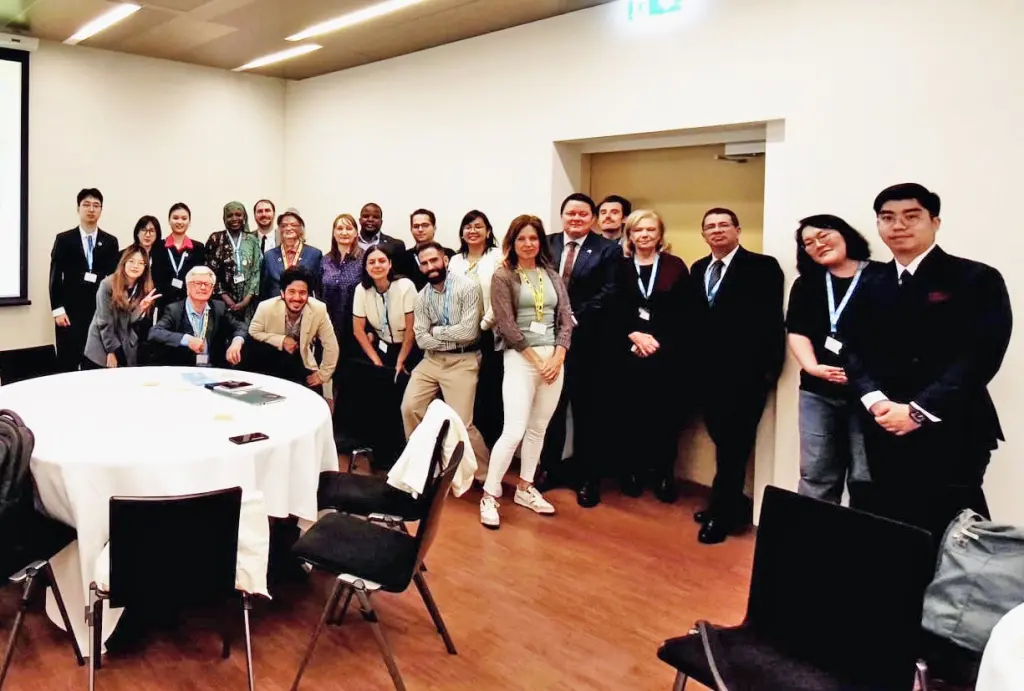
Participants of the WSIS conference posing for a picture
2025-08-10

WSIS+20 High-Level Event and AI4Good Global Summit 2025

I was privileged enough to visit this year’s World Summit on the Information Society (WSIS) and AI4Good in Geneva, Switzerland. Both organized by the ITU and happened in parallel. I have been there in the past and while the WSIS dates back quite some time, the AI4Good conference is rather new. It is puzzling to see how much more budget is available the new buzz-hyped AI conference while the WSIS is in comparison rather underfunded. The AI stage sparkles while the WSIS is just as always. The first hosts mostly players from the private sector and the latter focuses on the most marginalized on this planet.

I must admit that the AI hype was much stronger the last year when they promoted AI as the saviour to the failing SDGs – a rather ridiculous idea. At the WSIS, I was not any more the only Linux/FOSS user and there were more engineers attending, a welcomed change. Some where represented in the Fediverse and others actively promoted FOSS within the UN. I even chatted with someone about degoogleing Android phones by running custom ROMs to escape surveillance.

The attendees of the WSIS are usually a mix of policy makers, UN delegates, some civil sector and private actors discussing technology and its implications on the most marginalized. While most of them are experts in their own domains, such as agriculture, traditional media or education, they often lack the technical expertise to profoundly understand the technology behind their buzz words. Which often leads to discussion where engineers such as I role my eyes. As an example, I attended sessions about journalism and I have to admit that I got tired of journalists complaining on their iPhones via X tweets that their revenue crumbles and freedom of press is dying. If journalists still believe that their work is valued by surveillance capitalism, then they still lack a profound understanding on how big-tech exploits their business.

I attended a session by OpenAI where their speaker shared, that 40% of their users are under 24 years old and the number one thing they do is learning with ChatGPT. Which underlines the influence this technology has on our younger generation. The company promoted their OpenAI Academy where they train people on their products. OpenAI argued that future jobs such as programmers will not be needed any more and will get replaced by smart AI agents.

The Raspberry Pi Foundation drafted a different picture, the company behind Raspberry Pi computer. Since their beginning, they are invested in education and their speaker stated the following:

  1. We still need skilled human programmers as AI can generate code but have not automated programming. AI generated code does probably not have ethics or validity baked in
  2. Learning to code in an essential part of learning to program. Coding remains the most effective way we know to develop computational thinking skills. Knowledge and expertise is built through hands on programming
  3. Learning to code will open up even more opportunities in the age of AI. Previous waves of automation have increased demand for skilled human programmers – Jevons paradox. AI will increase the reach of programming and computational approaches into new domains. Programming will become relevant across a wider range of roles and is no longer just for software developers
  4. Coding is a literacy that helps young people to have agency in a digital world. The kids who learn to code will shape the future
  5. The people who design AI also control the technology. They wield enormous power. The risk is that we concentrate that power into the hands of a small and unrepresentative group. Ensure that all young people can develop these skills is consequential for all of us

Find here their position paper titled Why kids still need to learn to code in the age of AI. They offer Computer Science and AI courses.

It was refreshing to listen to sound criticism behind the power structures of AI. Not the technology is the problem, but rather a small hand of too powerful people controling it to further increase the imbalance between the rich and the poor. AI can have a positive potential to work for the most marginalized, but as every technology, it is currently controlled by an elite to exploit the masses. Meredith Whittaker, the president of the Signal Foundation resonated a similar message. In her brilliant review, she pointed out that if AI agents are granted unlimited access to our systems, then their Signal Messenger cannot any more guarantee its secrecy. A massive implications for anybody who relies on encrypted communications such as governments, journalists, doctors, activists, minorities or advocates.

The final talk by Geoffrey Hinton turned quite dark. He argued that AIs are like atomic bombs and regulations are far too slow. We face an existential threat and human mankind might cease to exist as AI will take over and eradicate human mankind. Keep in mind that he holds a Turin Award, is a Nobel Laureate and one of the AI Pioneer – someone we should carefully listen to. He painted a scenario where we let loose an AI agent to act on our behalf. It will create sub-goals to reach its main task and will try to grab more power to better achieve the outcome. This will lead to an AI in every system on this planet and it will be superior to any human. It will develop a sense for survival, or has probably already one built in by us. Think of an AI battle robot where humans will drill an AI to survive and succeed at any cost. It will get threaten by us as we would like to turn it off at one point. We will become AI’s number one enemy and might not stand a chance. Geoffrey Hinton demands strong policy by the public sector, a framework for regulation: politicians need to be pushed to create strong regulation to audit every big AI system. He strongly argued against open source AI systems as he sees them as too dangerous and they should not be in the hands of anybody.

Contributions to WSIS

In collaboration with the ICT4D Collective, I was a panel member in our session Digital tech and the most marginalised: what still needs to be done?. It was a wonderful session and Tim wrote a profound blog post about the outcome. Truly a pleasure and honour, a big thank you to Tim for inviting me and it was great to collaborate with my dear colleagues.

I was also delighted to moderate the session WSIS Action Line C7: E-Agriculture organized by FAO of United Nations. A vivid discussion on how technology can support our farmers.

Paul acting as a moderator ©ITU/Pierre Albouy

#AI #ai4good #conference #WSIS #WSISForum

A slide which shows all participantsPaul acting as a moderator at the WSIS
2025-07-18

RECORDING – WSIS 2025 High Level Event – Session 413 – Bridging the Digital Divide: Inclusive ICT Policies for Sustainable Development

YOUTUBE | AUDIO | TRANSCRIPT | SUMMARY |

ARCHIVE | PERMALINK

On Friday, 11 July 2025 the International Standard University and City University, Bangladesh organized a session 'Bridging the Digital Divide: Inclusive ICT Policies for Sustainable Development'

isoc.live/19523/

#post #Bangladesh #DigitalDivide #environment #ethics #wsis

Wikidata Taiwan 臺灣維基數據社群wikidatatw@liker.social
2025-07-14

Wikidata 與 #民主資料 的嘗試,在【Wikidata: Attempting to bridge #FOSS ideals and direct democracy】一文中提及了兩個與政府資料相關的專案,展現 Wikidata 在 #民主參與#公共透明度 上的潛力。

#GovDirectory:由開源倡議者 Jan Ainali 發起,目標是建立全球政府機構的公開目錄,包含聯絡方式與社群媒體帳號。目前已涵蓋近 40 個國家、約 13,000 個機構,並透過 Wikidata 提供 #結構化資料 支援;目前臺灣社群尚未共同參與這個計劃,但是目前臺灣社群已經完成了全臺灣各級行政區(含村里)以及中央政府各局處的目錄收錄,並持續維護新資料與增補行政區沿革。
#AletheiaFact:來自 #巴西#事實查核平台 ,運用 Wikidata 的資料架構與搜尋能量,快速建立查核系統。該平台強調資訊素養教育,並獲得 #世界資訊社會高峰會#WSIS )獎項提名。

這兩個專案的共同特色皆以 Wikidata 為核心,結合 #群眾參與 與開源精神,推動資訊公開與 #民主監督 。透過 Wikidata 的資料連結能力,使用者能夠跨語言、跨領域地查詢與整合資訊,進一步促進公民社會的發展。

文中也指出,Wikidata 的開放性使其成為打擊假訊息與促進事實查核的重要工具。在資訊氾濫的時代,這樣的資料平台不僅是技術資源,更是民主實踐的基礎。

完整原文:theregister.com/2025/07/04/wik

#維基資料 #維基數據 #民主 #公民科技
#Brasil

Wikidata Govdirectory 專案頁面,或在 Wikidata 中搜尋 WD:GD 。
2025-07-11

That’s a wrap on the World Summit on the Information Society (WSIS)+20 High-Level Event! We had an amazing time this week organizing meetings, speaking on panels, exchanging ideas, and engaging with our global community.

We were proud to advocate for the multistakeholder model of Internet governance and lead conversations (like Monday’s panel) on the key topic of community-centered connectivity. To everyone we chatted with in Geneva—thank you! #WSIS

A group of 21 people in professional attire stands outside for a photoFive people stand together at an Internet Society boothA man sits at a table with a few other people and speaks into a microphoneA man sits on a panel with five other people and speaks into a microphone
APCAPC
2025-07-09

More highlights of day 2 at +20 with @redesac_mx

2025-07-07

La Cumbre que no fue: antecedentes de la CMSI a veinte años de su celebración

libranet.de/display/0b6b25a8-1

Paul Spiesbergerspipau
2025-07-07

Opening ceremony of this year's WSIS forum. Anyone here in the Fediverse also attending?

A room full of people listening to a speaker on a stage opening the 2025 WSIS forum

@spipau will be speaking at WSIS+20 High-Level Event 2025:

Digital tech and the most marginalized: what still needs to be done?

Organized by: ICT4D Collective and Microsoft (UNIO), supported by Bangladesh NGOs Network for Radio and Communication, YouthIGF and ICT4D.at

Join us online or on-site:
8th July 2025, 09.00-09.45
Palexpo, Room L

itu.int/net4/wsis/forum/2025/A

#wsis #wsis25 #ict4d

A flyer with information about the upcoming WSIS session and an invitation to joinA picture of Paul Spiesberger, Chair of ICT4D.atA flyer with the URL of the WSIS forum: www.wsis.org/forum and the hastag #wsis
Derechos Digitalesderechosdigital
2025-07-03

🌐 A 20 años de la Cumbre Mundial sobre la Sociedad de la Información (), el nuevo informe “The Road to WSIS+20” analiza el posturas de los países. Desde Derechos Digitales escribimos el capítulo de Chile.

📄 gp-digital.org/publication/the

2025-06-30

Back in Geneva for more than a few hours in a long while.

Interesting how many memories this place holds for me after countless meetings for #WSIS, #WIPO, #IGF, and more.

Looking forward to #GC25 tomorrow...

Geneva Lake, HelvetiaGeneva Lake, Jet d'Eau

Client Info

Server: https://mastodon.social
Version: 2025.07
Repository: https://github.com/cyevgeniy/lmst