SF Chronicle Jill Tucker, Annie Vainshtein, “Staff Writers” write a scab article in a news site for closet conservatives and scabs. https://www.sfchronicle.com/sf/article/sfusd-teachers-strike-families-21343016.php
#Scabs
Today in Labor History February 7, 1913: A county sheriff and his deputies on the “Bull Moose Special” (an armored train fitted with machine guns), attacked a miners’ tent colony at Holly Grove, in West Virginia. This was during the Paint Creek-Cabin Creek Strike (4/18/1912 through July 1913). Mother Jones was one of the main organizers. Over 50 people died during the violent confrontations with scabs, goons and private detectives. Countless more died from starvation and malnutrition. In terms of casualties, it was one of the worst strikes in U.S. history. It was a prelude to the bigger and even more violent Battle of Matewan, and the Battle of Blair Mountain (Aug-Sep, 1921). The latter was the largest labor uprising in U.S. history, and the largest armed insurrection since the Civil War. 10,000 minors battled 3,000 lawmen and scabs, and only ended with the U.S. army intervened. Up to 100 people died. And during the battle, bombs were dropped on the striking miners by airplane, the 2nd time in U.S. history that had been done. (The first was just months earlier, during the Tulsa Race Massacre).
Read my full article on the Battle of Blair Mountain, and the history leading up to it, here: https://michaeldunnauthor.com/2024/04/14/the-battle-of-blair-mountain/
#workingclass #LaborHistory #motherjones #coal #mining #massacre #bombing #matewan #westvirginia #machineguns #scabs #strike #police #army #insurrection #civilwar

Miners #strike for safer work conditions. Management brings in #scabs. “As far as I know, they fled and refused to work under those conditions.”
https://www.panorama.am/en/news/2026/01/24/miner-ptotest/3150458
#strikes #union #unions #Armenia #WorkplaceSafety #capitalism #exploitation #ClassWar
Today in Labor History January 19, 1915: Factory guards, and sheriff’s deputies, under the pay of factory bosses, fired at striking workers at the Williams and Clark fertilizer factory in Roosevelt, New Jersey. They shot 20 workers, including children as young as 12. Two of the men died from their injuries. The workers were on strike, demanding the restoration of a recent 20% pay cut. Remarkably (as this seldom happens), several of the deputies were arrested and tried. 9 of them were convicted of manslaughter and sentenced to prison terms of 2-10 years each. Despite the violence, the workers persevered, ultimately winning the restoration of their original salaries.
#workingclass #LaborHistory #roosevelt #massacre #strike #wages #prison #scabs #newjersey #sheriff #children #solidarity
![Photograph shows men standing in front of Charles Ohlott's barber shop in Carteret, New Jersey; six wounded men lay on the ground awaiting an ambulance after being injured during a strike at the Williams & Clark Fertilizing Company near Roosevelt, N. J., April 13, 1915. Underwood & Underwood, C. C. (ca. 1915) Strikers at Roosevelt. Wounded awaiting ambulance. New Jersey Carteret, ca. 1915. [Photograph] Retrieved from the Library of Congress, https://www.loc.gov/item/2013647203/.](https://files.mastodon.social/cache/media_attachments/files/115/922/406/393/619/475/original/fb550535c6cb0cf0.jpg)
Today in Labor History January 14, 1895: The Knights of Labor (KOL) initiated the Brooklyn trolley strike over wages and safety (lasting until Feb. 28). It was the largest strike Brooklyn had ever seen. The bosses brought in scabs from Boston, Philadelphia and Pittsburgh. The drivers cut the wires, surrounded trains and assaulted the scab drivers. 2 people died. On January 19, the mayor called out the National Guard and declared martial law. Militiamen, with fixed bayonets, battled workers in the streets. Sympathetic locals threw rocks and bottles at the militiamen. When a supporter tried to disarm a soldier and was subsequently stabbed, the crowds of supporters swelled into the thousands. One New York paper called it another Paris Commune. However, the KOL had been weakened by years of poor leadership, and by the witch hunt that followed the Haymarket Bombing, and its membership had dwindled to under 100,000. They hadn’t waged a successful strike in years. In the end, the militia effectively quashed the strike and things returned to business as usual without the workers winning any of their demands.
#workingclass #LaborHistory #brooklyn #trolley #strike #knightsoflabor #union #martiallaw #haymarket #wages #scabs #ParisCommune #militia

The young women & girls working in #DoverMill, NH, took a pay-cut & went on #strike #ThisDayInHistory in 1828. Aged 12-25, they worked 11-hour days & were paid in company scrip. They were mocked in the press, Cocheo Manufacturing went to hire #scabs, & strike leaders were fired.

Today in Labor History December 24, 1913: Seventy-three people in Calumet, Michigan died in the "Calumet Massacre," including 59 kids. The majority were Finns, Croats and Slovenes. The Western Federation of Miners (WFM) was having a Christmas party for striking copper miners at the Italian Hall. About 500 miners and their family members were at the party. Someone yelled "Fire!" and dozens were trampled in the panic. Goons and scabs had barred the doors, trapping people inside, exacerbating the injuries and deaths. The person who yelled “fire” was never identified, but many strikers believed it was a company guard. WFM president Charles Moyer claimed that the person was wearing the badge of the Citizen’s Alliance, an anti-union, pro-boss vigilante group that routinely terrorized the miners and their families. In the aftermath, some Alliance members formed a relief committee and collected $25,000 for the survivors’ families, but they refused the money. Committee members believed that Moyer had forbidden his members from accepting the money. So, they shot and kidnapped him, sending him out of town by train, and forbidding him from ever returning to Michigan.
https://www.youtube.com/watch?v=UgrPK2CNuJg
There were over 15,000 miners working in Michigan’s Copper Country at the time of the strike. 9,000 had already signed up with the Western Federation of Miners (WFM). They were striking for union recognition, as well as better wages and hours, and safer working conditions. They typically had to work 10-12 hours per day, six days per week, including children. Additionally, they were forced to live in Company Towns, in which everything was owned by the mine owners. Rent, heating fuel, medical care, and even the tools of the trade, were deducted from the workers’ paychecks, leaving them little, to nothing, for themselves. The mine owners used Pinkertons, and several other private detective agencies as strike breakers and agents provocateur. In addition to those who died in the Calumet Hall disaster, another 15-20 were killed by cops and private cops. The strike continued until April, 1914, when the union was driven out of the Keweenaw Peninsula. The Copper Country strike in Michigan occurred concurrently with the Colorado Minefield War, with the infamous Ludlow Massacre occurring just days after the Michigan strike ended, in which National Guards and private cops massacred over a dozen unarmed women and children.
Prior to the Copper Country strike, in 1905, Moyer and WFM organizer, Big Bill Haywood were falsely charged with the murder of former Idaho governor, Frank Steunenberg, a long-time enemy of the WFM. Famed Pinkerton detective James McParland, who had previously infiltrated and helped destroy the WBA mining union in Pennsylvania (1875), ran the investigation. McParland (using his pseudonym, James McKenna) is also the villain in my first two novels: “Anywhere But Schuylkill” and “Red Hot Summer in the Big Smoke.” Famed union attorney Clarence Darrow successfully defended Haywood and Moyer. Mary Doria Russell wrote about the Calumet disaster in her 2019 novel, “The Women of Copper Country.”
You can read my full article on the Ludlow Massacre here: https://michaeldunnauthor.com/2024/04/20/the-ludlow-massacre/
And my article on the Pinkertons here: https://michaeldunnauthor.com/2024/04/04/union-busting-by-the-pinkertons/
And my article on the WFM here: https://michaeldunnauthor.com/2021/05/13/the-western-federation-of-miners/
You can pick up a copy of Anywhere But Schuylkill here:
https://www.keplers.com/
https://www.greenapplebooks.com/
Or send me $25 via Venmo (@Michael-Dunn-565) and your mailing address, and I will send you a signed copy!
#workingclass #LaborHistory #massacre #mining #union #strike #scabs #christmas #party #woodyguthrie #children #ludlow #pinkerton #wfm #books #novels #fiction #historicalfiction #author #writer @bookstadon
Today in Labor History October 12, 1898: A gun battle at the Chicago-Virden Coal Company, in Virden, Illinois, killed 8 coal miners and 5 private detectives, during the Virden Massacre. The Company hired the private cops to protect African-American strikebreakers they had brought in by train to operate their mine during the strike. 30 members of the UMWA were injured, as were several of the strikebreakers. The UMWA told the black miners they would be cared for if they came to the union hall. But the next day, the UMWA told them that their protection would end at 6 pm that evening. After that, Virden became a sundown town and most black miners were expelled. The mayor of Springfield sent the African American workers to East Saint Louis by train and abandoned them there without money, food or warm clothes. The governor then mustered the National Guard to prevent any more black strikebreakers from entering the state, telling his soldiers that if another train tried to enter the state, they should “shoot it to pieces with Gatling guns.” The next month, the mine owners recognized the union and agreed to keep the workers segregated. Virden remained a sundown town for decades after that.
Ever since Bacon’s Rebellion in 1676, the wealthy have been exploiting race to pit workers against each other, provoking mistrust, hatred, and violence. It was common for bosses to bring in African American replacement workers during strikes and lie to them about their employment status, deny that there was a strike going on, promise them equal treatment. Even when strikes were not going on, employers would (and still do) hire workers from different backgrounds, races, genders, ethnicities, ages, at different pay, status and working conditions, in order to divide them and sow mistrust among them. The mine owners of eastern Pennsylvania were infamous for this in the late 1800s. My novel, Anywhere But Schuylkill, shows how they’d hire native whites and English immigrants as the mine bosses and foremen, at the highest pay and status; Welsh and German miners as “skilled” or “contract” miners and engineers, at a middling pay and status; and Irish as Laborers at the lowest pay and status. They’d also hire Welsh workers to moonlight as coal cops, provoking sectarian violence between them and the Irish. And when the workers managed to overcome their mistrust, and unite in solidarity during a strike, the bosses would simply offer the higher status workers a tiny raise and that would often be enough to get them to break solidarity and bust the strike.
But these tactics did not always work. During the Matewan strike in West Virginia, in 1920, union organizers were able to successfully unite Italian immigrants, black workers who had initially been hired as scabs, and local whites, and to maintain solidarity between them, in spite of evictions and attacks by gun thugs. During the Great Upheaval of 1877, a 4-month nationwide labor uprising in which cops and National Guards slaughtered 100 people, black and white workers united in solidarity in Saint Louis, taking over the city in a Commune that lasted for several days. Black longshoremen in Galveston, Texas won a raise, inspiring white workers to join them. In Louisville, Kentucky, black sewer workers initiated a strike wave that quickly included coopers, textile workers, brick makers, cabinet workers and factory workers. Throughout the south, black workers demanded equal pay to whites and, in many cases, won it.
In 1887, the predominantly white Knights of Labor organized and supported black sugarcane workers in New Orleans. However, white paramilitaries attacked the strike, slaughtering up to 50 black workers. The KOL were unique for their time, organizing men, women, immigrants and black workers in one big union. However, even they weren’t immune to racism, xenophobia, and propaganda from the bosses and yellow press. Indeed, they were the primary culprits behind the Rock Springs Massacre of 1883, in Wyoming, where they slaughtered up to 50 immigrant Chinese miners and drove the survivors from town because they believed the Chinese workers were taking their jobs and driving down wages.
In the 1910s, the IWW were famous for organizing workers regardless of race, nationality, religion, gender, or employment status. Ben Fletcher, an African American longshoreman in Philadelphia, was one of the union’s most effective organizers. He successfully united black, native whites, Polish and Irish immigrants, giving the IWW control of nearly every dock in town. They also had considerable success at other ports along the eastern seaboard. The IWW was also instrumental in the multi-ethnic strike against United Fruit, in New Orleans, in 1913. Frank Little, a Cherokee worker, was another of the IWW’s top organizers. He helped organize oil workers, timber workers, and migrant farm workers in California, and helped pioneer many of the passive resistance techniques later used by the Civil Rights movement. He was lynched by vigilantes, during the Anaconda miners’ strike in 1917.
For the sake of space and time, I’m going to limit my discussion to these historical examples from the late 1800s to the 1910s. However, there are many more examples of worker solidarity across race, gender, ethnicity, and sexual orientation, particularly in the mid- to late 20th century.
Read more about the Great Upheaval here: https://michaeldunnauthor.com/2024/03/31/the-great-upheaval/
Read more about the Matewan massacre here: https://michaeldunnauthor.com/2024/04/14/the-battle-of-blair-mountain/
Read more about Ben Fletcher here: https://michaeldunnauthor.com/2021/05/13/ben-fletcher-and-the-iww-dockers/
Read more about Frank Little here https://michaeldunnauthor.com/2024/04/05/frank-little/
You can pick up my novel, ANYWHERE BUT SCHUYLKILL at
https://www.keplers.com/
https://www.greenapplebooks.com/
https://www.historiumpress.com/michael-dunn
Or send me $25 via Venmo (@Michael-Dunn-565) and your mailing address, and I will send you a signed copy!
#workingclass #LaborHistory #virden #massacre #illinois #coal #mining #strike #union #scabs #racism #police #PoliceBrutality #IWW


#Subsidizing #Clearcuts.
Communities and forest workers need a new social contract, not a corporate bailout.
https://watershedsentinel.ca/article/subsidizing-clearcuts/
In June, USW Local 1-1937 went on strike in Tree Farm License 64 because the company insists on hiring non-union contractors to do union work. The new TFL is held by Western Forest Products and La-Kwa sa muqw, a partnership of four Vancouver Island First Nations: Tlowitsis, We Wai Kai, Wei Wai Kum, and K’omoks.
Forest industry losses will continue because the Canadian lumber industry is barely profitable. Almost all the old growth forests are gone. The easy-to-reach, low-elevation, high-value trees were taken years ago. What’s left is the “guts and feathers,” as Wilderness Committee campaign director Joe Foy says.
It costs politicians nothing to claim that this bailout will benefit workers. But the only thing they can guarantee is a new round of austerity: cutting wages and benefits and replacing union workers with non-union contractors – the same gambit that led to the Steelworkers’ strike.
#BCpoli #CDNpoli #BCForestryReform #BCForestryWorkers #WorkerUnions #Greenwashing #Scabs #Logging
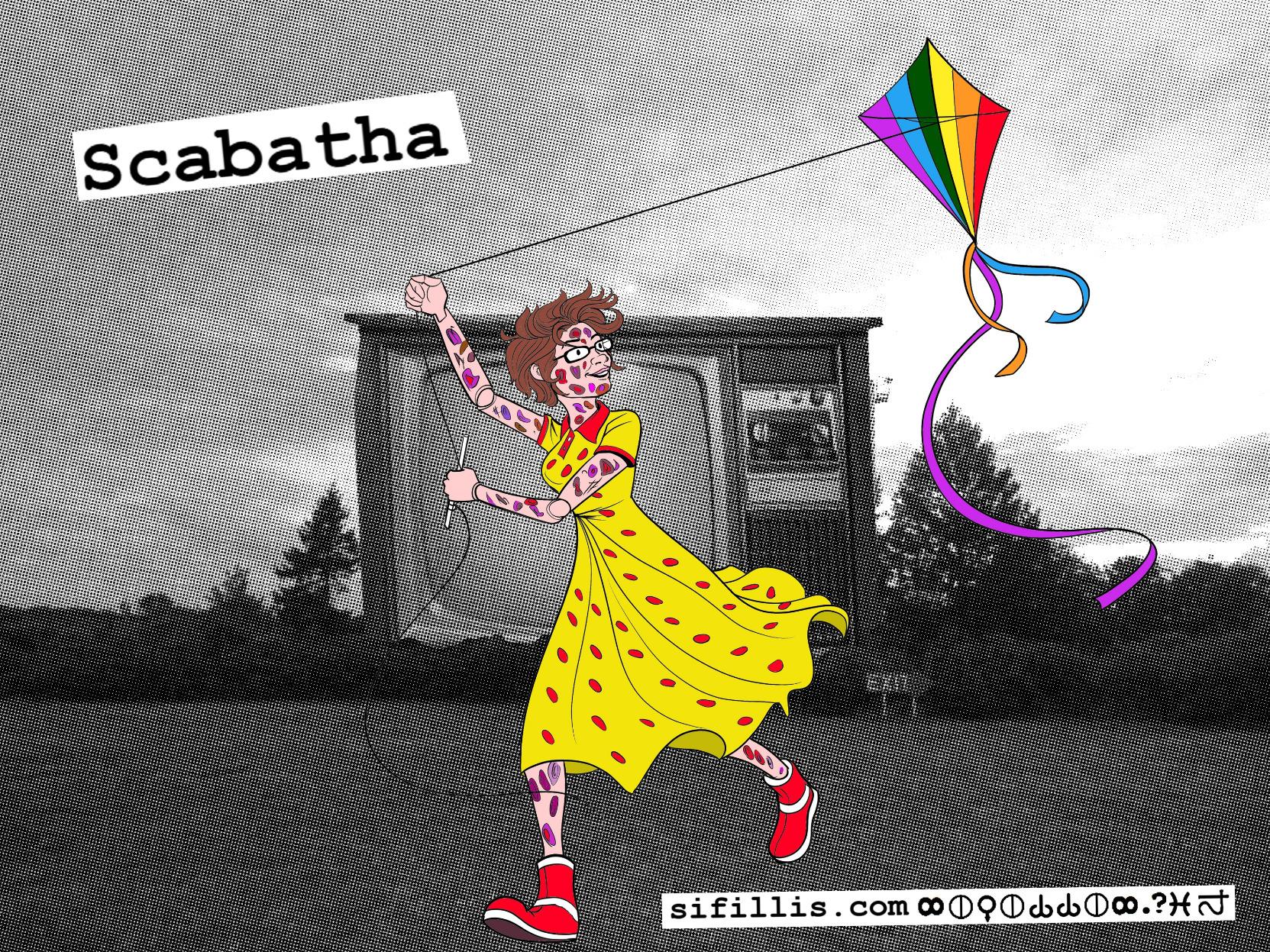
One of my favorite Sifillis Celebrities is Scabatha, who is based on my dear late friend Kelly who had a horrible skin disease that took her toes and fingers. Now thanks to my illustrator Lucas she's running happily with new hands! Figure drawn by Lucas Alukkart, colored and composited by me. #book #books #illustration #illustrator #artwork #illustrationart #illustrationartwork #farts #scabs #puke #kites #drivein
Today in Labor History September 8, 1909: The bosses bent to the demands of striking Wobblies (Industrial Workers of the World, IWW) in McKees Rock, Pa. They agreed to improved working conditions, a raise of 15% and an end to the “pool system” that gave foremen control over each worker’s pay. It was the Wobbly’s biggest victory to date. The strike started on July 13. The bosses tried to bring in hundreds of scabs, but the strikers shot at the boats, forcing many of them to turn back. Others quietly snuck in by rail. However, many scabs quit or formed their own union after suffering abuses by the bosses, including being held in boxcars against their will and served rotten food. On Sunday, August 22, a shootout occurred between strikers and police and private thugs. 12-26 people died, including 2 state troopers. One of the leaders of the strike was IWW cofounder William Trautman. He later wrote a novel based on the strike called “Riot.” Joe Etter and Big Bill Haywood also helped lead the strike.
#workingclass #LaborHistory #IWW #wobblies #pennsylvania #strike #union #scabs #police #policebrutality #books #novels #writer #author #fiction #bigbillhaywood #williamtrautman #joeetter @bookstadon


CPH Daily Bulletin 9/6/2025
CRY ABOUT IT: I’m a #Stanford Grad Student. The Graduate Student Union Is Trying to Get Me Fired.
https://www.city-journal.org/article/stanford-student-union-graduate-workers
#UnionStrong #Scabs #GradStudentUnion #Janus #Beck #RightToWork #WorkersRights
Today in Labor History September 6, 1912: Duluth streetcar drivers went on strike. On September 9, riots erupted, with workers stoning scab drivers and battling police in the streets. They overturned street cars and blockaded the streets. A 16-year-old clubbed a cop in the face. 14 were arrested. The workers were mostly Scandinavian immigrants. They were fighting for the right to form a union, and to cut their workday down to 9 hours. During a strike in 1899, Duluth drivers dynamited several streetcars off their tracks.
#workingclass #LaborHistory #streetcar #strike #union #duluth #Riot #scabs #police #sabotage

Today in Labor History August 17, 1985: Members of the United Food and Commercial Workers (UFCW) in Austin, Minnesota, went on strike against Hormel, makers of SPAM, after the company slashed wages by nearly $2.50 per hour, and this after an 8-year wage freeze. They ignored the advice of their national union and struck anyway. Workers continued to strike even after the company tried to reopen the plant with replacement workers, including some union members who crossed the picket lines, and even after the national union cut ties with them, seized funds, and changed the locks on the local’s office. The UFCW national organization accused the Hormel local of being fascists. The Communist Party sided with the national. The AFL-CIO refused the local’s request to call for a boycott. The authorities called out the National Guards who, along with the police, beat and arrested striking workers. After ten months the strike ended, with no gains for union members.
#workingclass #LaborHistory #hormel #spam #minnesota #union #strike #wages #police #policebrutality #scabs #boycott #communism

Today in Labor History July 11, 1892: Frisco Mine was dynamited by striking Coeur D’Alene miners after they discovered they had been infiltrated by Pinkertons and after one of their members had been shot. The striking miners belonged to the Western Federation of Miners. Prior to this, the mine owners had increased work hours, decreased pay and brought in a bunch of scabs to replace striking workers. Ultimately, over 600 striking miners were imprisoned without charge by the military in order to crush the strike.
You can read my article on the Pinkertons here: https://michaeldunnauthor.com/?s=pinkerton
#workingclass #LaborHistory #mining #union #strike #bombing #pinkertons #wfm #scabs #friscomine

Today in Labor History July 6, 1892: Locked out workers out at the Homestead Steel Works battled 300 Pinkerton detectives hired by Carnegie, who owned the Homestead mill. Homestead boss, Henry Clay Frick, had locked the workers out on July 1 and brought in Pinkertons to import and protect scabs brought in to replace striking workers. Determined to keep the plant closed and inoperable by scabs, the strikers formed military units that patrolled the grounds around the plant, and the Monongahela River in boats, to prevent access by strikebreakers and their Pinkerton guards. On the night of July 5, Pinkertons, armed with Winchester rifles, attempted to cross the river. Reports conflict as to which side fired first, but a gun battle ensued. Steelworkers defended themselves with guns and a homemade cannon. Women participated in the action, calling on strikers to kill the Pinkertons. 3-7 Pinkertons and 11 union members were killed in the battle. The Pinkertons eventually fled, but the strike continued for months. Court injunctions eventually helped to crush the union, protecting the steel industry for decades from organized labor.
Alexander Berkman and Emma Goldman plotted to assassinate Homestead Boss Henry Clay Frick for his role in killing the workers. Berkman later carried out the assassination attempt, failed, and went to prison for 14 years. He wrote a book about his experience called, “Prison Memoirs of an Anarchist” (1912). He also wrote “The Bolshevik Myth” (1925) and “The ABC of Communist Anarchism” (1929).
K. Friedman wrote about the strike in “By Bread Alone” (1901). Friedman was a Chicago socialist, settlement-house worker and journalist. His novel was an early example of the transformation in socialist fiction from "utopian" to "scientific" socialism. More recently, Trilby Busch wrote about the strike in her novel, “Darkness Visible” (2012). @robertatracy also references the strike in her recent novel “Zigzag Woman” (2024). And the Pinkertons play prominently in my novel “Anywhere But Schuylkill.”
You can read my history of the Pinkertons here: https://michaeldunnauthor.com/2024/04/04/union-busting-by-the-pinkertons/
You can get a copy of my novel, “Anywhere But Schuylkill,”
https://www.keplers.com/
https://www.greenapplebooks.com/
Or send me $25 via Venmo (@Michael-Dunn-565) and your mailing address, and I will send you a signed copy!
#workingclass #LaborHistory #union #strike #homestead #carnegie #socialism #pinkertons #scabs #anarchism #alexanderberkman #emmagoldman #pittsburgh #steel #fiction #books #novel #writer #author #historicalfiction @bookstadon

Today in Labor History July 2, 1892: Carnegie Steel locked out workers at its Homestead, PA, plant. The lockout culminated in a major battle between strikers and Pinkerton security agents on July 6. Determined to keep the plant closed and inoperable by scabs, the strikers formed military units that patrolled the grounds around the plant, and the Monongahela River in boats, to prevent access by strikebreakers and their Pinkerton guards. On the night of July 5, Pinkertons, armed with Winchester rifles, attempted to cross the river. Reports conflict as to which side fired first, but a gun battle ensued. Both sides suffered numerous deaths and injuries. Women also participated in the action. In the end, the Pinkertons gave up and surrendered. However, the governor called in the state militia, which quickly displaced the picketers and allowed the scabs in, thus ending the strike. In the wake of the bloody strike, Alexander Berkman, an anarchist, tried to assassinate Henry Clay Frick, Carnegie’s agent at Homestead.
K. Friedman wrote about the strike in “By Bread Alone” (1901). Friedman was a Chicago socialist, settlement-house worker and journalist. His novel was an early example of the transformation in socialist fiction from "utopian" to "scientific" socialism. More recently, Trilby Busch wrote about the strike in her novel, “Darkness Visible” (2012). @robertatracy also references the strike in her recent novel (2024), “Zigzag Woman.” And the Pinkertons play prominently in my novel, “Anywhere But Schuylkill” @michaeldunnauthor
You can read my history of the Pinkertons here: https://michaeldunnauthor.com/2024/04/04/union-busting-by-the-pinkertons/
#workingclass #LaborHistory #union #strike #homestead #carnegie #socialism #Pinkertons #scabs #anarchism #alexanderberkman #pittsburgh #steel #fiction #books #novel #writer #author #historicalfiction @bookstadon

Today in Labor History July 1, 1983: Copper miners began a strike against Phelps-Dodge in Clifton, Arizona. During the strike, company-owned railroad bridges were set on fire and strikers smashed windows of scab vehicles. Governor Bruce Babbitt repeatedly sent in state police and National Guardsmen to suppress and ultimately crush the 3-year-long strike. Replacement workers then voted to decertify the union in the largest mass decertification in U.S. history. 35 locals of 13 different unions representing Phelps-Dodge workers were all decertified. Within a couple of years, their profits skyrocketed 15-fold to $420 million per year. This was one of the most effective and historically significant union-busting campaigns of the post-WWII era, along with the PACTCO strike, and Reagan’s mass-firing of the air traffic controllers in 1981.
#workingclass #LaborHistory #copper #miners #arizona #unionbusting #union #strike #police #policebrutality #phelpsdodge #patco #Reagan #scabs

Today in Labor History June 27, 1905: The Industrial Workers of the World (AKA IWW or the Wobblies) was founded at Brand's Hall, in Chicago, Illinois. The IWW was a radical syndicalist labor union, that advocated industrial unionism, with all workers in a particular industry organized in the same union, as opposed by the trade unions typical today. Founding members included Big Bill Haywood, James Connolly, Eugene V. Debs, Lucy Parsons, and Mother Jones. The IWW was and is a revolutionary union that sought not only better working conditions in the here and now, but the complete abolition of capitalism. The preamble to their constitution states: The working class and the employing class have nothing in common. It also states: Instead of the conservative motto, "A fair day's wage for a fair day's work," we must inscribe on our banner the revolutionary watchword, "Abolition of the wage system."
They advocate the General Strike and sabotage as two of many means to these ends. However, sabotage to the Wobblies does not necessarily mean bombs and destruction. According to Big Bill Haywood, sabotage is any action that gums up the works, slowing down profits for the bosses. Thus, working to rule and sit-down strikes are forms of sabotage. The IWW is the first union known to have utilized the sit-down strike. They were one of the first and only unions of the early 20th century to organize all workers, regardless of ethnicity, gender, nationality, language or type of work (e.g., they organized both skilled and unskilled workers). They also were subjected to extreme persecution by the state and by vigilantes working for the corporations. Hundreds were imprisoned or deported. Dozens were assassinated or executed, including Joe Hill, Frank Little, Wessley Everest and Carlo Tresca. And scores were slaughtered in massacres, like in McKees Rock railway strike, PA (1909); Lawrence Textile Strike, MA (1912); San Diego Free Speech Fight, CA (1912); Grabow, LA Lumber Strike (1912); New Orleans, LA banana strike (1913); Patterson, NJ textile strike (1913); Mesabi Range Strike, MN (1916); Everett, WA massacre (1916); Centralia, WA Armistice Day riot (1919) and the Columbine, CO massacre (1921). There was also the Hopland, CA riot (1913), in which the police killed each other, accidentally, and framed Wobblies for it.
There are lots of great books about the IWW artwork and music. The Little Red Songbook. The IWW, Its First 50 Years, by Fred Thompson. Rebel Voices: An IWW Anthology, by Joyce Kornbluth. But there are also tons of fictional accounts of the Wobblies, too. Lots of references in Dos Passos’, USA Trilogy. Red Harvest, by Dashiell Hammett, was influenced by his experience working as a Pinkerton infiltrator of the Wobblies. The recent novel, The Cold Millions, by Jess Walter, has a wonderful portrayal of Elizabeth Gurly Flynn, during the Spokane free speech fight. And tons of classic folk and protest music composed by Wobbly Bards, like Joe Hill, Ralph Chaplin, Haywire Mac and T-Bone Slim.
To learn more about the IWW and its organizers you can read the following articles I wrote:
https://michaeldunnauthor.com/2024/03/24/lucy-parsons/
https://michaeldunnauthor.com/2021/03/16/the-haywire-mac-story/
https://michaeldunnauthor.com/2024/04/05/frank-little/
https://michaeldunnauthor.com/2021/05/13/ben-fletcher-and-the-iww-dockers/
https://michaeldunnauthor.com/2024/05/19/tom-mooney-and-warren-billings/
https://michaeldunnauthor.com/2024/04/04/union-busting-by-the-pinkertons/
#workingclass #LaborHistory #IWW #union #strike #generalstrike #sabotage #bigbillhaywood #freespeech #scabs #pinkertons #eugenedebs #motherjones #lucyparsons #assassination #prison #deportation #anarchism #socialism #books #fiction #folkmusic #author #write @bookstadon

Today in Labor History May 26, 1937: Henry Ford unleashed his company goons and local police on United Auto Workers organizers at the “Battle of the Overpass” near the River Rouge plant. General Motors and Chrysler signed collective bargaining agreements with the UAW in 1937, but Ford held out until 1942. Ford Motor Co. security guards attacked union organizers and supporters attempting to distribute literature outside the plant. The guards tried to destroy any photos showing the attack. However, a few survived and they inspired the Pulitzer committee to establish a prize for photography. No one died in the attack, but 16 workers were injured. 5 years earlier, workers had been attacked by gunfire at the same location.
#workingclass #LaborHistory #strike #union #uaw #henryford #scabs #photography #pulitzer #police #policebrutality
Client Info
Server: https://mastodon.social
Version: 2025.07
Repository: https://github.com/cyevgeniy/lmst