【🎉Latest accepted article】
Vegetation enhancement in #Lower_greenness_baseline grasslands and croplands dominated the significant greening on the #LoessPlateau of China
#LandUse | #VegetationGreennessChange | #AttributionAnalysis
【🎉Latest accepted article】
Vegetation enhancement in #Lower_greenness_baseline grasslands and croplands dominated the significant greening on the #LoessPlateau of China
#LandUse | #VegetationGreennessChange | #AttributionAnalysis
💡 #MachineLearningApplications🤖 to reveal the difference in #RobiniaPseudoacacia growth and its drivers on China’s #LoessPlateau.
factors:
1️⃣ forest age and stand density (prediction)
2️⃣ soil texture and soil pH (determinants)
https://doi.org/10.1093/jpe/rtae104


Bingqian Su et al. established a #Database based on #RobiniaPseudoacacia growth and its driving factors on China’s #LoessPlateau, developed #PlantGrowthModels considering #ForestAge, #Density, #ClimateFactors and #TopographicFactors using #LinearRegression and three #MachineLearningMethods.
https://doi.org/10.1093/jpe/rtae104
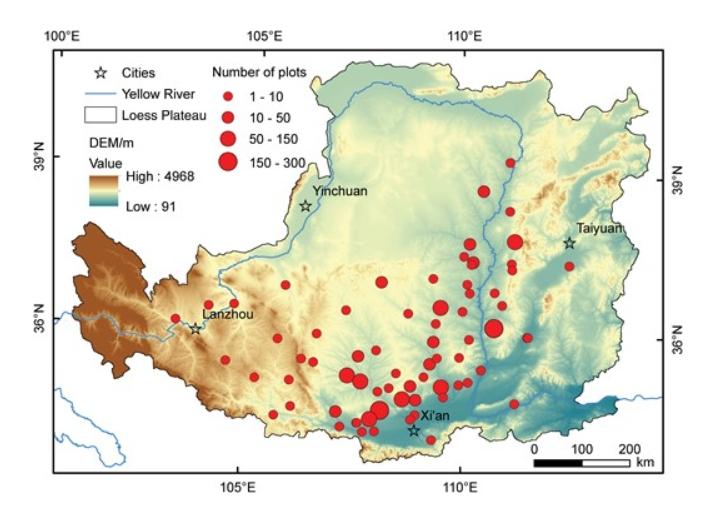
In the late 20th century, China’s Loess Plateau, the world’s most eroded region, faced severe soil degradation. The “Grain for Green” program, launched in 1999, restored the plateau by converting farmland to forests and grasslands. This initiative revitalized the environment and improved local livelihoods.
#GoodNews #EnvironmentalRestoration #China #LoessPlateau #GrainForGreen
https://www.theguardian.com/environment/2025/mar/14/how-china-led-way-water-soil-conservation
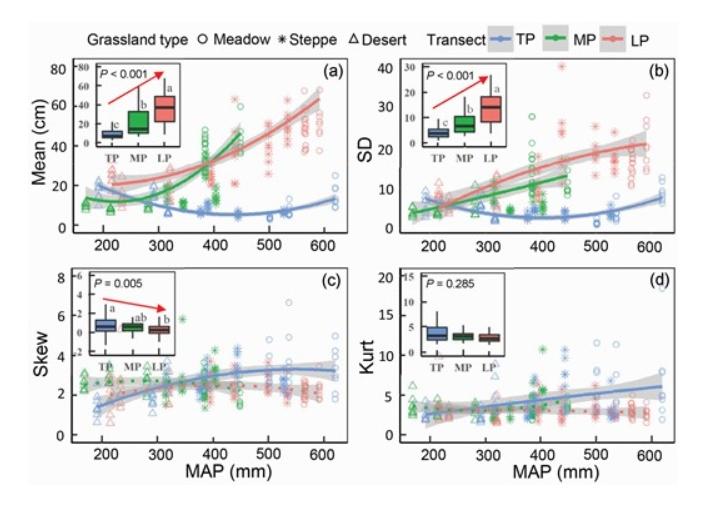
Jihua Hou et al. analyzed the #UniversalRules and #RegionalVariations of #VegetationGrowth of #TypicalGrasslands under #EnvironmentalChange by measuring #PlantHeights one by one in #TibetanPlateau (TP), #MongolianPlateau (MP) and #LoessPlateau (LP). The study showed that #NormalDistribution is a universal rule of grassland height construction, and that the synergy of environmental factors varies from region to region.
https://doi.org/10.1093/jpe/rtac048