#BayesianMethods

2026-01-17

Weekly Update from the Open Journal of Astrophysics – 17/01/2026

It’s Saturday once more so time for another update of activity at the Open Journal of Astrophysics. Since the last update we have published seven papers, bringing the number in Volume 9 (2026) to 11 and the total so far published by OJAp up to 459. This week has been quite busy; for only the second time in recorded history we published at least one paper each working day.

I will continue to include the announcements made on our Mastodon account (on Fediscience) to encourage you to visit it. Mastodon is a really excellent service, and a more than adequate replacement for X/Twitter which nobody should be using.

The first three papers this week were all published on Monday January 12th in the folder Astrophysics of Galaxies.

The first paper to report this week is “Rotational Kinematics in the Globular Cluster System of M31: Insights from Bayesian Inference” by Yuan (Cher) Li & Brendon J. Brewer (U. Auckland, New Zealand), Geraint F. Lewis (U. Sydney, Australia) and Dougal Mackey (independent researcher, Australia). This study uses Bayesian modelling to explore the kinematics of globular clusters in the Andromeda Galaxy, revealing distinct rotation patterns that suggest different subgroups were added at separate times.

The overlay is here:

You can find the officially accepted version on arXiv here and the announcement on Fediverse here:

https://fediscience.org/@OJ_Astro/115881522738421378

The second paper is “DESI Data Release 1: Stellar Catalogue” by Sergey Koposov (U. Edinburgh, UK) and an international cast of 67 other authors. This paper introduces and describes the stellar Value-Added Catalogue (VAC) based on DESI Data Release 1, providing measurements for over 4 million stars, including radial velocity, abundance, and stellar parameters.

The overlay for this one is here:

The official version of the paper can be found on arXiv here and the Fediverse announcement here:

https://fediscience.org/@OJ_Astro/115881586884465975

Next we have “On the origins of oxygen: ALMA and JWST characterise the multi-phase, metal-enriched, star-bursting medium within a ‘normal’ z>11 galaxy” by Joris Witstok (Cosmic Dawn Centre, Copenhagen, Denmark) and 37 others in locations dotted around the world. This paper presents new ALMA observations of the JADES-GS-z11-0 galaxy confirm the presence of the [O III] 88 µm line, suggesting it consists of two low-mass components undergoing star formation and enriched in metals.

The overlay is here:

The official version can be found on arXiv here and the Fediverse announcement is here:

https://fediscience.org/@OJ_Astro/115881659633273777

The fourth paper this week is also in the folder Astrophysics of Galaxies. but was published on Tuesday 13th January. It is entitled “Accelerated calibration of semi-analytic galaxy formation models” by Andrew Robertson and Andrew Benson (Carnegie Observatories, USA). This paper presents a faster calibration framework for galaxy formation models, using fewer simulations for each evaluation. However, the model shows discrepancies suggesting the model needs to be made more flexible.

The overlay is here:

You can find the officially accepted version on arXiv here and the Mastodon announcement here:

https://fediscience.org/@OJ_Astro/115887131054018297

Next one up, published on Wednesday 14th January in the folder Cosmology and Nongalactic Astrophysics, is “Constraints from CMB lensing tomography with projected bispectra” by Lea Harscouet & David Alonso (U. Oxford), UK), Andrina Nicola (U. Manchester, UK) and Anže Slosar (Brookhaven National Laboratory, USA). This study presents angular power spectra and bispectra of DESI luminous red galaxies, finding that the galaxy bispectrum can constrain the amplitude of matter fluctuations and the non-relativistic matter fraction. The overlay is here:

You can find the officially accepted paper on arXiv here and the Mastodon announcement here:

https://fediscience.org/@OJ_Astro/115893813149036197

The sixth paper this week is “Universal numerical convergence criteria for subhalo tidal evolution” by Barry T. Chiang & Frank C. van den Bosch (Yale U., USA) and Hsi-Yu Schive (National Taiwan University, Taiwan). This was published on Thursday 15th January in the folder Cosmology and Nongalactic Astrophysics; it presents an analysis of a simulation suite that addresses the ‘overmerging’ problem in cosmological simulations of dark matter subhalos, showing that up to 50% of halos in state-of-the art simulations are unresolved. The overlay is here:

The final accepted version of this paper can be found on arXiv here. The Mastodon announcement follows:

https://fediscience.org/@OJ_Astro/115898339098021093

Finally for this week we have “Detectability of dark matter subhalo impacts in Milky Way stellar streams” by Junyang Lu , Tongyan Lin & Mukul Sholapurkar (UCSD, USA) and Ana Bonaca (Carnegie Observatories, USA). This was published on Friday 16th January (i.e. yesterday) in the folder Astrophysics of Galaxies. The study develops a method to estimate the minimum detectable dark matter subhalo mass in stellar streams, ranking them by sensitivity and identifying promising lines for further research.

The overlay is here:

The officially accepted version can be found on arXiv here and the Fediverse announcement here:

https://fediscience.org/@OJ_Astro/115904083514716420

That concludes the update for this week. I will do another next Saturday.

#ALMA #arXiv250207781v3 #arXiv250514787v3 #arXiv250707968v2 #arXiv250722888v4 #arXiv250900143v2 #arXiv251026901v2 #arXiv260105380v2 #AstrophysicsOfGalaxies #BayesianMethods #CosmologyAndNonGalacticAstrophysics #DarkEnergySurvey #darkMatter #DES #DiamondOpenAccess #DiamondOpenAccessPublishing #galaxyFormation #JWST #M31 #MilkyWay #OpenAccess #OpenAccessPublishing #OpenJournalOfAstrophysics #Oxygen #semiAnalyticModels #subhalos #TheOpenJournalOfAstrophysics #Tomography #weakGravitationalLensing

LBHustonlbhuston
2025-12-15

Sponsorship opportunities are available for specific topics, whitepapers, tools, or advisory insights.

Read more 👉 lttr.ai/AmKRK

2025-12-06

Weekly Update from the Open Journal of Astrophysics – 06/12/2025

Once again it’s time for the usual Saturday morning update of the week’s new papers at the Open Journal of Astrophysics. Since the last update we have published a further six papers, which brings the number in Volume 8 (2025) up to 190, and the total so far published by OJAp up to 425. I blogged about the significance of the latter figure here.

The first paper this week is “The galaxy-IGM connection in THESAN: observability and information content of the galaxy-Lyman-alpha cross-correlation at z>6” by Enrico Garaldi (U. Tokyo, Japan), Verena Bellscheidt (Tech. U. Munich, Germany), Aaron Smith (U. Texas Austin, USA) and Rahul Kannan (York U. Canada). This paper was published on Monday 1st December 2025 in the folder Cosmology and Nongalactic Astrophysics. It describes an investigation of the impact of observational limitations on the ability to retrieve the intrinsic galaxy-Lyman-alpha cross correlation from line-of-sight observations.

The overlay is here:


You can find the officially accepted version on arXiv here and the Fediverse announcement is here:

Open Journal of Astrophysics

@OJ_Astro@fediscience.org

New Publication at the Open Journal of Astrophysics: "The galaxy-IGM connection in THESAN: observability and information content of the galaxy-Lyman-alpha cross-correlation at z>6" by Enrico Garaldi (U. Tokyo, Japan), Verena Bellscheidt (Tech. U. Munich, Germany), Aaron Smith (U. Texas Austin, USA) and Rahul Kannan (York U. Canada)

doi.org/10.33232/001c.151666

December 1, 2025, 8:37 am 1 boosts 0 favorites

The second paper of the week is “A Less Terrifying Universe? Mundanity as an Explanation for the Fermi Paradox” by Robin H.D. Corbet (U. Maryland, USA). This paper was published on 1st December 2025 in the folder Instrumentation and Methods for Astrophysics. It presents a discussion of possible explanations for the lack of s evidence for the presence of technology-using extraterrestrial civilizations in the Galaxy (usually called the Fermi paradox). The overlay is here:


You can find the official version of this one on arXiv here. The federated announcement on Mastodon is here:

Open Journal of Astrophysics

@OJ_Astro@fediscience.org

New Publication at the Open Journal of Astrophysics: "A Less Terrifying Universe? Mundanity as an Explanation for the Fermi Paradox" by Robin H.D. Corbet (U. Maryland, USA)

doi.org/10.33232/001c.151454

December 1, 2025, 8:50 am 2 boosts 2 favorites


Next one up is “Sulphur abundances in star-forming regions from optical emission lines: A new approach based on photoionization models consistent with the direct method” by Enrique Pérez-Montero, Borja Pérez-Díaz, & José M. Vílchez ( (Instituto de Astrofísica de Andalucía, Spain), Igor A. Zinchenko (LMU, Germany), Asier Castrillo, Marta Gavilán, Sandra Zamora & Ángeles I. Díaz (Universidad Autonoma de Madrid, Spain). This was published on 1st December 2025 in the folder Astrophysics of Galaxies. This study uses the emission lines produced in the optical part of the spectrum and with photoionization models to derive sulphur chemical abundances in the gas-phase of star-forming galaxies.

The overlay is here:


You can find the official accepted version on arXiv here. The fediverse announcement is here:

Open Journal of Astrophysics

@OJ_Astro@fediscience.org

New Publication at the Open Journal of Astrophysics: "Sulphur abundances in star-forming regions from optical emission lines: A new approach based on photoionization models consistent with the direct method" by Enrique Pérez-Montero, Borja Pérez-Díaz, & José M. Vílchez ( (Instituto de Astrofísica de Andalucía, Spain), Igor A. Zinchenko (LMU, Germany), Asier Castrillo, Marta Gavilán, Sandra Zamora & Ángeles I. Díaz (Universidad Autonoma de Madrid , Spain)

doi.org/10.33232/001c.151253

December 1, 2025, 9:12 am 0 boosts 0 favorites

The fourth article of the week is “Bayesian Posteriors with Stellar Population Synthesis on GPUs” by Georgios Zacharegkas & Andrew Hearin (Argonne National Laboratory, USA) and Andrew Benson (Carnegie Observatories, USA). This is an exploration of a range of computational techniques aimed at accelerating Stellar Population Synthesis predictions of galaxy photometry using the JAX library to target GPUs (Graphics Processing Units, in case you didn’t know). This paper was published on Tuesday December 2nd 2025 in the folder Astrophysics of Galaxies.

The overlay is here:


You can find the official published version on arXiv here. The Fediverse announcement follows:

Open Journal of Astrophysics

@OJ_Astro@fediscience.org

New Publication at the Open Journal of Astrophysics: "Bayesian Posteriors with Stellar Population Synthesis on GPUs" by Georgios Zacharegkas & Andrew Hearin (Argonne National Laboratory, USA) and Andrew Benson (Carnegie Observatories, USA)

doi.org/10.33232/001c.151255

December 2, 2025, 7:38 am 3 boosts 1 favorites

Next one up is “IAEmu: Learning Galaxy Intrinsic Alignment Correlations” by Sneh Pandya Yuanyuan Yang, Nicholas Van Alfen, Jonathan Blazek and Robin Walters (Northeastern University, Boston, USA). This presents a neural-network-based emulator that predicts the galaxy position-position, position-orientation, and orientation-orientation, correlation functions and their uncertainties using mock catalogs based on the halo occupation distribution (HOD) framework. It was published on December 2nd 2025 in the folder Cosmology and Nongalactic Astrophysics. The overlay is here:

The official accepted version can be found on arXiv here. The Mastodon announcement is here:

Open Journal of Astrophysics

@OJ_Astro@fediscience.org

New Publication at the Open Journal of Astrophysics: "IAEmu: Learning Galaxy Intrinsic Alignment Correlations" by Sneh Pandya Yuanyuan Yang, Nicholas Van Alfen, Jonathan Blazek and Robin Walters (Northeastern University, Boston, USA)

doi.org/10.33232/001c.151749

December 2, 2025, 7:52 am 1 boosts 0 favorites

The last paper for this weel is “Unraveling the Nature of the Nuclear Transient AT2020adpi” by Paarmita Pandey (Ohio State University, USA) and a team of 15 others based in the USA, UK and Australia. This was published on Thursday December 4th 2025 in the folder High-Energy Astrophysical Phenomena. It is an investigation into a particular transient event AT2020adpi and a discussion of whether it is an extreme example of AGN variability or a Tidal Disruption Event (TDE). The overlay is here:

You can find the officially-accepted version on arXiv here, and the Mastodon announcement is here:

Open Journal of Astrophysics

@OJ_Astro@fediscience.org

New Publication at the Open Journal of Astrophysics: "Unraveling the Nature of the Nuclear Transient AT2020adpi" by Paarmita Pandey (Ohio State University, USA) and 15 others based in the USA, UK and Australia

doi.org/10.33232/001c.151453

December 4, 2025, 8:48 am 1 boosts 0 favorites

And that concludes the update for this week. I will do another next Saturday.

#arxiv241002850v2 #arxiv250405235v4 #arxiv250614736v2 #arxiv250619919v2 #arxiv250903593v3 #arxiv250922878v2 #astrophysicsOfGalaxies #at2020adpi #bayesianMethods #cosmologyAndNongalacticAstrophysics #diamondOpenAccessPublishing #fermiParadox #gpus #highEnergyAstrophysicalPhenomena #instrumentationAndMethodsForAstrophysics #intrinsicAlignments #lymanAlpha #machineLearning #nuclearTransient #openAccessPublishing #openJournalOfAstrophysics #photoionization #seti #starFormation #stellarPopulations #suplhur #theOpenJournalOfAstrophysics #thesanSimulations

LBHustonlbhuston
2025-09-16

🌀 We've all built (or trusted) a model that felt solid—until the market laughed in its face.

Read more 👉 lttr.ai/Ai04r

LBHustonlbhuston
2025-07-21

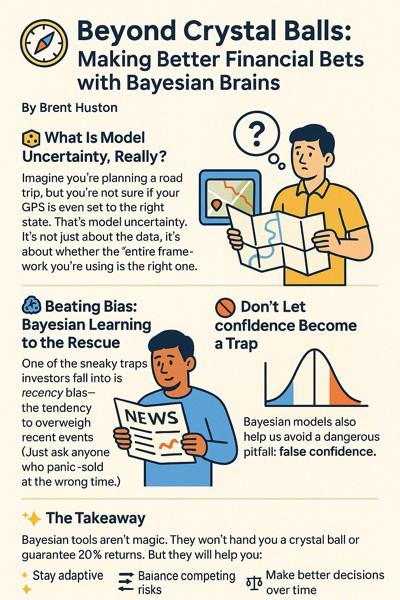
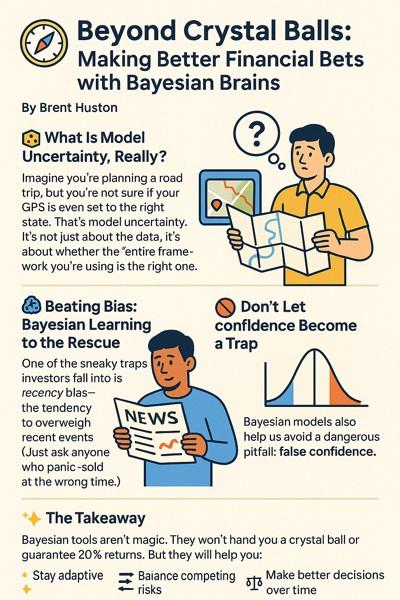
Bayesian approaches handle this by saying: “Why pick one model when you can blend several?” Using

Read more 👉 lttr.ai/Agq5G

LBHustonlbhuston
2025-07-03

One of the sneaky traps investors fall into is recency bias—the tendency to overweigh recent events.

Read more 👉 lttr.ai/AgAUI

LBHustonlbhuston
2025-06-26

Rigid models often fail to account for rare events or black swans.

Read more 👉 lttr.ai/AfuEp

Doc Edward Morbius ⭕​dredmorbius@toot.cat
2025-04-26

Does anyone have a good starting point for Bayesian ranking of text-based content?

Application in mind is placing of news articles on a page-based layout, and I'd like something more sofistikated than LIFO or manual text-based grading.

Ultimately I would probably have a set of curated exemplar articles of high and low rank to toss at a Bayesian classifier.

The system need not be perfect (and I'll probably add some random jitter to it), but it should be useful.

Boosts appreciated.

#BayesianMethods #ContentRanking #DearMastomind

2025-02-26

#BayesianMethods in Practice” were discussed on a workshop at CAS last week.
Many thanks to the organizer Andreas Doepp and the speakers:
Stephan Hartmann, Borut Trpin, Volker Schmid, Florian Pargent, Felix Schönbrodt @nicebread, Thomas Augustin, Matthias Feurer, Leon Assaad, Tom Sterkenburg, Rafael Fuchs, Lilian von Bressensdorf, Wiktor Młynarski @samplingrage, Oliver Friedrich, Daniel Gruen.

Client Info

Server: https://mastodon.social
Version: 2025.07
Repository: https://github.com/cyevgeniy/lmst