#ARCHAIC

2026-02-20

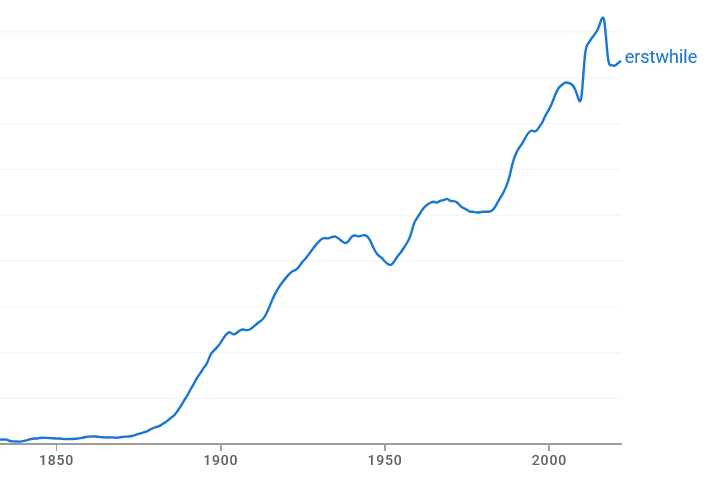
Due to its rising popularity in formal use in many Indian documents, "erstwhile" is less archaic than you might have supposed? #archaic #language #ngram

2026-02-20

‘Even the fool, who erstwhile bored your Grace's royal ears with his dull wit’ ‘I would fain believe thou art not the monster I erstwhile thought thee to be.’ — J. E. Muddock, Basile the Jester. A Romance of the days of Mary Queen of Scots (1896). #archaic #history #novels

BOOK COVER: — J. E. Muddock,  Basile the Jester. A Romance of the days of Mary Queen of Scots (1903).BOOK COVER: — J. E. Muddock,  Basile the Jester. A Romance of the days of Mary Queen of Scots (1903).
Dr Ian McCormickpostfilm@ieji.de
2026-02-15

Francis A. Fahy, "How to become a Poet"
The #Humour of #Ireland (1894), p361
#archaic #language #poetry

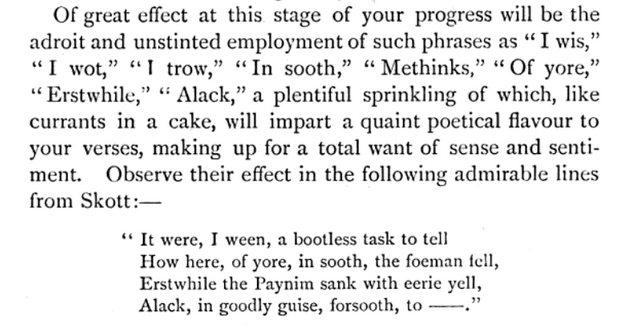
Of great effect at this stage of your progress will be the adroit and unstinted employment of such phrases as "I wis," "I wot," "I trow," "In sooth,” “Methinks," "Of yore," "Erstwhile," " Alack," a plentiful sprinkling of which, like currants in a cake, will impart a quaint poetical flavour to your verses, making up for a total want of sense and sentiment. Observe their effect in the following admirable lines from Skott:

"It were, I ween, a bootless task to tell

How here, of yore, in sooth, the foeman fell, 
Erstwhile the Paynim sank with eerie yell, 
Alack, in goodly guise, forsooth, to ---."
2026-02-15

Francis A. Fahy, "How to become a Poet" The Humour of Ireland (1894), p361 #archaic #language

Of great effect at this stage of your progress will be the adroit and unstinted employment of such phrases as "I wis," "I wot," "I trow," "In sooth,” “Methinks," "Of yore," "Erstwhile," " Alack," a plentiful sprinkling of which, like currants in a cake, will impart a quaint poetical flavour to your verses, making up for a total want of sense and sentiment. Observe their effect in the following admirable lines from Skott:

"It were, I ween, a bootless task to tell

How here, of yore, in sooth, the foeman fell, 
Erstwhile the Paynim sank with eerie yell, 
Alack, in goodly guise, forsooth, to -."
2026-02-15

"Today you can buy an honest to goodness science fiction dream machine" #archaic

2026-02-06

Glossary from Beowulf: An Anglo-Saxon Epic Poem (Boston, USA, 1892), trans. John Lesslie Hall (1856–1928), Professor of English History and Literature at the College of William & Mary. #literature #English #poetry #archaic #obsolete #language
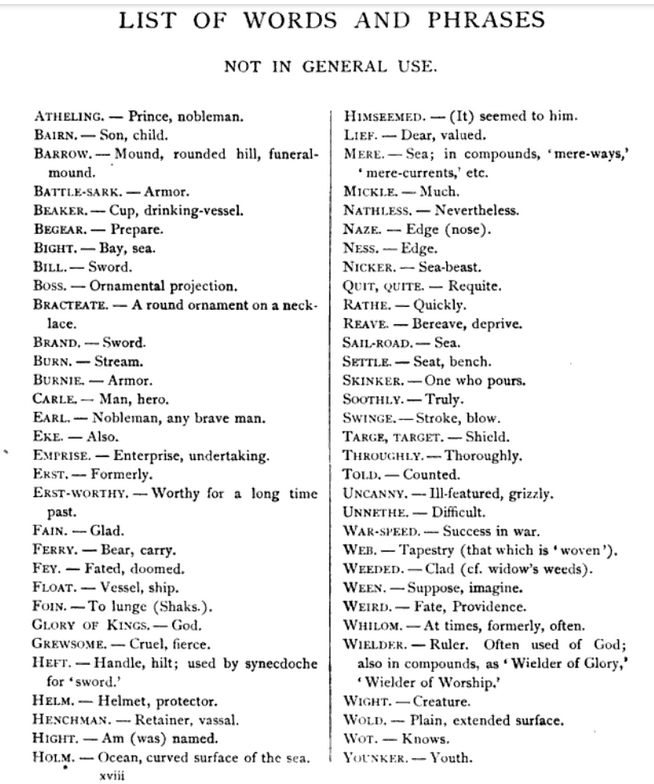
LIST OF WORDS AND PHRASES NOT IN GENERAL USE.

ATHELING.—Prince, nobleman.

BAIRN.—Son, child.

BARROW.—Mound, rounded hill, funeral-mound.

BATTLE-SARK.—Armor.

BEAKER.—Cup, drinking-vessel.

BEGEAR.—Prepare.

BIGHT.—Bay, sea.

BILL.—Sword.

BOSS.—Ornamental projection.

BRACTEATE.—A round ornament on a necklace.

BRAND.—Sword.

BURN.—Stream.

BURNIE.—Armor.

CARLE.—Man, hero.

EARL.—Nobleman, any brave man.

EKE.—Also.

EMPRISE.—Enterprise, undertaking.

ERST.—Formerly.

ERST-WORTHY.—Worthy for a long time past.

FAIN.—Glad.

FERRY.—Bear, carry.

FEY.—Fated, doomed.

FLOAT.—Vessel, ship.

FOIN.—To lunge (Shaks.).

GLORY OF KINGS.—God.

GREWSOME.—Cruel, fierce.

HEFT.—Handle, hilt; used by synecdoche for ‘sword.’

HELM.—Helmet, protector.

HENCHMAN.—Retainer, vassal.

HIGHT.—Am (was) named.

HOLM.—Ocean, curved surface of the sea.

HIMSEEMED.—(It) seemed to him.

LIEF.—Dear, valued.

MERE.—Sea; in compounds, ‘mere-ways,’ ‘mere-currents,’ etc.

MICKLE.—Much.

NATHLESS.—Nevertheless.

NAZE.—Edge (nose).

NESS.—Edge.

NICKER.—Sea-beast.

QUIT, QUITE.—Requite.

RATHE.—Quickly.

REAVE.—Bereave, deprive.

SAIL-ROAD.—Sea.

SETTLE.—Seat, bench.

SKINKER.—One who pours.

SOOTHLY.—Truly.

SWINGE.—Stroke, blow.

TARGE, TARGET.—Shield.

THROUGHLY.—Thoroughly.

TOLD.—Counted.

UNCANNY.—Ill-featured, grizzly.

UNNETHE.—Difficult.

WAR-SPEED.—Success in war.

WEB.—Tapestry (that which is ‘woven’).

WEEDED.—Clad (cf. widow’s weeds).

WEEN.—Suppose, imagine.

WEIRD.—Fate, Providence.

WHILOM
2026-02-05

Rise, fall, and modern revival: hurrah! #archaic #English #language #philology

2026-02-05

HAMLET: "I prithee take thy fingers from my throat" #Shakespeare #archaic #language #drama #tragedy

In the foreground, Laertes grapples with Hamlet in the open grave, while behind them a a small crowd look on in horror: the two men holding Ophelia's coffin, which is half-covered with a black cloth, the priest, hands raised in alarm, and others behind; in the foreground beyond the grave, a tombstone and a shovel. 1843. Impression from the 1864 edition
2026-02-05

Hugh Downman's The Land of the Muses: a Poem in the Manner of Spenser (1768) helpfully includes a Glossary #literature #English #poetry #archaic #obsolete #language
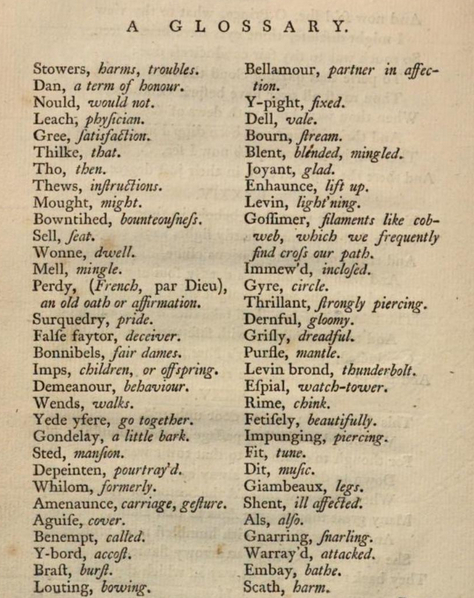
A GLOSSARY.
•	Stowers, harms, troubles.
•	Dan, a term of honour.
•	Nould, would not.
•	Leach, physician.
•	Gree, satisfaction.
•	Thilke, that.
•	Tho, then.
•	Thews, instructions.
•	Mought, might.
•	Bowntihed, bounteousness.
•	Sell, seat.
•	Wonne, dwell.
•	Mell, mingle.
•	Perdy, (French, par Dieu), an old oath or affirmation.
•	Surquedry, pride.
•	False faytor, deceiver.
•	Bonnibels, fair dames.
•	Imps, children, or offspring.
•	Demeanour, behaviour.
•	Wends, walks.
•	Yede yfere, go together.
•	Gondelay, a little bark.
•	Sted, mansion.
•	Depeinten, pourtray'd.
•	Whilom, formerly.
•	Amenaunce, carriage, gesture.
•	Aguise, cover.
•	Benempt, called.
•	Y-bord, accost.
•	Brast, burst.
•	Louting, bowing.
•	Bellamour, partner in affection.
•	Y-pight, fixed.
•	Dell, vale.
•	Bourn, stream.
•	Blent, blended, mingled.
•	Joyant, glad.
•	Enhaunce, lift up.
•	Levin, light'ning.
•	Gossimer, filaments like cobweb, which we frequently find cross our path.
•	Immew'd, inclosed.
•	Gyre, circle.
•	Thrillant, strongly piercing.
•	Dernful, gloomy.
•	Grisly, dreadful.
•	Purfle, mantle.
•	Levin brond, thunderbolt.
•	Espial, watch-tower.
•	Rime, chink.
•	Fetisely, beautifully.
•	Impunging, piercing.
•	Fit, tune.
•	Dit, music.
•	Giambeaux, legs.
•	Shent, ill affected.
•	Als, also.
•	Gnarring, snarling.
•	Warray'd, attacked.
•	Embay, bathe.
•	Scath, harm.
•	Page  31 Feare, wife. 
•	Bevy, company.
•	Teen, affliction.
•	Y-fere, together.
•	Tedes, torches.
•	Sheen, shine.
•	Forespent, tired out.
•	Adaw'd, t
2026-02-03

"To understand many words it is only necessary to pronounce them aloud; and the meaning, which is obscured by the spelling, will be evident from the found. W is often used for u and for v : h is uselessly introduced, as yhe for ye, &c ." #Scots #Scotland #literature #history #epic #archaic

2026-02-03

"The chief obstacle in perusing this work arises from the orthography, which is ſo irregular that no glossary can pretend to explain every disguised word." --- John Barbour's THE BRUCE, p. 181, ed. Pinkerton (1790) #Scots #Scotland #literature #history #epic #archaic

2026-02-03

" ... the oldest monument of the Scotish [sic] language. A monument which may well bear company with the best early poetry which any modern country can boast." p. x --- Preface, John Barbour's THE BRUCE #Scots #Scotland #literature #history #epic #archaic

19th century engraving showing what Robert the Bruce (1274-1329) might have looked like.
2026-02-03

"The original MS. from it's orthography, appears to have been copied from one co-eval with the author; for the spelling is more barbaric, and uncouth" --- Preface, John Barbour's THE BRUCE, p. ix. #Scots #Scotland #literature #history #epic #archaic

2026-02-03

John Barbour's THE BRUCE: "the poem now presented to the reader for the first time, in it's genuine ancient dress, has already gone thro' about twenty editions in Scotland since the year 1616" #Scots #Scotland #literature #history #epic #archaic

TITLE PAGE:
The Bruce
Or, The History of Robert I. King of Scotland · Volumes 1
By John Barbour, John Pinkerton · 1790
SPADOK.ORG.UA 🇺🇦spadok
2026-01-08

Середньовічний меч як традиційна ознака військово-рицарського стану на українських землях

spadok.org.ua/starozhytnosti/s

Рицарський меч
2025-12-08

"GET: booty, gain" (Halliwell's Dictionary, Gawayne, line 1638) #ARCHAIC #English #medieval

Image shows the coat of arms of the Bacon family. 
SOURCE: The 15th-cnetury Paston Book of Arms.
2025-12-08

GETTS: Earnings (Halliwell) #ARCHAIC #dialect #Victorian #19thC
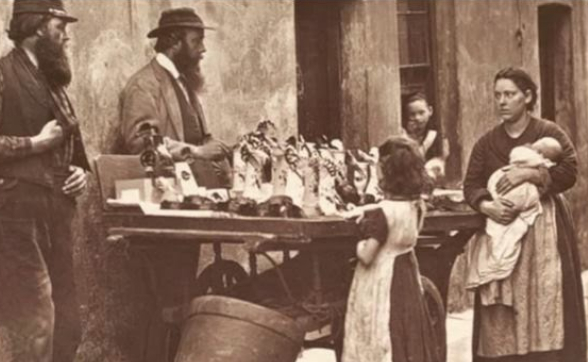
19th-century Street stall with men and a woman holding a baby.
TEXT: Dictionary Of Archaic And Probincial Words by Halliwell, James Orchard
RichRARobiRichRARobi
2025-12-04

@advocate.com

So the WI showing they too are an outdated institution following pseudo-science and values.

The law in this case has shown itself to be an ass.
The ruling was badly considered and poorly written, difficult to read and likely to be misread.

The WI should follow modern common sense and values instead of cow-towing to ill-considered thinking.

Sad.

RichRARobiRichRARobi
2025-11-25

@2legged

Our has been at least since the times of Pepys. Half the ships used for hulks on the thames were rotten though sold as good quality.

corruption then was the same as for recently

The will continue to worsen while we have this medieval and house of . The house of is at least , even though many of the are abject liars and are probably worse thieves than dick turpin ever was.

2025-11-17

Hmm. Did I find an entry on Wiktionary that needs updating?

en.wiktionary.org/wiki/gest#No

The scan on the right is from the 1640s, the citations on the left are a mere 40-50 years earlier.

#English #dictionary #archaic

A screenshot of the Wiktionary page for the English noun gest (https://en.wiktionary.org/wiki/gest#Noun), meaning 4 "A gesture or action" (obsolete) highlighted. There are a citation to Spenser from 1590 and Michel de Montaigne from 1603.A scan of a 1640s text listing homophones in context. The highlighted sample includes the phrase "A Gest or worthy act"

Client Info

Server: https://mastodon.social
Version: 2025.07
Repository: https://github.com/cyevgeniy/lmst