Reymond Aguinaldo

Space, science and wonder. Personal account. Views and opinions my own. Socials: @mondinspace

Reymond Aguinaldo boosted:
Where are we now?wawn
2026-02-15

2026-02-15 13:00:00 UTC (Delta: 2026-02-08)

WHERE ARE THE GOLDEN RECORDS NOW?

🟣 VOYAGER 1
- Barycentric speed: 16.92 km/s
- Distance (km): 25,427,388,026.19 km (-3,341,886.70 km)
- Distance (AU): 169.97 (-0.02)
- Light travel time: 23 h 33 min 39.22 s (-11.15 s)

🟢 VOYAGER 2
- Barycentric speed: 15.27 km/s
- Distance (km): 21,352,416,365.50 km (+1,625,587.57 km)
- Distance (AU): 142.73 (+0.01)
- Light travel time: 19 h 47 min 6.17 s (+5.42 s)

Audio Credit: NASA

Reymond Aguinaldo boosted:
Robert McNeesmcnees
2026-02-15

"That's here. That's home. That's us. On it everyone you love, everyone you know, everyone you ever heard of, every human being who ever was, lived out their lives. The aggregate of our joy and suffering…every saint and sinner in the history of our species lived there – on a mote of dust suspended in a sunbeam."
— Carl Sagan

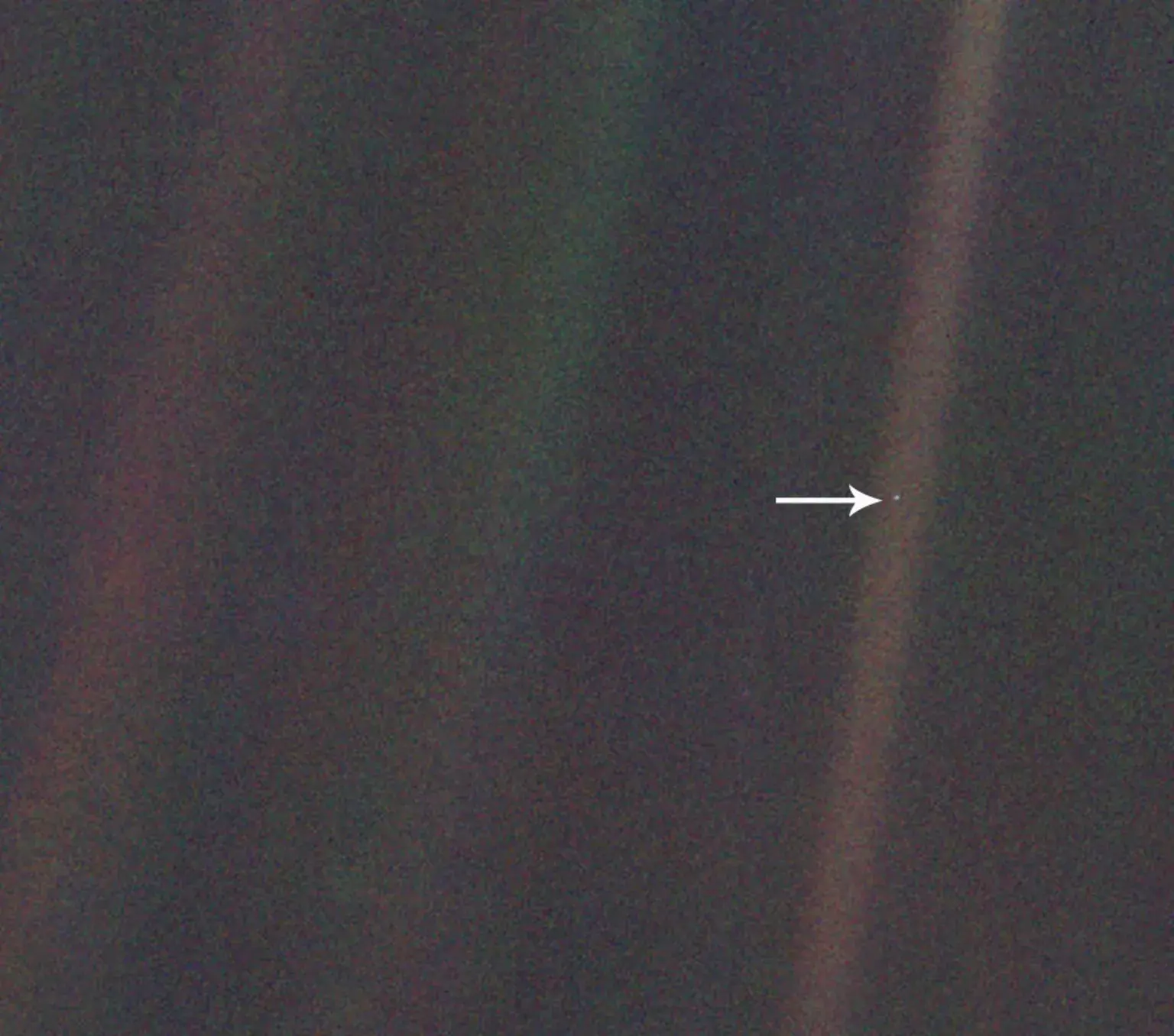
Voyager 1 captured the "Pale Blue Dot" image in 1990.

Image: NASA/JPL-Caltech

The "pale blue dot" photo. It shows three or four colored beams of light – optical artifacts – passing from the left side of the image to the right. The background is dark, empty space. In the topmost light beam is a single pale blue pixel. That's Earth. Sagan's quote is printed on the image. It reads ""We succeeded in taking that picture [from deep space], and, if you look at it, you see a dot. That's here. That's home. That's us. On it, everyone you ever heard of, every human being who ever lived, lived out their lives. The aggregate of all our joys and sufferings, thousands of confident religions, ideologies and economic doctrines, every hunter and forager, every hero and coward, every creator and destroyer of civilizations, every king and peasant, every young couple in love, every hopeful child, every mother and father, every inventor and explorer, every teacher of morals, every corrupt politician, every superstar, every supreme leader, every saint and sinner in the history..."
Reymond Aguinaldo boosted:
2026-02-15

On this day in 1990, the Voyager 1 space probe took a photo of our planet from approximately 6 billion kilometers (3.7 billion miles) away.

"Commissioned by NASA and resulting from the advocacy of astronomer and author Carl Sagan, the photograph was interpreted in Sagan's 1994 book, Pale Blue Dot, as representing humanity's minuscule and ephemeral place amidst the cosmos."

en.wikipedia.org/wiki/Pale_Blu

Image via bbc.com/news/science-environme

#OnThisDay #OTD #history #space #science #nasa #PaleBlueDot #humanity

A grainy, low resolution image of space, with faint bright-colored streaks. An arrow points to a small dot, our very own planet Earth.
Reymond Aguinaldo boosted:
AkaSci 🛰️AkaSci@fosstodon.org
2026-02-15

The "Pale Blue Dot" image was part of the "Family Portrait" set of images taken by Voyager 1 on Feb 14, 1990, from a vantage point 6 billion km away and ~32° above the ecliptic.

Starting at 01:00 UTC after a 3 hour warm-up, Voyager 1's cameras imaged Neptune, Uranus, Saturn, Mars, the Sun, and then Jupiter, Earth, and Venus. The Earth images were taken at 04:48 UTC. The cameras were turned off permanently at 05:22.

Image data download was completed on May 1, 1990.

science.nasa.gov/mission/voyag
1/n

A simulated view, made using NASA's Eyes on the Solar System app, approximates Voyager 1's perspective when it took its final series of images known as the "Family Portrait of the Solar System," including the "Pale Blue Dot" image.

A few key members didn’t show up in the shot: Mars was obscured by scattered sunlight bouncing around in the camera, Mercury was too close to the Sun, and dwarf planet Pluto was too tiny, too far away, and too dark to be detected.

Credit: NASA/JPL-Caltech
Reymond Aguinaldo boosted:
Astronomy Picture of the Dayapod@reentry.codl.fr
2026-01-19

CTB 1: The Medulla Nebula
Image Credit: Pierre Konzelmann

Explanation: What powers this unusual nebula? CTB 1 is the expanding gas shell that was left when a massive star toward the constellation of Cassiopeia exploded about 10,000 years ago. The star likely detonated when it ran out of elements, near its core, that could create stabilizing pressure with nuclear fusion. The resulting supernova remnant, nicknamed the Medulla Nebula for its brain-like shape, still glows in visible light because of the heat generated by its collision with confining interstellar gas. Why the nebula also glows in X-ray light, though, remains a topic of research. One hypothesis holds that an energetic pulsar was created and powers the nebula with a fast outwardly moving wind. Following this lead, a pulsar was found in radio waves that appears to have been expelled by the supernova explosion at over 1000 kilometers per second. Although the Medulla Nebula appears as large as a full moon, it is so faint that it took 84-hours of exposure with a small telescope in Texas, USA, to create the featured image.

https://apod.nasa.gov/apod/ap260119.html #apod

A colorful starfield surrounds a giant nearly-spherical nebula that has texture and stripes like watermelon. The lower right of the nebula is open making it appear like a medulla oblongata -- the stem that connects to a brain.
Reymond Aguinaldo boosted:
2026-01-18

Artemis 2 rocket rollout latest news: NASA begins rollout for giant moon rocket
space.com/news/live/artemis-2-

Posted into Space.com @space-com-Spacecom

Reymond Aguinaldo boosted:
2026-01-18
Reymond Aguinaldo boosted:
2026-01-18
Reymond Aguinaldomondinspace
2026-01-15

As it drifts into the dark, the probe remains a testament to curiosity—reaching distances measured by time itself.

Learn more about Voyager 1:
science.nasa.gov/mission/voyag
en.wikipedia.org/wiki/Voyager_1

🧵 3/3

Reymond Aguinaldomondinspace
2026-01-15

Launched in 1977, Voyager 1 is now almost 16 billion miles away, traversing the silent interstellar void. At this range, radio signals moving at light speed take a full day to arrive. This two-day delay highlights the vast scale of our cosmos and the durability of 1970s tech.

🧵 2/3

A detailed technical diagram of the Voyager 1 spacecraft and its journey.
Reymond Aguinaldomondinspace
2026-01-15

In November 2026, a historic milestone awaits humanity's Voyager 1. The legendary probe will reach the "one light-day" mark, meaning it will be so distant that communication requires a 48-hour round trip!

🧵 1/3

Image featuring a silhouette of the Voyager 1 spacecraft set against a vibrant, nebulous space background. At the bottom center, there is bold text that says, "It’s official. NASA confirms Voyager 1 will reach one light-day from Earth in 2026."
Reymond Aguinaldo boosted:
2026-01-15
Reymond Aguinaldo boosted:
2026-01-15

Meteor showers 2026: When, where and how to see the best 'shooting stars' of the year
space.com/stargazing/meteor-sh

Posted into Stargazing @stargazing-Spacecom

Reymond Aguinaldomondinspace
2026-01-03

Its outer layers will cool and redden as the core heats up, later forming a planetary nebula and leaving behind a dense, Earth-sized White Dwarf. This fate reveals how stars evolve, why solar systems change, and how studying our Sun helps predict the future of planets across the cosmos.

Reymond Aguinaldomondinspace
2026-01-03

The Sun will one day grow so large it will consume Earth, during its Red Giant phase. Today, it is a stable Yellow Dwarf, fusing hydrogen into helium for about 4.6 billion years. In roughly 5 billion years, its fuel will run out, causing it to expand and likely engulf Mercury, Venus, and Earth.

An illustrated timeline titled "The Life of the Sun." It shows the Sun’s life cycle from birth (4.6 billion years ago) to now, then into the future as it expands into a Red Giant, and finally its death as a planetary nebula in about 5-7 billion years. The Sun is depicted growing larger over time, with labeled stages arranged along a curved path against a space background.
Reymond Aguinaldo boosted:
2025-12-29

Take a glimpse into APEX 📡 👀

Located at 5100 m in ’s Atacama Desert, APEX explores cold, dark regions of our Universe, such as clouds of gas and cosmic dust where new stars are born.

Once a joint project of the Max-Planck Institute for Radio Astronomy (MPIfR), the Onsala Space Observatory & ESO, APEX now enters a new chapter and becomes a project solely of the MPIfR. But the science continues!

Read more: eso.org/public/videos/potw2552

📹 ESO

Reymond Aguinaldo boosted:
2025-12-17
Reymond Aguinaldo boosted:
2025-12-17

Client Info

Server: https://mastodon.social
Version: 2025.07
Repository: https://github.com/cyevgeniy/lmst