We’re about to turn night into day. Is that a good idea? Proposals before the FCC involve mirrors that could bathe entire cities in sunlight and, from SpaceX, a million satellites to serve as data centers.

Stella-Luna Observatory ✨🌙
A private #observatory in #Medina, #Ohio, USA. Photographer, tech guy, former network administrator. I also operated Stephens Memorial Observatory at Hiram College for 16 years, presenting public #astronomy #outreach. That’s ended now, the circa 1901 telescope sold and removed. Posting on #Astronomy and Science topics. #Astrodon #scicomm
Email
stellalunaobservatory@gmail.com
It was a bright, sunshiny day but the atmosphere was roiled by northern winds -- seeing was not good; bad by some measures. We did manage to capture some decent images and are happy about that as Sun had much to look at. In the northeast quadrant (upper left of this image) sunspots are appearing from over the horizon. Several large filaments were visible, especially along the western rim, and many prominences were visible. Hoping for another chance tomorrow but not holding our breath!

Late morning today, February 26, provided good viewing conditions and our Sun provided interesting sights. Just appearing over the eastern horizon were Active Regions 4378 (upper) and 4379 -- ending a period of spotless photosphere. In the hydrogen-alpha view of the chromosphere we see those areas as bright patches on the left edge of the Solar disk. A nice prominence was also visible on Sun's southwest edge. All-in-all a good observing session.


The International Astronomical Union (IAU) has launched a global campaign to disseminate accurate scientific information about the recently discovered interstellar visitor, 3I/ATLAS. This initiative aims to inform the public and media while minimizing the effect of sensationalist rumors and false information circulating online. A central piece of that effort is a web page devoted to the science of the comet.
We captured a filaprom!
Shown in white light is our Sun as it appeared on February 4, 2026. A large sunspot, designated Active Region 4366, drew much attention as it transited the surface, issuing flares along the way. On sunny days, this winter, when it's not bone-shatteringly cold, we've been imaging Sun. In white light, we've tracked the progress of a couple of impressively-large sunspots as they traversed the Solar photosphere, including one designated Active…
http://stellalunaobservatory.space/2026/02/17/we-captured-a-filaprom/
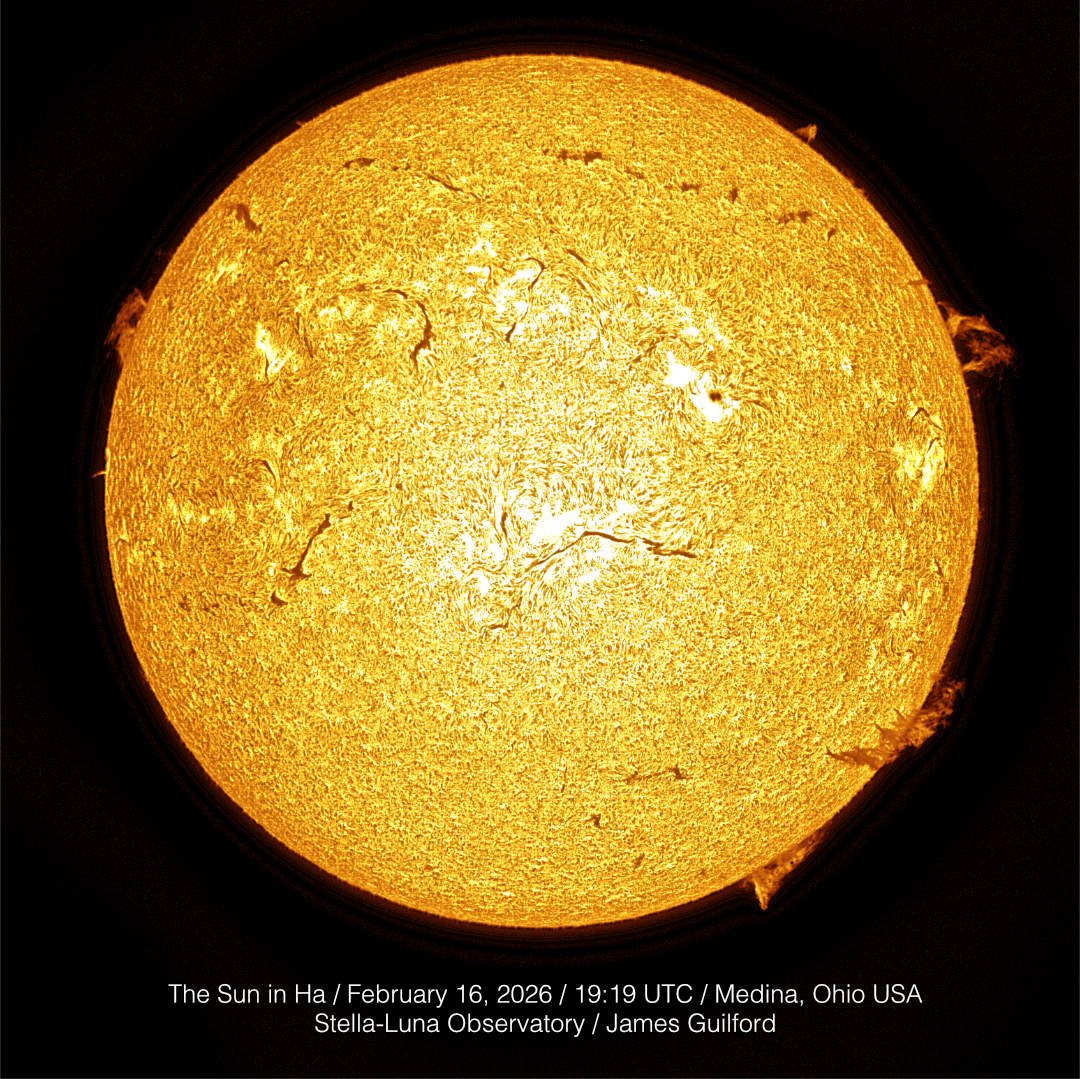
Sun was particularly busy February 16th, producing many beautiful and large prominences around its rim. Also visible were intriguing filaments including one showing its true nature -- a dark filament in the chromosphere, and as a bright prominence contrasted against the blackness of space. A first for me and delightful to observe! This is a monochrome image recorded in hydrogen-alpha light, false color applied.

Here's a full-disk view of Sun as it appeared yesterday. This really shows off the extraordinary prominence activity that was going on midday, February 16, including a "filaprom" at about the four o'clock position on the disk -- when a filament extends over the Solar limb, its nature as a prominence is revealed against the blackness of space. It's our first viewing and imaging of a filaprom; exciting to view and record!
A view of Sun's western horizon, recorded February 13. There was plenty of prominence activity along the limb -- some more prominent than others -- a few filaments, and much turmoil around Active Region 4373, near the top-center of this image. This is a monochrome image of Sun in hydrogen-alpha light -- false color applied. Friday the 13th was a "lucky imaging" day in more ways than one and we’re delighted with this image!

Finally a day of clear skies *and* good seeing -- we were able to image Sun without dodging clouds!! Very pleased with the results, as well. This is the Solar eastern limb with several "small-ish" prominences, assorted filaments, and the sunspot at Active Region 4374 surrounded by magnetic field lines traced in plasma. Excited to edit more of today's images but tired -- they'll have to wait for our recharge!

I wasn't going to do it. I was sure the sky would be cloudy and the sunspot gone. Today, however, I could see Sun (sort of) so I had to try. Seeing conditions were not poor, they were bad. The atmosphere was stirred up and clouds were present -- at times blocking the view entirely. So, with all of those qualifiers, here is our best effort recording departing sunspot AR4366 -- weakening but reportedly still issuing flares -- and a couple of its companions.


Farewell to Active Region 4366 -- the giant sunspot complex seen in Sun's upper right quadrant (northwest). The region continues to issue flares but is showing signs of decay, according to forecasters. Soon the sunspot will disappear over the Solar limb; today was the last day I will observe that feature. While the sky was clear, and winds were light, seeing was not good. We take what we can get! #sunspots


@mrbones909 It’s very impressive! I was happy to be able to get some decent images to remember it by.
Though seeing was predicted to be "bad", the sky was clear and blue, and transparency was very good. So, with the temperature at 14°F, and the wind ripping around the observatory, we recorded images of the sunspot at AR4366. They turned out well. Good thing, too, since the enormous sunspot complex is moving toward Sun's western horizon and will soon disappear. We may have another opportunity tomorrow! For now, we're pretty happy. #sunspots #AR4366 #solar #astronomy


A little extra … domy
The gray observatory is surrounded by accumulated and drifting snow. The dome itself wears an extra dome of accumulated snow. Recent arctic-air frigid weather has brought real winter weather to our region for the first time in a few seasons. Snowfall over the past 48 hours amounted to 10 or 12 inches of light, flaky, fluff. Nighttime below-zero low temperatures have erased any thought of going out; skies have been cloudy, anyway, preventing guilt…
http://stellalunaobservatory.space/2026/01/26/a-little-extra-domy/
A break in the weather allows view of an active Sun
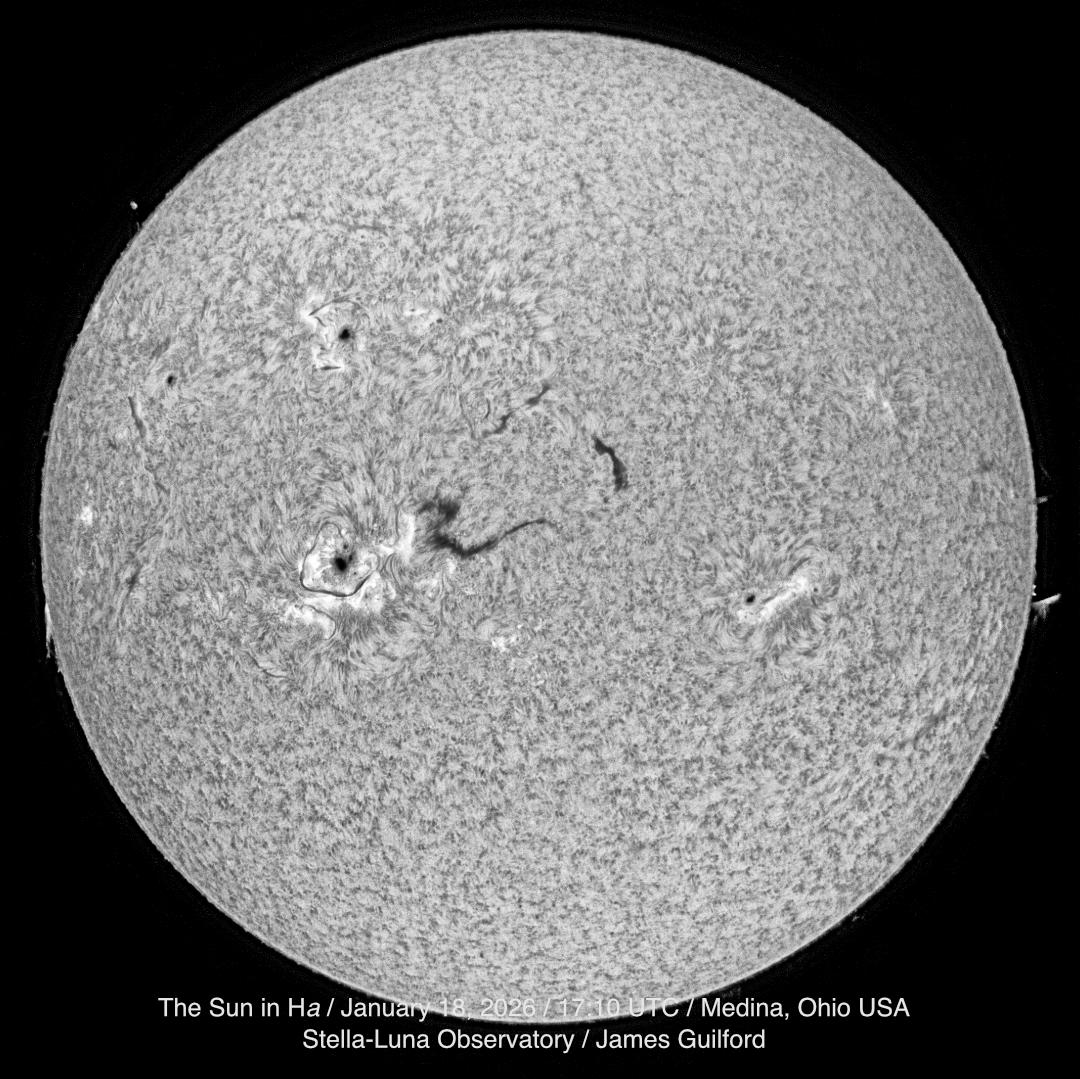
Full disk image of Sun as viewed in hydrogen-alpha light. Snake-like, dark filaments grace the center of the image. Several sunspots are also noted. Dominant in its influence on surrounding plasma features, is Active Region 4341 which exploded with a powerful flare one hour after this image was recorded. With recent weather, we believed the observatory might be closed until spring.
http://stellalunaobservatory.space/2026/01/19/a-break-in-the-weather-allows-view-of-an-active-sun/
With a beautiful clear, blue sky today, we recorded Sun in hydrogen-alpha light. Of particular interest was active region 4341 and, as it turns out, it was particularly active right after we imaged it. “Sunspot 4341 erupted today (Jan. 18 @ 1809 UTC),” reported Spaceweather.com, “producing an X1.9-class solar flare. The explosion lasted for hours, which makes this flare even more powerful than its ‘X1.9’ rating would suggest.” #sunspots #astronomy #sun

NEW YORK (AP) — In a rare move, NASA is cutting a mission aboard the International Space Station short after an astronaut had a medical issue.
The space agency said Thursday the U.S.-Japanese-Russian crew of four will return to Earth in the coming days, earlier than planned.
The space agency did not identify the astronaut or the medical issue, citing patient privacy. The crew member is now stable.
https://apnews.com/article/nasa-spacewalk-postponed-1a6f794035be86582025c196f8f9e7b5
The moisture crisis has been mitigated! Since sealing against outside air inflow, and installing a dehumidifier, relative humidity inside the dome has plunged from an awful 97% to 50%. Things are dry again. It won't be convenient to open the observatory for spur-of-the-moment observing but the gear won't be moldy or rusty!
Stella-Luna Observatory ✨🌙 boosted:

The Impact of Light Pollution from Low-Earth Orbital Space on Astronomical Observation in Antarctica, by Kairon Xia:
"Our findings demonstrate significant light pollution degradation at Antarctic astronomical observatories"
Client Info
Server: https://mastodon.social
Version: 2025.07
Repository: https://github.com/cyevgeniy/lmst