
How it started how it's going

Paul Macklin
multicellular systems & cancer with #PhysiCell • #COVID19 & immune modeling • #DigitalTwins • #OpenSource • #astrophotography • Associate Professor of Intelligent Systems Engineering at IU Bloomington
(@MathCancer on Twitter) Also: @mathcancer
#fedi22 #compbio #mathonco #mathbio #ABM #agentbasedmodels #HoosierMast
Website
Verification


@fertiglab congrats Elana!!
Paul Macklin boosted:

RT @jmuiuc@twitter.com
Excited to share our paper in @NatureGenet@twitter.com: SPICEMIX, a joint model of spatial info and gene exp from spatial transcriptome data. Advances upon NMF w/ integration of graphical model, resulting in more meaningful latent reps of cells and spatial metagenes. https://www.nature.com/articles/s41588-022-01256-z

Paul Macklin boosted:

Super crepuscular rays through the clouds at sunset in London this evening

Paul Macklin boosted:
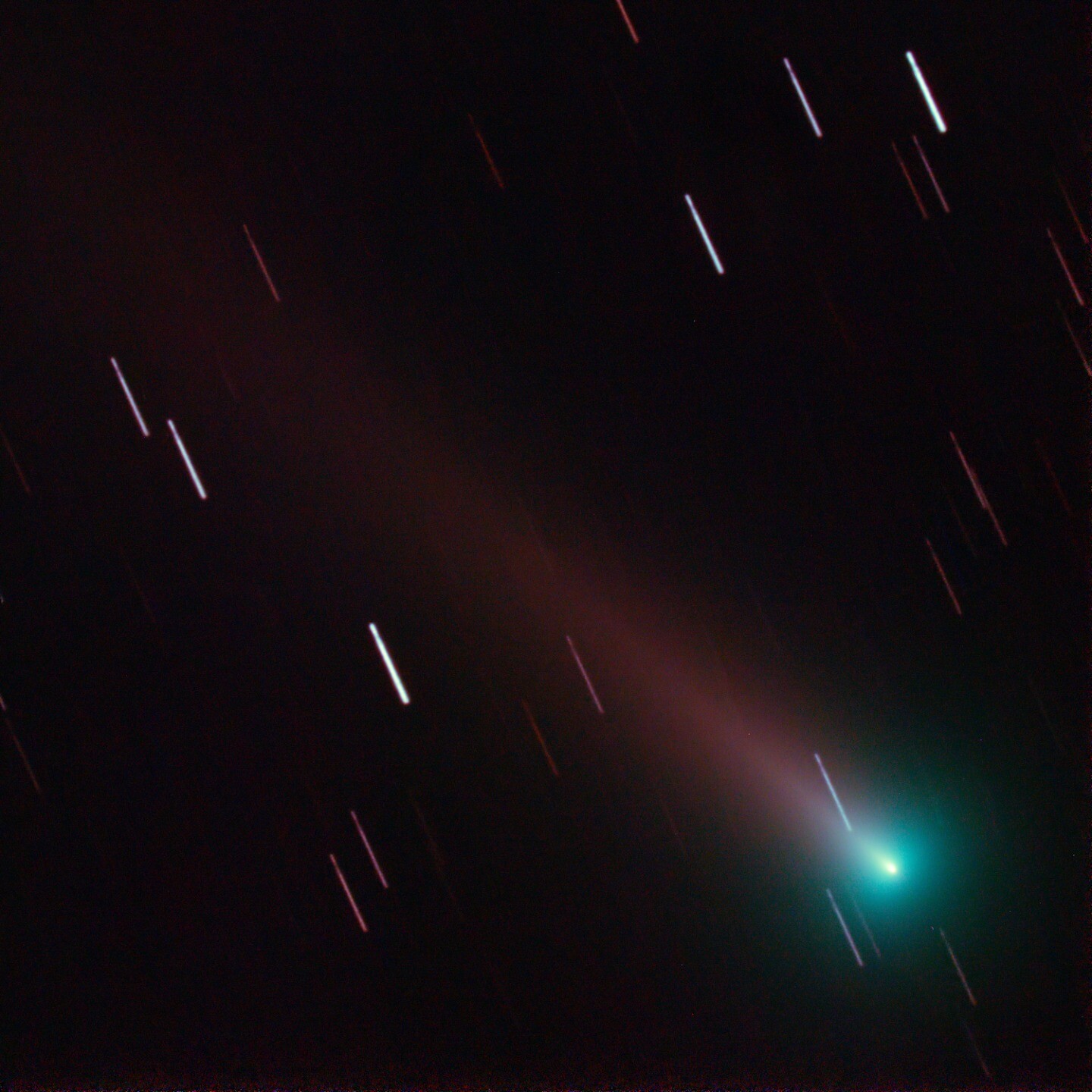
Here's an animation of #Comet C/2022 E3 (ZTF) from 27th Dec '22. 1 min single exposures showing its movement between 02:36 - 04:24 UT. 8" #RitchieChretien telescope + Altair Hypercam 183C camera. Collab with my husband @markmac99 #C2022E3 #CometImaging
@ryderdavid thanks!
Yes I'll admit I also view it more as the enemy, but gosh it's pretty!
99.7% illuminated #moon, captured as a 2-panel mosaic from my backyard on January 7, 2023.
I tried to keep a delicate touch in processing, in particular to avoid oversaturation and overbrightening that tends to wash out details. #astrodon #astrophotography
Tech details: https://www.astrobin.com/3sj03t/
Prints available at: https://mathcancer.darkroom.com/products/solar-system/868092

Just finished processing #Comet #C2022E3 ZTH.
This shows 2 hours of travel against the background stars, captured from my Indiana backyard at 4 am this morning.
Note the separate dust and ion tails.
#astrodon #astrophotography #HoosierMast
tech details: https://www.astrobin.com/9a9i6o/
Paul Macklin boosted:

Wanted to share our recent paper on how a cell, Chlamydomonas, "knows" when its flagella are removed. When flagella are detached in this unicellular alga, they grow back in an hour, and while that happens a whole program of genes are turned on. Here we show that induction depends on intraflagellar transport, suggesting a model in which a repressor is sequestered in flagella when they are re-growing, and then accumulates to turn genes off as growth tapers off.
https://www.molbiolcell.org/doi/10.1091/mbc.E22-09-0444
Our Corgi for #SpeakerOfTheHouse.
Tenacious. Pro-America. Anti-werewolf.

OK, it's 2023. Is there any way to do auto-hyphenation in google docs yet?
Paul Macklin boosted:

RT @AMathelier@twitter.com
Come work with us! @NCMMnews@twitter.com is seeking experienced and self-driven candidates for the role of Head of Research Strategy, Communication, and International Relations.
@UniOslo_MED@twitter.com @UniOslo@twitter.com
🐦🔗: https://twitter.com/AMathelier/status/1609858301994627073
Paul Macklin boosted:
The Journal of Open Source Software (JOSS) is looking for editors! If you are keen to help this exciting journal check this link and fill out the form:
https://blog.joss.theoj.org/2022/12/call-for-editors
Let me know if you have questions about the journal too.

@gepasi ah. Good luck!
@gepasi And I'll trade a modest memory cost to avoid repeated calculation any day of the week. :-)
What you describe sounds like a simple summation over a list of indices.
something_for_i = sum_{j in N_i} data_j
That's a pretty cheap calculation once you pre-compute N_i. And this works for any mesh.
Right. You only have to compute and store the topology once.
If you divorce the topology from the individual cells from the sites / topology, this never needs to be recomputed.
My position is in voxel i. My neighbors are N_i. I compute whatever I need to compute over N_i. Sometimes, I need information in A[i,j] (e.g., area of the interface) to make my computations.
Should be cheap to loop over these lists of arrays. Works for finite volume codes in n-D.
@gepasi @soliman
Hmm, not sure what you mean in indices of sides of neighbors. I guess I don’t understand the types of calculations.
In general meshes (and this works in n dimensions), each voxel with index i can store a neighbor list N_i.
If you need to store some information A that varies on voxel i being a neighbor of voxel j, you could store this in an array A[i,j]. That makes for easy access for j in N_i
Constructing the arrays is a one-time cost (unless you have a moving mesh).
A question for comet experts.
I've been reprocessing my C/2021-A1 Leonard photos, and I noticed that if I zoom in on parts of the histogram, I see a teardrop shape close the nucleus. Is this showing the edge of the magnetic cavity?
Shown with exaggerated curves (and then with more regular coloring), with a diagram from the ESA here for comparison:
https://www.esa.int/ESA_Multimedia/Images/2002/12/Structure_of_a_comet

Paul Macklin boosted:
Hi all! For any mathematical biologists who will be at the #JointMathMeetings in Boston, I will be co-chairing a special session on "Mathematical Modeling of Ecology and Evolution: From Infectious Disease to the Evolution of Cooperation", together with Daniel Cooney, Chadi Saad-Roy, and Olivia Chu. Talks will span a wide range of interests--hope to see some of you there!
https://www.jointmathematicsmeetings.org/meetings/national/jmm2023/2270_program_ss48.html#title
#MathematicalBiology
#Epidemiology
#EvolutionaryGameTheory
#Ecology
#Evolution
Client Info
Server: https://mastodon.social
Version: 2025.07
Repository: https://github.com/cyevgeniy/lmst